A comprehensive new study by the Pew Research Center reveals significant gender-based disparities in how Americans engage with and perceive artificial intelligence (AI). The research, conducted in February 2026, indicates that men are generally more likely than women to use AI tools, particularly chatbots, and express more optimistic views about AI’s future impact on their lives and society. This marks a deepening trend as AI technologies become increasingly integrated into daily life.
Understanding the Research and Its Context
This in-depth investigation is part of the Pew Research Center’s ongoing commitment to understanding the evolving landscape of artificial intelligence and its societal implications. For years, the Center has prioritized tracking the rise of AI, aiming to provide crucial insights for the public, journalists, and policymakers. This particular study delves into the usage patterns of AI chatbots and smart home devices with AI features, alongside exploring public sentiment regarding AI’s personal and societal influence. The findings underscore the importance of understanding how individuals interact with these powerful new technologies and their evolving perceptions.

Key Findings: A Divergent Engagement with AI
The survey data clearly illustrates a divergence in AI adoption and sentiment between men and women. While AI chatbots like ChatGPT, Gemini, and Copilot have seen a surge in usage, with 49% of U.S. adults reporting they have ever used one in early 2026, up from 33% in 2024, this adoption rate is not uniform across genders. Men now report using AI chatbots at a rate of 50%, essentially on par with women at 47% in early 2026. However, this near-parity in overall usage masks more nuanced differences in the types of AI tools men and women are more inclined to use and the reasons behind their adoption.
Specific AI Chatbot Usage: A Closer Look
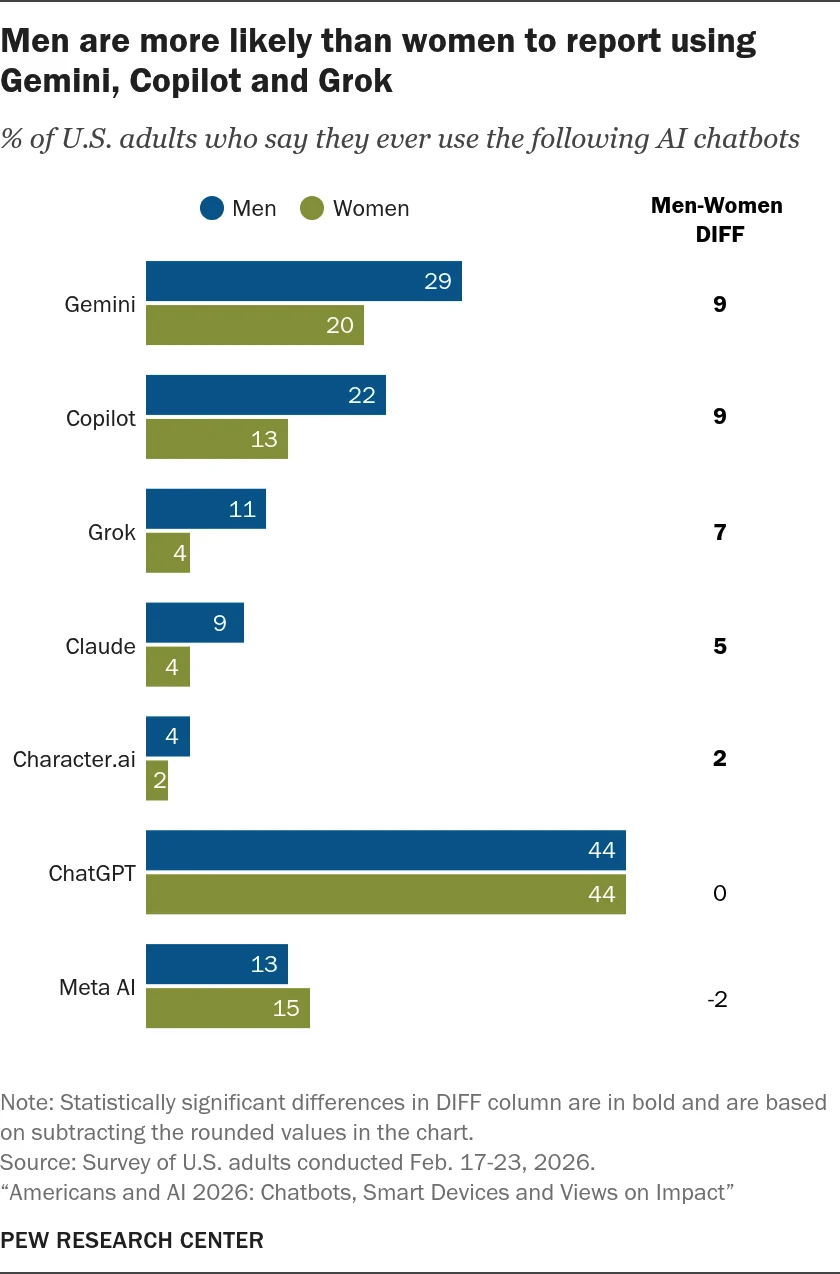
While overall chatbot usage has become more balanced, specific AI platforms reveal a more pronounced gendered preference. Men are significantly more likely to report using platforms such as Gemini (29% of men vs. 20% of women), Copilot (22% vs. 13%), Grok (11% vs. 4%), and Claude (9% vs. 4%). This suggests that certain AI functionalities or marketing efforts may resonate more strongly with male users. In contrast, ChatGPT, the most widely adopted chatbot, shows an equal usage rate between men and women at 44%. Interestingly, Meta AI shows a slight preference among women, with 15% reporting usage compared to 13% of men.

These findings suggest that while a baseline level of AI chatbot engagement is being achieved across genders, the adoption of more specialized or emerging AI tools may still be influenced by gendered interests or perceived utility. The growth in these specific platform usages indicates a maturing AI market, with distinct user segments emerging.
Reasons for AI Chatbot Utilization: Practicality vs. Emotional Support
The motivations behind using AI chatbots also exhibit gender-related differences. Broadly, both men and women utilize these tools for practical purposes like searching for information and for tasks related to their work. A significant 45% of men and 39% of women report using chatbots to search for information. For employed adults, 40% of men and 35% of women use AI for work-related tasks. Entertainment also plays a role, with 28% of men and 22% of women using chatbots for fun or entertainment.
However, a notable divergence emerges when considering the use of AI for personal well-being. Women are slightly more likely than men to report using chatbots for emotional support or advice (11% of women vs. 8% of men). Conversely, men are more likely to report using AI for tasks such as creating or editing images/videos (24% vs. 23%), and getting medical or diet/fitness advice (21% vs. 19% for medical, 20% vs. 19% for diet/fitness). The finding that women are more inclined to seek emotional support from AI, while men lean towards creative or informational tasks, could reflect differing communication styles or societal expectations around emotional expression and technical engagement.

Perceived Helpfulness of AI Chatbots: Productivity Gains and Beyond
The perceived benefits of AI chatbots also vary by gender, particularly concerning productivity. Men are more likely to report that AI chatbots enhance their productivity, with 35% of men believing so, compared to 25% of women. This aligns with men’s higher reported use of chatbots for work-related tasks.
Beyond productivity, the perceived impact on other areas shows more modest differences. Men are slightly more likely to believe chatbots help them stay informed (30% vs. 26%) and boost their creativity (23% vs. 19%). When it comes to personal happiness and relationships, the differences are minimal, with roughly equal proportions of men and women reporting that chatbots contribute to these aspects of their lives. This suggests that while AI’s practical and professional benefits are perceived more strongly by men, its impact on personal well-being is seen more uniformly, albeit at lower overall percentages.
AI-Enabled Smart Devices and Broader Views on AI

Beyond chatbots, AI is increasingly embedded in smart home devices, virtual assistants, and a myriad of other applications. The Pew Research Center’s study also touches upon broader attitudes toward AI, revealing a persistent trend of women holding more negative views than men. This sentiment is not isolated to this specific survey, having been observed in previous Pew Research Center studies concerning teenagers and AI experts.
Future Outlook: Optimism vs. Skepticism
Looking ahead over the next two decades, a significant gender divide emerges in expectations for AI’s impact. Women are considerably more likely to anticipate negative consequences, with 33% expecting AI to impact them personally negatively, compared to only 17% anticipating a positive impact. Men, in contrast, show a more balanced outlook, with roughly equal proportions expecting positive and negative outcomes.
This divergence extends to societal impacts as well. A substantial 43% of women believe AI will negatively affect society, while only 11% foresee a positive impact. Men’s views also lean negative regarding societal impact, but the gap between positive and negative expectations is less pronounced than among women. This suggests a more pervasive sense of caution or concern among women regarding the long-term trajectory and consequences of AI development.

Pace of AI Development: A Source of Concern
The speed at which AI is advancing is another area where gender differences are evident. A significant majority of Americans (63%) believe AI is advancing too quickly. However, women are even more likely to express this sentiment, with 68% indicating that the pace is too fast, compared to 58% of men. Conversely, men are more likely than women to believe AI is progressing at about the right pace (23% of men vs. 14% of women). Relatively few Americans believe AI is moving too slowly. This disparity in perception regarding the speed of AI development might correlate with differing levels of comfort and confidence in navigating the rapidly changing technological landscape.
AI Literacy and Confidence: A Knowledge Gap
The study also sheds light on the levels of familiarity and confidence men and women have with AI. While both genders demonstrate a general awareness of AI, men report hearing "a lot" about AI and AI chatbots more frequently than women. Specifically, 55% of men and 41% of women state they have heard a great deal about AI in general. This knowledge gap extends to AI chatbots, with 48% of men and 38% of women reporting extensive awareness.

This difference in perceived knowledge may contribute to varying levels of confidence in using AI tools. Men are more likely to express high confidence in their ability to use chatbots, with 22% reporting being extremely or very confident, compared to 15% of women. This suggests that higher reported familiarity might translate into greater self-assurance in engaging with these technologies.
Implications and Future Directions
The findings from the Pew Research Center’s study offer critical insights into the multifaceted ways gender shapes AI engagement and perception in the United States. The observed disparities in chatbot usage, reasons for use, perceived helpfulness, and future outlook highlight the need for AI developers and policymakers to consider gender as a key factor in their strategies.
The higher adoption of specific AI platforms by men suggests that future AI development might benefit from targeted outreach and design considerations to appeal to a broader range of users, including women. The greater inclination of women to seek emotional support from AI, while also expressing more skepticism about its overall impact, points to complex emotional and societal considerations that AI technologies must navigate.

Furthermore, the more negative outlook and concern about the speed of AI development among women underscore the importance of inclusive dialogue and robust ethical frameworks. Ensuring that AI advancements are perceived as beneficial and safe for all segments of society will be crucial for widespread acceptance and responsible integration. The Pew Research Center’s ongoing commitment to monitoring these trends will be vital in shaping an AI-integrated future that is equitable and understood by all.