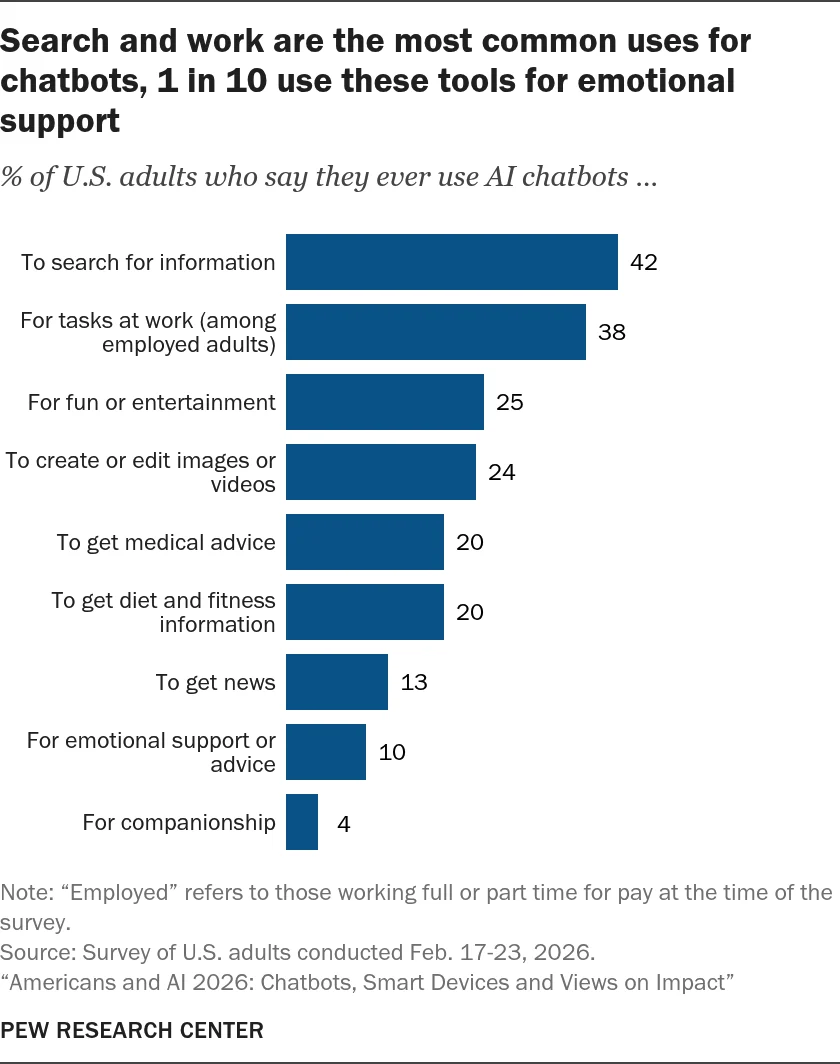
A significant portion of the U.S. adult population remains disengaged from artificial intelligence (AI) chatbots, with roughly half reporting they have never used such tools, according to a recent survey conducted by the Pew Research Center. This finding emerges as the broader study delves into the multifaceted landscape of AI adoption and public perception across the United States. The research, a comprehensive effort to understand how Americans interact with and view AI, also examines the prevalence of smart home devices with AI features and the perceived societal and personal impacts of this rapidly evolving technology.
The Pew Research Center’s ongoing commitment to informing the public, journalists, and policymakers about emerging technologies has placed the rise of AI at the forefront of its research priorities. This particular study aims to shed light on the current state of AI integration into daily life and the underlying sentiments of the American populace regarding its influence. By exploring who is using AI chatbots and smart devices, and what their expectations are for AI’s future role, the Center seeks to provide a nuanced picture of public engagement with artificial intelligence.
The Divide in Chatbot Adoption
Despite the increasing visibility and accessibility of AI chatbots like ChatGPT, Google Gemini, and Microsoft Copilot, the Pew Research Center’s February survey reveals a notable segment of the population opting out. Exactly 51% of U.S. adults reported never using an AI chatbot. Crucially, these non-users generally express little to no current interest in adopting these tools, indicating that their non-engagement is not a temporary phase but rather a deliberate stance for many.
The survey data highlights significant demographic disparities in chatbot adoption. Younger adults are far more likely to be active users. Among those aged 18 to 29, a substantial 66% reported having used an AI chatbot, while only 34% stated they had not. This trend continues with adults aged 30 to 49, where 61% have used chatbots, leaving 39% who have not.
The adoption rate begins to decline notably with older age groups. For adults aged 50 to 64, the numbers shift, with 58% reporting they have never used a chatbot, compared to 42% who have. The most pronounced gap is observed among adults aged 65 and older, where a staggering 77% indicated they have never used an AI chatbot, with only 23% reporting any use. This pattern aligns with historical trends where older demographics often exhibit a slower uptake of new technologies.

Racial and ethnic lines also show differences in chatbot engagement. While 70% of Asian adults reported using AI chatbots, with only 29% not having done so, other groups show a more balanced distribution. White adults were split at 46% usage versus 54% non-usage. Hispanic and Black adults showed nearly equal proportions, with 49% having used chatbots and 50% or 51% respectively reporting no use. These figures underscore the uneven diffusion of AI technology across various segments of the American population.
Understanding the Hesitancy: Reasons for Non-Adoption
The Pew Research Center’s investigation also sought to understand the underlying reasons why a substantial portion of the U.S. adult population has not embraced AI chatbots. The study presented non-users with five potential explanations for their disengagement: lack of interest, concerns about privacy and data usage, distrust in accuracy, lack of knowledge on how to use them, and the perception of potential social judgment.
A significant majority of individuals who do not use chatbots cited a lack of interest as a primary deterrent. A total of 83% of non-users identified lack of interest as a reason, with 60% specifying it as a "major reason." This suggests that for a large segment, the perceived utility or appeal of these tools simply does not resonate with their current needs or preferences.
Concerns regarding the responsible use of personal information and data privacy emerged as the second most significant barrier. Seventy-nine percent of non-users identified privacy concerns as a reason for their abstention, with 54% labeling it a "major reason." This indicates a widespread apprehension about how their data might be collected, stored, and utilized by AI systems, a sentiment that has been amplified by ongoing public discourse on data security and corporate data practices.
Trust in the accuracy of AI-generated information also presents a considerable hurdle. A substantial 76% of non-users expressed concern about the reliability of chatbot outputs, with 45% deeming it a "major reason." This highlights a critical challenge for AI developers and proponents: building public confidence in the factual integrity and dependability of these advanced systems.
The perceived complexity or lack of familiarity with AI tools also contributes to non-adoption. Fifty-five percent of non-users indicated that not knowing how to use chatbots is a reason for their avoidance, with 29% citing it as a "major reason." This suggests a need for more accessible user education and intuitive interface design to lower the barrier to entry for less tech-savvy individuals.

In contrast, the fear of social judgment for using AI chatbots was cited by a much smaller proportion of non-users. Only 14% of this group considered it a reason, with a mere 3% identifying it as a "major reason." This suggests that while social stigma is a factor for a small minority, it is not a primary driver for the broader non-adoption of AI chatbots.
Future Outlook: A Hesitant Path Forward
The survey also probed the future intentions of those who currently do not use AI chatbots. The findings suggest that a significant portion of this group does not foresee adopting these technologies in the near future. A considerable 67% of non-users stated they are "not too likely" or "not at all likely" to use chatbots in the next 12 months. This includes 40% who explicitly indicated they are "not at all likely" to engage with these tools.
A smaller segment, comprising 16% of non-users, expressed being "somewhat likely" to try chatbots in the coming year. Only a modest 5% indicated they are "extremely likely" or "very likely" to do so. This indicates that while a small fraction of non-users might be open to exploration, the overwhelming sentiment leans towards continued disengagement. Furthermore, 12% of non-users remained "not sure" about their future chatbot usage, suggesting a segment that might be swayed by future developments or increased familiarity.
Broader AI Engagement: Smart Home Devices
Beyond chatbots, the Pew Research Center’s research also encompasses the adoption of smart home devices that incorporate AI features. While the specific data on smart home device usage was not detailed in the provided excerpt, its inclusion in the broader study signifies an intent to map the diverse ways Americans are encountering and interacting with AI in their domestic environments. Smart speakers, thermostats, security systems, and other connected appliances often leverage AI for functions like voice recognition, personalized automation, and data analysis, representing another significant frontier of AI integration into daily life.
The Pew Research Center’s Mission and Methodology
The Pew Research Center, an independent non-partisan "fact tank," conducts this type of research to provide objective data and analysis on a wide array of social and demographic trends. Their work is designed to be a resource for journalists, policymakers, academics, and the general public, fostering a more informed national dialogue.
The data presented in this article is drawn from a survey of U.S. adults conducted between February 17-23, 2026. The study, titled "Americans and AI 2026: Chatbots, Smart Devices and Views on Impact," is part of a larger, ongoing initiative by the Center to track and analyze the evolving relationship between technology and society. While the full methodology for this specific survey is not detailed in the provided text, Pew Research Center is known for employing rigorous sampling techniques and survey design to ensure the representativeness and reliability of its findings. The inclusion of detailed demographic breakdowns by age, race, and ethnicity, as well as the exploration of specific reasons for technology adoption or non-adoption, are hallmarks of their in-depth approach.

Implications and Future Trajectories
The findings from the Pew Research Center survey present a complex picture of AI adoption in the United States. While AI chatbots are gaining traction, their reach is far from universal. The significant proportion of Americans who remain disengaged, particularly older adults, highlights a persistent digital divide and raises questions about equitable access and participation in the AI-driven future. The reasons for non-adoption – primarily lack of interest, privacy concerns, and distrust in accuracy – point to key areas where developers and proponents of AI technology must focus their efforts.
The emphasis on privacy and accuracy resonates with broader societal concerns about the ethical implications of AI. As AI systems become more pervasive, addressing these issues will be critical for building public trust and fostering widespread acceptance. The educational gap, indicated by those who "don’t know how to use" chatbots, suggests a need for greater digital literacy initiatives and user-friendly design to democratize access to AI tools.
The reluctance of a majority of non-users to adopt chatbots in the near future suggests that the current trajectory of AI adoption may continue to be uneven. This has implications for various sectors, including education, employment, and consumer services, where AI is increasingly being integrated. Understanding these adoption patterns is crucial for anticipating how AI will shape American society and for developing policies that ensure its benefits are broadly shared and its risks are effectively mitigated. The ongoing research by the Pew Research Center will undoubtedly continue to be an invaluable resource for navigating this rapidly evolving technological landscape.