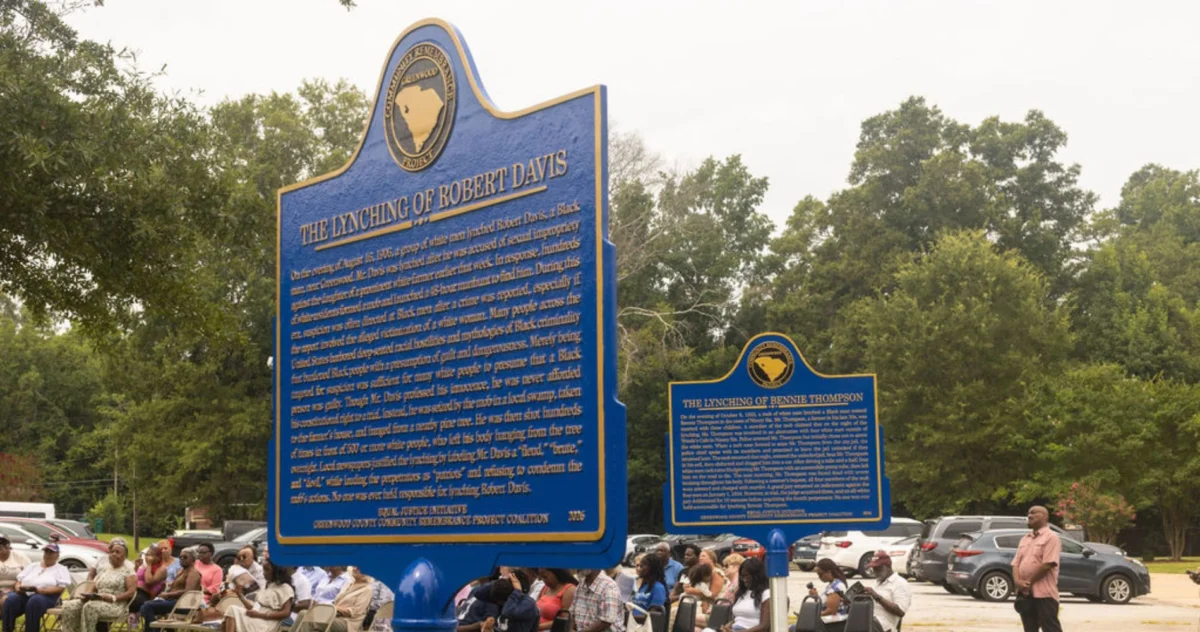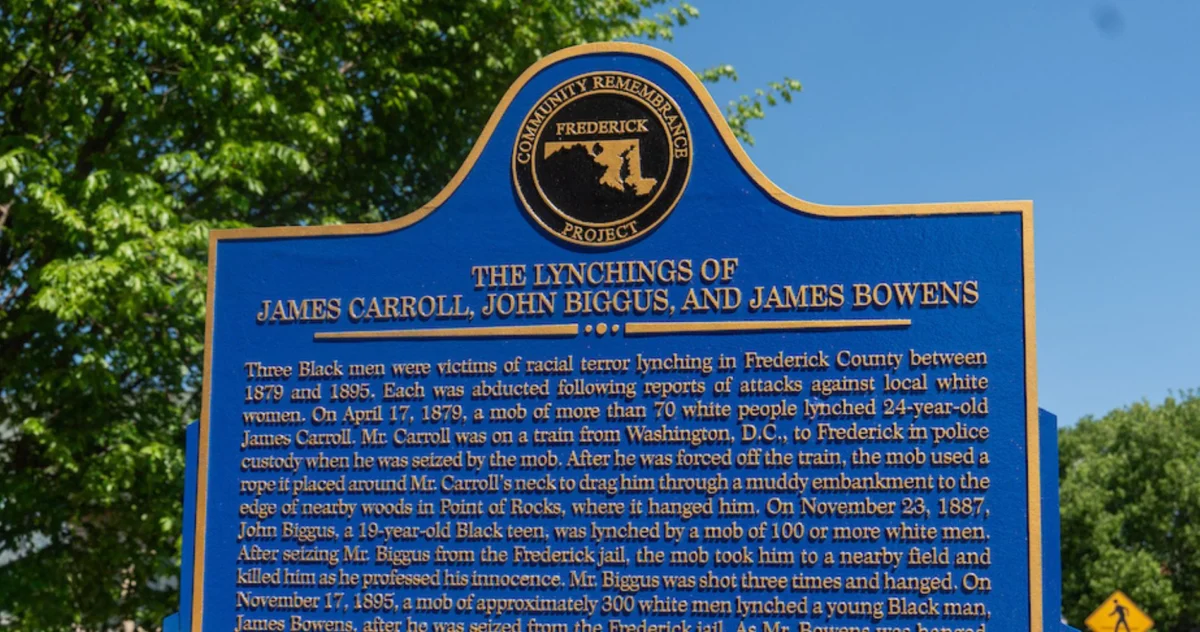
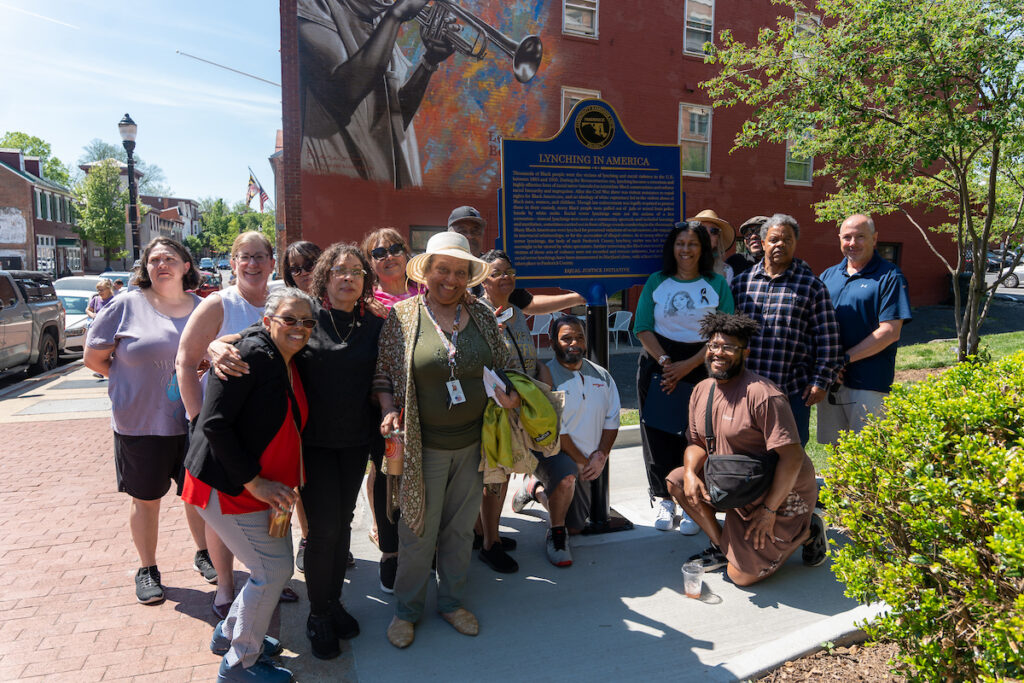
Frederick County, Maryland, embarked on a significant journey of truth and reconciliation on April 18, 2026, with the dedication of a historical marker memorializing James Carroll, John Biggus, and James Bowens, three African American men who were victims of racial terror lynchings in the late 19th century. This solemn ceremony, a collaborative effort between community leaders, descendants of the victims, and the Equal Justice Initiative (EJI), underscored a profound commitment to acknowledging a painful chapter of local history and confronting the enduring legacy of racial injustice. The event, facilitated by the Frederick Remembrance Memorial Coalition, took place on historic South Market Street near Carroll Creek in downtown Frederick, serving as a powerful public reckoning with the systemic violence that once plagued the community.
A Ceremony of Remembrance and Resolve
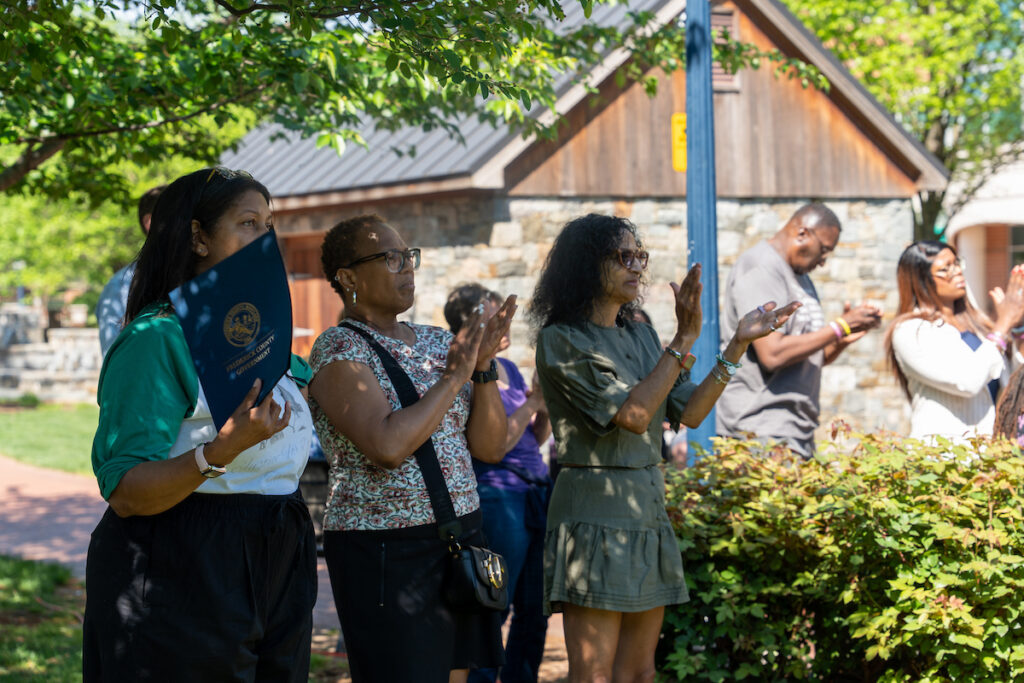
The dedication ceremony was a poignant gathering that brought together a diverse cross-section of the community, including descendants of John Biggus and James Bowens, alongside prominent local officials such as County Executive Jessica Fitzwater and Mayor Michael O’Connor. Organizer Tina Allen initiated the proceedings with a heartfelt address, emphasizing the critical importance of memorializing lynching victims and directly confronting the pervasive legacy of racial terror. "Today, we are here to honor the lynching victims James Carroll, John Biggus, and James Bowens," Allen stated, setting the tone for an event focused on historical truth and communal healing. The initiative is a vital component of EJI’s broader Community Remembrance Project, a nationwide campaign dedicated to recognizing the victims of lynching through historical narrative markers, soil collections from lynching sites, and the development of Legacy Sites. This partnership between EJI and counties across Maryland reflects a growing statewide effort to publicly acknowledge and atone for these historical atrocities.
The ceremony commenced with an opening prayer led by the Rev. Ernest Thomas, who invoked a powerful plea for strength and guidance. He prayed for the county to possess "the strength to confront the legacy of this violence, to speak truth, and to walk humbly towards true racial reconciliation and justice." Rev. Thomas articulated the dual purpose of the ceremony: to "honor the lives of all the victims by ensuring this history is not forgotten, and by building a community where all are safe, protected, and treated with dignity." His words resonated deeply, highlighting the transformational potential inherent in facing uncomfortable truths.
County Executive Jessica Fitzwater further solidified the county’s official commitment to this critical work. She presented the Frederick Remembrance Memorial Coalition with a certificate of recognition, a formal acknowledgment of their tireless efforts. More significantly, Ms. Fitzwater issued a proclamation declaring April 18th as Frederick Remembrance Memorial Day in Frederick County, permanently embedding the memory of this day and its purpose into the civic calendar. "It is moments like this that remind us what a special place Frederick County is," Ms. Fitzwater remarked, reflecting on the county’s diverse, multi-ethnic communities today. She emphasized the imperative for all residents to grasp "the painful legacy of racism and discrimination faced by African Americans through openly commemorating, reflecting on, and grieving past injustices." The County Executive reaffirmed the county’s dedication to actively "promote healing and advanced reconciliation for all," a statement that articulated a forward-looking vision rooted in historical understanding.
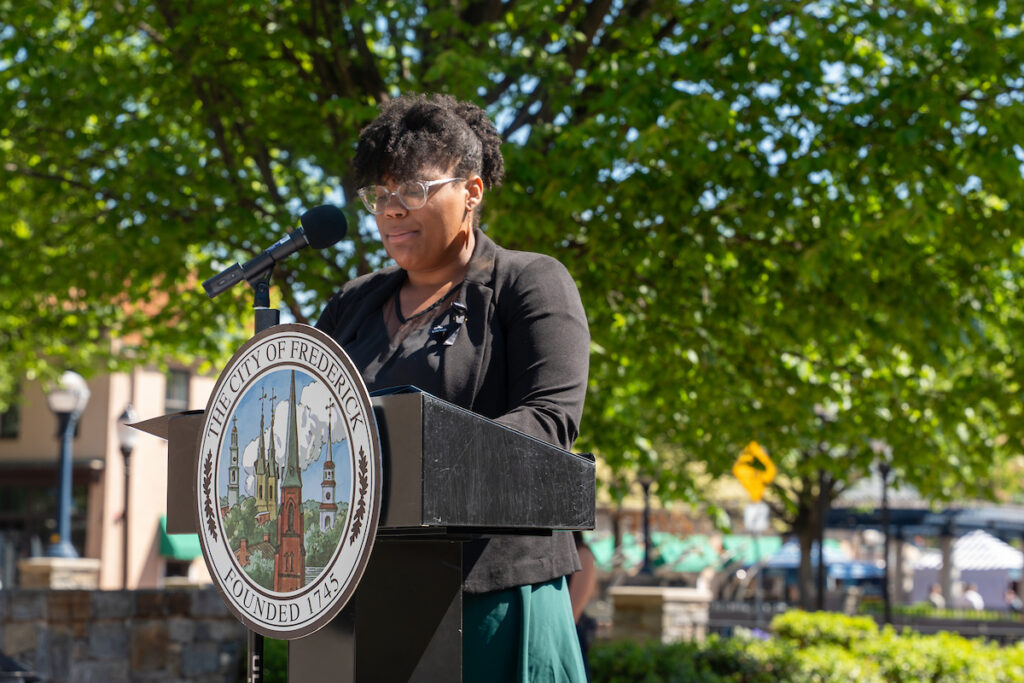
The narratives of the three victims were meticulously recounted by Jane Weir, a dedicated local family history researcher. Ms. Weir meticulously detailed the circumstances surrounding each lynching, ensuring that the individual stories of James Carroll, John Biggus, and James Bowens were brought to the forefront. Her presentation underscored the hope that their stories would not fade into obscurity. "It’s important for the truth to come out and to be taught," she asserted, "not silenced." This emphasis on education and transparency is central to the project’s goal of fostering a more informed and just society.
A particularly moving moment came with the address by Robin Dorsey-Cosley, the grand-niece of victim John Biggus. She shared the profoundly impactful journey of her family’s discovery of this painful history and their subsequent unwavering efforts to uncover and share the truth about what happened to their beloved relative. "We should be able to talk about it," she told the participants, expressing profound gratitude for the collective community support that culminated in "this commemorative moment in honor of the ones whose lives were taken without true justice being served." Her words provided a poignant human connection to the historical injustices, transforming abstract historical facts into deeply personal legacies.
Mia Taylor, a Project Manager at EJI, provided a broader perspective on the significance of the community’s engagement. She spoke eloquently about the transformative power inherent in communities coming together to directly address and confront the profound damage wrought by this history. "You are embracing the process of truth, justice, and reconciliation with difficult histories that is essential for us to recover from a history of racial injustice," Taylor affirmed, highlighting Frederick’s role in a larger national movement towards historical reckoning. The solemnity of the event was further enhanced by Terrence Boyd’s deeply moving rendition of "Total Praise," a moment of musical reflection that allowed attendees to absorb the weight of the day’s proceedings.
Following the musical interlude, Mayor Michael O’Connor delivered a powerful apology on behalf of the city. He expressed profound regret for the "acts and omissions of government officials that contributed to the three racial terror lynchings," a rare and courageous acknowledgment of institutional complicity. The Mayor’s statement represented a crucial step towards institutional accountability, recognizing that silence and inaction are also forms of participation. "I ask each of us to let this moment guide us, let it deepen our commitment to being a community where truth is not feared, where justice is not delayed, and where every person’s story is honored," the mayor implored, articulating a vision for a more equitable future. He concluded by dedicating the marker as "a place of reflection, a place where we remember James Carroll, John Biggus, and James Bowens."
Before the marker’s unveiling, organizer Tina Allen announced that the newly dedicated historical marker would be formally entrusted to the City of Frederick, signifying its permanent place within the public landscape and civic memory. "The Frederick Remembrance Memorial Coalition will continue its work," she declared, looking ahead to future endeavors. "This is just the beginning." Her statement underscored that while a significant milestone had been achieved, the work of reconciliation, education, and social justice remains an ongoing commitment.
Lynching in Frederick County: A Chronicle of Racial Terror
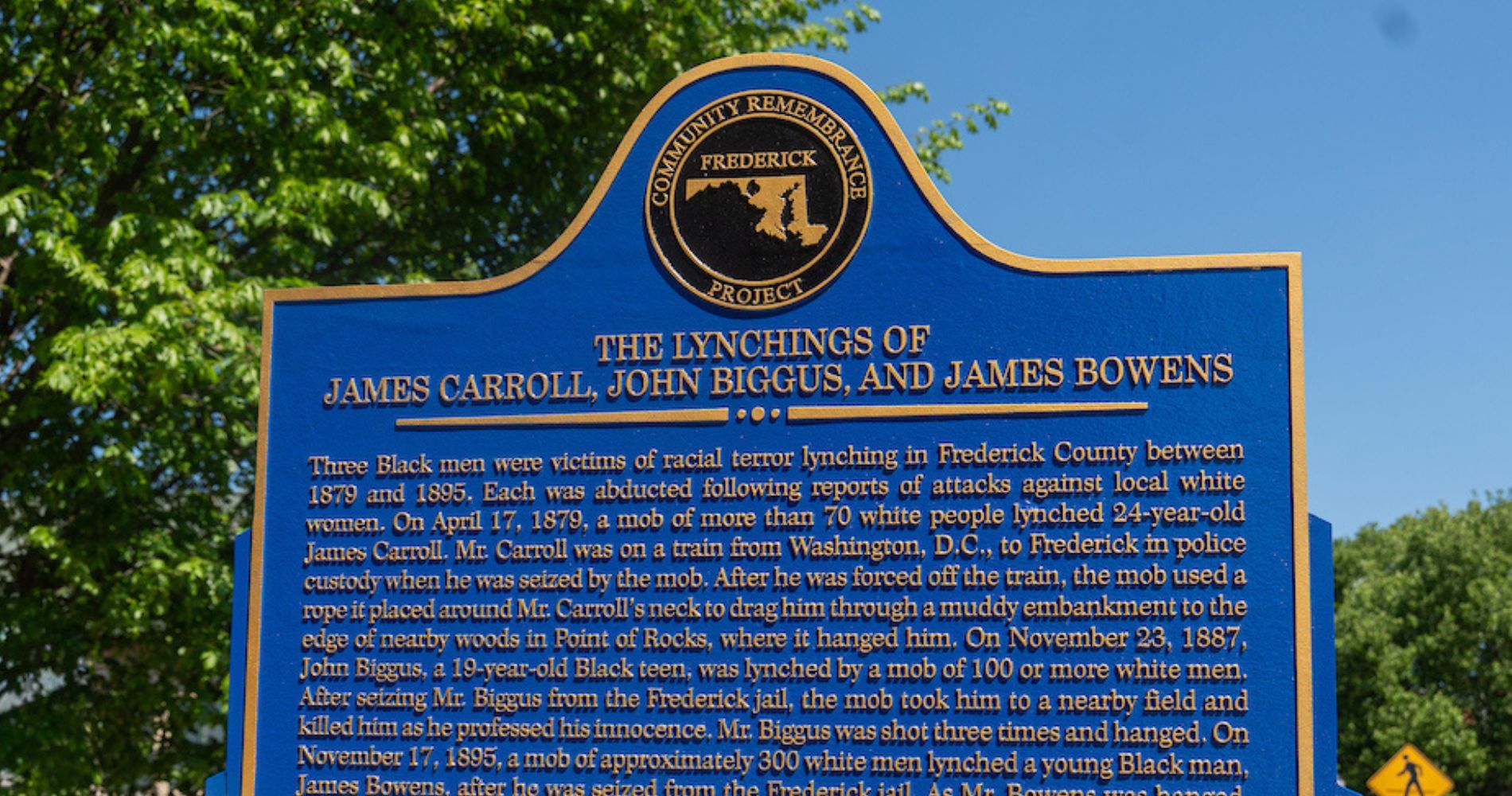
The historical marker unveiled in Frederick County stands as a stark reminder of the brutal racial terror inflicted upon three Black men between 1879 and 1895. These acts were not isolated incidents but rather chilling manifestations of a deeply entrenched system of racial hierarchy and violence. In each case, James Carroll, John Biggus, and James Bowens were abducted from police custody, following accusations—often unsubstantiated or exaggerated—of attacks against local white women. The complicity of prominent citizens and the absolute lack of accountability for these murders are central to understanding the systemic nature of these injustices, as noted by Ms. Weir during her presentation.
James Carroll (April 17, 1879): The first of the three victims commemorated was 24-year-old James Carroll. On April 17, 1879, a mob exceeding 70 white individuals orchestrated his lynching. Mr. Carroll was in police custody, being transported by train from Washington, D.C., to Frederick, when the mob intercepted the train, forcibly seizing him. He was brutally dragged through a muddy embankment at Point of Rocks, a rope tied around his neck, to the edge of the woods where he was hanged. In a grotesque display of dehumanization, members of the mob took "souvenirs" from the lynching site, including pieces of the tree and even a tip of Mr. Carroll’s finger. His corpse was left hanging for hours, a public spectacle designed to terrorize the Black community. It was not until the following afternoon that the Frederick County coroner and a constable arrived to cut down his body. A coroner’s jury was convened, yet despite numerous witnesses to the horrific act, no one was ever identified, let alone prosecuted, for Mr. Carroll’s murder, epitomizing the pervasive impunity that enabled racial terror.
John Biggus (November 23, 1887): Eight years later, on November 23, 1887, 19-year-old John Biggus met a similar fate. A mob of 100 or more white individuals, armed with axes and a rope brazenly taken from a nearby fire station, violently broke into the Frederick jail. As Ms. Weir recounted, the perpetrators dragged Mr. Biggus from his cell, a rope already around his neck. He was pulled down South Street to a nearby field, all while desperately professing his innocence. The mob then threw the rope over a tree limb and began to hoist Mr. Biggus from the ground. As he slowly suffocated, he was shot three times, adding another layer of brutal violence to his agonizing death. Like Carroll, no one was ever brought to justice for the murder of John Biggus.
James Bowens (November 17, 1895): The third victim, James Bowens, a young Black man, was lynched on November 17, 1895. A mob, estimated at approximately 300 white people, seized him from the Frederick jail. In a grim echo of the previous lynching, Ms. Weir noted that the mob dragged Mr. Bowens to the very same field where John Biggus had been murdered eight years prior. As Mr. Bowens was hanged, one of the perpetrators fired a gunshot into his head, ensuring a swift and brutal end. Following the killing, a member of the mob chillingly announced that they had murdered Mr. Bowens "to teach men of his class that they must let the white women of Frederick county alone or suffer the consequences." This declaration starkly revealed the underlying motive: to enforce racial and sexual hierarchies through terror. In a further act of desecration, some individuals took photographs of Mr. Bowens’s corpse as mementos, and after the coroner cut him down, the rope used to hang him was divided and distributed as souvenirs, underscoring the public, celebratory, and unpunished nature of these crimes.
Lynching in America: A National System of Terror
The lynchings of James Carroll, John Biggus, and James Bowens were not isolated aberrations but rather emblematic of a widespread and systematic campaign of racial terror that permeated the United States for decades. Between 1865 and 1950, over 6,500 Black men, women, and children were killed in racial terror lynchings across the nation. This horrifying phenomenon emerged in the aftermath of the Civil War and the abolition of slavery, as many white people, particularly in the South, vehemently opposed the notion of equal rights and full citizenship for Black people. Lynching became the most public and notorious form of racial terrorism, strategically employed to re-establish and enforce a rigid racial hierarchy.
These acts of violence served multiple purposes. They instilled fear throughout the Black community, discouraging any challenge to white supremacy. They also provided a brutal, public spectacle that reinforced the social order for white observers. Almost 25% of documented lynchings were sparked by charges of "inappropriate behavior" or "assault" between a Black man and a white woman. These accusations, often baseless, fabricated, or exaggerated, were weaponized to justify fatal mob violence, regardless of any actual evidence or due process. The mere insinuation of impropriety was enough to ignite a frenzy of racial hatred.
A particularly disturbing aspect of this era was the pervasive complicity, and often active participation, of law enforcement and government officials. It was alarmingly common for lynch mobs to seize their victims from jails, prisons, courtrooms, or directly from police custody. Despite being armed and officially charged with protecting those in custody, police forces almost invariably failed to use force to resist white lynch mobs intent on killing Black people. In numerous documented cases, police officials were found to be complicit in the lynchings, either by standing aside, providing access, or even actively participating in the violence. This institutional failure underscores that lynching was not merely the act of rogue mobs but a tool of state-sanctioned or state-tolerated terror.
The lynching of African Americans was, fundamentally, terrorism—a widely supported campaign designed to enforce racial subordination and segregation. The methods employed by lynch mobs were often calculated to inflict extreme violence, mutilating and destroying the victim’s body. Victims were frequently left to hang for hours, preventing families from claiming their loved ones and extending the terror and humiliation to the entire Black community. This tactic aimed to maintain the racial order through the ever-present threat of brutal violence, ensuring that the message of white supremacy was undeniably clear. James Carroll, John Biggus, and James Bowens are tragically three of at least 34 Black victims of racial terror lynching killed in Maryland between 1865 and 1950, underscoring that this dark chapter of American history was not confined to a single region but touched communities across the nation.
The Community Remembrance Project: Forging a Path to Healing
The dedication in Frederick is a tangible manifestation of the Equal Justice Initiative’s (EJI) ambitious Community Remembrance Project. This comprehensive campaign is built on the profound belief that by actively reckoning with the truth of racial violence, communities can initiate a necessary and transformative conversation that fosters healing and advances true reconciliation. EJI’s project involves several key components: meticulously collecting soil from lynching sites as a symbolic act of remembrance and reclaiming sacred ground, erecting historical markers like the one in Frederick to publicly acknowledge these atrocities, and developing the Legacy Sites in Montgomery, Alabama, including the National Memorial for Peace and Justice and the Legacy Museum.
The core philosophy driving EJI’s work is that ignoring or sanitizing difficult histories prevents genuine progress. By courageously confronting the brutal realities of racial terror, communities can begin to understand the systemic roots of racial injustice that continue to impact society today. The historical markers serve not only as memorials to the victims but also as educational tools, forcing passersby to acknowledge the violent past and prompting reflection on its contemporary implications. This process of truth-telling is considered essential for communities to recover from a history of racial injustice, dismantle its lingering effects, and build a more equitable and just future for all.
Implications and the Path Forward
The dedication of the historical marker in Frederick County represents more than just a commemorative act; it is a foundational step in an ongoing process of community healing, education, and reconciliation. The powerful statements from local officials, particularly Mayor O’Connor’s apology for governmental complicity, set a precedent for institutional accountability and honest historical engagement. By formally establishing April 18th as Frederick Remembrance Memorial Day, the county has ensured that the memory of these victims and the lessons of their tragic deaths will be permanently etched into the community’s consciousness, providing an annual opportunity for reflection and recommitment.
The involvement of descendants like Robin Dorsey-Cosley humanizes the historical narrative, transforming statistics into personal tragedies and underscoring the intergenerational impact of racial violence. Their courage in sharing their families’ stories is a crucial element in fostering empathy and understanding within the broader community. The Frederick Remembrance Memorial Coalition’s commitment to "continue its work" signifies that this dedication is not an endpoint but rather a renewed beginning. Future initiatives could include educational programs in local schools, deeper historical research into other untold stories, and ongoing community dialogues aimed at addressing systemic inequities that persist as legacies of this historical terror.
This marker stands as a permanent fixture, a silent yet powerful sentinel urging reflection. It is a constant reminder that truth must not be feared, justice must not be delayed, and every person’s story deserves to be honored. Frederick County’s initiative serves as a poignant example for other communities grappling with similar histories, demonstrating that confronting the past, however painful, is an indispensable step towards building a future rooted in justice, dignity, and true racial reconciliation. The journey initiated by this dedication promises to foster a more informed, compassionate, and ultimately, a more just society for all its residents.