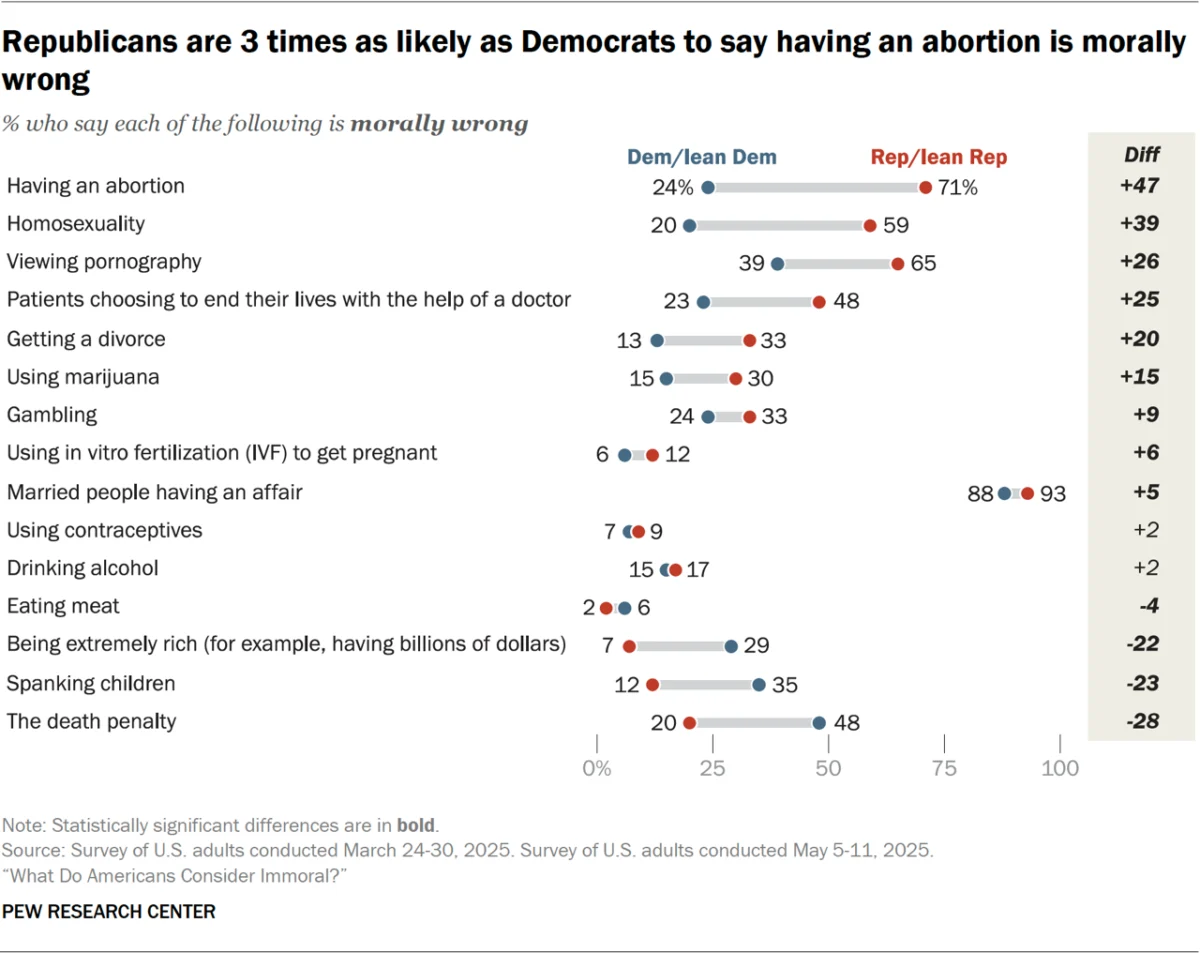
A comprehensive new study by the Pew Research Center reveals a significant shift in American moral attitudes, with a majority of U.S. adults expressing permissive views on a wide range of behaviors previously considered by many to be morally questionable. The research, based on two large-scale surveys conducted in the spring of 2025, indicates that Americans are increasingly likely to view many actions as morally acceptable or not a moral issue, a trend that cuts across various demographics but shows notable divergences along political and religious lines.
The analysis, which examined 15 distinct behaviors, found that an overwhelming 96% of U.S. adults consider eating meat to be either morally acceptable or not a moral issue. Similarly, 91% of Americans hold permissive views on using contraceptives to prevent pregnancy. These findings underscore a broad societal acceptance of practices that were once subjects of intense moral debate.

The Pew Research Center, a non-partisan organization dedicated to informing the public, journalists, and leaders, has a long-standing commitment to researching religion and its intersections with societal values, including morality. This latest study builds upon years of their work in understanding the evolving moral landscape of the United States. The data was collected from two surveys of the American Trends Panel (ATP): an initial survey of 3,605 U.S. adults from March 24 to 30, 2025, and a subsequent survey of 8,937 U.S. adults from May 5 to 11, 2025. The detailed questions and methodology for this analysis are available through the Pew Research Center’s online resources.
Moral Boundaries: Where Americans Draw the Line
While the prevailing trend points towards greater moral permissiveness, the study also identified a clear moral consensus on certain issues. The most prominent example is extramarital affairs, which a staggering 90% of U.S. adults deem morally wrong. This finding suggests that despite a broader relaxation of moral stances on other matters, fidelity within marriage remains a deeply held moral principle for the vast majority of Americans.
The research also highlighted deep divisions within the American populace regarding the morality of abortion and pornography. On pornography, 52% of U.S. adults consider viewing it morally wrong, while a substantial 32% view it as not a moral issue, and 15% find it morally acceptable. The debate surrounding abortion is similarly contentious, with 47% of Americans viewing it as morally wrong. In contrast, 31% consider it not a moral issue, and 21% deem it morally acceptable. These near-even splits indicate that these issues remain at the forefront of cultural and ethical discussions in the United States.
The Partisan Divide on Morality
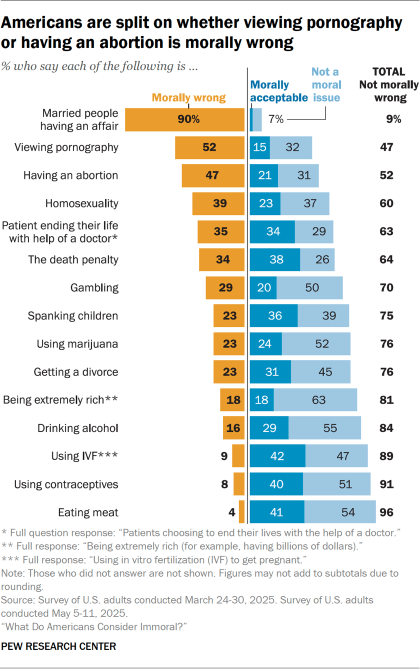
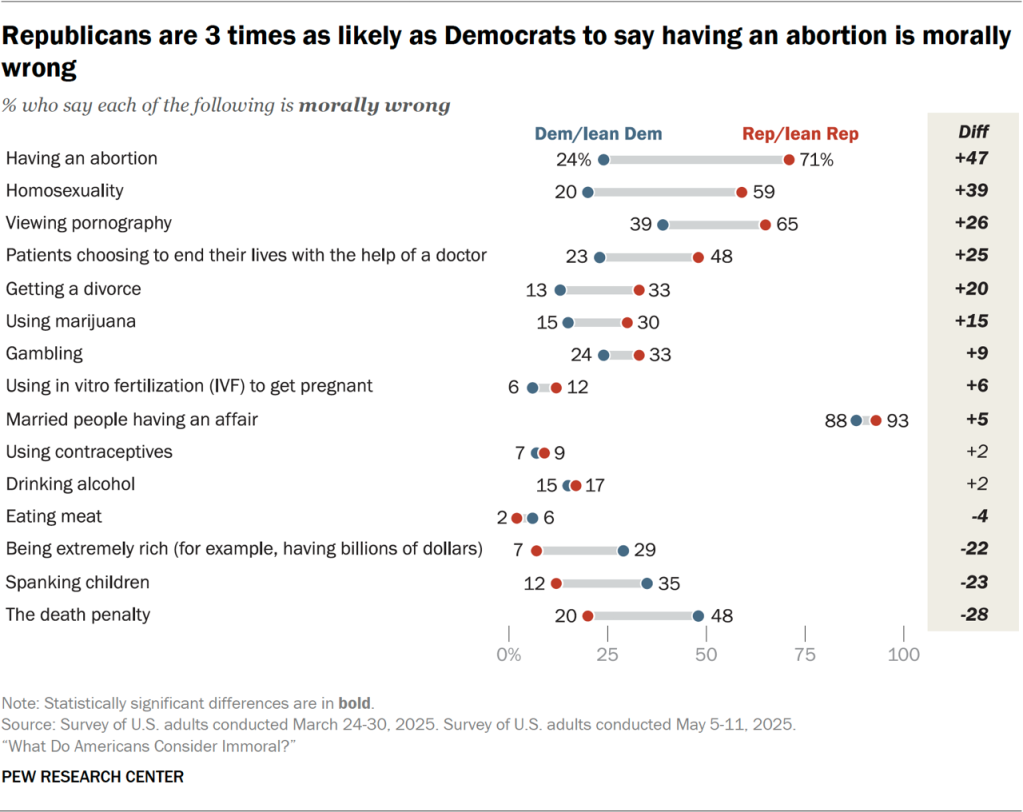
The surveys revealed a pronounced partisan divide on a number of moral issues, particularly those related to sex, family, and social policy. The controversy surrounding abortion legality has long been a defining feature of American politics, and this divide extends to its perceived morality. Republicans and Republican-leaning independents are significantly more likely than Democrats and Democratic-leaning individuals to consider having an abortion morally wrong, with 71% of Republicans holding this view compared to just 24% of Democrats.
This ideological chasm is not confined to abortion. Republicans are also more likely than Democrats to view several other behaviors related to sex and family life as morally wrong. These include:
- Having an extramarital affair: 94% of Republicans vs. 86% of Democrats
- Having an abortion: 71% vs. 24%
- Viewing pornography: 67% vs. 37%
- Homosexuality: 66% vs. 30%
- Getting a divorce: 41% vs. 21%
- Having an abortion: 71% of Republicans and Republican-leaning independents believe having an abortion is morally wrong, compared to 24% of Democrats and Democratic-leaning individuals.
- Viewing pornography: 67% of Republicans and Republican-leaning independents consider viewing pornography morally wrong, versus 37% of Democrats and Democratic-leaning individuals.
- Homosexuality: 66% of Republicans and Republican-leaning independents view homosexuality as morally wrong, while 30% of Democrats and Democratic-leaning individuals do.
- Getting a divorce: 41% of Republicans and Republican-leaning independents find divorce morally wrong, compared to 21% of Democrats and Democratic-leaning individuals.
- Cloning humans: 69% of Republicans and Republican-leaning independents believe cloning humans is morally wrong, versus 41% of Democrats and Democratic-leaning individuals.
- Having an abortion: 71% of Republicans and Republican-leaning independents believe having an abortion is morally wrong, compared to 24% of Democrats and Democratic-leaning individuals.
- Viewing pornography: 67% of Republicans and Republican-leaning independents consider viewing pornography morally wrong, versus 37% of Democrats and Democratic-leaning individuals.
- Homosexuality: 66% of Republicans and Republican-leaning independents view homosexuality as morally wrong, while 30% of Democrats and Democratic-leaning individuals do.
- Getting a divorce: 41% of Republicans and Republican-leaning independents find divorce morally wrong, compared to 21% of Democrats and Democratic-leaning individuals.
- Cloning humans: 69% of Republicans and Republican-leaning independents believe cloning humans is morally wrong, versus 41% of Democrats and Democratic-leaning individuals.
Conversely, Democrats are more inclined than Republicans to view certain other behaviors as morally wrong. These include:
- Being extremely rich: 48% of Democrats and Democratic-leaning individuals vs. 20% of Republicans and Republican-leaning independents
- Cloning humans: 41% of Democrats and Democratic-leaning individuals vs. 69% of Republicans and Republican-leaning independents
- Having an abortion: 24% of Democrats and Democratic-leaning individuals vs. 71% of Republicans and Republican-leaning independents
- Viewing pornography: 37% of Democrats and Democratic-leaning individuals vs. 67% of Republicans and Republican-leaning independents
- Homosexuality: 30% of Democrats and Democratic-leaning individuals vs. 66% of Republicans and Republican-leaning independents
- Getting a divorce: 21% of Democrats and Democratic-leaning individuals vs. 41% of Republicans and Republican-leaning independents
- Spanking children: 37% of Democrats and Democratic-leaning individuals vs. 26% of Republicans and Republican-leaning independents
- The death penalty: 38% of Democrats and Democratic-leaning individuals vs. 23% of Republicans and Republican-leaning independents
Religious Affiliation and Moral Frameworks
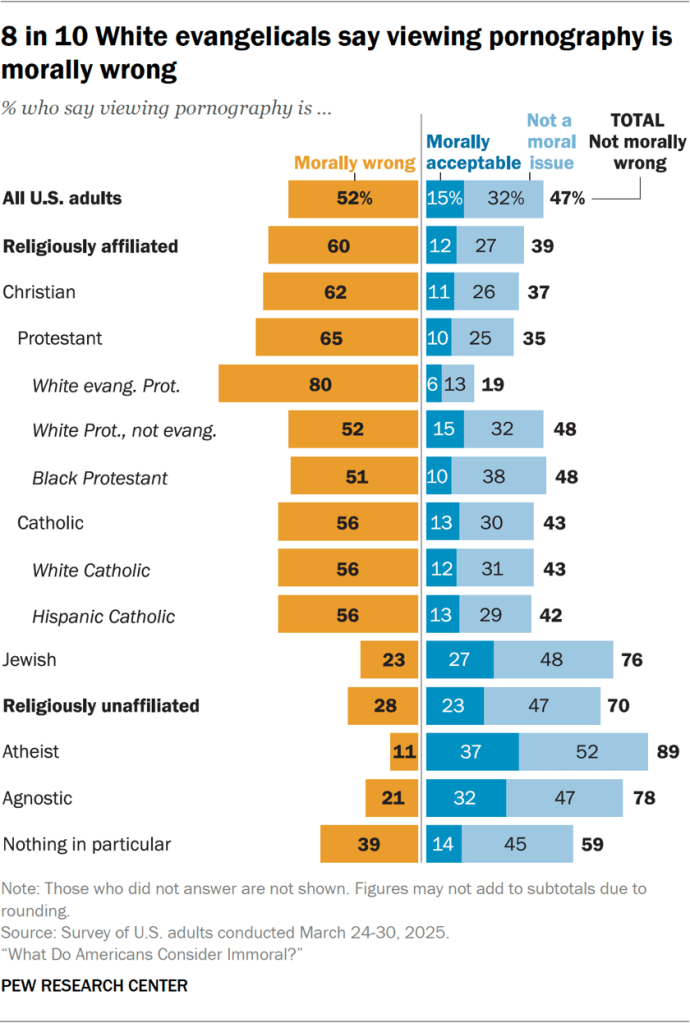
Religious affiliation also plays a significant role in shaping moral viewpoints. White evangelical Protestants, in particular, tend to hold more traditionally conservative moral positions on several of the examined issues. For instance, 80% of White evangelicals believe viewing pornography is morally wrong, a stark contrast to the 13% who see it as not a moral issue and 6% who find it acceptable. This contrasts sharply with other religious groups, where attitudes are more varied. Among other Protestants, about half consider pornography wrong, and 56% of Catholics hold the same view.
Jewish adults (23%) and the religiously unaffiliated (28%) are considerably less likely than evangelicals to find pornography morally wrong, with roughly half of these groups viewing it as not a moral issue.
The divergence is even more pronounced on the issue of homosexuality. A significant 72% of White evangelicals view homosexuality as morally wrong, compared to 34% of all Catholics and a mere 13% of religiously unaffiliated adults. Furthermore, White evangelicals are more likely than members of most other religious groups to consider abortion and physician-assisted suicide morally wrong.
On the other hand, White evangelical Protestants are the least likely among the studied religious groups to deem the death penalty morally wrong, with only 20% expressing this view. In stark contrast, 48% of atheists, 46% of Black Protestants, and 42% of Jewish adults consider the death penalty to be immoral.
Generational Divides in Moral Beliefs
Generational differences also emerged as a significant factor in moral attitudes, though the pattern is not uniform across all issues. Younger Americans, particularly those aged 18 to 29, exhibit a greater tendency to view certain behaviors as morally wrong. For example, approximately one-third of the youngest adults consider "being extremely rich" (33%) and spanking children (35%) to be morally wrong.
However, younger adults are less likely than older generations to find homosexuality morally wrong, with only 30% of those aged 18 to 29 holding this view, compared to 37% of adults aged 30 to 49 and higher percentages among older age groups.
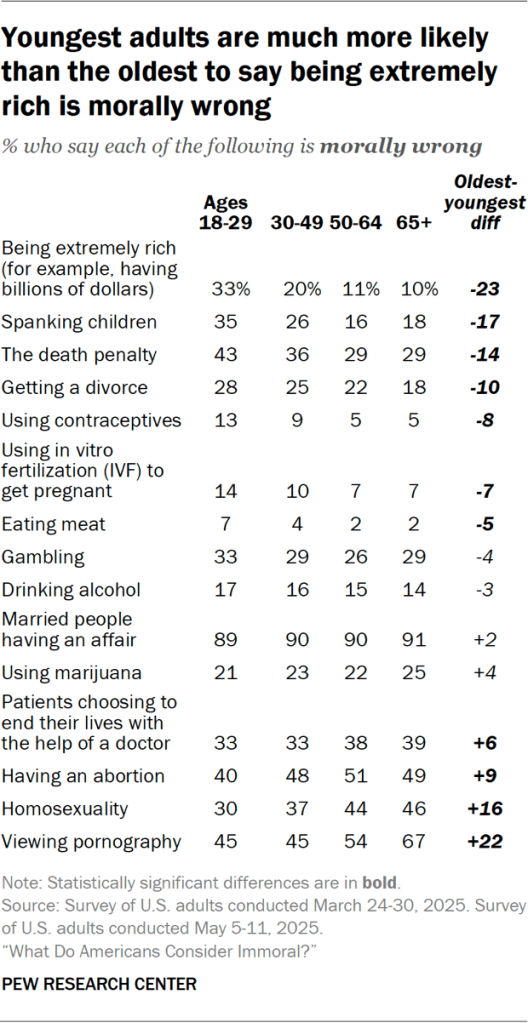
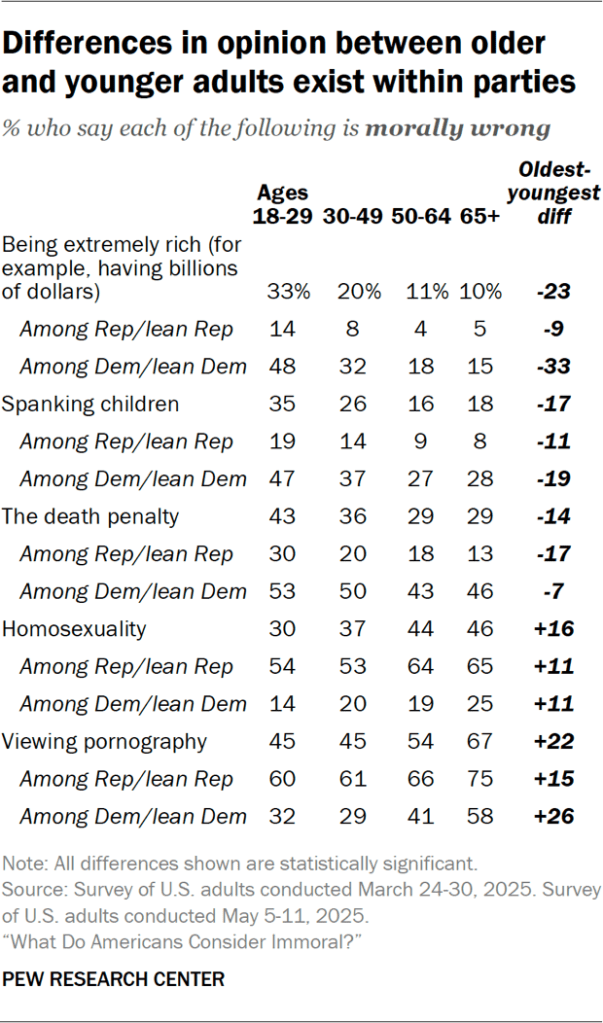
These generational differences are evident even within partisan affiliations. For instance, among Republicans, there is a noticeable age gap regarding the morality of being extremely rich, with 14% of younger adults holding this view compared to 5% of older adults. This divide is even more pronounced among Democrats, where 48% of younger adults and 15% of older adults find being extremely rich morally wrong.
Gender Differences in Moral Perspectives
On many of the 15 behaviors examined, men and women express similar moral judgments. However, notable differences emerge on a few specific issues. Men are somewhat more likely than women to consider divorce (28% vs. 19%), abortion (51% vs. 44%), and homosexuality (43% vs. 37%) as morally wrong.
Conversely, women are more likely than men to view the consumption of pornography as morally wrong, with 58% of women and 47% of men holding this opinion.
Broader Implications and Context
The Pew Research Center’s findings offer a nuanced portrait of American morality in 2025. The general trend toward moral permissiveness on a range of issues suggests a society grappling with evolving social norms and a willingness to re-evaluate traditional ethical frameworks. The stark divisions along political and religious lines highlight the ongoing cultural polarization within the United States, underscoring how deeply held moral beliefs are intertwined with identity and political affiliation.
The data also provides a valuable point of comparison for understanding American values in a global context. A related international report from Pew Research Center indicates that Americans are particularly likely to view their fellow citizens as morally bad compared to people in many other countries. This self-assessment, coupled with the internal divisions revealed in this study, suggests a nation in the midst of a significant moral reckoning.
The research methodology, employing nationally representative surveys of a large sample of U.S. adults, lends significant weight to these conclusions. The detailed appendix, providing breakdowns by political party, religious group, and age, allows for further in-depth analysis of these complex moral landscapes. As society continues to evolve, such research will be crucial for understanding the foundations of American values and the potential fault lines that shape its future.