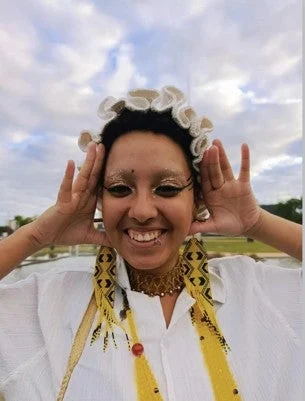
The periphery of Brazil’s Federal District, a landscape often perceived as distant from ancestral Indigenous territories, has become a crucial nexus for Cati Paprep Mykwyj (Kanela), a 22-year-old non-binary transmasculine artist. Through their multifaceted artistic practice, encompassing digital collage, bio-jewelry craftsmanship, and audiovisual production, Cati is actively forging a narrative that defies fragmentation. Their work embodies a powerful form of Indigenous 2SLGBTQ+ resistance, challenging both dominant Western queer paradigms and the colonial impositions that have historically disrupted traditional community structures. This interview, conducted by Cultural Survival, delves into Cati’s unique perspective on identity, art, and the ongoing struggle for self-determination.
Navigating Pride: An Indigenous Lens
Cati Paprep Mykwyj articulates a profound distinction between their experience of Pride as an Indigenous individual and the more visible, urban 2SLGBTQ+ narratives. "For us, as trans Indigenous people, the experience is different because it directly involves our ancestry," Cati explains. This connection to lineage necessitates a complex relationship with elders, a relationship that can be fraught with the risk of encountering violence due to gender identity. This contrasts sharply with the urban 2SLGBTQ+ experience, where detachment from elders is often more feasible, and the intrinsic connection to the natural world is less pronounced.
"Particularly, I find it difficult to relate to the urban environment; I perceive that there is an overvaluation of appearance and status," Cati observes. The urban ideal of "making it in life" is frequently measured by financial success and academic achievement. For Cati and many Indigenous individuals, the ultimate measure of success is intrinsically linked to the fight for territorial preservation and sovereignty. This fundamental divergence in life goals highlights the distinct socio-cultural priorities that shape Indigenous 2SLGBTQ+ existence.
Visibility and Vulnerability: A Delicate Balance
The concept of visibility, so central to Pride movements, carries a dual nature, offering recognition while simultaneously amplifying risk. Cati addresses this paradox with a pragmatic approach to self-preservation. "I usually open up only to people I already know," they state. "I talk about myself as little as possible as a protection strategy, because I know that many people are just waiting for an opportunity to confirm their own prejudices." This guardedness is a testament to the lived reality of many Indigenous 2SLGBTQ+ individuals who face a heightened level of scrutiny and potential prejudice from both within and outside their communities.
This strategy underscores the inherent vulnerability associated with asserting one’s identity in contexts where it is not fully accepted or understood. The desire for visibility must be carefully weighed against the imperative to safeguard oneself and one’s community from harm, whether that harm manifests as discrimination, violence, or the erosion of cultural integrity.
Ancestral Echoes: Culture, Spirituality, and Gender Identity
Cati’s understanding of their gender identity and sexual orientation is deeply interwoven with the cultural fabric of their people and their connection to the land. The Cerrado, the vast Brazilian savanna, plays a particularly significant role. "Something that strengthened me a lot was my people’s connection to the Cerrado," Cati reveals. The prevalence of "animalistic graphisms"—traditional patterns and motifs that draw inspiration from the animal kingdom—serves as a powerful conduit for self-understanding.
"Personally, I identify heavily with that ‘strangeness’: the freedom of not necessarily being a man or a woman, and being able to be something beyond that, even an animal," Cati explains. This identification with the fluid, adaptable nature of the animal world offers a spiritual and cultural framework that transcends rigid Western binary gender constructs. It suggests a pre-colonial understanding of gender as something more dynamic and multifaceted, echoing ancient cosmologies where the boundaries between human, animal, and spirit are permeable.
Deconstructing Colonial Impositions on Gender and Sexuality
The enduring influence of colonial ideologies on contemporary understandings of gender, sexuality, and diversity is a critical concern for Cati. "There are many," they assert, pointing to the pervasive influence of patriarchal social gender roles. Despite personal resilience against disrespectful treatment, Cati acknowledges the rigidity of current gender organization within their community, a direct consequence of historical impositions.
"The strong influence of Christianity" is identified as a primary driver of these shifts. Cati notes, "In ancient times, my people were not monogamous, but that is something that has changed drastically over time." This historical reality directly contradicts the imposed monogamous and heteronormative structures that Christianity brought, fundamentally altering social practices and beliefs. The erasure of pre-colonial sexual and gender diversity through religious and cultural subjugation is a recurring theme in Indigenous histories across the Americas.
Challenging the Narrative of Non-Existence
The assertion that certain identities "didn’t exist before in our cultures" is a common refrain, often used to dismiss or delegitimize contemporary Indigenous 2SLGBTQ+ existence. Cati directly confronts this narrative, stating, "Everyone in my reservation repeats that phrase. However, these identities did exist, but they were erased by Christian impositions." The persistence of this "taboo" surrounding discussions of historical Indigenous gender and sexual diversity underscores the deep-seated impact of colonial assimilation policies.
The historical record, though often suppressed, contains ample evidence of diverse gender expressions and sexual practices among Indigenous peoples prior to colonization. Anthropological studies and oral histories from various Indigenous groups across North and South America document roles such as Two-Spirit individuals in North America, or various gender-variant individuals in South America, who held respected positions within their communities. The colonial project actively sought to dismantle these traditions, replacing them with European norms of gender and sexuality.
The Painful Dichotomy: Belonging and Fragmentation
The inherent tension between belonging to one’s Indigenous community and belonging to the broader LGBTQIA+ community presents a profound challenge. "That is a major question in my life," Cati admits. The reality for many Indigenous 2SLGBTQ+ individuals is that urban environments often offer greater safety and acceptance than their traditional communities. "Whether we like it or not, those of us who are 2SLGBTQ+ Indigenous people resist in a much more viable way within the city than in the traditional community," they explain.
The struggle to inhabit both worlds without fragmentation is an immense undertaking. "It is only possible to resist inside the villages if the person has an immense psychological and emotional strength to hold that up alone," Cati emphasizes. The absence of acceptance within one’s own community creates a deeply isolating and emotionally taxing environment, highlighting the urgent need for greater understanding and inclusion within Indigenous territories.
Beyond Marches: Everyday Acts of Resistance
Indigenous 2SLGBTQ+ resistance extends far beyond conventional avenues like marches and institutional spaces. Cati defines it as a continuous act of being and existing authentically. "Resistance is occupying public space, being on the street wearing my traditional graphisms, and being a visibly 2SLGBTQ+ person," they state. The profound impact of this visible presence lies in its unexpectedness. "People generally do not expect to see an Indigenous person, let alone an 2SLGBTQ+ person; seeing both identities in a single body causes a huge impact."
This visibility is a powerful disruption of colonial stereotypes and heteronormative expectations. Furthermore, Cati highlights the fundamental nature of everyday existence as resistance: "Living, smiling, and feeding myself are also fundamental forms of resistance." These simple acts assert presence, resilience, and the right to exist fully and joyfully in the face of ongoing oppression.
Indigenous Languages: Reclaiming Narratives of Identity
The role of Indigenous languages in articulating identities that defy Western categories is invaluable. Cati points out that many Indigenous languages do not adhere to binary grammatical gender. "There are various Indigenous languages that do not even use feminine or masculine pronouns," they note. This linguistic richness provides a foundation for understanding and naming a broader spectrum of identities that have historically existed within Indigenous cultures.
"Furthermore, there is a great wealth of terms for non-cis-heteronormative identities that already existed historically across several Peoples," Cati adds. The revival and use of these Indigenous linguistic resources are crucial for reclaiming and validating Indigenous 2SLGBTQ+ identities, offering alternatives to imposed Western terminology like "gay," "lesbian," "trans," or "queer."
Ethical Engagement: Supporting Indigenous 2SLGBTQ+ Voices
Cati offers direct guidance to organizations and allies seeking to support Indigenous 2SLGBTQ+ individuals without resorting to tokenism or extractive practices. "There are very practical ways to support, such as making donations and strengthening independent collectives that are already organizing autonomously," they advise. This approach emphasizes empowering existing Indigenous-led initiatives rather than imposing external agendas.
Crucially, Cati stresses the importance of "giving genuine visibility, voice, and attention to 2SLGBTQ+ Indigenous individuals." This means prioritizing Indigenous voices, amplifying their narratives on their own terms, and ensuring that support mechanisms are respectful of their autonomy and self-determination.
Envisioning a Future of Recognition and Belonging
Looking towards a truly free future, Cati envisions an Indigenous community where 2SLGBTQ+ individuals are not merely accepted but are fully recognized as integral to the community’s knowledge, leadership, and healing. "On a personal level and within my people, I would like to have the freedom to use masculine and feminine graphisms freely, whenever I want," Cati expresses. This desire for uninhibited self-expression is fundamental.
"I want to walk through the reservation without hearing insults or prejudiced comments," they continue, highlighting the pervasive nature of discrimination. The ultimate aspiration is for the freedom to form a family, irrespective of a partner’s gender. This vision encapsulates a future where Indigenous communities are revitalized by embracing the full spectrum of their people, recognizing that the inclusion and empowerment of 2SLGBTQ+ individuals strengthens the collective well-being and resilience of the entire community. This future represents a profound healing from the historical wounds of colonization and a powerful affirmation of Indigenous sovereignty in all its forms.