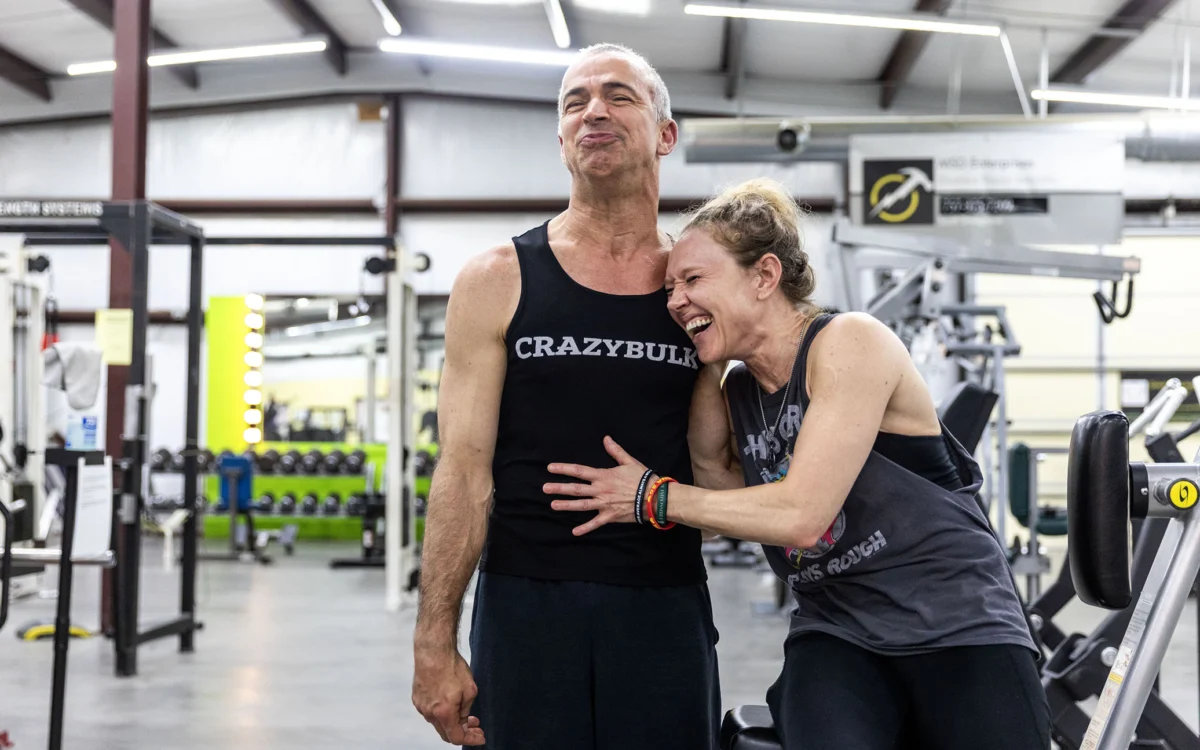
The clinking of heavy iron plates echoes throughRetro Flex Gym in Courtland, Virginia, a familiar soundtrack for Steve Alexy and Arlyn Smith. Moving with deliberate, synchronized focus, the couple navigates the gym floor—Alexy with a careful, pigeon-toed gait and one arm held rigid, Smith taking short, precise steps to maintain her balance. To the casual observer, their physical movements immediately reveal their neurological challenges. But beneath the surface of everyday assumptions lies an extraordinary athletic reality: Alexy, 53, and Smith, 45, are record-setting powerhouse athletes competing successfully in mainstream powerlifting competitions against able-bodied athletes, shattering preconceptions of what disability looks like.
Both accomplished athletes contend with severe muscle incoordination and dysarthria, characterized by slurred speech. Alexy lives with cerebral palsy, a congenital neurological disorder affecting movement and muscle coordination, while Smith manages cerebellar ataxia, a condition resulting from brain trauma that impairs balance and motor control. Despite these medical hurdles, the couple has spent the last half-decade dominating regional, national, and international powerlifting circuits—not within specialized adaptive divisions, but in open, mainstream competitions. Their journey is one of mutual resilience, athletic excellence, and a persistent push against societal underestimation.
Chronology and Personal Histories: A Path Forged Through Adversity
The road to the powerlifting platform was vastly different for each athlete, marked by decades of personal struggles, medical challenges, and transformative moments.
Alexy grew up in Franklin, Virginia, where symptoms of cerebral palsy shaped his early life. Seeking an outlet for physical development, he turned to weightlifting as a teenager, eventually establishing a daily routine at the local YMCA when he turned 21. For years, his primary arena was competitive bodybuilding. Between 2014 and 2019, Alexy competed in 13 physique competitions, winning nearly every single one. Unlike powerlifting, which measures raw strength in pounds moved, bodybuilding judged contestants on muscular aesthetics, symmetry, and stage presentation—a discipline Alexy wryly summarized as "trying to look pretty."
Meanwhile, Smith’s early life was defined by entirely different trials. Growing up with a deep-seated desire to be an athlete, she spent hours running track while her father watched from the sidelines—a cherished memory that sustained her through his tragic suicide when she was 21 years old. At age 23, a near-fatal drug overdose caused a severe stroke, inflicting permanent damage to her cerebellum and confining her largely to a wheelchair or walker for the next 15 years.
By the time she met Alexy, Smith was 39, navigating a grueling recovery path that encompassed both substance abuse rehabilitation and severe anorexia. A mutual acquaintance—whom Alexy had met backstage at one of his final bodybuilding shows—suggested they connect over their shared experiences with physical disabilities and an interest in athletics. A simple text message sparked a profound connection. Within three months of dating, Alexy relocated to the Peninsula to be closer to her, and six months later, they settled together in his hometown of Franklin.
Breaking Down Barriers: The Mental Toll of Misconception
Beyond the physical demands of their conditions, Alexy and Smith have spent decades combating a psychological barrier far heavier than any barbell: the assumption that physical impairments equate to cognitive deficits. Because both athletes struggle with clear verbal articulation, strangers routinely mistake their physical speech impediments for intellectual disabilities.
"What was assumed was that something else was wrong with me because I couldn’t verbalize," Smith reflected. "But the reason was, I physically could not, which was frustrating, because I had fully formed thoughts. I just couldn’t get them out."
This daily friction forged a deep psychological bond between the couple. Sharing an affinity for weights, professional wrestling, and caring for a three-legged rescue cat, they found in each other an unyielding sense of mutual understanding. Within this supportive environment, Smith’s rehabilitation accelerated dramatically.
Under Alexy’s encouragement, Smith began shedding her reliance on assistive mobility devices. What started as a goal to walk unaided to the end of a driveway eventually blossomed into independent outdoor mobility. "No one in my life had ever supported me with things, like driving to the mailbox or walking down the sidewalk," Smith noted, crediting Alexy’s unwavering support with helping her reclaim her physical autonomy.
Dominating the Platform: Record-Breaking Achievements
Transitioning from general fitness to competitive powerlifting unlocked unprecedented athletic potential. Powerlifting events typically judge athletes across three primary compound movements: the squat, the bench press, and the deadlift, with the combined maximum weights dictating the final score.
Due to anatomical constraints—specifically, knees that buckle inward under heavy loads and chronic shoulder arthritis—Alexy refrains from the squat and bench press. Instead, he focuses exclusively on the deadlift, where his exceptional upper-body and core strength shine. In 2024, competing in the men’s masters 50 to 54 division at a body weight of 67.5 kilograms (approximately 149 pounds), Alexy set an official United States Powerlifting Coalition (USPC) deadlift record by successfully hoisting 227 pounds.
Smith, conversely, competes across multiple disciplines. Last year, her dominance in the 56-kilogram (123-pound) weight class within the women’s masters 45 to 49 division earned international recognition. The International Powerlifting Coalition formally recognized her as a world record holder in the deadlift after she successfully lifted 264.5 pounds—more than twice her total body weight. This achievement was followed by additional accolades from the USPC, cementing her status as a national standard-bearer for her division.
Reflecting on her ascent to elite athletic status, Smith noted the profound what-ifs of her journey: "I could have gone my entire life and never even have tried, and I wouldn’t have known."
Community Impact and Broader Implications
At Retro Flex Gym in Courtland, where the couple trains nearly every day, their presence has left a lasting impression on staff and fellow members. Gym owner Hunter Darden speaks of the pair with immense respect, noting their disciplined work ethic and welcoming demeanor. "They’re here almost every day," Darden said. "They are inspiring people, really good people."
The achievements of Alexy and Smith arrive at a time of growing public interest in adaptive sports and inclusive athletics. While organizations like the Paralympic Games have long provided platforms for elite athletes with physical impairments, the couple’s success in mainstream, open-class powerlifting competitions highlights a broader cultural shift. Their victories challenge traditional medical models of disability, which historically emphasized patient passivity and limitation, in favor of an active, self-actualized model of health and wellness.
For the sports community, their trajectories offer a compelling case study in the intersection of neurological rehabilitation and heavy resistance training. Exercise physiologists and sports medicine professionals increasingly recognize the therapeutic benefits of strength training for individuals with neuromuscular conditions, noting improvements in bone density, neuromuscular pathways, and psychological well-being.
Yet, for Alexy and Smith, the numbers on the scorecards and the certificates hanging on their walls represent something simpler yet infinitely more profound: validation, partnership, and the quiet triumph of showing up. As they continue to train side by side, lifting weights that surpass their own bodies and breaking records that once seemed impossible, they serve as living proof that true strength is measured not just in kilograms, but in resilience.