LOS ANGELES — It is pronounced “human.” Yet writer-director Siân Heder acknowledges that the unusual spelling of the title of her new movie, Being Heumann, is something audiences might give a puzzled second look, unsure of how to pronounce it and potentially dismissing it altogether. However, the more she sat with the concept, the more she realized it was the ideal title for a portrait of real-life disability rights activist Judy Heumann, a wheelchair user who systematically made herself undismissable to the American political establishment.
More specifically, the film examines the pivotal 1977 protest in which Heumann led a coalition of disabled activists in a 26-day sit-in at a federal office building in San Francisco. The demonstration continued until the federal government finally began enforcing Section 504 of the Rehabilitation Act of 1973—marking the first federal legislation that formally recognized disability as a protected civil rights category.
“The fact that her last name was ‘human’ has so many beautiful layers of meaning,” Heder reflected during a recent interview in Los Angeles. “I think Judy was asking for the world to see disabled people as human beings who were worthy of rights and being looked at and being included.”
Following a high-profile world premiere as the opening-night selection of the Toronto International Film Festival in September, Being Heumann is scheduled to arrive in theaters on November 6 before making its streaming debut on Apple TV on November 13. Crucially, the project serves as Heder’s first directorial feature since 2021’s CODA, the bittersweet drama centered on a hearing teenager in a Deaf family. An acronym for “child of Deaf adults,” CODA achieved historic success by winning three Academy Awards, including Best Picture and Best Adapted Screenplay for Heder.
The Evolution of a Leader and a Filmmaker
In Judy Heumann—who became a wheelchair user after contracting polio as a young child—Heder found a historical subject who was actively discovering her identity as a leader, navigating the delicate balance of when to hold firm and when to cede ground to empower others. For a filmmaker grappling with the sudden, overwhelming aftermath of unexpected international success, the parallel felt deeply personal.
“I think I was making a movie about myself, honestly,” Heder admitted from a quiet corner in an Eagle Rock coffee shop, where she has long resided. “When you’re moving forward on a massive project or a movement or anything, there’s a necessary drive and ambition and focus that is needed. And if you look at any major change that’s happened in human history, it takes a certain kind of person to push that through. I’m not identifying myself with great leaders of the civil rights movement, but directing a movie is a similar thing.”
Community is a recurring theme in conversations with Heder, who maintains a quiet self-possession despite her elevated profile. Though CODA brought her unprecedented mainstream recognition, she was far from a novice when she helmed the project. Her extensive television credits include earning a Peabody Award as a writer on the comedy-drama series Men of a Certain Age, as well as serving as a writer, director, and producer on the critically acclaimed Netflix series Orange Is the New Black. She also expanded her 2006 short film Mother into her feature directorial debut, Tallulah, which premiered at the Sundance Film Festival in 2016.
Winning the Academy Award for CODA, however, introduced profound shifts in her professional and personal life. At first, she placed her Oscar statuette on her home desk, only to relocate it because the figure’s crossed arms seemed to quietly judge her as she worked. The cultural milestone also brought immediate industry pressure, forcing Heder to recalibrate her trajectory amid an influx of high-profile offers, including multiple meetings with Marvel Studios for various franchise properties.
Rather than chasing commercial blockbusters, Heder chose to anchor herself in the storytelling instincts that originally defined her independent career. “Suddenly there are a lot of voices chiming in too because your reps have an idea of what you should do next and the industry has an idea of what you should do next,” she noted. “And it was really important for me to center myself back in a feeling of: I’ve always been drawn to stories because they move me. And that hasn’t changed.”
Historical Context and the 1977 504 Sit-In
The historical foundation of Being Heumann rests upon one of the most significant yet historically overlooked protests in American civil rights history. Signed into law in 1973, the Rehabilitation Act prohibited discrimination against individuals with disabilities in programs receiving federal financial assistance. However, successive administrations delayed issuing the implementing regulations required to enforce Section 504.
By April 1977, patience among disability advocates had worn thin. Under Judy Heumann’s leadership, activists occupied the U.S. Department of Health, Education, and Welfare regional offices in San Francisco. The protest transformed into a 26-day occupation, sustained by community solidarity, coalition building with organizations such as the Black Panthers and the Gray Panthers, and fierce determination despite attempts by federal authorities to cut off water, food, and telephone services. The successful resolution of the sit-in established a vital precedent for future legislation, ultimately paving the way for the landmark Americans with Disabilities Act (ADA) of 1990.
Heder’s path to chronicling this history began prior to the release of CODA, when a friend recommended she watch the 2020 documentary Crip Camp, which prominently features Heumann. Deeply moved, Heder read Heumann’s 2020 memoir and initiated contact via a cold email expressing adaptation interest. Coincidentally, Heumann was evaluating potential directors for a cinematic adaptation on that exact day. A subsequent pitch meeting—wherein Heder committed to authentic casting practices utilizing performers with disabilities, mirroring her approach on CODA—secured her the position.
Heder spent two years researching and developing the project alongside Heumann, conducting dozens of interviews with participants from the Carter-era protest. Following Heumann’s unexpected death in 2023, Heder initially questioned whether she could proceed with the production. It was Crip Camp co-director James LeBrecht who ultimately convinced her to carry the project forward.
“I think Judy’s death, which was sudden, it made me feel like she had left her legacy in my hands,” Heder reflected.
Navigating Production and Industry Accessibility
As post-Oscar development continued, Heder found herself in the rare position of having two major projects simultaneously greenlit: Being Heumann at Apple and a feature adaptation of Gabrielle Zevin’s bestselling novel Tomorrow, and Tomorrow, and Tomorrow at Paramount Pictures. Seeking guidance, she consulted filmmaker Guillermo del Toro during a public event in Westwood regarding how to prioritize conflicting opportunities.
“And he said, ‘Make the movie that can’t get made without you,’” Heder recalled. “And that was very clarifying for me. When you are the element that gets that story told, it takes on an importance and urgency.”
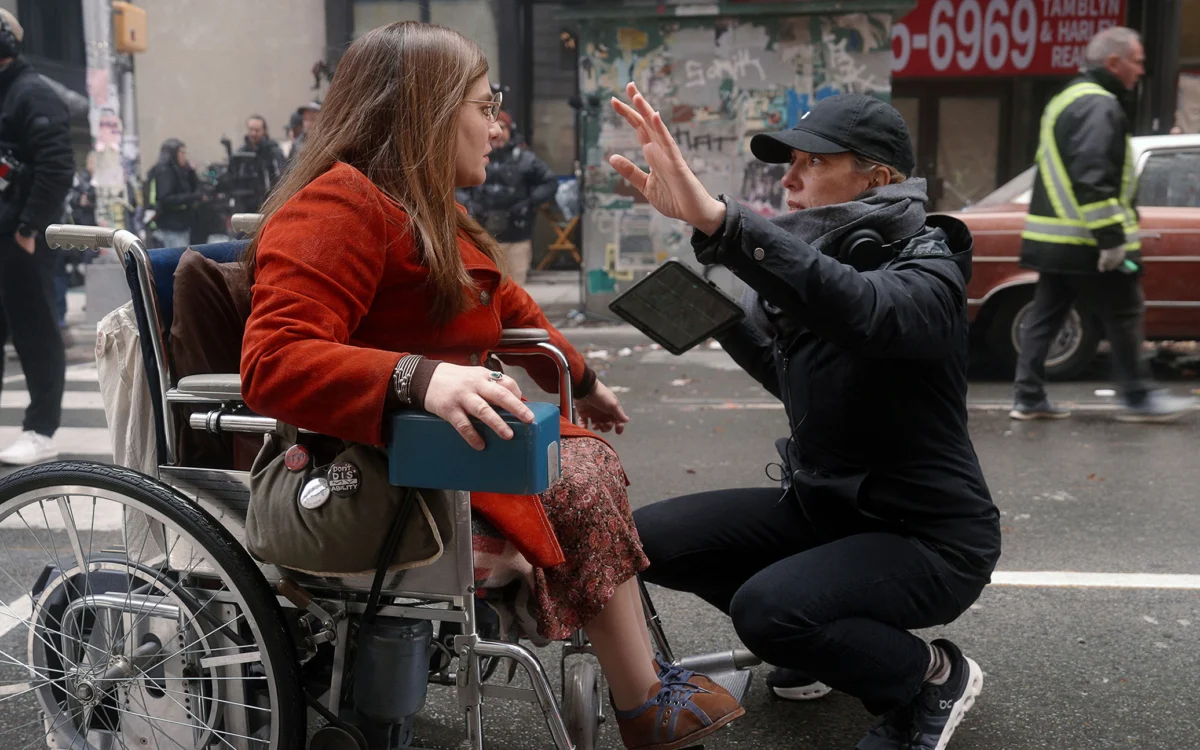
Leveraging her newly acquired industry influence, Heder chose the more challenging independent path rather than opting for a commercial studio tentpole. Following an exhaustive casting process she described as “the casting Olympics,” she selected BAFTA-nominated actor Ruth Madeley, a wheelchair user, to portray Heumann.
Production took place primarily on a constructed soundstage in Toronto designed to replicate the San Francisco federal building. A central priority for the production was maintaining rigorous accessibility standards across all departments. Heder noted that Hollywood remains one of the least accessible professional sectors, necessitating custom-built trailers, specialized architectural modifications to sets, and an overarching accessibility team dedicated to managing logistics and individual accommodations for cast and crew members with diverse disabilities.
Rather than adhering to the conventions of a traditional biographical film, Heder framed the narrative around the collective action of the 504 sit-in. She described the tonal approach as a hybrid of disparate cinematic styles: “It’s almost like Bad News Bears and Dog Day Afternoon together. There’s an underdog-sports-team feeling and bank-heist-gone-wrong.”
Broader Implications and Future Outlook
Addressing potential perceptions regarding her growing body of socially conscious work, Heder remains pragmatic about how critics and audiences might categorize her directorial choices.
“Of course it was on my mind if it starts to feel like: Oh, is Siân Heder a social justice warrior who’s just out to try to make these movies that have some kind of message behind them,” she said. “But I think this is just a great story. Outside of disability, outside of anything else, it is a great story.”
By focusing her narrative lens on outsiders, class dynamics, and populations marginalized by mainstream society, Heder continues to prioritize substance over conventional celebrity metrics. As she actively prepares to transition into her next directorial venture with Tomorrow, and Tomorrow, and Tomorrow, she remains committed to championing narratives defined by directness and truth—qualities she feels are too often dismissed in modern entertainment culture.
“Earnest has become a dirty word,” Heder concluded. “And what earnest actually means is direct and truthful.”