For years, organizations worldwide have turned to Unconscious Bias Training (UBT) as a primary tool in their efforts to foster diversity, equity, and inclusion (DEI). This approach, which seeks to make individuals aware of their inherent cognitive biases, has ballooned into a multi-billion-dollar industry, with companies spending vast sums annually on programs designed to "fix" biased thinking and behavior. However, a growing body of research and real-world experience indicates that UBT is often ineffective, and in some cases, can even exacerbate the very problems it aims to solve. This widespread reliance on a potentially flawed solution raises critical questions about the efficacy of current DEI strategies and the path forward for creating truly equitable environments.
The Proliferation of Unconscious Bias Training: A Chronological Overview
The journey to widespread UBT adoption is rooted in a confluence of social movements, evolving workplace demographics, and a desire by organizations to demonstrate commitment to fairness. Early diversity training initiatives, often compliance-driven, emerged in the wake of civil rights legislation, focusing on explicit discrimination and legal obligations. However, the conceptualization of bias began to shift in the late 20th and early 21st centuries, with academic research highlighting the pervasive nature of unconscious or implicit biases – mental shortcuts that operate outside conscious awareness but significantly influence perceptions, attitudes, and decisions.
This "cognitive turn" provided a new framework for understanding discrimination, moving beyond overt prejudice to subtle, often unintentional, forms of bias. As societal awareness of systemic inequalities grew, particularly with the rise of digital communication and global interconnectedness, the demand for practical solutions escalated.
The 2010s marked a significant inflection point. Major social movements like #MeToo and #BlackLivesMatter brought issues of gender inequality, racial injustice, and workplace discrimination to the forefront of public discourse. Organizations, facing intense scrutiny from employees, customers, and investors, sought visible and immediate responses. Unconscious Bias Training emerged as a seemingly palatable and scalable solution. It offered a tangible action that leaders could point to, signaling a commitment to addressing systemic issues without necessarily requiring deep, structural overhauls.
This period saw a dramatic surge in UBT adoption. Companies, from tech giants to government agencies, quickly integrated these programs into their HR and DEI strategies. The pattern became almost formulaic: a public incident of discrimination, an employee grievance, or a general call for greater inclusion would often be met with the announcement of organization-wide unconscious bias training. This created a robust market for consultants and training providers, transforming UBT into a global trend and a significant segment of the corporate learning and development industry.
The Ineffectiveness Debate: Why UBT Falls Short
Despite its widespread adoption, the efficacy of UBT has been increasingly questioned by academic researchers, behavioral scientists, and experienced DEI practitioners. The core critique centers on a fundamental misunderstanding of how the human mind operates and how biases are formed and perpetuated.
The Dual-Process Theory and Cognitive Mismatch:
A key insight from cognitive psychology, notably Daniel Kahneman’s work on "Thinking, Fast and Slow," distinguishes between two systems of thought:
- System 1 (Unconscious/Automatic): Fast, intuitive, emotional, and operates largely outside conscious awareness. This system is responsible for the vast majority of our cognitive functioning, including the formation and application of biases and stereotypes.
- System 2 (Conscious/Deliberate): Slow, effortful, logical, and under conscious control. This system is engaged for complex problem-solving and rational decision-making.
The fundamental flaw of most UBT programs is their reliance on appealing primarily to System 2. By delivering knowledge-based content, presentations, and discussions, these trainings aim to make individuals consciously aware of their biases. However, knowing about a bias in one’s rational, conscious mind (System 2) does not automatically reduce its impact on the unconscious mind (System 1), where the bias truly operates and influences behavior. Lasting behavioral change requires engaging System 1, which UBT largely fails to do.
Mental Overload and Paradoxical Effects:
The attempt to be constantly, consciously aware of one’s unconscious biases can lead to cognitive overload. When individuals are forced to constantly monitor and correct their thoughts and actions for potential biases, their cognitive resources become strained. This mental exhaustion can paradoxically strengthen the impact of System 1 biases, as the conscious mind, fatigued from constant vigilance, defaults more readily to ingrained mental shortcuts. Instead of reducing bias, this approach can make individuals more reliant on their default, often biased, behaviors, creating a vicious cycle.
Enhancing Bias and Reinforcing Stereotypes:
Several studies have shown that UBT can, unintentionally, backfire by enhancing biased thinking and strengthening stereotypes. By explicitly discussing stereotypes and the nature of bias, these trainings can make participants more aware of, and even internalize, the very stereotypes they are meant to overcome. Research published in outlets like Psychological Science and Organizational Behavior and Human Decision Processes has highlighted instances where individuals exposed to bias awareness content subsequently exhibited stronger adherence to stereotypes or made more biased decisions.
Strengthening Misconceptions of Inequality:
Further research, including a 2020 study published in Personality and Social Psychology Bulletin, has revealed another concerning backfire effect. Making individuals in privileged positions aware of racial prejudice, inequality, and discrimination in contemporary society often does not change their common misconception of society being largely fair to all. Instead, it can strengthen that belief and even lead to a more optimistic (and often inaccurate) perception of past inequalities. This "awareness backfire" undermines the very goal of promoting a nuanced understanding of systemic injustice.
The "Bias is Natural" Excuse:
Many UBT programs emphasize that biases are "natural" and an inherent part of human cognition. While this statement holds scientific truth, its presentation in a training context can have unintended consequences. When participants hear that everyone is biased and that holding stereotypes is "natural," it can reduce their motivation to actively change their own biases. This normalization can foster a sense of complacency, leading individuals to feel less responsible for mitigating their biased behaviors, or worse, to excuse them.
Psychological Backlash: Shame, Fear, and Moral Licensing:
The very framing of "Unconscious Bias Awareness Training" or even "Inclusion & Diversity Training" can trigger counter-productive emotional and psychological responses:
- Anxiety and Defensive Reactions: The implied message that one needs to be "fixed" can generate anxiety, defensiveness, or resentment. Individuals may feel personally attacked or accused, leading to a closed mindset rather than an open one.
- Loss Aversion: For those in positions of privilege, the training can activate fears of losing status, power, or opportunities, leading to resistance and a "zero-sum game" mentality.
- Moral Licensing: Perhaps one of the most insidious backfire effects is "moral licensing." This unconscious phenomenon occurs when individuals engage in a positive action (like attending UBT), which then creates a self-perception of being a "good person" or being in control of their biases. This positive self-image can, ironically, make them more likely to make immoral or non-inclusive choices subsequently. Studies have demonstrated this effect: individuals who strongly disagreed with sexist statements were later more likely to hire a man for a job where a woman was equally qualified, or even make sexist comments, because they felt secure in their "non-sexist" identity. Similarly, those who expressed anti-racist sentiments were shown to be more likely to unconsciously discriminate against racial minorities. The act of "doing good" inadvertently gives permission for "doing bad" later.
Limited Positive Outcomes and Short-Term Gains
It is important to acknowledge that UBT is not entirely without merit. Such sessions can create a shared experience, provide insights, and, through "aha moments," prompt self-reflection about previously unseen patterns of discrimination and bias. They can also foster a shared language around DEI concepts, which can be useful for initiating conversations about root causes within an organization or community.
However, the consensus from robust research indicates that any positive results generated by UBT are typically fleeting. Studies consistently show that the effects on behavior and decision-making rarely last beyond a few days or weeks. This transient impact suggests that while UBT might raise temporary awareness, it fails to instigate the sustained behavioral and systemic changes necessary to create genuinely inclusive environments.
Expert and Organizational Reactions: A Growing Call for Systemic Change
The accumulating evidence of UBT’s ineffectiveness has led to growing skepticism among academics, seasoned DEI practitioners, and even some forward-thinking organizational leaders. Many are now openly questioning the return on investment for the billions spent annually on these trainings.
Shift Towards Systemic Interventions:
There is a pronounced shift in expert discourse towards advocating for systemic and structural interventions rather than relying solely on individual awareness. Leading voices in the DEI field emphasize that bias is not merely an individual failing but is often embedded in organizational processes, policies, and cultural norms. Therefore, addressing bias effectively requires redesigning these systems.
The Dilemma for HR and DEI Leaders:
Despite the skepticism, many Human Resources and DEI leaders find themselves in a challenging position. UBT has become a default expectation, a visible checkbox action that demonstrates corporate commitment. The pressure to "do something" in response to public calls for justice or internal grievances often leads organizations to revert to familiar UBT programs, even if internal data or external research suggests their limited impact. This creates a disconnect between the stated goal of achieving equity and the chosen methods for reaching it.
The Way Forward: Designing for Inclusion Through Behavioral Science
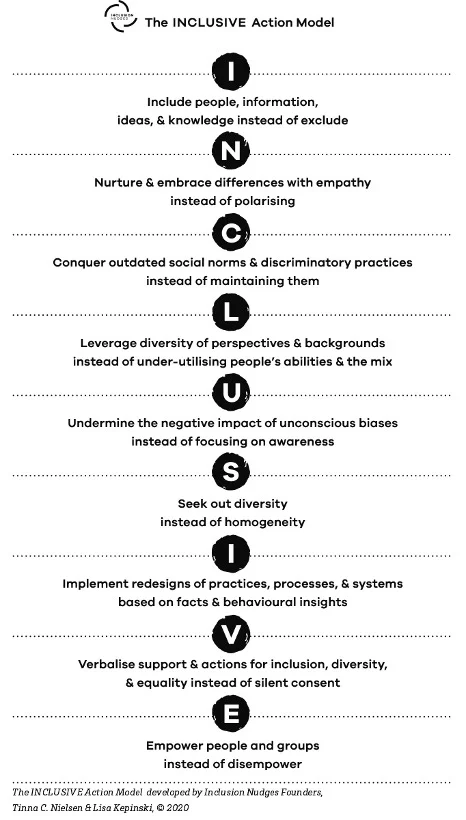
Given the limitations and potential drawbacks of traditional UBT, the path forward for fostering truly inclusive environments lies in a paradigm shift: moving from attempting to "fix people" by making them aware of their biases, to "fixing systems" by designing environments that mitigate the impact of bias by default. This approach leverages insights from behavioral and social sciences to create "Inclusion Nudges."
What are Inclusion Nudges?
An Inclusion Nudge is an action designed to influence the unconscious mind, making it easy to be inclusive and to practice inclusion automatically in daily actions. These actions are practical applications of insights from behavioral and social sciences, nudge theory, and a deep understanding of the hidden barriers to achieving inclusion. Inclusion Nudges work because they steer the unconscious mind (both one’s own and others’) to change behavior to be inclusive automatically, without requiring conscious effort or constant vigilance.
How Inclusion Nudges Work:
Inclusion Nudges operate on several key principles:
- Minimizing Bias Impact: They are designed to reduce the influence of mental shortcuts and biases at the point of decision-making, rather than relying on individuals to consciously override their biases.
- Engaging the Unconscious: Unlike UBT, Nudges appeal directly to the unconscious System 1, where most behavioral decisions originate. This makes the desired inclusive behavior automatic and effortless.
- No Rational Arguments Needed: They do not rely on convincing people through rational arguments or moral persuasion, which are often ineffective against deeply ingrained biases.
- Aligning Behavior with Intent: Nudges help align actual behavior with individuals’ stated values and intentions for inclusion, often by making the inclusive choice the default or easiest option.
- Respecting Freedom of Choice: Nudges work by gently steering, not coercing. They maintain freedom of choice while subtly guiding individuals towards more inclusive actions.
- Cost-Effective Implementation: Often, these design changes can be implemented with minimal cost, making them a highly efficient approach to DEI.
An Illustrative Example: Anonymous Auditions in Symphony Orchestras
One of the most compelling and long-standing examples of an Inclusion Nudge comes from the world of classical music. Since the 1970s, many major symphony orchestras globally have implemented anonymous auditions. The impetus for this change arose when internal discussions questioned the overwhelming predominance of white males in orchestras.
The design is simple yet profoundly effective: musicians perform behind a screen, preventing the selection committee from seeing their gender, ethnicity, or appearance. Early pilot programs yielded astonishing results. The number of women selected for orchestras increased by as much as 50%, and the ethnic diversity of candidates also saw a radical shift. This evidence of mitigated bias was so compelling that anonymous auditions became a permanent fixture in many orchestras, now considered best practice for ensuring merit-based selection. Some orchestras even went further, placing carpets on the stage to muffle the sound of footsteps, as the click of high heels could unconsciously prime a gender bias in the minds of the committee members, subtly skewing their perception of the musical performance.
This example demonstrates the power of systemic design. It bypasses the need for committee members to be "aware" of their gender or racial biases and consciously correct them. Instead, it removes the visual cues that trigger those biases in the first place, allowing for a truly objective evaluation of talent. The evidence for this approach has existed for over four decades, yet its widespread adoption across other industries, particularly in hiring, has been remarkably slow. While technological platforms are now making anonymized candidate review easier, the pace of implementation still needs to accelerate significantly.
Other Examples of Inclusion Nudges:
- Structured Interviews: Implementing standardized interview questions, consistent evaluation criteria, and diverse interview panels reduces interviewer bias compared to unstructured, free-form interviews.
- Default Options: Setting inclusive choices as the default (e.g., opting-out of certain biased processes rather than opting-in to inclusive ones).
- De-biasing Language: Using gender-neutral language in job descriptions or communications to attract a broader pool of candidates.
- Data-Driven Decision Tools: Implementing tools that analyze hiring or promotion data for patterns of bias and prompt corrective action.
Implications for a More Just World
The shift from "awareness training" to "designing for inclusion" has profound implications for how organizations approach DEI. It represents a move from individual blame and performative actions to strategic, evidence-based interventions that address the root causes of inequality embedded within systems and processes.
Redefining DEI Strategy: Organizations must move beyond the quick-fix mentality and embrace a more sophisticated DEI strategy that prioritizes behavioral science-backed interventions. This means investing in design thinking, data analysis, and systemic re-engineering rather than simply allocating budgets to generic training programs.
Financial Stewardship: Redirecting resources from ineffective UBT to proven Inclusion Nudges represents better financial stewardship. Organizations can achieve more impactful and sustainable change with potentially lower costs, maximizing their investment in DEI.
Sustainable and Lasting Change: Inclusion Nudges offer the promise of sustainable behavioral change because they work with, rather than against, the inherent mechanisms of the human mind. By making inclusive actions the default, they embed fairness into the organizational culture and processes, leading to lasting shifts in behavior and outcomes.
The Urgency of Action: The continued reliance on ineffective UBT in the face of compelling evidence highlights a critical gap between intent and impact. To genuinely advance towards a more just and equitable world, organizations must accelerate the adoption of design-based solutions. The evidence is clear: awareness alone is insufficient. We must mitigate the influence of unconscious bias by actively nudging the unconscious mind to be inclusive by default and as the norm.
Let’s make inclusion the norm everywhere, for everyone, by systematically designing our environments for equity.