A comprehensive new study by the Pew Research Center, supported by the Pew-Knight Initiative, reveals the significant presence and diverse characteristics of religious and faith-based radio stations across the United States. The research, which analyzed AM and FM stations broadcasting predominantly religious content, offers a detailed look at their programming, listener demographics, and the factors influencing their reach. The Pew-Knight Initiative, a collaboration between The Pew Charitable Trusts and the John S. and James L. Knight Foundation, aims to foster a deeper understanding of how Americans engage with civic information, form their beliefs, and participate in their communities. This report specifically delves into the landscape of religious broadcasting, a substantial, yet often under-examined, segment of the American media ecosystem.
Understanding the Scope of Religious Broadcasting
The report underscores that religious radio stations are accessible in most parts of the United States, playing a vital role in the media consumption habits of many Americans. Pew Research Center, a nonpartisan fact tank dedicated to informing the public on critical issues, attitudes, and trends, conducted this in-depth analysis to shed light on these stations’ characteristics and their audiences. The John S. and James L. Knight Foundation, a social investor committed to building informed and engaged communities, partnered with Pew to fund this important research.
The motivation behind this study stems from Pew Research Center’s ongoing commitment to understanding news habits and media consumption. By examining the sources Americans rely on for information, including faith-based radio, the center aims to provide a more complete picture of the contemporary media environment. Religious radio stations, due to their widespread availability, represent a considerable portion of the nation’s audio media landscape, making their analysis crucial for a holistic understanding of public information consumption.
Methodology and Data Collection
To provide a robust overview, the study employed a multi-faceted approach, utilizing three primary data sources to capture the breadth of religious radio stations, their programming content, and listener engagement. This methodology allowed for a comprehensive examination of the phenomenon.
The research meticulously analyzed FCC-licensed terrestrial AM/FM radio stations identified as primarily broadcasting religious or faith-based content. Data was gathered from Radio-Locator, accessed in March 2025, to identify the stations themselves. Further analysis involved examining 439,711 hours of programming broadcast on these stations between July 2025, providing insights into the actual content being disseminated. This programmatic analysis was crucial in categorizing stations by their primary content type, such as music or talk, and identifying religious traditions based on their website content.
The study also incorporated survey data to understand listener motivations and preferences. While specific survey details were not elaborated upon in the provided text, the methodology section indicates that survey questions were used to gather information on why listeners tune into religious programming. The full questionnaire, detailed responses, and the comprehensive methodology are available for public review, allowing for transparency and further research.
Regional Disparities in Religious Radio Presence
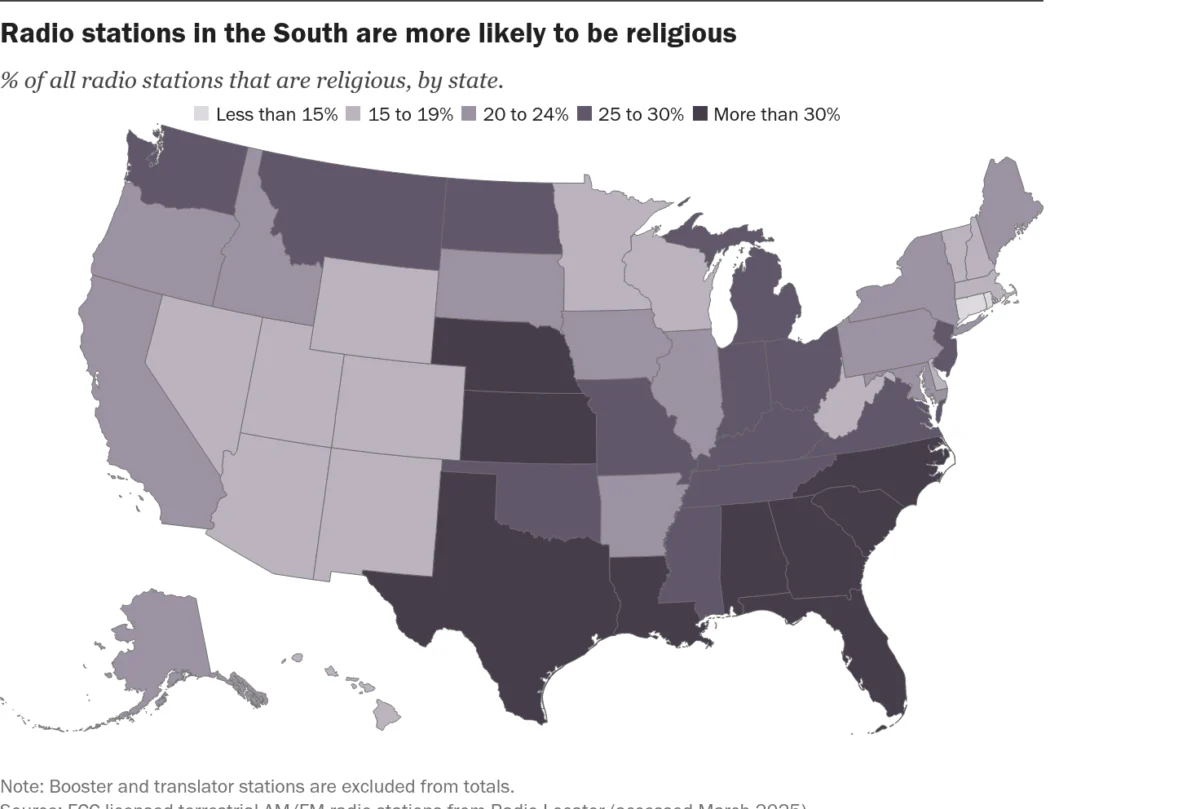
A key finding of the Pew Research Center’s study is the significant regional variation in the prevalence of religious radio stations. The data indicates that states in the Southern United States tend to have a higher proportion of their radio stations dedicated to religious programming compared to other regions.
States with the Highest Percentage of Religious Radio Stations:

- North Carolina: Stands out with 35.9% of its radio stations broadcasting religious content.
- Texas: Follows closely with 34.1%.
- Nebraska: Shows a substantial presence at 32.2%.
- South Carolina: Also features a high proportion at 31.8%.
- Florida and Georgia: Both report approximately 31.1% of their stations being religious.
Conversely, states like Rhode Island (13.3%), Vermont (14.7%), New Hampshire (15.8%), and Utah (16.1%) have a considerably lower percentage of religious stations. This geographical distribution suggests that cultural and demographic factors may play a significant role in the landscape of religious broadcasting.
Characteristics of Religious Radio Programming
The study also delved into the types of programming offered by these stations. While a significant portion of religious stations broadcast talk programming, a substantial number also feature music-based content.
- Music vs. Talk: Across the analyzed stations, the percentage that plays mostly music varies. For instance, Colorado leads with 64.7% of its religious stations primarily broadcasting music, while states like Maryland (58.8%) and South Carolina (60.0%) also show a strong leaning towards music programming. Conversely, states like Wyoming (27.3%), Mississippi (61.5%), and Texas (54.4%) exhibit a higher proportion of talk-focused religious content.
- Faith-Specific Programming: The research also explored the denominational affiliation of these stations. While the provided data offers a breakdown of the percentage of religious stations that are Catholic, it also notes that the categorization of religious tradition is primarily based on the content of station websites. This suggests a diverse range of faith traditions represented, from broadly Christian programming to more specific denominational broadcasts. For example, states like Connecticut (25.0% Catholic), Iowa (20.8% Catholic), and Minnesota (18.0% Catholic) show a notable presence of Catholic-affiliated religious radio stations.
It’s important to note that the categorization of "mostly music" or "mostly talk" programming is based on a threshold of 70% of that specific content type. Stations that do not meet this threshold are classified as playing a mix of talk and music, which is not explicitly detailed in the presented summary data. Furthermore, stations without accessible web streams, such as those in the District of Columbia, were excluded from this specific content analysis.
Listener Engagement and Motivations
While the report primarily focuses on the characteristics of the stations, it also touches upon the listeners. The research aims to understand "who listens to religious programming and why." This aspect of the study is critical for comprehending the role these stations play in the lives of their audience members. Although specific listener demographics and detailed motivations are not fully elaborated in the provided snippets, the study’s premise suggests an exploration into how faith-based radio serves as a source of spiritual guidance, community connection, and information for its listeners.
The very existence and prevalence of these stations indicate a sustained demand for such content. Factors such as the desire for spiritual enrichment, connection with a faith community, and access to religiously-oriented news and commentary likely contribute to listener loyalty. The fact that these stations are often the only accessible form of media in certain geographic areas or for specific demographics further amplifies their importance.
Broader Implications and Future Research
The findings of the Pew-Knight Initiative’s study on religious radio offer several implications for understanding the American media landscape and public discourse. The significant presence of religious stations highlights the continued influence of faith in public life and the media’s role in shaping and reflecting those beliefs.
- Media Diversity: The study contributes to a more nuanced understanding of media diversity by examining a segment often overlooked in broader media analyses. It demonstrates that beyond mainstream commercial and public broadcasting, a substantial network of faith-based media outlets serves specific audiences.
- Civic Engagement: By understanding how Americans consume information, including religious content, researchers can better assess the pathways to civic engagement. Religious organizations and their media platforms can serve as conduits for community organizing and public discourse, influencing how individuals perceive and interact with societal issues.
- Information Consumption Habits: The research provides valuable data for media organizations, policymakers, and academics seeking to understand evolving information consumption habits. As the media landscape continues to fragment, niche broadcasters like religious radio stations play an increasingly important role in reaching specific demographic groups.
Future research could further explore the content of these stations in greater detail, analyze listener demographics more comprehensively, and investigate the impact of religious radio on political attitudes and community involvement. Understanding the interplay between religious broadcasting, listener engagement, and broader societal trends remains a critical area for continued study.
The Pew-Knight Initiative’s ongoing commitment to exploring the complex relationship between media, information, and civic life promises to yield further insights into how Americans navigate their information environments and engage with the world around them. This report on religious radio serves as a foundational piece, illuminating a significant, yet often under-acknowledged, aspect of American media consumption.