The Trump administration has issued a new guidance memo that could require many immigrants who are seeking a green card – lawful permanent residence in the United States – to leave the country and apply for it from their home nation instead of from within the U.S. The memo gives immigration officers the discretion to make decisions on a case-by-case basis. This directive significantly alters the landscape for those pursuing permanent residency, potentially impacting hundreds of thousands of individuals annually and shifting established pathways for becoming a U.S. citizen.
Background and the "Adjustment of Status" Process
For decades, a significant portion of immigrants already residing in the United States have been able to adjust their immigration status to become lawful permanent residents without leaving the country. This process, known as "adjustment of status" (AOS), has been a crucial pathway for individuals on valid temporary visas, such as those on student, work, or tourist visas, who later become eligible for a green card through family sponsorship, employment, or other established categories. The new guidance, released by U.S. Citizenship and Immigration Services (USCIS), introduces stricter discretionary powers for immigration officers, potentially limiting the availability of this in-country application process.
The administration contends that this policy aims to "return to the original intent of the law" and "close loopholes in the immigration process." They argue that the AOS process has been exploited in ways that were not originally envisioned, and that requiring individuals to apply from abroad is the more traditional and intended method for obtaining a green card. This stance suggests a desire to reassert what they perceive as a more rigorous and controlled immigration system.
However, critics of the memo express significant concerns. They warn of potential processing delays, which could extend wait times for green card applications by months or even years. Such delays could lead to family separations, as individuals may be forced to leave their U.S.-based families behind while awaiting a decision on their application abroad. Furthermore, these delays could also result in job losses for those who rely on their temporary work visas and whose ability to continue working in the U.S. is tied to their pending green card application. Opponents also argue that this policy will fundamentally limit pathways to legal immigration, creating unnecessary hurdles for those seeking to contribute to American society.
Pew Research Center Analysis: A Shift in Green Card Issuance
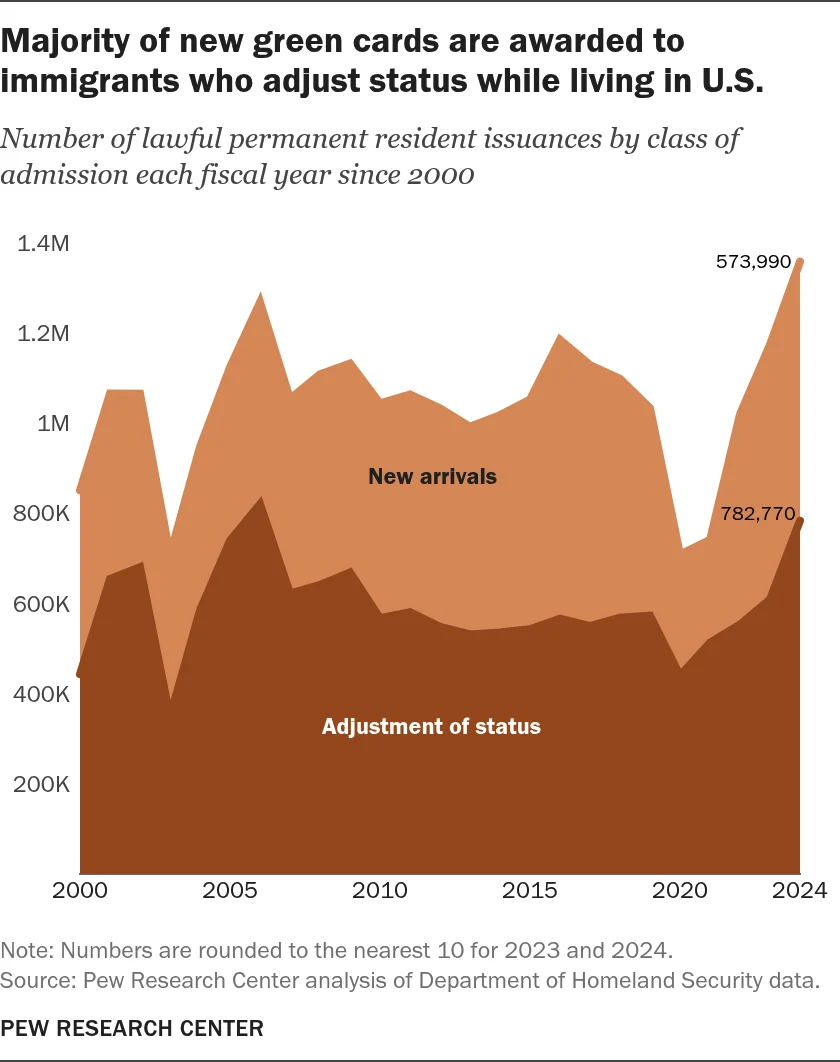
A recent analysis by the Pew Research Center sheds critical light on the potential impact of this new guidance. The research reveals that since the turn of the century, a substantial portion of green cards – approximately half or more – have been granted to individuals already living in the U.S. through the adjustment of status process, rather than to new arrivals applying from abroad.

In fiscal year 2024, the U.S. issued a total of about 1.36 million green cards. The Pew analysis found that a majority, 58%, were awarded to individuals already residing in the country. In contrast, 42% were granted to new immigrant arrivals who applied through U.S. consulates in their home countries. This data underscores the significance of the AOS process as a primary avenue for immigrants to achieve permanent residency. The new guidance, by potentially restricting this pathway, could disrupt the status quo for a large segment of aspiring immigrants.
Data Breakdown: Who Adjusts Status and From Where?
The Pew Research Center’s analysis further dissects the data to identify which immigrant groups are most likely to utilize the adjustment of status pathway. This insight is crucial for understanding the precise demographics that could be most affected by the new policy.
Fiscal Year 2024 Green Card Issuances by Status:
- Total Lawful Permanent Resident (LPR) Issuances: 1,356,760
- Adjustment of Status (AOS) within the U.S.: 782,770 (58%)
- New Arrivals from Abroad: 573,990 (42%)
The data highlights that certain categories of immigrants are disproportionately reliant on the AOS process. For instance, refugees and asylees overwhelmingly adjust their status within the U.S., with over 99% in fiscal year 2024 falling into this category. This is often due to specific legal provisions allowing individuals granted refuge or asylum to apply for permanent residency once they are physically present in the United States.
Employment-based preferences also show a strong reliance on AOS, with 69% of issuances going to individuals adjusting their status within the U.S. This is particularly relevant for highly skilled workers who have secured jobs in the U.S. and are pursuing permanent residency based on their professional qualifications.

Immediate relatives of U.S. citizens also constitute a significant group utilizing AOS, with 60% of issuances in this category occurring within the U.S. This reflects the common scenario where U.S. citizens sponsor their spouses, children, or parents, who may already be in the U.S. on temporary visas.
Conversely, other categories show a much lower rate of adjustment of status, indicating they are more commonly processed abroad. Family-sponsored preferences saw only 6% of issuances through AOS, with the vast majority of new arrivals. Similarly, the diversity visa category had only 3% of issuances through AOS.
Top Countries of Nationality for Adjustment of Status (Fiscal Year 2024):
The analysis also identified key countries from which immigrants are most likely to adjust their status within the U.S. This data reveals consistent patterns over time, suggesting deep-rooted immigration dynamics.
- Cuba: Led in AOS green card approvals with 87% of Cuban immigrants becoming permanent residents this way, totaling over 155,000 individuals. This high percentage is often attributed to specific U.S. policies towards Cuban nationals, including parole programs and the ability for refugees to adjust status.
- Venezuela: Another country with a high AOS rate, with 87% of Venezuelan immigrants adjusting their status. This surge in recent years reflects significant migration flows and specific policy considerations.
- Brazil: Showed a strong AOS rate at 80%, with over 22,000 individuals.
- El Salvador: 71% of Salvadoran immigrants adjusted their status.
- Colombia: 69% of Colombian immigrants adjusted their status.
- Mexico: Contributed a substantial number of AOS applications, with 65% of Mexican immigrants obtaining their green cards through this process. This is partly due to the high number of immediate relatives of U.S. citizens from Mexico.
- China: 66% of Chinese immigrants adjusted their status, largely driven by employment-based applications.
- India: Similar to China, 61% of Indian immigrants utilized AOS, primarily through employment-based pathways.
- Dominican Republic: While a significant source of immigrants, only 25% adjusted their status within the U.S.
- Afghanistan: 31% adjusted their status, reflecting the complex situation for Afghan nationals following recent geopolitical events.
These figures underscore that the impact of the new guidance will not be uniform, with individuals from certain countries and those pursuing specific immigration pathways facing a more significant shift in their application process.

Broader Implications and Future Outlook
The administration’s move to restrict adjustment of status is part of a broader effort to reform and tighten U.S. immigration policies. While the stated goal is to uphold the integrity of the legal immigration system, the practical consequences could be far-reaching.
Potential Economic Impacts:
The delays and potential rejections stemming from the new guidance could affect the U.S. economy. Highly skilled workers, who often contribute significantly to innovation and economic growth, may face prolonged uncertainty, potentially leading them to seek opportunities in other countries. Furthermore, businesses that rely on foreign talent to fill critical labor shortages could experience disruptions.
Humanitarian Concerns:
For families, the requirement to apply from abroad could create immense hardship. Separating family members for extended periods, particularly when children are involved, raises significant humanitarian concerns. The emotional and financial toll on these families could be substantial.
Legal and Policy Challenges:
The increased discretion granted to immigration officers could lead to inconsistencies in decision-making and potential legal challenges. Critics argue that the memo could be interpreted in ways that are overly restrictive, going beyond the intended scope of immigration law. The long-term impact will likely depend on how USCIS officers implement the new guidance and whether any legal challenges are successful.
Temporary Visa Holders Unaffected:
It is important to note that the new guidance specifically targets individuals seeking to adjust their status to lawful permanent residency. Millions of individuals currently residing in the U.S. on various temporary (nonimmigrant) visas, such as international students, temporary workers, and tourists, are not directly affected by this memo. Their status and ability to remain in the U.S. are governed by different regulations.

Public Opinion on Immigration Priorities
Public sentiment regarding immigration priorities, as reflected in a Pew Research Center survey from August 2024, offers context for the ongoing debate. Nearly half of Americans (48%) believe that legal immigration into the U.S. should be maintained at current levels. When asked about which groups should receive top priority for legal immigration, the survey found:
- High-skilled workers (scientists, doctors, nurses, computer programmers) were favored by 42% of Americans.
- People filling labor shortages (agricultural or childcare workers) were prioritized by 25%.
- Individuals with close family members in the U.S. were prioritized by 19%.
- Those from countries not well represented in the U.S. were prioritized by only 5%.
This data suggests a public inclination towards prioritizing skilled labor in legal immigration decisions, which aligns with the administration’s stated focus on closing perceived loopholes and strengthening the economic benefits of immigration. However, it also highlights a significant portion of the public that values family reunification and diversity in immigration.
The Trump administration’s new guidance on adjustment of status marks a significant policy shift with potentially profound implications for immigrants and the U.S. immigration system. The analysis from the Pew Research Center provides crucial data to understand the scope of this change, highlighting the large number of individuals who have historically relied on this pathway and the specific demographics most likely to be impacted. As the guidance is implemented, its effects will be closely watched by immigrant communities, policymakers, and the public alike.