The efficacy of diversity, equity, belonging, and inclusion (DEBI) initiatives within organizations is profoundly shaped by the foundational language and definitions employed, with precise framing acting as a critical determinant of success or stagnation. Industry experts and behavioral scientists increasingly highlight that the way these terms are articulated directly influences perceptions, engagement, and ultimately, the tangible outcomes of DEBI efforts, moving beyond abstract concepts to actionable change.
For decades, organizations globally have invested significant resources into fostering more diverse and inclusive workplaces. Yet, despite these efforts, many initiatives struggle to gain universal buy-on or achieve their intended transformational impact. A primary contributing factor, as observed by practitioners in the field, is the often-unexamined lexicon surrounding DEBI. Words such as "diversity," "equity," and "inclusion" can evoke a spectrum of reactions, ranging from genuine understanding and enthusiasm to disengagement, confusion, or even outright resistance.
The Subtlety of Language: Triggering Unseen Reactions
Imagine the internal monologue of an employee hearing "diversity initiative." Does it spark thoughts of opportunity, innovation, and a richer work environment, or perhaps an immediate mental barrier – "Uhhh! That’s not my issue," or a dismissive "Blah blah blah!" This variation in response underscores the potent psychological impact of language. For some, "diversity" might be perceived as exclusively pertaining to minority groups, leading to the sentiment, "It only applies to people from the minority groups, not me!" Others, particularly those from historically marginalized communities, might react with exasperation, feeling burdened by the expectation to "fix it," framing it as "your problem" (directed at the majority group) or even "your problem" (directed at other minority group members).
These responses are not isolated incidents but reflect common patterns identified over years of dedicated work in the DEBI space. Other frequently encountered sentiments include: "Diversity and inclusion are not my day job, so I don’t really have time for that. Someone else has got to fix it." Or, in talent acquisition, the phrase "Let’s make sure we attract some diversity talent" often translates narrowly to "minority or women." Perhaps most concerning is the zero-sum perception: "If we are going to promote women and minorities, then we have to exclude others" (often implicitly meaning white men). These underlying understandings and perceptions, though often unarticulated, create "hidden trip wires" that impede progress.
Historical Context and Perceptual Pitfalls
The roots of these perceptions can often be traced back to how DEBI efforts have been historically positioned. Early diversity initiatives frequently focused on compliance and representation targets for specific demographic groups, such as women and racial minorities. While well-intentioned, this approach sometimes led to programs designed to "help the minority" or "fix the women," inadvertently fostering an "us and them" dynamic. This narrow focus often neglected the broader imperative of engaging all individuals—majority and minority alike—and overlooked the necessity of redesigning systemic practices and implicit norms that perpetuate inequality.
For example, a 2020 study by McKinsey & Company, "Diversity Wins: How Inclusion Matters," reinforced the business case for diversity, showing that companies in the top quartile for gender diversity on executive teams were 25% more likely to have above-average profitability than companies in the fourth quartile. However, without a universal understanding and engagement strategy, such statistics alone do not translate into widespread behavioral change. Many organizations continue to grapple with making DEBI an intrinsic part of their operational fabric rather than a standalone, often siloed, initiative.
This historical framing, often centered on "fixing the difference" or promoting assimilation, has frequently worked against the core intentions of achieving true diversity and inclusion. By creating divisions and reinforcing existing biases, it inadvertently excludes large segments of the workforce and limits the potential benefits that genuine DEBI can unlock. The challenge is that professionals and advocates, often with the best intentions, articulate DEBI terms in abstract ways that lack common grounding or fail to inspire collective action, leading to a persistent "stuck pattern" in achieving desired outcomes.
The Scientific Power of Words: Shaping Reality and Behavior
The notion that mere "words" and "definitions" could act as significant impediments to fundamental change might seem counterintuitive. Yet, scientific research consistently demonstrates the profound influence of language on human perception, cognition, and behavior. Language is not merely a tool for communication; it is a fundamental architect of our realities, shaping cultures and individual mindsets.
The "priming effect," a well-documented phenomenon in cognitive psychology, illustrates how exposure to certain words or images can unconsciously influence subsequent thoughts and behaviors. A classic study, for instance, showed that individuals primed with words associated with the elderly (e.g., "wrinkle," "forgetful") subsequently walked slower than those exposed to neutral words. This suggests that even subtle linguistic cues can subtly direct behavior.
Moreover, words possess the power to reinforce stereotypes, even when deployed in an attempt to dismantle them. Research on gender stereotypes in mathematics education, for example, found that statements like "girls are as good as boys at math" paradoxically backfired. By explicitly drawing a comparison, such phrases inadvertently heightened the false belief that boys are inherently superior in math, thereby reinforcing the very stereotype they aimed to counteract. This highlights the critical need for precise, non-comparative, and empowering language in DEBI discourse.
Emotional Triggers: Loss Aversion, Tribalism, and Shame
Beyond shaping perception, words also trigger powerful emotions, which are primary drivers of unconscious thinking, decision-making, and behavior. In the context of DEBI, certain linguistic framings can activate significant emotional barriers.
One such barrier is loss aversion. If diversity is perceived as a zero-sum game—where one group’s gain necessitates another’s loss—then calls for equity can be interpreted as demands to relinquish power or privilege. This perception triggers the loss-aversion bias, a well-established psychological phenomenon where individuals are more motivated to avoid a loss than to acquire an equivalent gain. Consequently, individuals may unconsciously resist change and actively strive to maintain the status quo, perceiving DEBI as a threat rather than an opportunity. Data from the World Economic Forum’s Global Gender Gap Report often highlights the slow pace of progress in closing economic and political gaps, partly due to entrenched power structures and the perception of loss by dominant groups.
Another potent emotional trigger is tribalism, rooted in our innate fear of the "unknown" and our instinctive preference for "in-group" members. When DEBI language inadvertently creates or reinforces distinctions between "us" and "them" (e.g., "minority vs. majority," "diverse talent vs. regular talent"), it can activate an unconscious, irrational fear of "out-groups." This primal reaction can lead to unintentional exclusion of knowledge and information shared by "out-group" members, while simultaneously fostering greater trust and acceptance of input from "in-group" peers. This tribal mentality severely hampers collaboration, innovation, and the realization of diverse perspectives.
Finally, the pervasive and often unspoken emotional impact of shame can create a significant impediment to DEBI change. For some individuals, DEBI language can evoke feelings of shame, stemming from past accusations of unintentional discrimination or from a sense of guilt over unearned privilege in the face of inequality. This shame can manifest as unconscious micro-aggressions or passive resistance, even when individuals consciously desire to be allies. The paradox is that the very language intended to foster awareness and accountability can, if not carefully framed, inadvertently alienate those whose engagement is crucial for progress.
The Absurdity of Unarticulated Definitions
Given these powerful psychological and emotional responses, it becomes an "absurd reality" to expect aligned actions when the fundamental definitions of diversity, equity, belonging, and inclusion are rarely formally articulated within organizations. When individuals are left to interpret these terms based on their own lived experiences, social constructs, and varying knowledge, a wide divergence in mindsets emerges.
For one employee, "diversity" might exclusively mean "women." For another, "inclusion" might be limited to participation in "diversity networks." And "equity" might be narrowly construed as merely having "minority hiring targets." While these interpretations may contain elements of truth, they fall far short of the comprehensive scope required for meaningful change. The absence of a common framework of understanding creates misalignment in actions, leading to stalled progress and fragmented efforts.
The Inclusion Nudges Approach: Guiding Stars for Shared Understanding
Recognizing this critical gap, the founders of the Inclusion Nudges global initiative, Lisa and Tinna, advocate for clear, actionable definitions that serve as "guiding stars" for organizational transformation. Their approach is not merely about semantic correctness but about consciously shaping perceptions to reveal barriers and engage all people in making inclusion the norm.
The Inclusion Nudges framework provides specific definitions designed to be broadly inclusive and action-oriented:
-
Diversity: The Mix of All of Us. This definition broadens diversity beyond specific demographics to encompass all people, their demographic differences, backgrounds, multiple identities, unique experiences, perspectives, knowledge, abilities, and ideas. It explicitly refutes the notion that diversity refers only to "the minority," thereby engaging everyone in its scope.
-
Equity: The Fairness Frame for the Mix. Equity is defined as ensuring that all people have equal access to opportunities and fair treatment. Crucially, it involves the active elimination of discriminatory practices, systems, laws, policies, social norms, and cultural traditions. It emphasizes balancing power, correcting existing inequalities, and addressing patterns of behavior that perpetuate unfairness. The intent is clear: fairness to all.
-
Belonging: I Feel Valued as a Part of the Mix. Belonging focuses on the individual’s experience within a setting. It means being welcomed, having structures that ensure fairness, and feeling able to be one’s full, authentic self without having to "cover" or downplay personal traits. Belonging results when people feel seen, heard, safe, and valued, and is the natural outcome of well-executed diversity, equity, and inclusion practices.
-
Inclusion: Welcoming and Applying the Mix. Inclusion is defined by fostering the structures, systems, processes, culture, behaviors, and mindsets that embrace and respect all people and all their diversity. It is about actively seeking out diverse knowledge, perspectives, and ideas, challenging excluding norms and stereotypes, being open to others, and speaking up. Inclusion ensures that all people are valued, able to participate fully, and contribute to their utmost potential.
These definitions serve as a blueprint for designing actions, behaviors, systems, and cultures that embody true inclusivity. However, merely articulating and communicating these definitions is insufficient. Rational understanding, which resides in the conscious "System 2" mind, does not automatically translate into inclusive behavior. Behavior is often driven by unconscious biases and heuristics (System 1). Therefore, the challenge lies in bridging the gap between cognitive understanding and ingrained behavioral patterns.
Inclusive Definitions Through Inclusive Actions
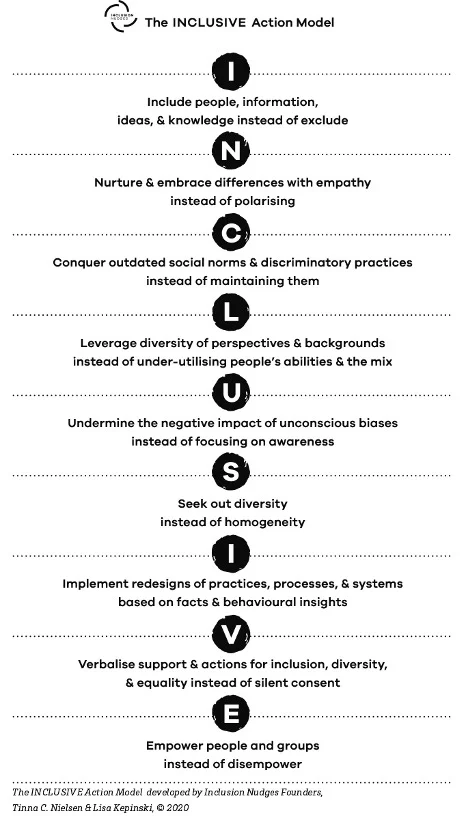
The most effective strategy, according to the Inclusion Nudges methodology, is to move beyond simply defining words and instead engage "the people it’s about" in defining DEBI through actions. This participatory approach is vital for alignment, engagement, and sustainable progress. Rather than focusing on abstract terms, organizations should involve employees in identifying specific, observable actions and behaviors that they perceive as inclusive, inviting, respectful, empathetic, and that make them feel included, belonging, valued, growing, and empowered.
The outcomes of this approach are multifaceted. Firstly, it generates definitions that are contextually relevant and resonate with the lived experiences of the workforce. Secondly, by involving employees in the development process, it fosters immediate ownership and onboard employees into the change initiative. This inclusive process itself leverages the diversity within the group, making the journey as inclusive as the desired destination.
Once these examples of inclusive behavior are gathered, the next crucial step is to make them highly visible and accessible. Instead of burying them in spreadsheets or lengthy policy documents, these diverse, real-life practical examples and personal stories should be showcased prominently in communication materials, on factory floors, in offices, meeting rooms, and digital platforms. The key is to illustrate how inclusion plays out in myriad ways, without necessarily using the word "inclusion" itself. For instance, internal communications can highlight one concrete example at a time, emphasizing that "your peers and similar others are doing this." If data indicates a majority of people are engaged in a specific inclusive action, communicating that "8 out of 10 of your colleagues are doing X" leverages social proof to normalize desired behaviors.
Achieving Inclusion Without the Buzzwords: The Future of DEBI
The ultimate goal is to achieve inclusion without constantly talking about "inclusion" as a separate initiative. Over time, a shared understanding of diversity, equity, belonging, and inclusion will organically take shape. While formal definitions may be necessary for strategic documents, KPIs, or external communications, the focus internally should shift from buzzwords to integrated practices.
The Inclusion Nudges approach advocates for reframing DEBI concepts by focusing on desired outcomes and integrating them into the everyday fabric of work. Instead of saying "inclusion," one might say "it’s how work gets done here" or "it’s how people experience being in the group." Challenging oneself to articulate the desired outcomes without using the DEBI lexicon can be powerful. For example, rather than "we need diversity," state "we need the thinking from everyone for new solutions." Instead of "we need equity," say "we need our systems designed to enable our most objective decision-making."
This shift in perception, focusing on resource-oriented and positively associated outcomes, is crucial for fostering inclusive behaviors and cultures that become the norm rather than a "stand-alone initiative." It transforms DEBI from a peripheral concern to an intrinsic aspect of organizational excellence, driving innovation, performance, and employee well-being.
The challenge of translating definitions into reality—of moving thousands of individuals with diverse understandings and reactions in the same inclusive direction—is significant. This is precisely why approaches like Inclusion Nudges, grounded in behavioral science, are vital. They provide practical frameworks and tools to embed inclusive actions and mindsets across organizations and communities.
By adopting a nuanced, action-oriented, and psychologically informed approach to framing diversity, equity, belonging, and inclusion, organizations can move beyond the "Uhhh!" and "Blah blah blah!" reactions. They can instead cultivate environments where every individual feels valued, heard, and empowered to contribute, ultimately making inclusion the universal norm—everywhere, for everyone.