Washington D.C. – June 10, 2026 – Pew Research Center today released its ninth iteration of the Political Typology, a comprehensive study that delves beyond the traditional partisan divide to categorize the American electorate into nine distinct groups. This ambitious project, utilizing data from an extensive survey of 30 questions probing political values and beliefs, aims to provide a nuanced and granular understanding of the American political landscape, moving beyond simplistic "red versus blue" distinctions that often obscure the complexities of public opinion.
The latest typology report, titled "Beyond Red vs. Blue: The Political Typology," builds upon a long-standing tradition at Pew Research Center of dissecting the American public’s ideological and value-based alignments. This version, meticulously compiled and analyzed, seeks to offer a more sophisticated lens through which to view the diverse sentiments and priorities that shape political discourse and behavior in the United States. By focusing on a broad spectrum of values, from economic philosophies to social issues and trust in institutions, the typology aims to reveal how Americans coalesce into distinct, often unexpected, political communities.
The Genesis of a Deeper Understanding
The Political Typology project was initially conceived to address a growing recognition within political science and public opinion research that party affiliation alone was an insufficient metric for understanding the American voter. As political polarization intensified in recent decades, it became increasingly apparent that many Americans held views that did not neatly align with their declared party. The typology was designed as a corrective, employing statistical methods to identify clusters of individuals who shared similar patterns of attitudes and beliefs, irrespective of their stated party loyalty.
The first typology was released in 1994, providing an early framework for understanding the American political mind. Subsequent versions, released periodically, have tracked the evolution of these groups and the emergence of new political dynamics. This ninth edition represents a significant update, reflecting the contemporary political climate and the shifting sands of American public opinion. The 30 questions employed in the survey are carefully crafted to elicit responses on a range of issues, from views on government’s role in the economy, to social justice, environmental policy, immigration, and foreign policy. The analysis then uses these responses to statistically group individuals into nine distinct typological categories.
Methodology: Unpacking the Data
The foundation of the Political Typology lies in rigorous survey research. Pew Research Center’s survey methodology is designed to be representative of the U.S. adult population. For this 2026 report, a statistically significant sample of American adults was interviewed, employing a mixed-mode approach to ensure broad reach and minimize sampling bias. The 30 questions included in the survey were specifically chosen to cover a wide array of political values and beliefs, seeking to capture the multidimensionality of individuals’ perspectives.
The analytical process involves sophisticated statistical techniques, primarily cluster analysis, to identify patterns in the survey responses. This method groups individuals based on the similarity of their answers across the 30 questions. The output is a classification of the U.S. adult population into nine distinct groups, each characterized by a unique profile of political values and beliefs. These groups are not static; they evolve over time as public opinion shifts and as new political issues gain prominence. The typology is thus a dynamic snapshot, offering insights into the evolving American political psyche.
The Nine Typological Groups: A Spectrum of Beliefs
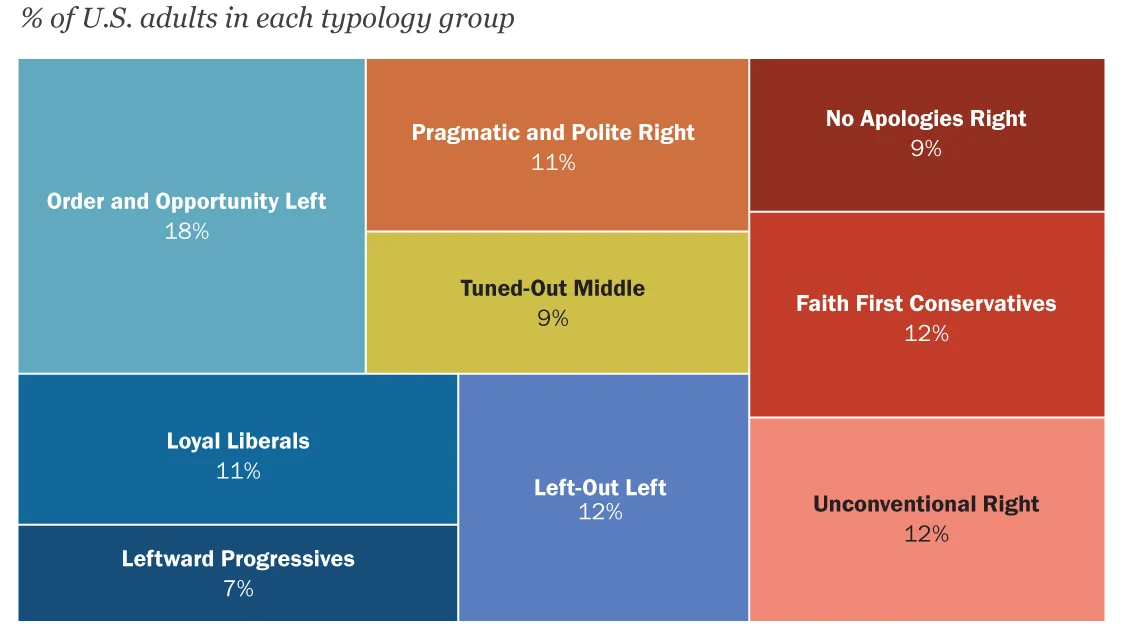
While the specific names and precise compositions of the nine groups are detailed within the full Pew Research Center report, a general understanding of their nature is crucial. The typology aims to move beyond the binary of liberal/conservative or Democrat/Republican, instead identifying groups that may span across traditional party lines or exist within them with varying degrees of ideological commitment.
These groups can be broadly understood as occupying different points on a spectrum of political and cultural values. Some groups might be characterized by strong ideological convictions, while others might be more pragmatic or issue-specific in their political outlook. The typology also considers factors such as levels of political engagement, trust in institutions, and social attitudes. For instance, one group might be defined by its deep commitment to free-market principles and limited government, while another might prioritize social equality and government intervention to address societal problems. Still others might be distinguished by their skepticism of established political structures or their focus on specific cultural issues.
The names assigned to these groups are descriptive, aiming to encapsulate the core characteristics of each cluster. These names are derived from the analysis of the survey data and are intended to provide an intuitive understanding of the group’s identity. For example, names might reflect a group’s demographic makeup, its dominant values, or its characteristic political behaviors.
Key Findings and Implications
The release of this ninth Political Typology report is expected to provide valuable insights into the current state of American politics. By moving beyond simple partisan labels, the study offers a more granular and accurate portrayal of the electorate. This nuanced understanding has significant implications for:
- Political Campaigns and Strategy: Understanding the specific values and concerns of each typological group allows political campaigns to tailor their messaging and outreach efforts more effectively. Instead of broad appeals to generic "voters," campaigns can target specific groups with messages that resonate with their particular concerns.
- Policy Development: Policymakers can gain a deeper appreciation for the diverse perspectives that shape public opinion on key issues. This can inform the development of more inclusive and effective policies that address the needs and priorities of various segments of the population.
- Media and Public Discourse: Journalists and commentators can use the typology to provide more sophisticated analysis of political trends and public sentiment. This can help to elevate public discourse beyond partisan talking points and foster a more informed citizenry.
- Academic Research: The typology serves as a foundational tool for political scientists, sociologists, and other researchers seeking to understand the dynamics of American democracy, political behavior, and social change.
Supporting Data and Context
The value of the Political Typology is enhanced by its contextualization within broader trends in American public opinion. For example, previous typologies have highlighted the increasing ideological sorting of the electorate, where Democrats have become more consistently liberal and Republicans more consistently conservative. This current report will likely offer updated data on these trends, as well as explore emerging divisions.
The report is also likely to provide demographic breakdowns for each typological group, illustrating how factors such as age, race, ethnicity, education, income, and geographic location correlate with specific value systems. This granular data can reveal how different demographic segments of the population are represented across the various political groups, offering a more complete picture of societal divisions and commonalities.
Furthermore, the report will likely draw connections between the typology and key political events and policy debates of recent years. By examining how different groups responded to major issues such as economic crises, social movements, and elections, the typology can illuminate the underlying value systems that drive public reactions and political engagement.
Looking Ahead: The Evolving American Electorate
The Political Typology is not a static classification but a reflection of an ever-evolving electorate. The emergence of new social and technological forces, coupled with demographic shifts, continually reshapes the American political landscape. This ninth iteration serves as a vital benchmark, providing a detailed map of the current terrain and offering crucial insights for understanding the future trajectory of American politics.
Pew Research Center’s commitment to this long-standing project underscores its dedication to providing the public and policymakers with data-driven, objective analysis of the forces shaping American democracy. The "Beyond Red vs. Blue" typology promises to be an indispensable resource for anyone seeking to comprehend the complexities of the American political mind in 2026 and beyond. The detailed findings of the report are available on the Pew Research Center website, offering a deep dive into the nine distinct groups that comprise the American electorate.