A comprehensive survey conducted by the Pew Research Center between March 24-30, 2025, reveals a complex and often divided landscape of American moral perspectives on a range of contemporary issues. The findings underscore significant variations in opinion based on religious affiliation, political affiliation, gender, and age, painting a nuanced picture of the nation’s evolving ethical compass. The data offers a valuable snapshot into what the American public considers morally acceptable, morally wrong, or not a moral issue, providing crucial insights for policymakers, social commentators, and citizens alike.
Declining Moral Condemnation for Personal Choices
One of the most striking trends emerging from the survey is a marked decrease in the percentage of Americans who deem certain personal choices as "morally wrong." This shift is particularly evident in areas such as extramarital affairs, gambling, and the use of marijuana.
Views on Married People Having an Affair:
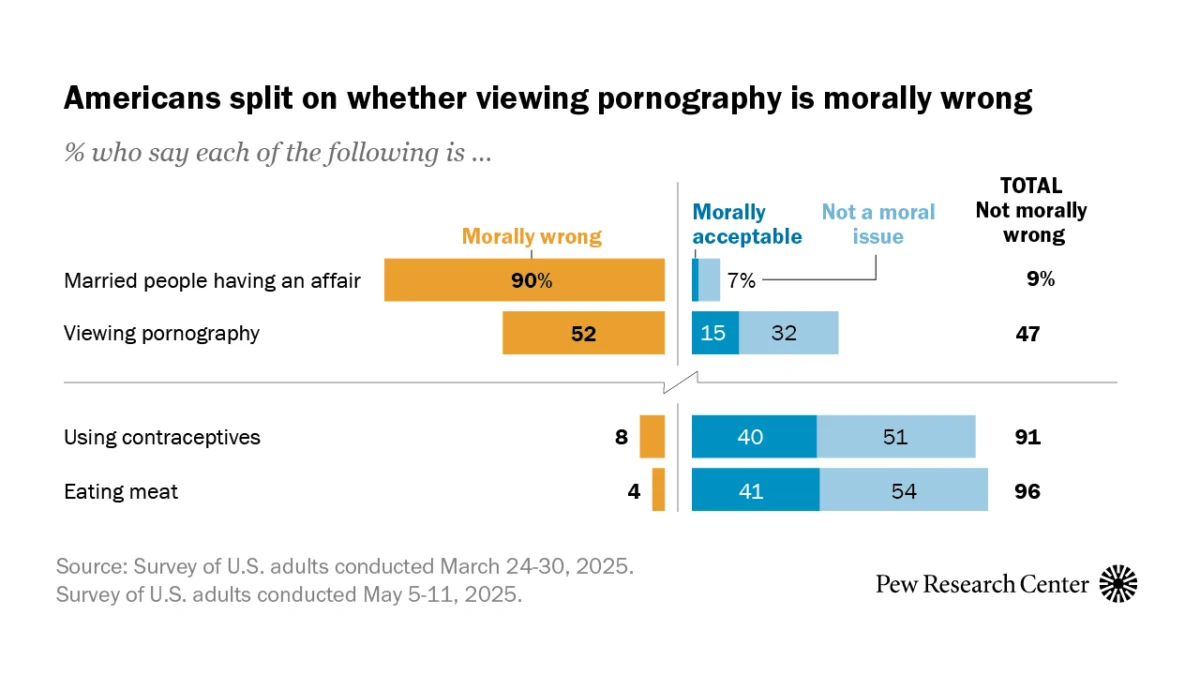
The survey found an overwhelming consensus that married people having an affair is morally wrong, with 90% of all U.S. adults holding this view. However, even within this strong majority, subtle variations exist. Christians, at 92%, were slightly more likely to condemn infidelity than the religiously unaffiliated at 87%. Within the Christian demographic, White evangelical Protestants (94%) and White non-evangelical Protestants (95%) expressed the strongest disapproval. Notably, atheists were marginally less likely to view infidelity as morally wrong, with 84% holding this view, compared to 91% of agnostics. Political affiliation also showed a divide, with Republicans/lean Republicans (93%) more likely to condemn affairs than Democrats/lean Democrats (88%).
Morality of Gambling:
When it comes to gambling, the moral landscape shifts. A majority of Americans (70%) do not consider it morally wrong, with 50% viewing it as "not a moral issue" and 20% deeming it "morally acceptable." However, 29% still believe gambling is morally wrong. Religious affiliation plays a significant role here. While Christians generally view it as morally wrong more often (33%) than the religiously unaffiliated (19%), specific subgroups within Christianity show divergence. White evangelical Protestants were the most likely to consider gambling morally wrong (40%), while White Catholics (15%) and White non-evangelical Protestants (20%) were far less inclined to do so. The religiously unaffiliated, particularly atheists (10%) and agnostics (17%), showed the lowest rates of moral condemnation.
Using Marijuana:
The perception of marijuana use has undergone a significant transformation. A substantial 76% of U.S. adults do not consider using marijuana morally wrong, with 52% classifying it as "not a moral issue" and 24% finding it "morally acceptable." Only 23% believe it is morally wrong. The religiously unaffiliated (88%) and atheists (98%) overwhelmingly view marijuana use as not a moral issue or morally acceptable, reflecting broader societal trends toward decriminalization and legalization. Christians, while still more likely to find it morally wrong (27%) than the unaffiliated, still represent a majority (72%) who do not consider it morally wrong. White evangelical Protestants remain the most likely to view marijuana use as morally wrong (33%).
Divisive Ethical Terrain: Abortion, Death Penalty, and Euthanasia
While many personal choices are seeing reduced moral condemnation, other issues remain deeply divisive, reflecting fundamental disagreements on life, liberty, and individual autonomy.
Views on Having an Abortion:
The morality of abortion continues to be a highly contentious issue, with public opinion deeply split. Overall, 47% of U.S. adults consider having an abortion morally wrong, while 21% find it morally acceptable and 31% view it as not a moral issue. Religious affiliation is a primary driver of these views. White evangelical Protestants overwhelmingly consider abortion morally wrong (78%), a stark contrast to Jewish individuals (21% morally wrong) and the religiously unaffiliated (23% morally wrong). Democrats/lean Democrats are significantly more likely to view abortion as morally acceptable or not a moral issue (75% combined) than Republicans/lean Republicans (29% combined).
The Death Penalty:
Public opinion on the death penalty is also divided. A plurality of Americans (38%) find the death penalty morally acceptable, while 34% consider it morally wrong, and 26% see it as not a moral issue. Religious and political affiliations are strong indicators of differing perspectives. White evangelical Protestants are the most likely to find the death penalty morally acceptable (56%), aligning with Republican/lean Republican voters (53% morally acceptable). Conversely, Democrats/lean Democrats are twice as likely to view it as morally wrong (48%) as morally acceptable (26%). Jewish individuals (42% morally wrong) and Black Protestants (46% morally wrong) also show higher rates of moral condemnation.
Patient-Assisted End-of-Life Decisions:
The morality of patients choosing to end their lives with the help of a doctor, often referred to as medical aid in dying or physician-assisted suicide, elicits a more divided response. 35% of Americans consider it morally wrong, 34% deem it morally acceptable, and 29% view it as not a moral issue. The religiously unaffiliated are significantly more likely to find it morally acceptable (51%) than Christians (27%). Atheists (66%) and agnostics (63%) lead this group in viewing it as morally acceptable. White evangelical Protestants stand out as the most likely to consider it morally wrong (60%). Political affiliation also shows a clear divergence, with Democrats/lean Democrats more likely to find it morally acceptable (43%) compared to Republicans/lean Republicans (27%).
Societal Norms and Evolving Morality
The survey also probes attitudes towards issues that have seen significant societal evolution and debate, including views on homosexuality, divorce, and the use of reproductive technologies.
Views on Homosexuality:
While significant progress has been made in LGBTQ+ rights and acceptance, the survey indicates that moral judgments still persist, albeit with decreasing intensity compared to past decades. Overall, 39% of U.S. adults still consider homosexuality morally wrong, while 23% find it morally acceptable and 37% view it as not a moral issue. Religious affiliation remains the strongest predictor of views on homosexuality. White evangelical Protestants overwhelmingly consider it morally wrong (72%), a sentiment shared by a majority of Black Protestants (55%). In contrast, the religiously unaffiliated (13% morally wrong) and atheists (3% morally wrong) show much higher levels of acceptance. Younger adults (18-29) are also more inclined to view homosexuality as morally acceptable or not a moral issue (70% combined) compared to older adults (65+ at 53% combined).
Getting a Divorce:
The moral stigma surrounding divorce has diminished considerably. While 23% of U.S. adults still consider getting a divorce morally wrong, a substantial 31% find it morally acceptable, and 45% view it as not a moral issue. Religious affiliation plays a role, with White evangelical Protestants (44% morally wrong) being the most likely to condemn divorce, while Jewish individuals (3% morally wrong) and the religiously unaffiliated (11% morally wrong) show much higher acceptance. Democrats/lean Democrats (87% not morally wrong) are more likely to view divorce as acceptable or not a moral issue compared to Republicans/lean Republicans (65% not morally wrong).
Using IVF to Get Pregnant:
Assisted reproductive technologies like In Vitro Fertilization (IVF) are viewed with less moral concern by a majority of Americans. Only 9% consider IVF morally wrong, while 42% find it morally acceptable and 47% view it as not a moral issue. Religious affiliation shows some variation, with Catholics (15% morally wrong) and Hispanic Catholics (20% morally wrong) expressing higher rates of disapproval compared to Protestants (9% morally wrong) and the religiously unaffiliated (4% morally wrong). The religiously unaffiliated, particularly atheists (2% morally wrong) and agnostics (3% morally wrong), are the most likely to view IVF as morally acceptable or not a moral issue.
Social and Demographic Influences on Morality
The Pew Research Center’s data consistently highlights how demographic factors shape moral viewpoints.
The Role of Religion:
Religious affiliation remains a powerful predictor of moral judgments across a wide array of issues. While certain conservative religious groups, particularly White evangelical Protestants, tend to hold more traditional views and condemn a broader range of behaviors, less religiously affiliated individuals and those in more liberal religious traditions often exhibit more permissive moral stances. This is evident in views on abortion, homosexuality, and even personal choices like extramarital affairs. The data suggests a continuing trend of secularization influencing moral outlooks, with the religiously unaffiliated increasingly forming a significant bloc with distinct moral perspectives.
Political Polarization:
Political affiliation, especially the divide between Republicans and Democrats, is another major factor shaping moral attitudes. Republicans/lean Republicans tend to hold more conservative views on issues such as abortion, the death penalty, and extramarital affairs, often aligning with traditional religious doctrines. Democrats/lean Democrats, on the other hand, demonstrate more liberal perspectives on issues like abortion, homosexuality, and patient-assisted end-of-life decisions, often prioritizing individual autonomy and social justice. This polarization suggests that moral debates are increasingly intertwined with broader political ideologies.
Generational and Gender Differences:
Age and gender also play a role, though often less pronounced than religion or politics. Younger adults (18-29) generally exhibit more liberal moral viewpoints on issues like homosexuality and assisted suicide, reflecting evolving societal norms. Women are sometimes more likely than men to view certain actions as morally wrong, particularly in areas relating to interpersonal conduct, while men may hold slightly different views on issues like gambling or the death penalty. However, these differences are not uniform across all moral questions and can be influenced by intersecting factors like education and religious upbringing.
Broader Implications and Future Trends
The findings from the Pew Research Center’s 2025 survey offer critical insights into the shifting moral landscape of the United States. The data suggests a continued trend towards greater acceptance of personal choices, particularly those that were once considered taboo or morally reprehensible. This is likely driven by a combination of factors, including increased secularization, a more diverse society, and evolving cultural norms.
However, the persistent divisiveness on issues such as abortion, the death penalty, and end-of-life care underscores the deep ideological and value-based rifts within American society. These disagreements are not merely abstract ethical debates; they have profound implications for public policy, legal frameworks, and the very fabric of social cohesion.
The survey also highlights the growing influence of the religiously unaffiliated population, a demographic that increasingly holds views that diverge from traditional religious teachings. As this group continues to grow, their perspectives are likely to play an even more significant role in shaping national moral discourse.
In conclusion, the 2025 Pew Research Center survey provides a vital barometer of American morality. It reveals a nation grappling with complex ethical questions, where personal freedoms are increasingly valued, yet deeply held moral convictions continue to shape fundamental disagreements. Understanding these nuanced views is essential for navigating the challenges and opportunities of an ever-changing social and ethical environment.