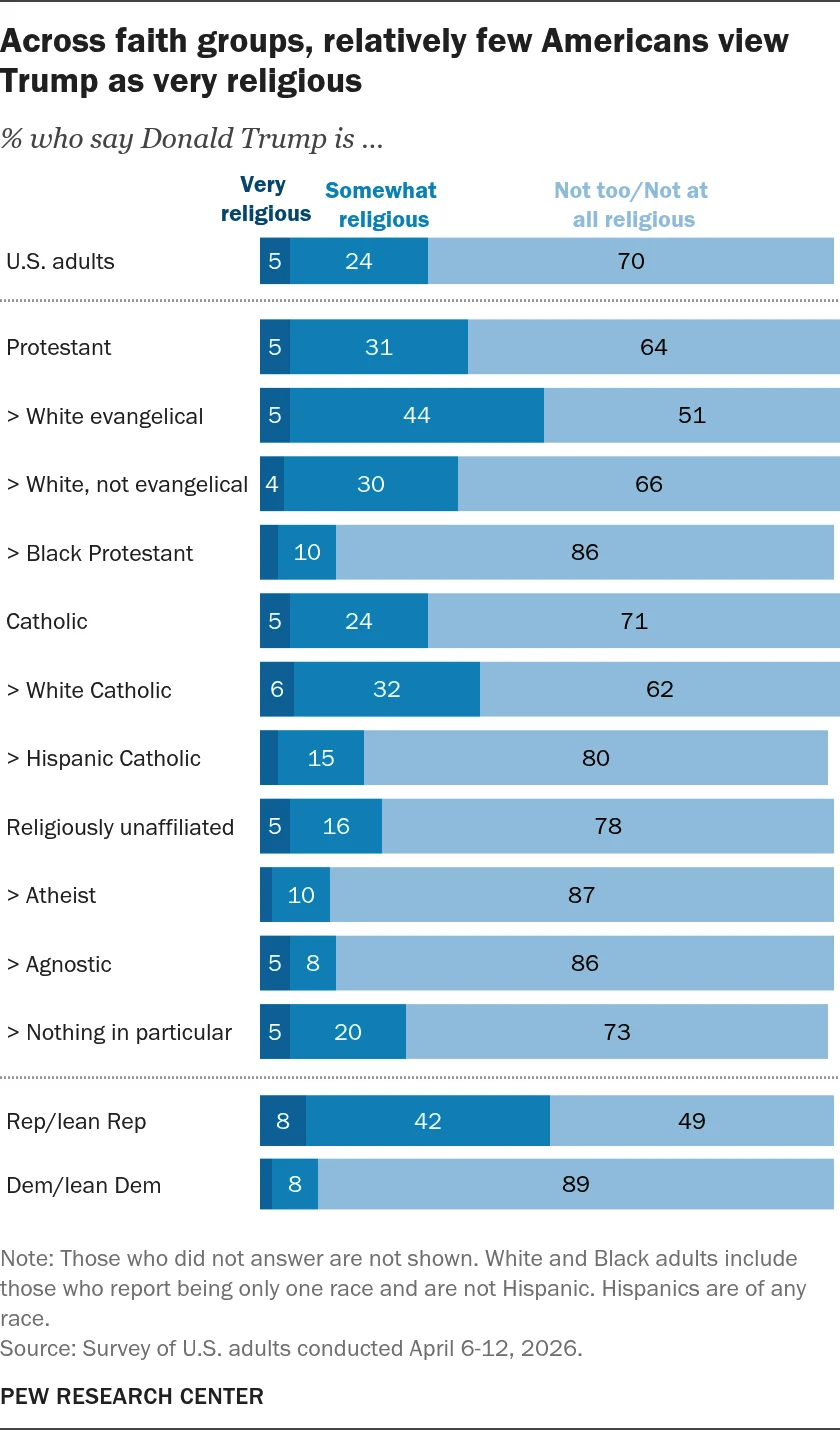
Seven-in-ten Americans now say President Donald Trump is not too or not at all religious, according to a comprehensive new survey by the Pew Research Center. This figure represents a notable increase of 8 percentage points since the question was last posed in the fall of 2024, indicating a shifting public perception of the former president’s religiosity. The survey, conducted between April 6-12, 2026, offers a granular look at these perceptions across various demographic and religious groups, revealing significant partisan divides and highlighting subtle but important trends within specific faith communities.
The data indicates that while a substantial majority of U.S. adults hold this view, the breakdown is starkly divided along political lines. A commanding 89% of Democrats and Democratic-leaning independents believe Trump is not too or not at all religious. Conversely, this sentiment is shared by 49% of Republicans and Republican leaners, a significant minority within the president’s own party, suggesting that even among his staunchest supporters, his personal religious devotion is not universally perceived.
Shifting Perceptions of Religiosity
The trend of Americans viewing Trump as less religious has been a gradual one. The Pew Research Center’s polling data reveals a consistent upward trajectory in the percentage of adults who describe him as "not too or not at all religious." In February 2020, this figure stood at 63%. By March 2021, it had risen to 67%. In February 2024, 68% held this opinion, and by October 2024, it had reached 62% before climbing to the current 70% in April 2026.
Conversely, the proportion of Americans who view Trump as "very religious" has remained consistently low. In the latest survey, only 5% of U.S. adults hold this opinion, a slight decrease from 6% in October 2024 and 4% in February 2024. Those who describe him as "somewhat religious" constitute 24% of the adult population, a dip from 31% in October 2024 and 25% in February 2024.
Partisan Divides on Religious Identity
The survey’s findings underscore the deep partisan chasm in how Americans perceive political figures’ religious standing. While Democrats overwhelmingly categorize Trump as not religious, Republicans, though less uniformly, still show a greater inclination to view him as at least somewhat religious. This is particularly evident in the responses regarding "somewhat religious," where 42% of Republicans and Republican leaners agree, compared to a mere 8% of Democrats and Democratic leaners.
This disparity can be partly attributed to differing interpretations of religious expression in public life. For many Republicans, a perceived alignment with certain religious values or a willingness to engage with religious leaders and communities may be interpreted as a sign of religiosity, regardless of personal practices. Democrats, on the other hand, may place a higher emphasis on demonstrated personal faith and adherence to religious tenets.
Perceptions Across Religious Groups
The survey also provides a detailed breakdown of perceptions across various religious affiliations. Across most major religious groups, a significant majority express the view that Trump is not too or not at all religious.
-
Protestants: While 64% of all Protestants hold this view, the internal divisions within Protestantism are notable.
- White evangelical Protestants: This group, a key constituency for the former president, shows a more nuanced perspective. 51% say Trump is not too or not at all religious, while 44% consider him "somewhat religious." Critically, only 5% of this group describe him as "very religious."
- White, non-evangelical Protestants: A larger majority, 66%, view him as not too or not at all religious, with 30% seeing him as somewhat religious.
- Black Protestants: This group expresses the strongest perception of Trump’s lack of religiosity, with 86% stating he is not too or not at all religious, and only 3% viewing him as very religious.
-
Catholics: 71% of Catholics believe Trump is not too or not at all religious.

- White Catholics: A greater proportion, 62%, hold this view, with 32% considering him somewhat religious.
- Hispanic Catholics: This group shows a significant shift, with 80% now saying Trump is not too or not at all religious, an increase from 60% in the previous survey. Only 15% view him as somewhat religious.
-
Religiously Unaffiliated: This segment of the population overwhelmingly views Trump as not religious. 78% of the religiously unaffiliated hold this opinion, with atheists (87%) and agnostics (86%) showing the highest percentages.
Trump’s Role in Defending Religious Beliefs
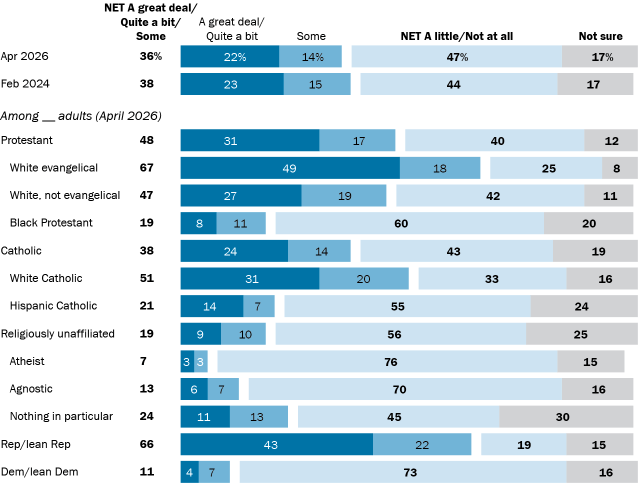
Beyond perceptions of his personal religiosity, the survey also probed how Americans view Trump’s commitment to defending religious beliefs. Approximately 22% of U.S. adults believe Trump stands up "a great deal" or "quite a bit" for people with religious beliefs similar to their own. Another 14% feel he stands up "some."
However, a substantial 47% of Americans believe Trump stands up "a little" or "not at all" for people with their religious beliefs, while 17% remain unsure.
Again, partisan lines are sharply drawn. A significant majority of Republicans (66%) believe Trump stands up at least "some" for their religious beliefs, with 43% indicating he stands up "a great deal" or "quite a bit." In stark contrast, 73% of Democrats believe he stands up "a little" or "not at all" for their religious beliefs.
White evangelical Protestants, a core demographic for Trump, overwhelmingly feel he champions their religious interests. Two-thirds (67%) of White evangelicals report that Trump stands up at least "some" for their religious beliefs, with 49% stating he does so "a great deal" or "quite a bit." This aligns with their general perception of his religiosity, where a notable portion sees him as somewhat religious.

Conversely, groups that traditionally lean Democratic, such as atheists (76%), agnostics (70%), and Black Protestants (60%), largely feel that Trump does not adequately represent or defend their religious beliefs.
Notable Shifts Among Hispanic Catholics
The survey highlights a particularly significant shift in the views of Hispanic Catholics regarding Trump’s defense of religious beliefs. In April 2026, 55% of Hispanic Catholics stated that Trump stands up "a little" or "not at all" for people with their religious beliefs. This represents a substantial increase from 40% in February 2024. This trend suggests a growing disconnect between this demographic and the former president’s perceived advocacy for their faith.
Broader Context and Implications
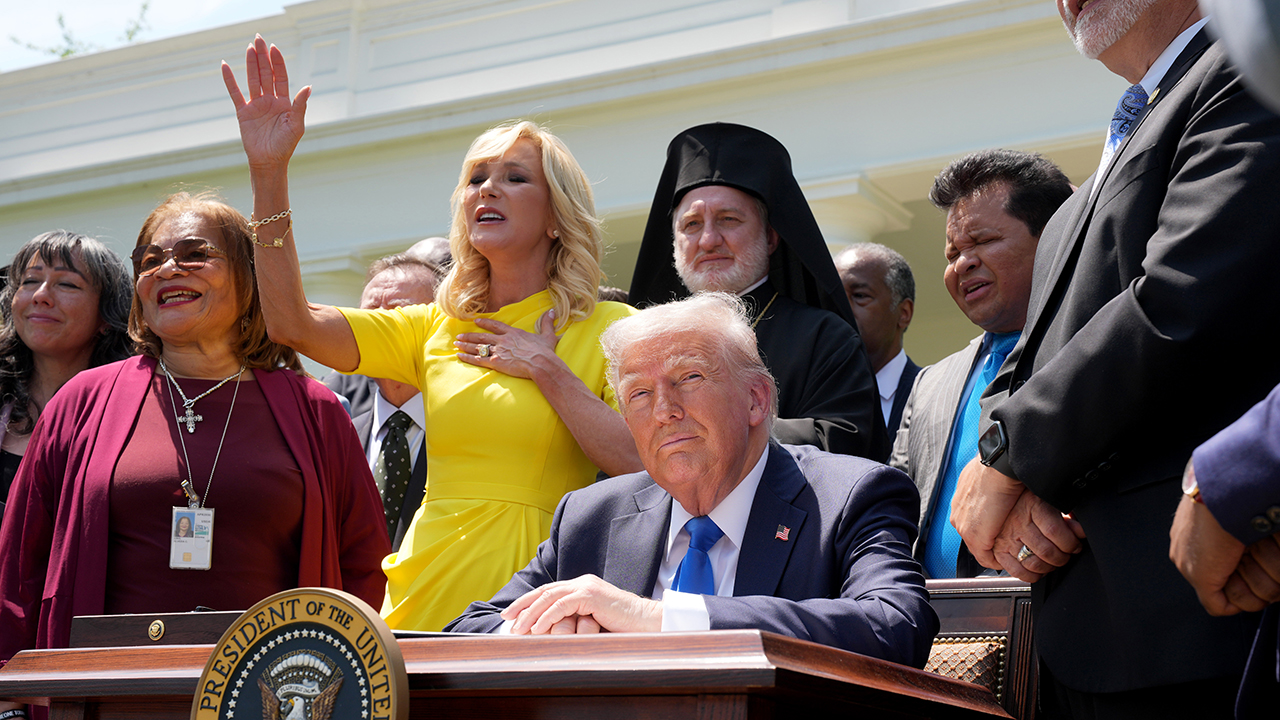
The Pew Research Center’s findings emerge in a complex political and religious landscape. President Trump has historically courted evangelical and other religious voters, often framing himself as a defender of traditional values and religious freedom. His administration took several steps aimed at appealing to religious conservatives, including appointing conservative judges, advocating for religious exemptions in healthcare, and speaking at religious events.
However, these survey results suggest that the effectiveness of these appeals, in terms of public perception of his personal religiosity, may be waning or, at best, highly polarized. The slight uptick in the perception of him being "not too or not at all religious" indicates a segment of the population, including some within his base, may be questioning the depth of his personal faith.
The timing of the survey, conducted just prior to reports of Trump criticizing Pope Leo XIV and posting a Jesus-like image on social media (which he later deleted and explained as intending to depict himself as a healer), adds an interesting layer. While these specific events occurred after the survey’s data collection, they reflect a broader narrative and public discourse surrounding Trump’s engagement with religious imagery and figures.
The diverging views between Democrats and Republicans on Trump’s religiosity and his role as a defender of faith underscore the deep cultural and political fault lines in the United States. For religious communities, particularly those with strong partisan affiliations, these perceptions can influence voting behavior and shape their engagement with the political process.
The consistent, albeit modest, increase in the number of Americans viewing Trump as not very religious suggests that public scrutiny of political figures’ faith remains a salient issue. As the political landscape evolves, these perceptions will likely continue to be a subject of interest and analysis. The data also underscores the importance of understanding how different religious and demographic groups interpret and respond to political appeals that touch upon faith and religious values. The findings from this Pew Research Center survey provide valuable insights into these complex dynamics, offering a snapshot of public opinion on a pivotal aspect of presidential perception.