A Pew Research Center study reveals a stark contrast between American views on political reform and those in other high-income nations, highlighting widespread dissatisfaction coupled with low confidence in the possibility of change.
A comprehensive analysis by the Pew Research Center, drawing on extensive surveys conducted in spring 2025 across 25 countries, has illuminated a significant divergence in public sentiment regarding political systems. While citizens in many high-income nations generally express contentment with their existing political structures, a striking majority of Americans believe their nation’s system requires substantial overhaul. This sentiment, however, is tempered by a pervasive pessimism about the feasibility of such reforms, positioning the United States as an outlier among its economic peers.
The study found a general trend where individuals in wealthier countries tend to favor minor or no changes to their political systems. Conversely, populations in middle-income nations are more inclined to advocate for significant reforms or complete overhauls. The United States, despite boasting the highest gross domestic product (GDP) per capita among the surveyed nations, deviates sharply from this pattern. A substantial 77% of Americans surveyed indicated that the nation’s political system is in need of major changes or complete reform. This widespread call for transformation stands in stark contrast to the more sanguine outlook observed in many other affluent democracies.
The American Paradox: A Demand for Change Amidst Deep Skepticism

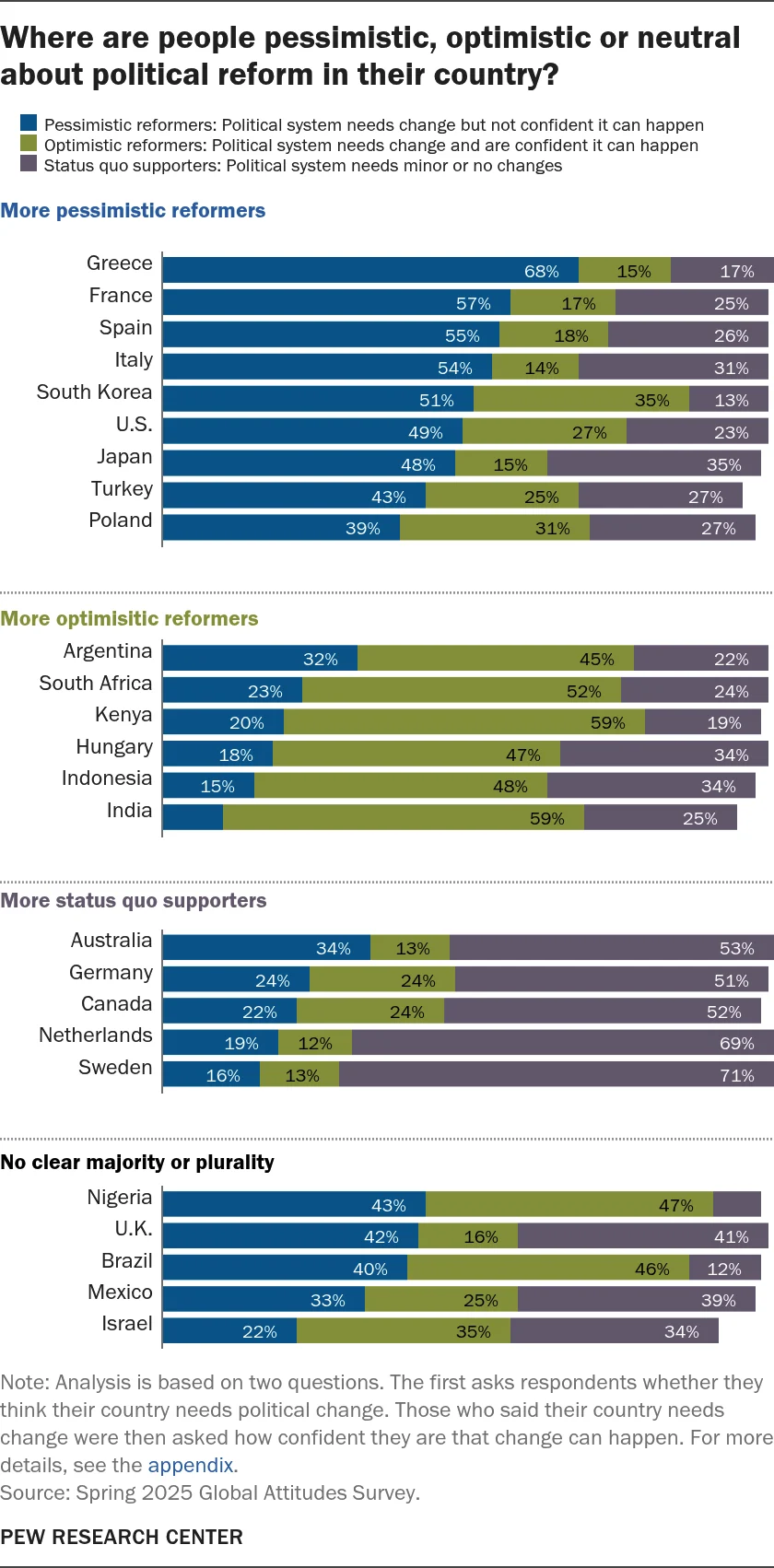
The research categorized respondents into three groups based on their views of political reform: "pessimistic reformers," "optimistic reformers," and "status quo supporters." The findings reveal a complex landscape within the American electorate. Nearly half of all Americans surveyed (49%) fall into the category of "pessimistic reformers." These individuals acknowledge the urgent need for significant political change but express a lack of confidence that such transformations can be successfully implemented.
A smaller, yet significant, segment of the population, comprising 27%, are identified as "optimistic reformers." These Americans also believe in the necessity of major political overhauls but maintain a degree of confidence that these changes can be achieved effectively. The remaining 23% of Americans are classified as "status quo supporters," holding the view that the political system requires no or only minor adjustments. The dominance of pessimistic reformers in the U.S. underscores a national mood of dissatisfaction with the current political state, coupled with a pervasive sense of inertia or an inability to enact meaningful change.
Global Perspectives: A Spectrum of Political Sentiment
The Pew Research Center’s Global Attitudes Survey, which polled 31,938 individuals across 25 countries, provides a broad comparative framework for understanding these sentiments. The data reveals distinct regional and economic patterns in attitudes toward political reform.
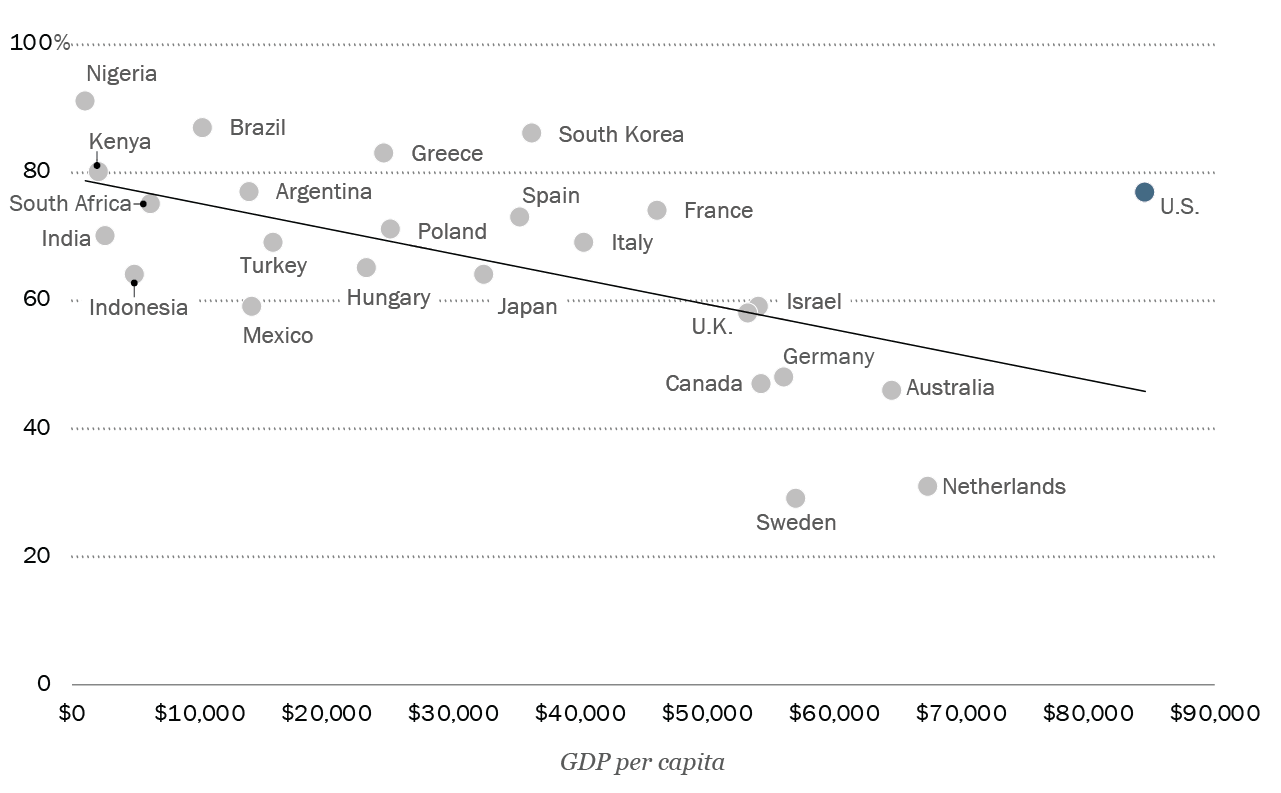
In countries like Greece (83%), South Korea (86%), and Brazil (87%), a high percentage of the population desires significant political change, mirroring the sentiment in the U.S. However, the accompanying levels of optimism or pessimism vary. For instance, while South Korea exhibits a high demand for reform, a significant portion of its population also expresses confidence in achieving it, placing them closer to optimistic reformers.
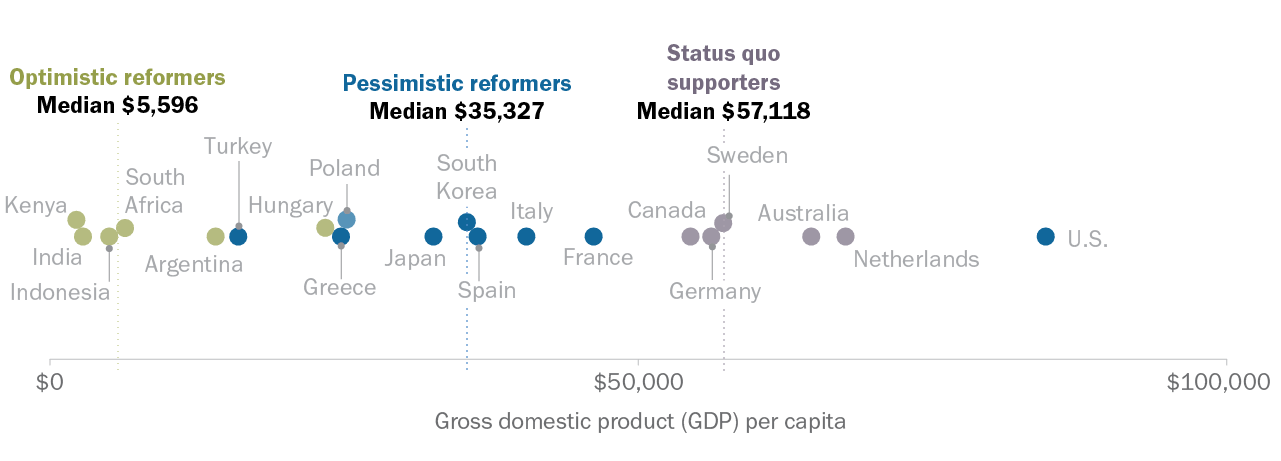
Conversely, nations with robust economies and established democratic institutions often show a higher proportion of "status quo supporters." Sweden, with a GDP per capita of $57,117.5, has only 29% of its population advocating for major or complete reform, with a substantial 71% identifying as status quo supporters. Similarly, the Netherlands (GDP per capita $67,520.4) and Australia (GDP per capita $64,604.0) show a strong preference for maintaining the existing political order, with 31% and 46% respectively desiring major reforms, and a larger share content with the status quo.
Pessimistic Reformers: A Common Thread in Diverse Nations
The United States is not alone in having "pessimistic reformers" as the largest demographic group. The study identified nine countries where this sentiment prevails, including Greece, France, Spain, Italy, South Korea, Japan, Turkey, and Poland. This suggests that the challenges and frustrations driving a desire for reform without confidence in its achievement are not confined to a single nation but represent a broader international phenomenon, albeit with varying intensity.

Optimistic Reformers: A Vision of Possibility
In contrast, six countries identified a majority of "optimistic reformers," individuals who believe in the need for change and are confident in its attainability. These nations include India, Kenya, South Africa, Indonesia, Hungary, and Argentina. This group represents a vital force for potential political evolution, embodying a belief in the capacity for positive systemic transformation.
Status Quo Supporters: Contentment with the Present
The "status quo supporters," those who believe their political system requires no or only minor changes, form the largest segment of the population in five surveyed countries: Sweden, the Netherlands, Australia, Canada, and Germany. These nations, predominantly high-income, suggest a correlation between economic stability and a general satisfaction with the existing political framework, at least among the majority.
Economic Standing and Political Discontent: A Complex Relationship
The Pew study delves into the interplay between a nation’s economic standing and its citizens’ political outlook. The U.S. stands out starkly within the group of "pessimistic reformer" nations due to its exceptionally high GDP per capita of $84,534.0. This economic prosperity, however, does not translate into political contentment. In fact, the U.S. has a significantly higher GDP per capita than other countries where pessimistic reformers are the dominant group.
A comparative analysis reveals that in the next tier of high-income countries surveyed, those with large proportions of status quo supporters often exhibit a starkly different economic-political correlation. For example, the Netherlands, with the second-highest GDP per capita at $67,520.4, has a dominant group of status quo supporters (69%), with only 19% identifying as pessimistic reformers. This suggests that in some affluent nations, economic success may indeed foster a greater sense of satisfaction with the political system.
Democracy Ratings and Political Views: A Deeper Correlation
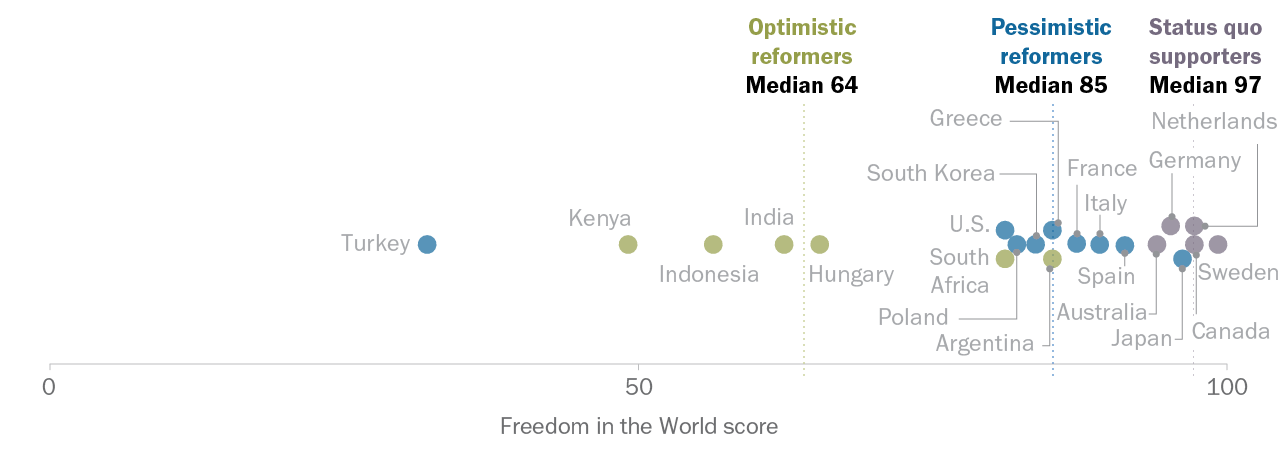
Beyond economic indicators, the study examined expert evaluations of democratic health, utilizing data from Freedom House. The U.S. aligns with other "pessimistic reformer" nations in terms of its democracy score, generally rating high but not exceptionally so compared to countries dominated by "status quo supporters." For instance, while the U.S. received a Freedom in the World score of 81, indicating a relatively free and democratic society, Sweden, where status quo supporters are prevalent, scored a near-perfect 99. This suggests that even in countries with robust democratic institutions, a significant portion of the population may still desire reform, particularly if they perceive systemic flaws or inefficiencies. Turkey, a notable exception among the pessimistic reformer nations, received a significantly lower score of 32, indicating a more challenging democratic landscape.
Societal Trust and Economic Outlook: A Gloomy Picture for Pessimistic Reformers
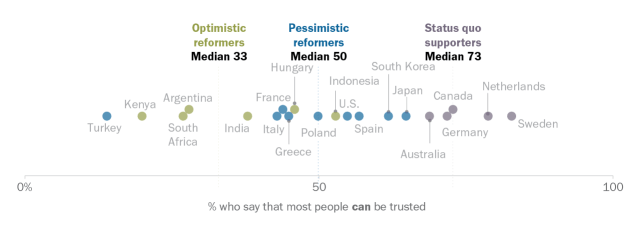
The dissatisfaction among pessimistic reformers extends beyond political structures to encompass broader societal views. Individuals in these countries, including the U.S., tend to exhibit lower levels of trust in their fellow citizens, perceive morality and ethics more negatively, and express greater pessimism about their nation’s economic future.
In the U.S., only 55% of adults believe that most people can be trusted, a figure considerably lower than in countries with a larger proportion of status quo supporters, such as Sweden (83%) and the Netherlands (79%). More alarmingly, the United States is the sole surveyed nation where a majority of adults perceive the morality and ethics of their fellow citizens as "bad" rather than "good." This finding suggests a deep-seated erosion of social cohesion and trust within American society, a sentiment that may be intertwined with the widespread demand for political reform.
Furthermore, a 2024 survey on optimism about children’s financial futures revealed that in the nine countries where pessimistic reformers are the largest group, a median of only 20% of adults believed that the next generation would be financially better off than their parents. This stark pessimism about economic prospects for the future underscores a sense of stagnation and a lack of opportunity, further fueling discontent with the existing political and economic order. In contrast, nations with a majority of optimistic reformers, such as India (75%) and Indonesia (71%), reported significantly higher levels of optimism regarding the economic future of children.
Conclusion: A Call for Understanding and Action
The Pew Research Center’s findings present a compelling portrait of global sentiment regarding political systems. The United States, despite its economic strengths, exhibits a unique and concerning combination of widespread desire for political change and a profound lack of faith in the possibility of achieving it. This dual sentiment, shared with several other nations, suggests that addressing systemic issues and fostering confidence in reform processes will be critical for navigating the complex political landscapes of the 21st century. The data serves as a stark reminder that economic prosperity alone does not guarantee political stability or public satisfaction, and that a deeper understanding of societal trust, democratic health, and future economic prospects is essential for fostering a more engaged and hopeful citizenry.