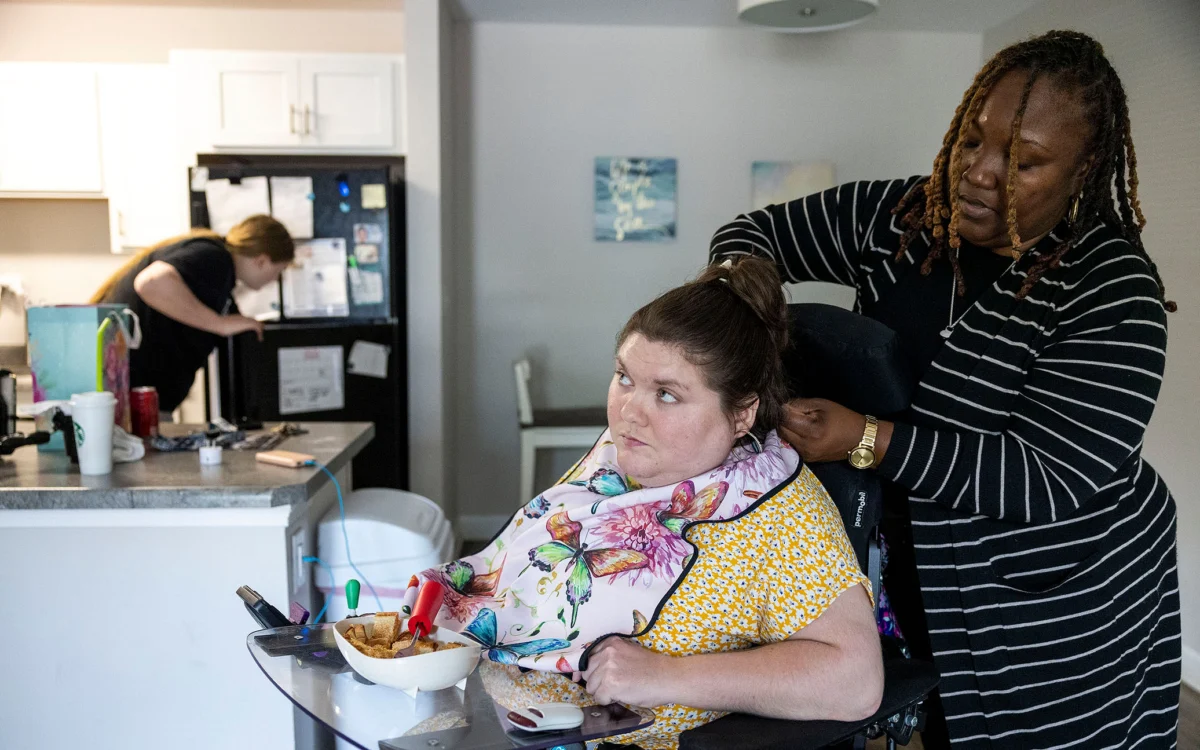
A significant legal battle, known as Texas v. Kennedy, aimed at challenging the rights of individuals with disabilities to receive services and live within their communities, is progressing despite recent withdrawals by some participating states. Indiana and South Dakota announced their departure from the lawsuit this month, yet Texas and six other states remain committed to pursuing the litigation. Disability advocates express grave concerns that this case could erode the hard-won protections ensuring community-based care for people with disabilities.
At the heart of the dispute is a 2024 update to the U.S. Department of Health and Human Services (HHS) regulations, specifically concerning Section 504 of the Rehabilitation Act. The states involved argue that this updated regulation is unconstitutional, with a particular focus on what is termed the "integration mandate." This mandate, as outlined in the regulation, requires state and local governments, along with other entities receiving federal funding from HHS, to serve individuals with disabilities in the most integrated setting appropriate to their needs. Crucially, the regulation also stipulates that placing individuals with disabilities at serious risk of unnecessary institutionalization constitutes a violation of Section 504, with non-compliance potentially leading to the loss of federal funding.
The Legal Challenge: States’ Arguments Against the Integration Mandate
In an amended complaint filed with the U.S. District Court for the Northern District of Texas earlier this year, the states involved articulated their opposition to the regulation. They contend that the "Final Rule" extends beyond the permissible scope of Section 504 of the Rehabilitation Act and the Americans with Disabilities Act (ADA). Their legal filing states, "The Final Rule exceeds the legitimate scope of Section 504 of the Rehabilitation Act and the Americans with Disabilities Act. The Final Rule’s unlawful provisions regulating institutionalization should be set aside for exceeding the scope of HHS’s authority under Section 504 and the ADA. Neither statute empowers HHS to mandate community-based care or to regard as discriminatory care that involves the mere prospect of institutional care."
The states remaining in the lawsuit are now requesting a judicial decision without proceeding to a full trial. Their core argument centers on the assertion that the HHS regulation infringes upon their "budgetary and policymaking discretion" and effectively imposes a "mandate for states to redesign their Medicaid programs." This claim suggests that the federal government, through these regulations, is overstepping its authority and dictating how states should manage their healthcare systems and allocate resources for disability services, potentially creating unfunded mandates or forcing significant programmatic overhauls.
Advocates’ Concerns: Undermining Decades of Progress
Disability advocates view the stakes of this litigation as exceptionally high. Alison Barkoff, a professor at George Washington University and former head of HHS’s Administration on Community Living under the Biden administration, emphasized the fundamental nature of the rights at risk. "This lawsuit by Texas puts at risk one of the most fundamental and hard-won rights of people with disabilities – the right to live and participate in their own communities," Barkoff stated. She further explained, "Despite the new Section 504 regulation just codifying the 25 years of interpretations of the integration mandate by the courts, the states now claim that the regulations create new obligations for states that are illegal and beyond their constitutional authority. If a court were to agree, it could greatly narrow the right to community living and restrict the ability to enforce the law."
The advocacy community has been actively engaged in lobbying the attorneys general of the states involved in the lawsuit, urging them to withdraw. This pressure has yielded some success, leading to the recent departures of Indiana and South Dakota.
A Shifting Legal Landscape: From Gender Dysphoria to Integration
The Texas v. Kennedy lawsuit has undergone a significant evolution since its initial filing in 2024. Originally, the suit encompassed 17 states and directly challenged the constitutionality of Section 504, with its legal strategy hinging on a mention of gender dysphoria within the preamble of the HHS rule. Following the Trump administration’s efforts to address this specific concern, eight states withdrew from the litigation.
The remaining states then recalibrated their legal approach, shifting their focus to the integration mandate and continuing their efforts to have the HHS rule invalidated. This strategic pivot highlights the broader implications of the regulation and the states’ fundamental disagreement with its mandate for community-based care.
Recent Withdrawals and Remaining States
Indiana Attorney General Todd Rokita, in explaining his state’s withdrawal this month, cited the resolution of the gender dysphoria issue as the primary catalyst. "While we remain concerned about federal overreach into traditional state matters, President Trump’s decisive action has resolved the gender dysphoria issue," Rokita said. "With that core victory secured, we have dismissed our claims." This statement suggests that while the states may have underlying concerns about federal authority, specific issues can influence their participation in such broad legal challenges.
Texas Attorney General Ken Paxton, who is leading the lawsuit, has not responded to requests for comment. The states that continue to be involved in Texas v. Kennedy are Alaska, Florida, Kansas, Louisiana, Missouri, and Montana.
The sustained pressure from disability rights organizations has been considerable. The Arc, a prominent advocacy group, reported that Paxton’s office has been inundated with calls and emails urging him to drop the suit, to the extent that his phone line has reportedly experienced intermittent disconnections.
Shira Wakschlag, senior executive officer for legal advocacy and general counsel at The Arc, reiterated the call for the remaining states to withdraw. "For over a year, people with disabilities have been watching this case and wondering what it could mean for their daily lives, including whether they can keep the supports they need to live in the community," Wakschlag stated. "We urge every remaining state to follow the lead of Indiana and South Dakota and withdraw from this lawsuit."
Broader Implications and the Future of Community Integration
The Texas v. Kennedy case has far-reaching implications for the disability rights movement and the lives of millions of Americans with disabilities. The integration mandate, rooted in decades of legal interpretation and advocacy, represents a cornerstone of the disability rights framework. It recognizes that segregation in institutions, even if well-intentioned, is inherently discriminatory and limits the full participation of individuals with disabilities in society.
The Centers for Disease Control and Prevention (CDC) has highlighted the benefits of community living for individuals with disabilities, including increased independence, improved health outcomes, and greater social inclusion. Data from the CDC indicates that individuals with disabilities who live in community settings often experience better access to healthcare, employment opportunities, and social networks compared to those residing in institutional settings. For instance, studies have shown that individuals with intellectual and developmental disabilities living in community settings are more likely to be employed and to have higher levels of social engagement than their institutionalized counterparts.
The legal challenge threatens to reverse progress made since landmark legislation like the Americans with Disabilities Act of 1990 and Section 504 of the Rehabilitation Act of 1973, which established federal protections against discrimination based on disability. These laws have been instrumental in dismantling discriminatory practices and promoting equal opportunities for people with disabilities. The integration mandate, in particular, is seen as a crucial tool for enforcing these rights and ensuring that individuals with disabilities are not relegated to segregated or institutional environments against their will.
The argument that the HHS regulation creates new, unlawful obligations for states by mandating community-based care or deeming the "mere prospect of institutional care" as discriminatory is a significant legal contention. If successful, this argument could weaken the enforcement of integration requirements and allow states to maintain or re-establish institutional models of care without facing federal repercussions. This would not only impact access to services but also the fundamental human right to choose where and how to live.
The legal battles surrounding disability rights are complex and often involve a tension between federal mandates and state autonomy. However, advocates argue that the right to community living for individuals with disabilities is a fundamental civil right that should not be subject to the budgetary or policy preferences of individual states. The outcome of Texas v. Kennedy could set a significant precedent for how these rights are interpreted and enforced in the future, shaping the landscape of disability services for generations to come. The ongoing legal struggle underscores the critical need for vigilance and continued advocacy to protect and advance the rights of people with disabilities.