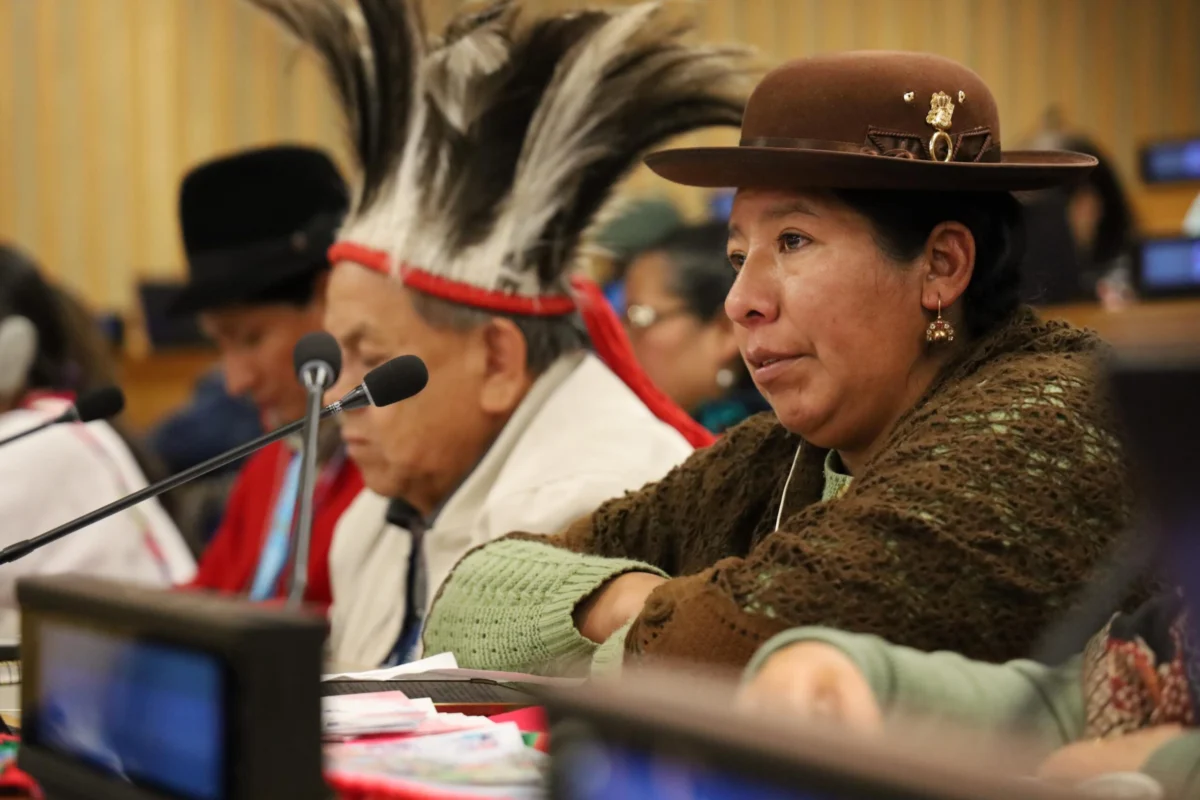
New York – A powerful plea for the Bolivian government to address the environmental and health crises facing its indigenous populations was delivered at the 25th session of the UN Permanent Forum on Indigenous Issues (UNPFII) on April 21, 2026. Rosa Fátima Mamani Quispe, representing the Chimpu Warmi Network of Bolivia, a vital partner of Cultural Survival’s Indigenous Community Media Fund, directly appealed to international bodies and the Bolivian state to confront the devastating impacts of extractivist policies, particularly mining, on indigenous territories and the health of both the land and its people. Her address highlighted the ecological catastrophe of Lake Poopó’s demise and the broader concept of "Mamacocha" or Mother Earth’s suffering, linking environmental degradation to profound violations of indigenous rights and well-being.
A Call for Accountability Amidst Ecological Collapse
Mamani Quispe’s statement at the prestigious UN forum served as a stark reminder of the urgent challenges indigenous communities are facing globally, with a specific focus on the critical situation in Bolivia. Her message, carried on behalf of the indigenous peoples and, crucially, the indigenous women of Bolivia, underscored a relentless struggle for the defense of their ancestral lands, their living spaces, and their fundamental right to self-determination. The theme of the 25th UNPFII session, "Ensuring the health of Indigenous Peoples, including in the context of conflicts," provided a crucial platform for Mamani Quispe to articulate how the destruction of their environment directly undermines their health, culture, and very existence.
"We bring the message of the indigenous peoples—and particularly the indigenous women—of Bolivia, who are fighting to defend our territories, our living spaces, and our right to self-determination," stated Mamani Quispe, setting a grave and resolute tone for her intervention. She emphasized that for indigenous communities, the health of the land is inextricably linked to their own well-being, a perspective that transcends the Western biomedical understanding of health.
Indigenous Women as Guardians of Life and Culture
The address eloquently positioned indigenous women as central to the preservation of life and cultural continuity. Mamani Quispe explained how these women have historically sustained their communities by safeguarding ancestral knowledge, languages, traditional governance systems, and unique life plans. The art of weaving, a deeply ingrained cultural practice inherited from female ancestors, was presented as a tangible embodiment of this enduring legacy, serving as a "living memory of life." This profound connection to their heritage underscores why the defense of territory is not merely a land rights issue, but a holistic defense of life itself.
"For us, the theme of this session—’Ensuring the health of Indigenous Peoples, including in the context of conflicts’—offers an ideal space for our voices and our thoughts to help safeguard the very fabric of life," Mamani Quispe articulated, highlighting the profound relevance of the UNPFII’s agenda to the lived realities of her people. The concept of Pachamama, or Mother Earth, as a fertile and nurturing female entity, is central to the indigenous worldview, making the desecration of the land a deeply personal and spiritual violation.
The Erosion of Rights and the Advance of Extractivism
Despite the recognition of indigenous rights to their lands and resources enshrined in the United Nations Declaration on the Rights of Indigenous Peoples (UNDRIP), Mamani Quispe detailed how these rights are systematically violated within the Bolivian state. The encroachment upon indigenous territories and the pervasive violence are directly attributed to aggressive extractivist policies. These policies are largely driven by both formal mining companies and informal mining operations, further facilitated by institutional actions from governmental bodies such as the National Institute for Agrarian Reform (INRA) and the Authority for the Oversight and Social Control of Forests and Land (ABT).
These institutions, Mamani Quispe explained, inadvertently or deliberately create pathways for external actors – formerly termed "colonizers" and now euphemistically referred to as "intercultural settlers," alongside "mining cooperatives" – to infiltrate indigenous territories. This influx not only undermines the autonomy and traditional ways of life of indigenous communities but also fragments their established systems of self-governance. Simultaneously, these activities inflict severe damage on the environment, contributing to the "polluting and sickening of our Mother Earth."
The Devastating Toll of Mercury and the Death of Lake Poopó
The address provided specific and harrowing details about the environmental consequences of mining, particularly gold mining, which relies heavily on the indiscriminate use of mercury. This toxic substance has led to widespread contamination of rivers, the destruction of delicate ecosystems, and the impoverishment of indigenous territories. The direct consequence for indigenous communities has been a surge in illnesses, impacting their health, both physically and mentally.
For indigenous women, the impacts are magnified. Mamani Quispe highlighted the increasing difficulty in accessing clean water and healthy food, essential for sustaining their families. The environmental degradation also fosters environments characterized by heightened violence, with the most vulnerable groups – women, children, and the elderly – bearing a disproportionate burden.
The symbolic and ecological tragedy of the death of Lake Poopó, referred to by the indigenous communities as Mamacocha (Mother Lake), was a focal point of Mamani Quispe’s plea. This sacred living entity for the Andean peoples has now vanished, leaving behind a community suspended between profound grief and the necessity of resilience. The loss of the lake signifies more than just the absence of water; it represents a deep wound to the culture, worldview, and collective memory of the people.
A Holistic Vision of Health and Well-being
Mamani Quispe articulated a nuanced understanding of health that diverges from conventional Western paradigms. For indigenous communities, health is not merely an individual state of physical and mental well-being but a holistic and reciprocal relationship with the environment. "If Mother Earth is healthy, we are healthy too, for she provides us with sustenance, balance, and the space to live. But if Mother Earth is ailing, we too fall ill—physically, emotionally, and spiritually," she explained, underscoring the profound interconnectedness.
The destruction of sacred sites—the Mamacocha, hills, rivers, and ceremonial spaces—by toxic substances like mercury and arsenic is seen as a severance of the vital bond of care between the community and its environment. Therefore, for indigenous peoples, the concept of well-being is intrinsically tied to respecting nature, safeguarding their territories, and protecting their collective rights.
Demands for State Responsibility and Upholding International Commitments
Standing firm in their resistance, indigenous women are actively sowing seeds of hope and continuing to weave the fabric of life. Their defense of territory is a defense of life itself, and their advocacy for water is a defense of the future. Mamani Quispe issued a direct demand to the Bolivian state to uphold its commitments as stipulated in the United Nations Declaration on the Rights of Indigenous Peoples. This declaration holds the force of law in Bolivia, having been enacted as Law 3760 on November 7, 2007, making it legally binding.
The state, she asserted, must assume its responsibilities to create an environment that enables indigenous peoples to live with dignity, health, and freedom. This includes halting destructive extractivist practices, ensuring environmental remediation, and respecting the autonomy and self-governance of indigenous communities.
Broader Implications and Context
The statement delivered by Rosa Fátima Mamani Quispe at the UNPFII is part of a larger, ongoing global movement by indigenous peoples to assert their rights and protect their ancestral lands from the relentless pressures of industrial development and resource extraction. The situation in Bolivia, with the stark example of Lake Poopó, serves as a microcosm of broader environmental crises affecting indigenous communities worldwide, from the Amazon rainforest to the Arctic.
Background and Timeline of Environmental Degradation in Bolivia:
- Pre-2000s: Traditional practices and the ecological balance of Lake Poopó, a vital water source and cultural hub for indigenous communities like the Uru, Chipaya, and Aymara, were already showing signs of strain due to climate variability and localized agricultural demands.
- Early 2000s – Present: The acceleration of mining operations, particularly artisanal and small-scale gold mining (ASGM) in the Bolivian Andes, intensified the use of mercury and other toxic chemicals. Informal mining activities, often operating with limited oversight, became a significant driver of pollution.
- 2000s – 2010s: Reports from environmental organizations and local communities began to document alarming levels of mercury contamination in rivers feeding into Lake Poopó and in the lake’s water itself. Deforestation for mining exploration and infrastructure also increased.
- 2016: Lake Poopó officially dried up, a catastrophic event that devastated local economies and cultures dependent on the lake’s resources for fishing and agriculture. This event was widely attributed to a combination of factors including climate change, reduced river flows due to upstream diversion for mining and agriculture, and the direct impact of pollution.
- 2007: Bolivia formally recognized UNDRIP through Law 3760, signifying a legal commitment to uphold indigenous rights, including those related to land and environmental protection. However, enforcement and implementation have been inconsistent.
- Present Day (2026): The legacy of Lake Poopó’s death continues to resonate, with ongoing concerns about mercury contamination in soil and water sources, impacting agricultural productivity and human health. The Chimpu Warmi Network and other indigenous organizations are actively advocating for remediation, stricter environmental regulations, and the recognition of indigenous environmental stewardship.
Supporting Data and Environmental Impacts:
- Mercury Contamination: Studies by the Bolivian Ministry of Environment and Water, as well as international NGOs, have repeatedly shown elevated levels of mercury in Bolivian rivers, soils, and water bodies, particularly in mining regions. Mercury bioaccumulates in the food chain, posing severe neurological and developmental risks to humans who consume contaminated fish and agricultural products.
- Water Scarcity: The drying of Lake Poopó exacerbated water scarcity issues in the Altiplano region, impacting not only indigenous communities but also the broader population and agricultural sectors. This leads to increased competition for dwindling water resources, often fueling social tensions.
- Health Crisis: Anecdotal and emerging scientific evidence points to a rise in health problems among indigenous communities in mining-affected areas, including neurological disorders, birth defects, and chronic illnesses linked to heavy metal exposure. Accurate epidemiological data is often scarce due to limited resources and access in remote areas.
- Biodiversity Loss: The pollution and habitat destruction associated with mining have led to a significant decline in local biodiversity, affecting plant and animal species crucial for the ecological balance and the subsistence of indigenous peoples.
Reactions and Analysis of Implications:
While specific official statements from the Bolivian government directly responding to Mamani Quispe’s UNPFII address were not immediately available at the time of reporting, past government responses to similar criticisms have often highlighted efforts to regulate mining activities and promote sustainable development. However, indigenous groups frequently criticize these measures as insufficient, pointing to a persistent gap between policy pronouncements and on-the-ground enforcement, particularly concerning informal and illegal mining operations.
The implications of Mamani Quispe’s appeal are far-reaching. It underscores the critical need for international bodies like the UNPFII to exert greater pressure on states to uphold their commitments to indigenous rights and environmental protection. The interconnectedness of indigenous health and environmental health, as articulated by Mamani Quispe, demands a paradigm shift in how development policies are conceived and implemented, moving away from purely economic growth models towards inclusive, rights-based, and ecologically sustainable approaches.
The Chimpu Warmi Network’s efforts, supported by organizations like Cultural Survival, exemplify the crucial role of indigenous media and advocacy groups in bringing these vital issues to the global stage. Their work not only raises awareness but also empowers indigenous communities to articulate their own narratives and demand justice. The ongoing struggle in Bolivia serves as a potent reminder that the defense of indigenous territories is intrinsically linked to the global fight for environmental sustainability and human rights. The memory of Lake Poopó’s demise stands as a somber testament to the devastating consequences of unchecked extractivism, urging a renewed commitment to protecting the planet and its most vulnerable inhabitants.