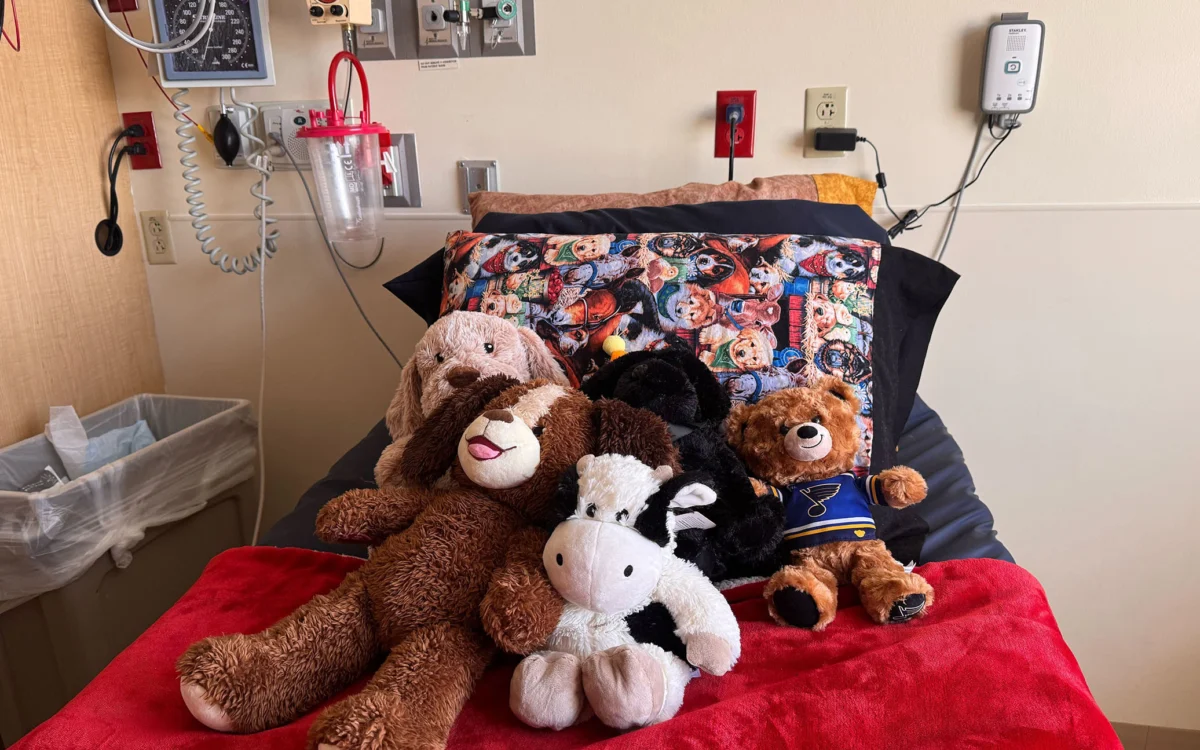
Overwhelmed by the demands of caregiving, Quette dialed 911 when she found her teenage son downstairs in their kitchen struggling to breathe. He had rolled his wheelchair to the oven to keep himself warm as he tried to regulate his temperature, she recalled, and was drenched in sweat from an apparent infection. In that moment, Quette knew that she and her son’s grandmother could no longer meet his medical needs on their own at their Illinois home just outside St. Louis. He had become paralyzed when he was shot in 2023, and, despite their efforts, they struggled to take care of him. But she never imagined that her quick call for help that day would turn into a months-long hospital stay for her son – even after he was well enough to be discharged.
This harrowing experience for Quette and her son is a symptom of a larger, pervasive crisis unfolding in healthcare systems across the United States: the phenomenon of "social stays" or "hospital boarding." This refers to the practice of keeping children in hospitals for extended periods, far beyond the point when their acute medical needs have been met. The underlying cause is a critical shortage of appropriate post-acute care settings, particularly for children with complex medical conditions, behavioral challenges, or disabilities. When there is no safe or adequate place for these vulnerable young people to go, hospitals become de facto holding facilities, straining resources and leaving children in a state of prolonged limbo.
A Mother’s Desperate Plea and a System’s Failure
Quette’s narrative highlights the immense pressure faced by family caregivers. "They were like, ‘Well, y’all almost killed him,’" she recounted officials telling her, referring to accusations of neglect leveled against her and her son’s grandmother when they sought assistance. KFF Health News has agreed to use only Quette’s nickname to protect the privacy and safety of her son, who is currently in state custody.
"I had to give up. I just couldn’t take care of him anymore," Quette admitted, her voice heavy with the weight of her experience. "It was just a lot on me. It was something that I was not ready for." Her situation underscores the profound gap between the intensive care needs of medically complex children and the available support systems for their families. The immediate aftermath of her son’s medical crisis, while stabilizing his condition, paradoxically ushered in a new, protracted struggle for placement.
The Escalating Crisis of Hospital Boarding
Once Quette’s son’s immediate medical needs were stabilized, he did not leave the hospital. His grandmother, who had served as his legal guardian, passed away. This left the teenage boy without a guardian and, consequently, he became a ward of the state. He has since been residing in a St. Louis children’s hospital, a situation commonly referred to as a "social stay." This practice, also known as hospital boarding or delayed discharge, is increasingly flummoxing officials in states like Missouri, Illinois, Minnesota, and Georgia, and indeed across the nation. The core issue is a lack of suitable alternatives for children who are medically cleared for discharge but have nowhere else to go.
The difficulty in finding stable placements for foster children is a well-documented national problem. In recent years, stories have emerged of children spending nights in unconventional locations, from casino hotels in Nevada to office buildings in Georgia and Maryland, a practice often termed "hoteling." However, when a child’s needs extend beyond basic care to include specialized medical equipment, technology, or constant nursing support, hospitals unfortunately become the default holding stations.
The Complex Needs of Children in Limbo
Many of the children who find themselves in this extended hospital limbo present with a range of complex needs. A significant portion struggle with mental health or behavioral issues that make finding a stable home environment challenging. Others have chronic physical conditions or disabilities that require specialized care, equipment, or ongoing assistance that is not readily available in community-based settings.
Dr. Elaine Lin, a pediatrician at Boston Children’s Hospital and chair of the American Academy of Pediatrics’ Section on Home Care, characterized the situation as a "national problem." She elaborated, "Every state has different options in terms of where kids can go post-acute care. But in general, there’s many of our kids with medical complexity who just don’t have access to the appropriate home nursing to bring them home safely." This shortage of specialized care at home or in community facilities directly contributes to the bottleneck in hospitals.
Legislative Efforts and Mounting Costs
The severity of the hospital boarding crisis has prompted legislative action. In Missouri, lawmakers have repeatedly introduced bills aimed at significantly reducing hospital boarding days for children and ultimately eradicating the practice. Despite these efforts, finding comprehensive solutions has proven challenging.
Quette’s son, for example, was housed in a private hospital room while the state worked to find him an alternative placement. However, this is not always the case for children experiencing prolonged hospital stays. According to Lynn Rasnick, a nurse and vice president at the Missouri Hospital Association, some children spend weeks, months, and in extreme cases, years in acute care hospitals. These children often occupy emergency room stretchers, sit in windowless rooms, miss out on crucial educational opportunities, and are exposed to the constant flux of trauma and illness inherent in a hospital environment.
To mitigate the risks associated with having children with no discharge plan in hospitals, some institutions have resorted to hiring dedicated "sitters" to supervise them. In other cases, the responsibility for chaperoning these children has fallen upon existing hospital staff, further stretching their already burdened workloads.
Beyond the human toll on the children and their families, hospital boarding incurs substantial financial costs. Once a child no longer requires acute medical care, insurers are typically not obligated to cover their extended hospital stay. While some hospitals absorb these costs, others seek reimbursement from the state if the child is in state custody.
The Missouri Hospital Association reported that the state’s Department of Social Services reimbursed $16.3 million to 19 hospitals for 9,943 boarding days in the previous year, averaging over $1,600 per night. However, association spokesperson Dave Dillon noted that this figure represents a significant undercount, as hospitals often do not receive reimbursement for housing children awaiting placement.
Further illustrating the financial burden, a study in Minnesota found that boarding a child with a complex medical condition cost approximately $3,932 per day in 2017. A more recent survey by the Minnesota Hospital Association in 2023 estimated the unpaid costs of "unnecessary" patient stays for both adults and children at a staggering $487 million for 195,000 days of care. These figures highlight the immense financial strain placed on healthcare systems by the failure to adequately address the discharge needs of vulnerable children.
The Looming Threat of Medicaid Cuts
Adding another layer of complexity to this crisis is the potential impact of federal funding cuts to state Medicaid programs. Proposed legislation, such as the "One Big Beautiful Bill Act," could lead to significant reductions in Medicaid funding. With Medicaid providing essential healthcare coverage for low-income individuals and those with disabilities, a projected loss of nearly $1 trillion in federal funding by 2034 is forcing some states to consider scaling back optional home-care programs. This looming threat jeopardizes the very services that could help keep medically complex children out of hospitals and in their homes.
Quette, a single mother who has worked as a paid caregiver and now works as a custodian, recounted her family’s repeated requests for a home health aide, only to be informed that her son’s insurance would not cover such services. Her son’s paternal grandmother, who was also in a wheelchair and assisted with his care, passed away, leaving Quette to manage increasingly demanding care tasks. "I had to wake up out of my sleep to rotate him," Quette shared, describing the essential task of repositioning her son to prevent pressure sores. "And I couldn’t do it. I was oversleeping." This personal account reveals the physical and emotional exhaustion faced by family caregivers when adequate support is absent.
A Widespread and Growing Problem
The challenges faced by Quette are not isolated. Parents across the country grapple with similar situations. In Georgia, state officials reported that 500 children were "relinquished" by their parents and placed with the Division of Family & Children Services in the past year, often due to complex behavioral or psychiatric needs.
In Colorado, a hospital worker reached out to a state representative for assistance after a 13-year-old boy with autism spent weeks at UCHealth Longs Peak Hospital in Longmont. After his father abandoned him there, hospital and human services officials indicated that it could take months to find a safe placement for the boy.
Illinois’ Department of Children and Family Services logged 304 cases of youth in psychiatric hospitals beyond medical necessity during the last fiscal year, with approximately 43% of these cases involving patients between the ages of 13 and 16. This data from Illinois paints a stark picture of the prevalence of prolonged hospital stays for children with behavioral and mental health needs.
Seeking Solutions Amidst Legislative Hurdles
In Missouri, state Senator Jamie Burger, a Republican, introduced a bill this year that would mandate faster action and state funding for the care of children stuck in hospitals. Similar legislative proposals have failed to advance in previous years. Senator Burger’s bill, intended to expedite placements and provide financial support for these children, remained stalled in committee when the legislative session concluded on May 15.
A fiscal note attached to the Missouri bill projected that funding hospital boarding could cost the state upwards of $148 million annually, a significant sum for a state already planning to utilize its reserves to fund a $50.7 billion budget.
Patty Morrow, a vice president at Mercy, a major hospital system in Missouri, testified about the extensive boarding days her system has logged. Over an 18-month period, Mercy recorded 2,687 boarding days, which included both children and adults awaiting placement. "That was never really ever the intended purpose of a hospital," Morrow stated, emphasizing that the current situation is unsustainable. "The current state cannot be the ongoing solution."
The proposed bill in Missouri aims to address this by requiring the juvenile court system to ensure children are placed in "an appropriate setting," which would involve the coordinated efforts of social workers and other public servants.
Lynn Rasnick of the Missouri Hospital Association underscored the urgency of the situation for lawmakers, stating, "You can’t just discharge a 9-year-old into the street." This blunt assertion highlights the moral and practical imperative to find safe and appropriate alternatives for these children.
A Lingering Connection to Care
Quette’s son remains in state custody but is no longer hospitalized. Illinois officials declined to permit the teen to share his story directly with KFF Health News, leaving his current circumstances largely private.
Despite the separation, Quette retains tangible links to her son’s medical journey. "That’s all I have," she said, referring to the brace, bandages, ointment, and other medical supplies she has kept at home. "That’s the stuff I will never give away." These items serve as a poignant reminder of the care she provided and the ongoing challenges faced by families navigating the complex and often unforgiving landscape of child welfare and healthcare. The story of Quette and her son is a microcosm of a national crisis, demanding urgent attention and systemic reform to ensure that no child is left behind in a hospital bed when they no longer require acute medical care.