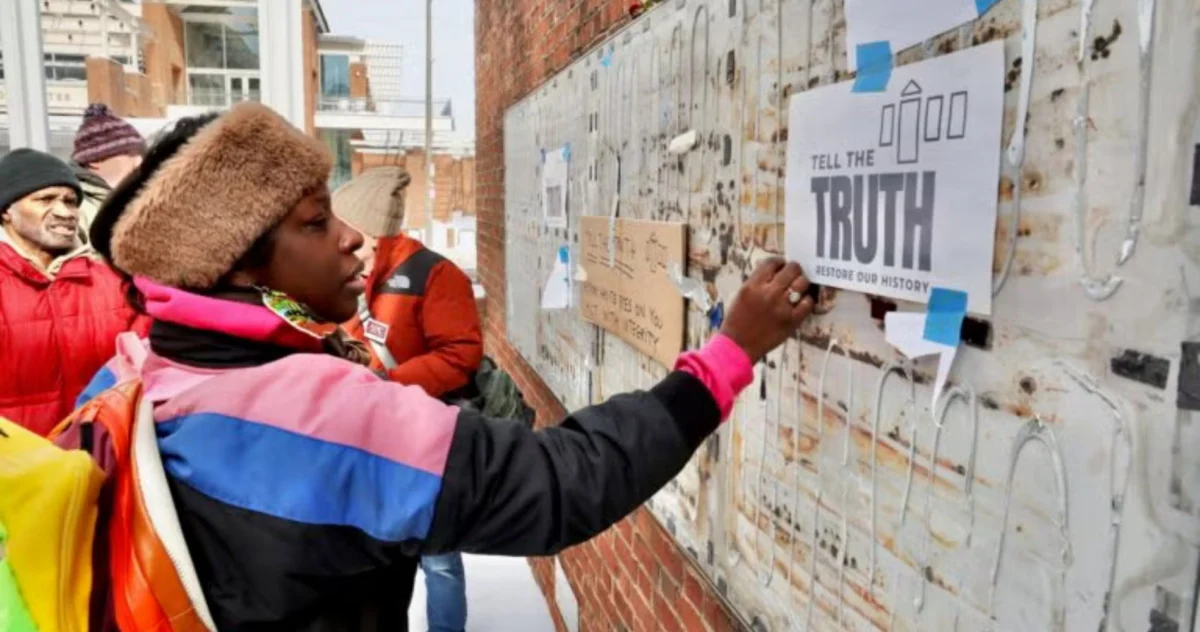
A federal court delivered a significant ruling on Monday, ordering the National Park Service (NPS) to immediately reinstate exhibits at the President’s House in Philadelphia. These crucial displays, which shed light on President George Washington’s ownership of enslaved people and detailed the lives of individuals he held in bondage at the nation’s temporary capital, had been controversially removed. The decision marks a victory for historical integrity and transparency, reaffirming the importance of confronting the complex "paradox of freedom and slavery" inherent in America’s founding narrative.
The Genesis of a Controversy: Erasure at a Historic Site
The legal battle began after the National Park Service, under directives from the previous presidential administration, systematically dismantled panels, interactive displays, and video exhibits at the President’s House site on January 22, 2026. This action, which occurred without the consent or consultation of the city of Philadelphia, triggered immediate alarm among historians, preservationists, and city officials. The removed content specifically addressed the lives of nine enslaved individuals—Oney Judge, Austin, Christopher Sheels, Giles, Hercules Posey, Joe Richardson, Moll, Paris, and Richmond—who were brought by President Washington to his official residence in Philadelphia. Critically, the exhibits explained Washington’s practice of rotating these individuals in and out of Pennsylvania to circumvent the state’s gradual abolition law, which granted freedom to enslaved persons residing in the state for six months.
The city of Philadelphia swiftly filed a lawsuit in federal court, seeking a preliminary injunction to halt the removal and compel the NPS to restore the exhibits. The city argued that the removal constituted a profound disservice to historical accuracy and public education, particularly as the nation approaches its Semiquincentennial in 2026. U.S. District Judge John F. Smith, in a comprehensive 40-page decision, sided with the city. The court mandated the NPS to "reinstall all panels, displays, and video exhibits that were previously in place" and to "prevent any additions, removals, destruction, or further changes of any kind to the President’s House site."
A Deep Dive into the Court’s Reasoning: Protecting Public Memory
Judge Smith’s ruling meticulously dismantled the federal government’s arguments, finding that the NPS’s actions violated federal law and pre-existing agreements dating back to the establishment of Independence National Historical Park in 1948. This foundational legislation explicitly tasked the NPS with preserving significant historical structures related to the nation’s founding for the benefit of the American people. The court emphasized that the removal was undertaken "without the city’s consent," a breach of collaborative agreements that had governed the site’s interpretation for years.
During the court hearing, Justice Department lawyers failed to present any "evidence" or "reasoned explanation" for the exhibit’s removal. Instead, they pointed to an executive order from the Trump administration that directed the NPS to review and remove materials deemed to "inappropriately disparage Americans" and specifically cited Independence National Historical Park as a site promoting "corrosive ideology." However, Judge Smith countered this, asserting that the NPS had done the very thing the executive order condemned: "replacing objective facts with a distorted narrative driven by ideology rather than truth."
The court’s decision was particularly scathing in its critique of the government’s stance on historical interpretation. "It is not disputed that President Washington owned slaves," the court wrote. "And yet, in its argument, the government claims it alone has the power to erase, alter, remove and hide historical accounts on taxpayer and local government-funded monuments within its control." The judge drew a stark parallel to George Orwell’s dystopian novel "1984," where a "Ministry of Truth" was tasked with rewriting history to suit the government’s agenda. "The government here likewise asserts truth is no longer self-evident, but rather the property of the elected chief magistrate and his appointees and delegees, at his whim to be scraped clean, hidden, or overwritten," Judge Smith declared, concluding that this assertion was made "Solely because, as Defendants state, it has the power."
The Justice Department’s argument that "the Government gets to choose the message it wants to convey" was firmly rejected. The court clarified that an agency "cannot arbitrarily decide what is true, based on its own whims or the whims of the new leadership." While the government is free to convey messages elsewhere, it cannot do so "by wiping away the history of the greatest Founding Father’s management of persons he held in bondage" at a site dedicated to a complete historical narrative.
A Site of Contradictions: The President’s House and the Enslaved
The President’s House site holds profound historical significance, marking the location of the official presidential residence where George Washington and John Adams lived during their terms in Philadelphia, then the nation’s capital (1790-1800). This site, unearthed through archaeological discoveries in the early 2000s, revealed not only the foundations of the executive mansion but also the quarters where enslaved Africans lived and labored.
The "President’s House: Freedom and Slavery in the Making of a New Nation" exhibit, which opened in December 2010, was the culmination of years of advocacy, research, and substantial investment. In 2003, the U.S. House of Representatives had formally urged the park service to commemorate the lives of individuals enslaved by President Washington at the site. The city of Philadelphia, alongside numerous historical and civil rights organizations, invested millions of dollars to develop an exhibit that would "tell an honest story about American history and the founding of this country and the role that slavery and enslaved Africans had." The NPS itself, prior to the recent removals, described the site as "crucially significant to examine the ‘paradox of freedom and slavery’ at the nation’s founding."
Central to this narrative are the stories of individuals like Oney Judge, who daringly escaped to freedom from the President’s House in 1796. Her flight became a powerful symbol of resistance against the institution of slavery. In recognition of this, and the site’s commitment to exploring "how her struggle for freedom represented this country’s progress away from the horrors of slavery," the NPS designated the President’s House a National Underground Railroad Network to Freedom site in 2022. This designation underscored its role in illuminating the journey toward liberty and the embodiment of the founding ideals of "Life, Liberty and the pursuit of Happiness" for all Americans.
The exhibit’s focus on the nine enslaved individuals provided a stark, humanizing counterpoint to the veneration of the Founding Fathers. Washington, who enslaved over 300 people throughout his lifetime, strategically moved his enslaved domestic workers between Philadelphia and Mount Vernon to prevent them from qualifying for freedom under Pennsylvania’s 1780 Gradual Abolition Act. This legal maneuvering highlighted the deep moral contradictions at the heart of the nascent republic, where the rhetoric of liberty coexisted with the brutal reality of human bondage.
Irreparable Harm: The Erosion of Public Trust
The city of Philadelphia’s argument for irreparable harm resonated deeply with the court. It contended that the removal of the displays would result in "a loss of access to historical truth, an undermining of the public trust, and an inability to recount its own story in preparation for the semiquincentennial." Judge Smith concurred, finding that the removal "constitutes erasure, undermines public trust, and compromises the integrity of public memory."
The court emphasized that the President’s House represents the City’s "fulfilling an obligation to tell the truth—the whole, complicated truth." Stripping the site of these "crucial interpretive materials" deprives the public of essential educational opportunities designed to be free and accessible. The judge further clarified that the exhibits "were not mere decorations to be taken down and redisplayed." Rather, they served as "a memorial to ‘men, women, and children of African descent who lived, worked, and died as enslaved people in the United States of America,’ a tribute to their struggle for freedom, and an enduring reminder of the inherent contradictions emanating from this country’s founding."
This ruling underscores the principle that every visitor to the President’s House, and indeed to any historical site, deserves to learn the full and unvarnished account of the past. To omit the realities of founding-era slavery, the court concluded, is to present "a false account of this country’s history."
Broader Implications: A National Conversation on Historical Memory
The federal court’s decision in Philadelphia resonates far beyond the boundaries of Independence National Historical Park. It sends a powerful message amid a national debate over how American history, particularly its more challenging aspects, should be presented in public spaces and educational institutions. This ruling affirms the critical role of historical sites in fostering a comprehensive understanding of the past, even when that past is uncomfortable or complex.
City officials and historical preservation groups across the nation have lauded the decision. "This is a win for truth and for the ongoing efforts to ensure our national narrative is inclusive and accurate," stated a representative from the Philadelphia Historical Commission, who chose to remain anonymous pending further official statements. "To truly understand America, we must confront all facets of its origins, including the foundational role of slavery." Civil rights organizations echoed this sentiment, emphasizing the importance of commemorating the lives and struggles of enslaved people as integral to the American story.
The court’s robust defense of historical facts against ideological interference sets a significant legal precedent. It suggests that government agencies, even under new administrations, do not possess unilateral authority to redefine or erase established historical narratives on public monuments and educational sites, especially when those narratives are the result of collaborative efforts and extensive historical research.
As the United States approaches its 250th anniversary of independence in 2026, the imperative to present an "honest story" of the nation’s founding becomes even more pronounced. The President’s House, with its restored exhibits, will serve as a poignant reminder that the pursuit of "Life, Liberty, and the pursuit of Happiness" has been a contested and often contradictory journey, shaped by the struggles and sacrifices of all people, including those whose voices were historically silenced. This ruling ensures that those voices, particularly of the enslaved individuals who lived and labored at the heart of the early republic, will continue to be heard. The National Park Service has not yet indicated whether it will appeal the decision, but for now, the path forward for historical interpretation at the President’s House appears firmly rooted in comprehensive truth-telling.