A comprehensive new report from the Pew Research Center, made possible by the Pew-Knight Initiative, offers an in-depth look at how Americans engage with religious audio programming. The study, titled "Religious Radio Across America," reveals that nearly half of U.S. adults tune into religious content, encompassing music, talk shows, sermons, and storytelling, across a variety of platforms. This research underscores the significant role religious audio plays in the lives of millions, influencing their spiritual journeys, daily routines, and even purchasing decisions. The Pew-Knight Initiative, a joint endeavor between The Pew Charitable Trusts and the John S. and James L. Knight Foundation, aims to support research that illuminates how Americans consume civic information, form beliefs, and participate in their communities. Pew Research Center, a nonpartisan fact tank, and the Knight Foundation, a social investor focused on informed and engaged communities, collaborate to bring crucial insights to the public.
Key Findings: Who Listens and How
The study, which surveyed 5,023 U.S. adults between June 9 and June 15, 2025, found that 45% of Americans report listening to at least one type of religious programming. This engagement spans diverse formats, with religious music being the most popular, cited by 37% of listeners. Religious services or sermons attract 30% of the audience, followed by religious talk shows (18%) and religious storytelling or audio dramas (16%).
Demographically, listening habits reveal distinct patterns:

- Religious Affiliation: White evangelical Protestants (76%) and Black Protestants (84%) are overwhelmingly likely to listen to religious programming. Among Catholics and White nonevangelical Protestants, about four-in-ten report tuning in. Individuals identifying with non-Christian religions show a notable preference for online platforms over traditional radio for accessing religious content, with 39% of this group listening to religious programming. Religious "nones" (atheist, agnostic, or nothing in particular) are the least likely group to engage, though 18% still do.
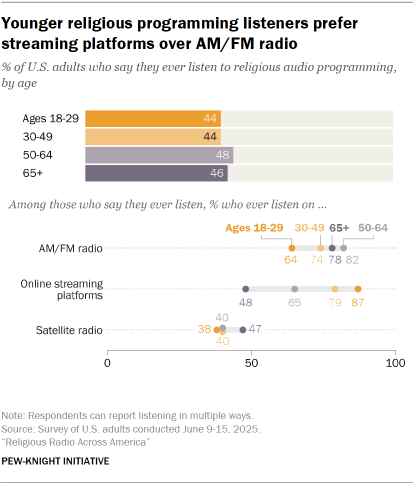
- Age and Politics: While age differences in overall listening are modest (44% of 18-49 year olds vs. 47% of those 50 and older), platform preferences diverge significantly. Listeners aged 50 and older predominantly favor AM/FM radio (82%), while younger adults aged 18 to 29 show a strong preference for online streaming platforms (87%). Politically, Republicans and Republican-leaning independents are more likely to listen to religious programming (53%) than Democrats and Democratic leaners (38%). This aligns with broader trends showing higher religious affiliation among Republicans.
- Platform Preferences: Across all listeners, AM/FM radio remains a dominant platform, with three-quarters of listeners tuning in at least occasionally. Online streaming services and podcasts are also widely used, by 70% of listeners, and satellite radio services reach 41%.
The report also delves into where individuals consume this content, with the vast majority listening at home (93%) or in a car (87%). Public spaces (55%) and workplaces (51%) are also common listening environments for a significant portion of the audience.
Understanding the Motivations Behind Listening
The importance of religious audio programming to listeners’ spiritual lives varies. Thirty-seven percent of those who listen consider it "extremely" or "very important" to their religious or spiritual well-being. An additional 35% find it "somewhat important," while 29% deem it "not too" or "not at all important."
The primary drivers for engaging with religious audio programming are centered on spiritual fulfillment and emotional well-being:
- Spiritual Fulfillment: 62% of listeners cite "it’s spiritually fulfilling or meaningful" as a major reason for tuning in.
- Relaxation and Calm: 51% find religious programming "relaxing or calming."
- Guidance and Advice: 39% turn to these programs for "life advice or guidance."
- Family-Friendly Content: 38% appreciate that the content is "family friendly."
- Entertainment: 28% find the programming "entertaining."
In contrast, staying informed about current events is not a significant motivator for most listeners. Only 14% consider it a major reason, and 59% report it is not a reason at all.

The Impact of Religious Audio Programming on Listeners’ Lives
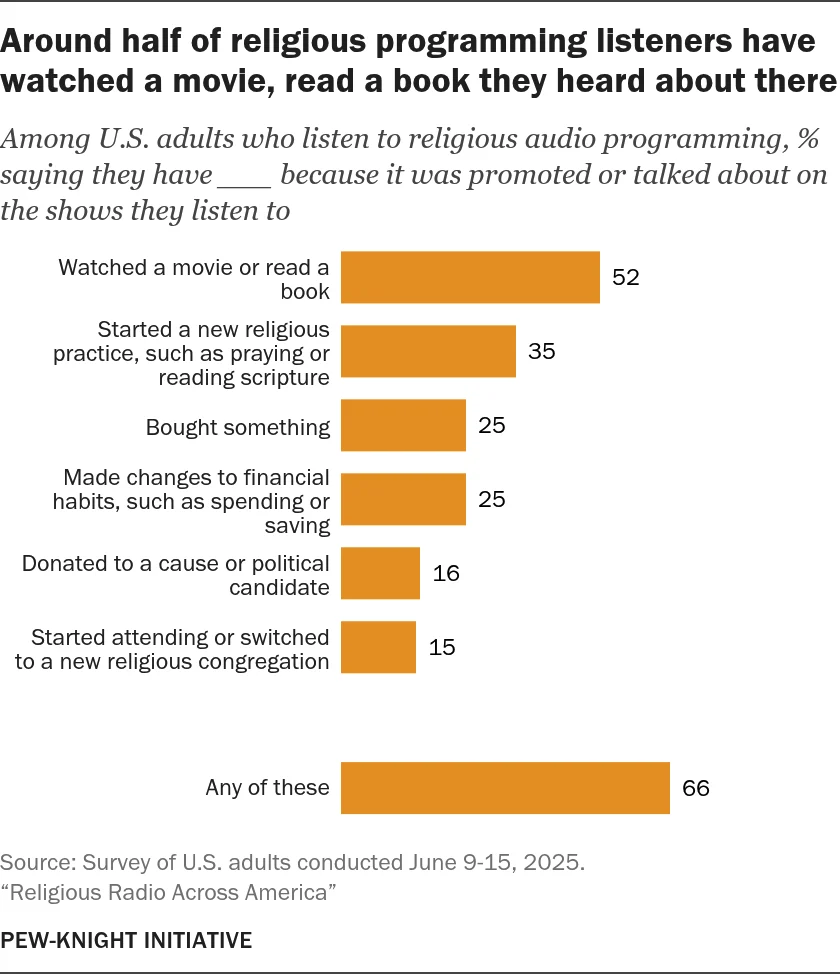
The influence of religious audio programming extends beyond passive listening, prompting tangible actions and changes in listeners’ lives. A significant 66% of listeners report taking at least one action as a direct result of content promoted or discussed on these programs.
Key actions taken by listeners include:
- Media Consumption: 52% have watched a movie or read a book that was recommended on the programming.
- Personal Practice: 35% have started a new religious practice, such as increased prayer or scripture reading.
- Financial Behavior: 25% have made changes to their financial habits, including spending or saving.
- Purchasing Decisions: 25% have bought something they heard about on the programs.
- Religious Engagement: 15% have started attending or switched to a new religious congregation.
- Philanthropy: 16% have donated to a cause or political candidate.
A notable finding is that 21% of listeners have directly contributed financially to a religious radio station, show, or podcast they follow. This behavior is somewhat more prevalent among Republican listeners compared to Democrats and is also relatively common among White evangelical Protestant listeners.
The alignment of content with personal beliefs is also a significant factor. Seventy-two percent of listeners feel the religious views expressed in the programming are very or somewhat similar to their own. Similarly, 74% find the content aligns with the views of their congregation. However, political differences emerge here, with Democratic listeners more likely than Republicans to report that the views they hear differ from their own (21% vs. 13%).
Context and Methodology: The Pew-Knight Initiative’s Role
This research is part of the broader "Religious Radio Across America" study, a multi-faceted project supported by the Pew-Knight Initiative. The initiative’s core mission is to foster a deeper understanding of how Americans engage with information, form their identities, and participate in civic life. Pew Research Center, renowned for its rigorous, nonpartisan approach, and the Knight Foundation, dedicated to strengthening communities through informed engagement, provide the foundational support and vision for this research.
The methodology for this specific report involved three primary data sources to provide a comprehensive overview of religious radio stations, their programming, and listener demographics and motivations. The survey data, collected from June 9-15, 2025, provides the granular details on listening habits and reasons for engagement. The survey questions, detailed responses, and full methodology are publicly available, reflecting the Pew Research Center’s commitment to transparency and data accessibility. This initiative builds upon the Center’s long-standing research agenda on news habits and media consumption, recognizing that religious radio stations constitute a substantial and often overlooked segment of the American media landscape.
Broader Implications and Future Directions
The findings from "Religious Radio Across America" offer critical insights for understanding media consumption patterns, religious engagement, and the influence of niche media in contemporary society. The persistent strength of AM/FM radio, even among older demographics, alongside the rapid adoption of digital platforms by younger audiences, highlights the evolving media ecosystem.
The data suggests that religious audio programming serves as more than just a source of spiritual comfort; it acts as a catalyst for action, influencing purchasing decisions, community involvement, and personal practices. This underscores the potential power of faith-based media to shape not only individual beliefs but also behaviors and economic activity.

As religious broadcasting continues to adapt to new technological landscapes and evolving audience preferences, further research into the long-term impact of these programs on community cohesion, civic participation, and individual well-being will be invaluable. The Pew-Knight Initiative’s commitment to exploring these complex intersections of information, belief, and engagement promises to yield further illuminating studies in the years to come.