The efficacy of diversity, equity, belonging, and inclusion (DEBI) initiatives is profoundly shaped by the precise articulation and communal understanding of their underlying terminology. Far from being mere semantics, the definitions applied to concepts like diversity, equity, belonging, and inclusion significantly influence how individuals perceive these efforts, whether they engage constructively, or if they instead retreat into resistance or apathy. This fundamental insight underpins the "Inclusion Nudges" change approach, which emphasizes that clearly defined, action-oriented terms are critical for dismantling systemic barriers and fostering widespread participation in making inclusion the societal norm.
The Unseen Barriers: Emotional and Cognitive Reactions to DEBI Terminology
For decades, organizations and societal movements have grappled with the challenge of implementing DEBI initiatives. Despite often noble intentions, the language used to champion these causes can inadvertently trigger profound, often negative, psychological reactions. Imagine the internal monologues evoked by terms such as "diversity," "equity," or "inclusion." For some, these words might spark enthusiasm and a sense of shared purpose; for others, they might elicit an immediate "Uhhh!" of apprehension or a dismissive "Blah blah blah!" of fatigue. Social psychology and cognitive science offer significant insights into why such varied and potent reactions occur.
Common patterns observed across various organizational settings reveal deeply entrenched misperceptions:
- "Diversity isn’t my issue; it only applies to minority groups, not to me." This sentiment highlights a crucial misunderstanding where diversity is siloed rather than recognized as encompassing the entire spectrum of human differences.
- "I am the one being discriminated against. Don’t ask me to fix it—it’s your problem." This reaction, often from marginalized groups, reflects exhaustion and a sense that the burden of change is unfairly placed upon them.
- "You’re diverse, so you need to fix it—it’s your problem." Conversely, this perspective from majority groups can externalize responsibility, shifting accountability away from those often in positions of greater systemic power.
- "Diversity and inclusion are not my day job, so I don’t really have time for that. Someone else has got to fix it." This illustrates how DEBI is often perceived as an ancillary function rather than an integral component of organizational culture and strategy.
- "Let’s make sure we attract some diversity talent." While seemingly positive, this phrase often narrowly defines "diversity" as a quota for specific demographic groups (e.g., women or minorities), overlooking the broader spectrum of differences.
- "If we are going to promote women and minorities, then we have to exclude others." This fear, often expressed by white men, underscores the pervasive "zero-sum game" mentality, where progress for one group is perceived as a direct loss for another.
These recurring patterns are not accidental; they are symptomatic of how DEBI efforts have historically been framed and implemented. Early approaches often focused on compliance, setting targets for specific demographic groups without engaging all members of an organization. Initiatives frequently aimed to "help the minority" or "fix the women," inadvertently reinforcing a narrative of difference that promoted assimilation rather than genuine inclusion. Such framing creates an "us and them" dynamic, fostering division and actively working against the very intentions of achieving the benefits that true diversity can bring.
The Power of Words: Shaping Perceptions and Behaviors
The profound impact of language on human perception, behavior, and culture is well-documented in scientific literature. Concepts like the "priming effect" demonstrate how words, even unconsciously, can influence thoughts and subsequent actions. A classic study, for instance, showed that individuals exposed to words associated with the elderly (e.g., "wrinkle," "forgetful") subsequently walked slower than those exposed to neutral words. In the context of DEBI, this means that the vocabulary used can subtly prime individuals to react with openness or defensiveness, cooperation or resistance.
Moreover, language can inadvertently reinforce stereotypes, even when attempting to dismantle them. Research has shown that statements like "girls are as good as boys at math" can backfire, paradoxically strengthening the underlying stereotype that boys are inherently better at math. This highlights the delicate nature of DEBI communication, where imprecise language, even with positive intent, can exacerbate existing biases.
Beyond cognitive priming, words also carry significant emotional weight, triggering responses that profoundly influence unconscious thinking and decision-making. Two powerful emotional drivers frequently activated by DEBI discussions are the fear of loss and the reinforcement of tribalism.
Fear of Loss and Tribalism: When diversity is perceived as a zero-sum game—where one group’s gain necessitates another’s loss—it triggers "loss aversion bias." Individuals are wired to avoid losses more strongly than they pursue equivalent gains. Consequently, the prospect of relinquishing perceived power or privilege can lead to resistance, defensiveness, and a tenacious desire to maintain the status quo. This emotional barrier can halt progress even when the rational arguments for DEBI are compelling.
Furthermore, discussions around difference can activate innate tribal mentalities. Humans possess an instinctive fear of the "unknown" and a tendency to favor "in-group" members while exhibiting caution or even unconscious bias toward "out-group" members. This can manifest as unintentional exclusion of knowledge or perspectives from individuals perceived as outside one’s immediate group, while information from "in-group" members is more readily trusted and processed. These emotional reactions significantly shape how individuals filter information and construct their mental models of DEBI.
The Overlooked Impact of Shame: A less acknowledged but equally potent emotional barrier in DEBI work is shame. The language used can inadvertently induce feelings of shame in some individuals, particularly those who perceive themselves as privileged or who have been accused of discrimination without malicious intent. This can stem from a realization of unconscious bias or from a sense of helplessness in addressing systemic inequalities. Such feelings often trigger defensive behaviors, including subtle micro-aggressions, which further impede constructive dialogue and collaborative action. These deep-seated emotional responses, if left unaddressed, can create profound "stuck patterns" that derail even the most well-intentioned change initiatives.
The Absurdity of Unarticulated Definitions
A critical "trip wire" in DEBI efforts is the pervasive lack of formally articulated definitions for core terms. While "diversity," "equity," "belonging," and "inclusion" are used extensively, a common, agreed-upon framework of understanding is often absent. This leaves individuals within organizations and communities to interpret these terms based on their unique lived experiences, social constructs, and knowledge bases, leading to widely divergent mindsets and approaches.
For example, "diversity" might be narrowly equated with "women" by some, while others might view "inclusion" solely as participation in affinity networks, missing its broader application to leveraging diverse perspectives. "Equity" might be reduced to "minority hiring targets," overlooking the systemic changes required for fair treatment and equal opportunity. Without a shared framework, expecting aligned actions and behaviors becomes an "absurd reality," leading to stalled progress and fragmented efforts. The founders of the Inclusion Nudges global initiative, Lisa and Tinna, acknowledge having fallen into this trap themselves, underscoring its commonality even among experts.
Crafting a Shared Understanding: The Inclusion Nudges Framework
To counteract these pervasive challenges, the Inclusion Nudges approach advocates for precise, comprehensive, and universally applicable definitions that serve as guiding stars for change. These definitions are designed not merely for intellectual understanding but to foster alignment, engagement, and ultimately, collective action towards desired outcomes.
The Inclusion Nudges initiative defines the core concepts as follows:
-
Diversity: The Mix of All of Us. Diversity is fundamentally about people, encompassing their demographic differences, backgrounds, multiple identities, unique experiences, perspectives, knowledge, abilities, and ideas. Crucially, it does not refer solely to specific characteristics of "the minority" but rather to the totality of human differences within any group or society. Diversity is recognizing and valuing the rich tapestry that constitutes "all of us."
-
Equity: The Fairness Frame for the Mix. Equity is centered on ensuring that all individuals have genuine access to opportunities and fair treatment. It actively seeks the elimination of discriminatory practices, systems, laws, policies, social norms, and cultural traditions. Equity involves balancing power dynamics and actively correcting historical and systemic inequalities. It acknowledges that achieving fairness often requires different approaches and resources to address differing needs and disadvantages. The overarching intent of equity is to ensure genuine fairness for all, moving beyond superficial equality.
-
Belonging: I Feel Valued as a Part of the Mix. Belonging focuses on the individual’s subjective experience within a given setting. It signifies a state where individuals feel genuinely welcomed, secure in the knowledge that structures exist to ensure fairness, and empowered to express their full, authentic selves without fear of having to "cover" or downplay personal traits. When diversity, equity, and inclusion are successfully implemented, belonging is the natural outcome, characterized by individuals feeling seen, heard, safe, and valued as integral members of a group.
-
Inclusion: Welcoming and Applying the Mix. Inclusion is the active process of fostering structures, systems, processes, cultures, behaviors, and mindsets that embrace and respect all people and their diverse attributes. It involves proactively seeking out diversity, challenging exclusionary norms and stereotypes, demonstrating openness to others, and speaking up against injustice. Inclusion ensures that the richness of diverse knowledge, perspectives, information, and ideas is not only welcomed but actively leveraged. It is when all individuals are valued and enabled to participate and contribute to their fullest potential. Inclusion is the active welcoming and application of the entire "mix of all of us."
These definitions provide a foundational common understanding that is vital for alignment and engagement. They shift the focus from a deficit-based approach (fixing problems) to a resource-oriented one (leveraging potential).
From Definitions to Actions: Cultivating Inclusive Behaviors
While articulating clear definitions is a crucial first step, a purely rational understanding is often insufficient to drive behavioral change. Human behavior is largely governed by unconscious cognitive processes (System 1 thinking), not just conscious reasoning (System 2). Therefore, a successful DEBI strategy must bridge the gap between abstract definitions and concrete, actionable behaviors.
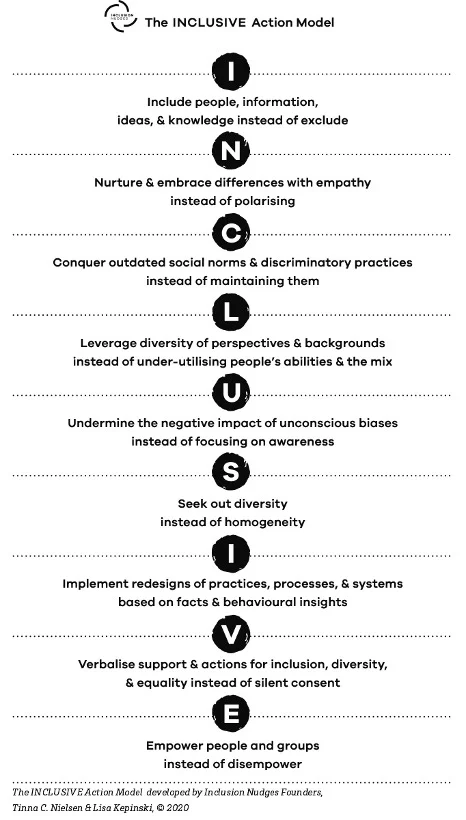
The Inclusion Nudges approach advocates for an "inclusive definitions of inclusive actions" methodology. Instead of presenting pre-determined definitions, organizations are encouraged to engage "the people it’s about"—employees, community members, stakeholders—in the process of identifying what inclusive, inviting, respectful, and empathetic actions look like and feel like in their specific context. This participatory approach achieves several critical objectives:
- Contextual Relevance: Definitions emerge organically from the group’s lived experiences, making them highly relevant and resonant.
- Engagement and Ownership: By involving individuals in the co-creation process, they become "onboarded" into the change initiative from the outset, fostering a sense of ownership and commitment. This leverages the diversity within the group itself to build a shared understanding.
- Action Orientation: The focus shifts from abstract concepts to tangible behaviors. Instead of discussing "what is inclusion," the conversation becomes "what do we do here that makes people feel included?"
Making Inclusive Actions Visible and Normative
Once these inclusive behaviors and actions are identified, the next step is to make them highly visible and reinforce them as the norm. This involves:
- Communication: Sharing diverse, real-life examples and personal stories of inclusive behavior through various communication channels. This could include internal newsletters, intranet articles, and dedicated storytelling platforms.
- Environmental Reinforcement: Displaying these examples prominently in physical spaces such as factories, offices, meeting rooms, and public areas. Visual cues serve as constant reminders and demonstrate that these behaviors are valued and expected. The key is to present these as common, peer-driven actions rather than top-down directives.
- Targeted Messaging: When communicating, share one example at a time to avoid cognitive overload. Crucially, emphasize that these are actions undertaken by "peers" or "similar others." Leveraging social proof, such as stating "8 out of 10 of your colleagues are doing XX," can powerfully influence behavior by signaling that inclusive actions are already the prevailing norm.
The goal is to "achieve inclusion without talking about inclusion" as a separate, isolated initiative. Instead, integrate inclusive practices into the fabric of daily work and organizational culture. Rather than using the abstract term "inclusion," refer to its desired outcomes or operational manifestations, such as "it’s how work gets done here," "it’s how people experience being in the group," or "we need the thinking from everyone for new solutions." This shifts perception towards a resource-oriented and positively associated understanding of DEBI, embedding it as an intrinsic part of organizational effectiveness, innovation, and agility.
Broader Impact and Future Implications
The strategic framing of DEBI terminology and the focus on action-oriented engagement have profound implications for organizational success and societal progress. By creating a common understanding and fostering a culture of shared ownership, organizations can expect:
- Increased Employee Engagement and Retention: When individuals feel truly valued, respected, and heard, their engagement, loyalty, and productivity naturally increase.
- Enhanced Innovation and Problem-Solving: Leveraging the full spectrum of diverse perspectives, knowledge, and experiences leads to more creative solutions, robust decision-making, and greater organizational adaptability.
- Reduced Resistance to Change: By involving everyone in the process and framing DEBI as a collective benefit rather than a zero-sum game, resistance diminishes, and buy-in grows.
- Stronger Organizational Culture: A truly inclusive culture fosters trust, psychological safety, and a sense of belonging, which are cornerstones of high-performing teams and resilient organizations.
- Compliance and Ethical Leadership: Moving beyond mere compliance, this approach embeds ethical leadership and social responsibility into the core operations, aligning with evolving societal expectations and legal mandates.
The challenge lies in translating these principles into consistent, large-scale action across thousands of individuals with diverse understandings and reactions. This is precisely the "headache" that methodologies like Inclusion Nudges aim to resolve by providing practical, behaviorally informed tools and strategies. By inviting organizations and individuals to adopt this change approach, the movement seeks to accelerate the pace at which inclusion becomes the default norm—everywhere, for everyone. The journey towards a truly inclusive society begins with the words we choose and the shared realities they create.