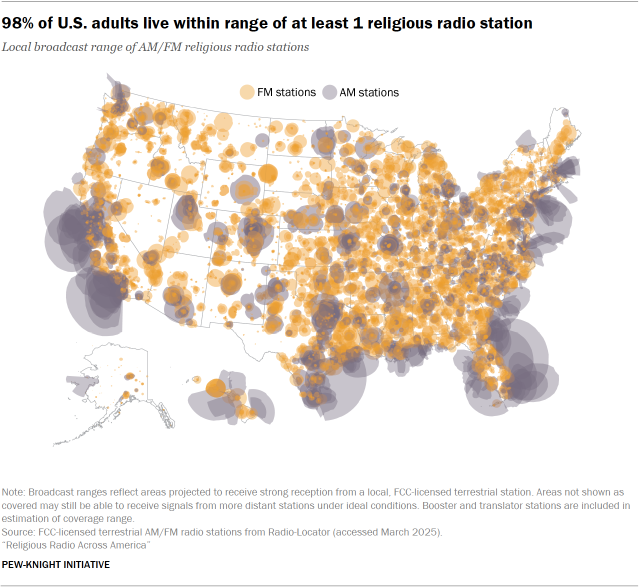
Faith-based radio stations constitute a significant and widespread presence within the United States’ media landscape, reaching an estimated 98% of the adult population. A comprehensive analysis conducted by the Pew Research Center, under the umbrella of the Pew-Knight Initiative, reveals that over 4,000 terrestrial religious stations broadcast across the nation. This figure represents approximately a quarter of the more than 17,000 FCC-licensed AM and FM stations, underscoring the extensive accessibility of religious programming to Americans in nearly every corner of the country.
The Pew-Knight Initiative, a collaborative research effort funded by The Pew Charitable Trusts and the John S. and James L. Knight Foundation, aims to deepen public understanding of how Americans consume civic information, shape their beliefs and identities, and engage within their communities. This particular report delves into the characteristics of religious radio stations, their programming, and the motivations of their listeners. Pew Research Center, a nonpartisan fact tank, and the Knight Foundation, a social investor focused on fostering informed and engaged communities, jointly support research that sheds light on these crucial aspects of American life.
A Widespread and Accessible Medium
The study highlights the ubiquitous nature of religious radio, noting that most Americans live within range of at least one such station. On average, individuals can access six different religious broadcasts from their homes. This broad coverage extends to geographical areas as well; approximately two-thirds of the nation’s landmass, and a remarkable 99% of its urban centers, fall within the signal range of at least one religious station. This pervasiveness suggests that religious radio serves as a consistent and readily available source of content for a substantial segment of the population.

While religious radio is broadly accessible, its concentration varies by region. The Southern United States exhibits the highest density, with 87% of its landmass covered by at least one religious station. This finding aligns with existing data from the Center’s 2023-24 Religious Landscape Study, which indicates that individuals in the South tend to report higher levels of religious affiliation compared to those in other regions, with 74% identifying with a religion, including 68% who are Christian.
Conversely, other regions demonstrate lower overall coverage. For instance, the Northeast region experiences the least widespread coverage of religious radio, with only 48% of its landmass within reach of these stations.
State-Level Variations and Ownership Structures
The analysis also reveals significant state-level disparities in the proportion of religious radio stations. North Carolina leads the nation, with 36% of its total AM and FM stations dedicated to religious programming. Texas follows closely with 34%, and Nebraska and South Carolina each have 32%. At the other end of the spectrum, states like Connecticut (12%), Rhode Island (13%), and Vermont (15%) have a considerably smaller percentage of their radio stations focused on religious content.
These figures are particularly noteworthy when considering the total number of stations. Texas boasts the highest absolute number of religious radio stations, with 433. However, when considering stations per capita, states with lower population densities often show a higher ratio. Wyoming, for example, has 6.6 religious stations per 100,000 residents, and Alaska has 7.3, illustrating how geography and population distribution influence the perceived density of this media format.
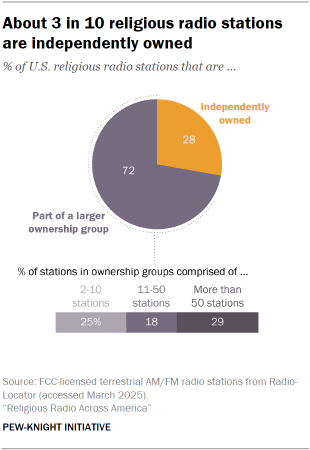
The ownership of religious radio stations reveals a landscape dominated by organizations operating multiple stations. Approximately 30% of these stations are part of large ownership groups, with more than 50 individual stations. The most prominent among these is the Educational Media Foundation (EMF), which operates the popular Air1 and K-LOVE radio networks. EMF’s extensive reach includes hundreds of stations nationwide, complemented by an online streaming platform and a podcast network.
A further 42% of religious stations are affiliated with small or medium-sized ownership groups. In contrast, 28% operate as independent entities, licensed to organizations that own no other radio stations. While similar proportions of religious and nonreligious stations are part of ownership groups, a key distinction emerges in content sharing. Nonreligious stations that stream online typically broadcast from unique URLs, even if their licensee owns multiple stations. However, religious radio stations that offer web streams are more likely to share a single online feed among five stations, suggesting a greater degree of content centralization within networked religious broadcasting.
Programming and Listener Engagement
Beyond ownership and accessibility, the content of religious radio programming is a crucial aspect of its appeal. Many religious stations carry popular syndicated shows, indicating a shared programming strategy across diverse ownership structures. For example, "Unshackled" and "Turning Point" are broadcast by roughly half of all religious radio stations, while "Focus on the Family" is featured on 44% of schedules.
Furthermore, the availability of these popular syndicated programs extends beyond traditional broadcast. A significant finding is that 99 out of the 100 most widely carried programs on religious radio are also accessible on-demand through podcasts or platforms like YouTube. This indicates a robust multi-platform presence for religious content, catering to listeners’ evolving media consumption habits.

Methodology and Research Context
This report is part of a broader study on religious radio in the U.S. initiated by the Pew-Knight Initiative. The research methodology employed a triangulation of data sources to provide a comprehensive view of religious radio stations, their programming, and listener motivations. These sources include an analysis of FCC licenses to identify station characteristics and ownership, a survey of radio listeners to understand their habits and reasons for tuning in, and an examination of station playlists and programming schedules. The detailed survey questions, topline responses, and methodology are publicly available, reflecting the Pew Research Center’s commitment to transparency.
The decision to conduct this research stems from Pew Research Center’s ongoing commitment to understanding news habits and media consumption. Religious radio stations represent a significant, yet often under-examined, component of the American media ecosystem. By investigating the role of these stations, the Center aims to provide a more complete picture of how Americans access information and form their beliefs, particularly in an era of increasingly fragmented media consumption. The findings contribute to a long-standing research agenda focused on informing the public, media, and policymakers about critical societal trends.
Implications and Broader Impact
The extensive reach and consistent presence of religious radio stations suggest their continued importance as a communication channel for religious communities and individuals seeking faith-based content. The high percentage of Americans within broadcast range, coupled with the multi-platform availability of popular programs, indicates a sustained engagement with this medium.
The concentration of religious radio in the South, mirroring regional religious demographics, highlights the intersection of faith, culture, and media consumption. The analysis of ownership structures, particularly the prevalence of networked content sharing, raises questions about the diversity of voices and perspectives offered within this segment of the media landscape.
As digital media continues to evolve, the accessibility of religious radio content through podcasts and online streaming platforms suggests an adaptation to changing listener preferences. This adaptability may be crucial for maintaining relevance and reach in the years to come. The Pew-Knight Initiative’s ongoing work provides a valuable resource for understanding these dynamics and their implications for civic life, belief formation, and community engagement in the United States. The findings offer a nuanced perspective on a significant, yet often overlooked, facet of American media and its role in shaping cultural and spiritual landscapes.