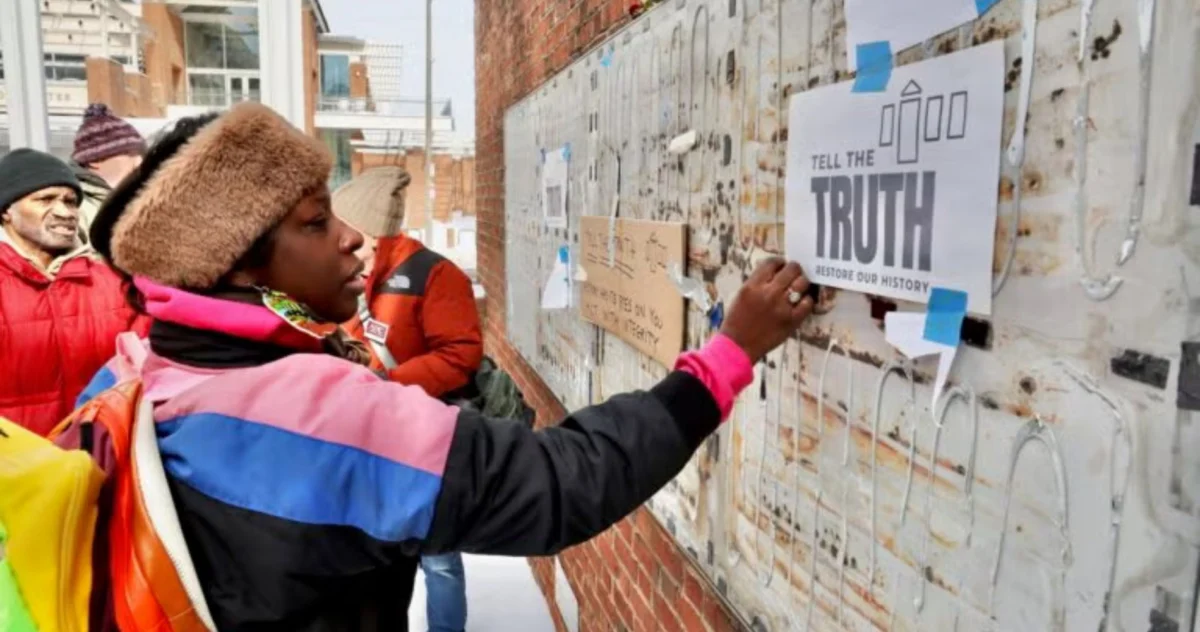
A federal court delivered a significant ruling on Monday, ordering the National Park Service (NPS) to reinstate exhibits at the President’s House in Philadelphia. These crucial displays detail President George Washington’s ownership of enslaved people and illuminate the lives of those he held in bondage, including the complex methods employed to circumvent Pennsylvania’s gradual abolition laws. The decision marks a victory for historical preservation and a comprehensive understanding of the nation’s founding, rebuking an attempt by the federal government to alter historical narratives without justification.
The Court’s Mandate: Reaffirming Historical Truth
The order, issued as a preliminary injunction, compels the NPS to "reinstall all panels, displays, and video exhibits that were previously in place" at the President’s House site. Furthermore, it prohibits "any additions, removals, destruction, or further changes of any kind" to the site, ensuring the integrity of the historical interpretation. This swift judicial intervention came after the City of Philadelphia filed a lawsuit against the NPS, following the agency’s unannounced removal of the exhibits on January 22, 2026. The city sought to halt the removal and mandate the restoration of the comprehensive historical narrative, arguing that the federal government’s actions constituted an illegal and damaging erasure of history.
The court’s 40-page decision meticulously outlined how the removal, initiated by the previous Trump administration without the city’s consent, violated federal law and agreements stretching back to the 1948 creation of Independence National Historical Park (INHP). This foundational park was established to preserve significant historical structures related to the nation’s founding for the benefit of the American people, implicitly demanding a commitment to accurate and complete historical representation.
A Contested History Unveiled: The President’s House and Its Legacy
The President’s House site holds profound historical significance, marking the precise location of the nation’s first executive mansion. It served as the official residence for Presidents George Washington and John Adams during Philadelphia’s tenure as the capital, from 1790 to 1800. For decades, the site was largely recognized for its presidential occupancy, but a deeper, more challenging truth lay beneath the surface, gradually brought to light by meticulous historical research.
The modern understanding of the President’s House began to coalesce in the early 2000s when archaeological excavations confirmed the footprint of the original residence. Concurrent historical investigations revealed critical information about the nine enslaved African individuals whom President Washington brought to Philadelphia: Oney Judge, Austin, Christopher Sheels, Giles, Hercules Posey, Joe Richardson, Moll, Paris, and Richmond. Their presence at the heart of the nascent American government starkly contrasted with Pennsylvania’s progressive (for its time) Act for the Gradual Abolition of Slavery, passed in 1780. This law stipulated that enslaved individuals residing in Pennsylvania for six months could petition for their freedom. To circumvent this, Washington systematically rotated his enslaved people in and out of the state, a practice that underscored the lengths to which slaveholders would go to maintain their human property, even while leading a nation founded on principles of liberty.
The Paradox of Freedom and Bondage at the Nation’s Birthplace
The concept of the "paradox of freedom and slavery" is central to the exhibit and the court’s ruling. It encapsulates the inherent contradiction of a nation declaring independence with the cry of "Life, Liberty and the pursuit of Happiness," while simultaneously upholding the brutal institution of chattel slavery. At the President’s House, this paradox was acutely felt. Steps away from Independence Hall, where the Declaration of Independence and the U.S. Constitution were forged, enslaved individuals toiled under the authority of the very man who led the Continental Army and presided over the Constitutional Convention.
The narrative of Oney Judge stands out as a powerful testament to this paradox. Judge, an enslaved woman who served Martha Washington, famously escaped from the President’s House in 1796, making her way to freedom in New Hampshire. Her escape, and the subsequent attempts by the Washingtons to recapture her, became a symbol of the individual struggle against an oppressive system, even in the shadow of the nation’s highest office. In 2022, recognizing its profound historical resonance, the NPS designated the President’s House a National Underground Railroad Network to Freedom site, specifically acknowledging Judge’s flight and its broader implications for American ideals. This designation underscored the site’s role in exploring "how her struggle for freedom represented this country’s progress away from the horrors of slavery and into an era where the founding ideals… could be embodied for every American."
Genesis of an Exhibit: A Community’s Commitment to Honest History
The journey to establish a comprehensive exhibit at the President’s House was a collaborative effort driven by a commitment to historical accuracy and public education. In 2003, the U.S. House of Representatives formally urged the park service to commemorate the lives of those enslaved by President Washington at the site. The City of Philadelphia, recognizing the profound importance of this untold history, invested millions of dollars into the project. City officials, historians, and community groups worked tirelessly to ensure that the site would "tell an honest story about American history and the founding of this country and the role that slavery and enslaved Africans had."
The culmination of these efforts was the opening of "President’s House: Freedom and Slavery in the Making of a New Nation" in December 2010. The exhibit was hailed as a groundbreaking initiative, designed not merely to acknowledge slavery but to explore its complexities, humanize the enslaved individuals, and force visitors to confront the foundational contradictions of American liberty. The NPS itself, at the time, described the site as "crucially significant to examine the paradox of freedom and slavery at the nation’s founding." It became a vital educational resource, drawing visitors from across the nation and the world, offering a nuanced perspective often absent from traditional historical narratives.
The Removal and the Legal Challenge: An Attack on Public Memory
The removal of these deeply researched and carefully curated exhibits on January 22, 2026, sent shockwaves through the historical and civic communities. The NPS, under the directive of the then-executive administration, dismantled panels, displays, and video exhibits that referenced slavery and detailed the lives of the enslaved individuals. The city of Philadelphia, a key partner and investor in the exhibit, viewed this action as an egregious violation of trust and an assault on public memory.
During the federal court hearing, Justice Department lawyers, representing the NPS, struggled to provide a coherent rationale for the removal. They presented "no evidence" or "reasoned explanation" to support their actions, relying instead on a broad executive order that directed NPS to review and remove materials deemed to "inappropriately disparage Americans" and specifically cited Independence National Historical Park as a site that promoted "corrosive ideology." This justification echoed a broader political movement during that period, characterized by efforts to promote a "patriotic education" that often downplayed or omitted inconvenient truths about American history, particularly regarding slavery and racial injustice. The "1776 Commission," established by the Trump administration, explicitly sought to push a narrative that minimized the role of slavery and racial conflict in the nation’s founding, advocating for historical interpretations that avoided what it termed "divisive concepts." The removal of the President’s House exhibits aligned perfectly with this ideological agenda.
Judicial Scrutiny: "Truth Is No Longer Self-Evident"
The court’s response to the government’s arguments was scathing and unequivocal. It found that the NPS, in removing the exhibits, had done precisely what the executive order purportedly condemned: "replacing objective facts with a distorted narrative driven by ideology rather than truth." The court firmly stated, "It is not disputed that President Washington owned slaves." Yet, the government’s argument suggested it "alone has the power to erase, alter, remove and hide historical accounts on taxpayer and local government-funded monuments within its control."
Drawing a stark parallel, the court invoked George Orwell’s dystopian novel "1984," specifically referencing the Ministry of Truth, with its chilling motto "Ignorance is Strength." This fictional ministry was empowered to "track down and collect all copies of books, newspapers, and other documents which had been superseded" and to "destroy or rewrite them to suit the government." The court explicitly warned that the government’s position mirrored this authoritarian concept: "The government here likewise asserts truth is no longer self-evident, but rather the property of the elected chief magistrate and his appointees and delegees, at his whim to be scraped clean, hidden, or overwritten." The court concluded with a pointed rhetorical question: "And why? Solely because, as Defendants state, it has the power."
The Justice Department’s assertion that "the Government gets to choose the message it wants to convey" was decisively rejected by the court. The ruling underscored a fundamental principle of governance and historical stewardship: "An agency… cannot arbitrarily decide what is true, based on its own whims or the whims of the new leadership." While acknowledging the government’s right to convey messages elsewhere, the court affirmed that it could not do so "by wiping away the history of the greatest Founding Father’s management of persons he held in bondage" at a site specifically dedicated to exploring that very history.
Irreparable Harm to Public Memory and Education
Central to the court’s decision was its finding of "irreparable harm" should the exhibits not be restored and safeguarded. The City of Philadelphia argued that the removal resulted in "a loss of access to historical truth, an undermining of the public trust, and an inability to recount its own story in preparation for the semiquincentennial." The court agreed, concluding that the removal "constitutes erasure, undermines public trust, and compromises the integrity of public memory."
The court emphasized that the President’s House represents the City’s "fulfilling an obligation to tell the truth—the whole, complicated truth." The removal of these crucial interpretive materials stripped the site of that truth and deprived the public of essential educational opportunities. Importantly, the court found that all visitors would be harmed by the absence of the displays, which were "not mere decorations to be taken down and redisplayed." Rather, they constituted "a memorial to ‘men, women, and children of African descent who lived, worked, and died as enslaved people in the United States of America,’ a tribute to their struggle for freedom, and an enduring reminder of the inherent contradictions emanating from this country’s founding." The court’s concluding statement on this point was unequivocal: "Each person who visits the President’s House and does not learn of the realities of founding-era slavery receives a false account of this country’s history."
Broader Implications for Historical Interpretation and Public Trust
This federal court ruling carries significant implications extending far beyond the President’s House. It sets a crucial legal precedent regarding the authority of federal agencies to unilaterally alter established historical narratives at national parks and monuments, especially when such alterations are perceived as ideologically driven rather than fact-based. Historians, civil rights advocates, and educators widely praised the decision, viewing it as a strong affirmation of the importance of comprehensive and unvarnished historical truth in public spaces.
The ruling reinforces the principle that historical sites, particularly those funded by taxpayers and developed through collaborative efforts with local communities, are not merely canvases for current political messaging. They are vital repositories of public memory, entrusted with the responsibility of presenting a factual and nuanced understanding of the past, even when that past is uncomfortable or complex. This decision also underscores the power of local governments and civic organizations to challenge federal overreach when it threatens shared cultural heritage.
Looking Ahead: The Semiquincentennial and the Future of Historical Stewardship
As the United States approaches its Semiquincentennial in 2026—the 250th anniversary of the Declaration of Independence—the debate over how the nation commemorates its founding and confronts its past is intensifying. The President’s House ruling serves as a timely reminder of the importance of presenting a complete and honest history, acknowledging both the triumphs and the profound moral failures embedded in the American story. Philadelphia, as the birthplace of the nation, is central to these commemorations, and its commitment to "the whole, complicated truth" at sites like the President’s House will be critical in shaping how Americans understand their heritage.
The National Park Service, now legally bound to restore the exhibits, faces the task of rebuilding public trust and demonstrating its commitment to its foundational mission of preserving and interpreting American history accurately. While the Justice Department has the option to appeal the preliminary injunction, the court’s robust reasoning makes such a challenge difficult. For now, the decision stands as a powerful affirmation that the pursuit of historical truth, however challenging, remains a cornerstone of American civic life and a non-negotiable obligation for those entrusted with the nation’s heritage. The President’s House will once again stand as a testament to the ongoing dialogue between the ideals of American freedom and the enduring legacy of American slavery.