PHILADELPHIA – The National Constitution Center, in a significant stride towards greater inclusivity, has launched "Feel the Founders’ Faces," an innovative program designed to provide blind and low-vision visitors with an immersive and sensory experience of its renowned Signers’ Hall. This groundbreaking initiative, a collaboration with Philly Touch Tours, an organization dedicated to creating accessible cultural experiences, allows individuals to explore the intricate details and palpable personalities of the Founding Fathers through touch. The program represents a novel approach to historical engagement, transforming static exhibits into dynamic, tactile narratives.
The genesis of "Feel the Founders’ Faces" lies in the desire to broaden access to pivotal historical narratives and to recognize the diverse ways in which individuals connect with information. For years, the National Constitution Center has strived to make its programming more inclusive, and the tactile nature of the life-sized bronze statues in Signers’ Hall presented a unique opportunity. These meticulously crafted figures, depicting delegates in moments of contemplation and discussion, were deemed ideal for a program that bypasses visual cues entirely.
"Our goal is to make all of our programming more accessible to more audiences," stated Vince Stango, interim president of the National Constitution Center. "Because of the way the statues are created, the texture and the features, Signers’ Hall is a great way to start. It’s about offering multiple pathways to understanding and appreciating the foundational moments of American democracy."
The program, which has been in development for approximately one year, is now scheduled to run four to six times annually on Sunday mornings, prior to the museum’s public opening. This dedicated time allows participants to engage with the exhibits at a deliberate pace, fostering a deeper connection with the historical figures and the context of their era.
Philly Touch Tours, which has a proven track record of designing tactile tours for various institutions, including the Mütter Museum and the Philadelphia Flower Show since 2014, recognized the exceptional potential of Signers’ Hall. Katherine Allen, program director for Philly Touch Tours, remarked on the natural synergy between the exhibit and their mission. "I’ve been on a lot of tours," Allen said, "but it’s like these statues were conceived for a touch tour. The detail and the poses lend themselves so beautifully to this kind of exploration."
A Sensory Journey Through History
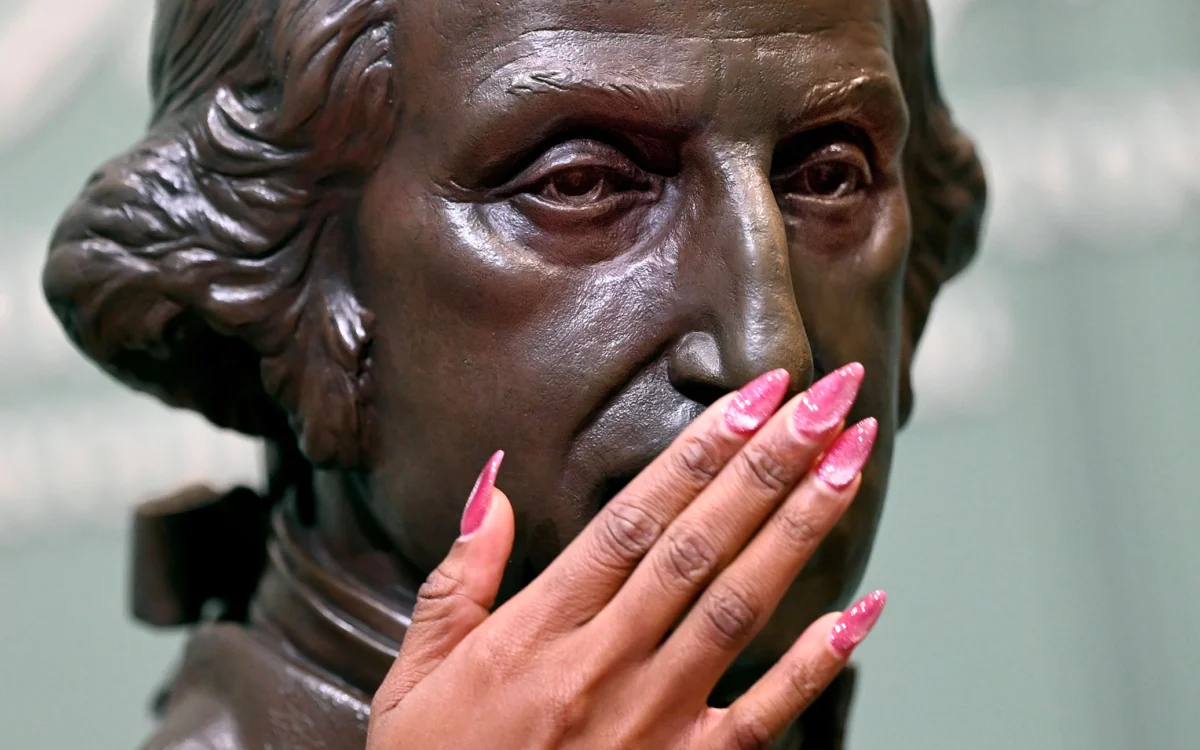
During a recent session, visitors like Kosi Asabere, a Philadelphia resident in her early 40s, navigated the hall, her hands tracing the contours of the bronze figures. The experience offered a profound connection to the individuals who shaped the nation. As Asabere placed her hands on a statue of George Mason, a delegate from Virginia, she interpreted his posture. "He seems confident," she observed, her fingers exploring the placement of his hands, gripping the lapels of his long coat, his shoulders pulled back, and his left foot forward. "I feel like his body language shows he is a man of status." This tactile engagement allowed Asabere to infer not just physical attributes but also character traits and social standing.
The statues, designed to capture delegates in active poses rather than stiff, formal stances, proved particularly effective for this tactile approach. "These are like action photos," noted Cory Lloyd, a 43-year-old tour participant from Philadelphia. "You can tell the people are in the middle of discussions – not posing, per se." This dynamism imbues the statues with a lifelike quality that translates powerfully through touch.
The program emphasizes not just the physical depiction of the Founders but also the nuances of their individual stances and expressions. Simon Bonenfant, a young man in his mid-20s who is also a cultural accessibility consultant for Philly Touch Tours, participated in a demonstration, mirroring the pose of Elbridge Gerry, a dissenter. His guide positioned his hands at his sides to match Gerry’s, asking him for his impression. "Obstinate," Bonenfant responded, a clear testament to the communicative power of posture and form.
This level of engagement goes beyond mere identification. Visitors are encouraged to notice "the set of a shoulder, the placement of a hand, the stance of a dissenter making his case." This guided exploration allows for a deeper, more personal understanding of the historical context and the individuals involved in the Constitutional Convention.
Training and Development: A Collaborative Effort
The success of "Feel the Founders’ Faces" is underpinned by extensive training and meticulous planning. Bonenfant, instrumental in developing the program, worked closely with the National Constitution Center’s staff. His expertise in disability awareness and guiding blind visitors informed the training modules, which covered verbal description techniques and the practicalities of leading tactile tours. Trial runs were conducted to optimize group movement through the hall and to determine the ideal amount of time to be spent at each statue, ensuring a comprehensive yet unhurried experience.
The curriculum for the guides focused on developing their descriptive language skills, enabling them to translate visual information into vivid auditory and tactile narratives. This involves not just identifying objects but also conveying their texture, temperature, and spatial relationships.
Uncovering Hidden Details
The program’s effectiveness is further highlighted by the unexpected discoveries participants have made. Jasmin Sethi, a 40-year-old visitor, was examining the detailing on the shirt of a delegate. While her guide had informed her that the delegate was a wealthy man who enslaved people, the tactile experience of "actually feeling the fancy buttons on the shirt" made the historical context more tangible and memorable.
Jeff Boudwin, 35, who lost his sight at four months old due to a brain tumor, had visited the National Constitution Center previously. However, on this tactile tour, as he traced the back of a delegate’s head, he discovered a detail he had never perceived before: a bow securing the man’s powdered queue. "I’ve been here before," he remarked, "But I never noticed that." Such discoveries underscore the value of the program in revealing layers of detail that might otherwise remain unseen and unappreciated.
The Historical Significance of Signers’ Hall
Signers’ Hall itself is a critical component of the National Constitution Center’s experience. It recreates the Assembly Room of the Pennsylvania State House (now Independence Hall) where the U.S. Constitution was debated and signed in 1787. The hall features 42 life-sized bronze statues of delegates, each rendered with remarkable accuracy based on historical portraits and descriptions. The decision to include statues of the signers themselves, rather than just the documents they created, was a deliberate choice by the museum to humanize the historical figures and make their contributions more relatable.
The Constitutional Convention, held in Philadelphia from May to September 1787, was a pivotal moment in American history. Delegates from twelve states (Rhode Island did not attend) convened to address the weaknesses of the Articles of Confederation, the first governing document of the United States. Over four months of intense debate, compromise, and negotiation, they drafted a new Constitution, establishing a federal system of government with three branches: legislative, executive, and judicial. The convention brought together a diverse group of individuals, many of whom had played significant roles in the American Revolution. Their differing viewpoints and political philosophies are reflected in the complex and enduring document they produced.
The statues in Signers’ Hall represent key figures such as George Washington, presiding over the convention; James Madison, often called the "Father of the Constitution" for his intellectual contributions and detailed notes; Alexander Hamilton, a strong advocate for a powerful federal government; and Benjamin Franklin, the elder statesman whose wisdom and pragmatism were invaluable. The inclusion of figures like George Mason, who famously refused to sign the Constitution without a bill of rights, adds a layer of complexity and highlights the spirited debates that characterized the convention.
Broader Implications and Future Vision
The "Feel the Founders’ Faces" program has significant implications for the field of museum accessibility and historical interpretation. It demonstrates that tactile engagement can be a primary mode of learning, not merely an auxiliary accommodation. By prioritizing touch, the program unlocks a deeper level of comprehension and emotional connection for visually impaired visitors, while also offering a novel perspective for sighted individuals who may choose to participate.
The success of this initiative is likely to inspire similar programs in other cultural institutions. As museums and historical sites increasingly commit to universal design principles, tactile tours offer a powerful avenue for ensuring that the richness of human history is accessible to all. The program’s emphasis on the expressive qualities of sculpture—the stance, the gesture, the subtle tilt of a head—reveals how art can convey information and evoke emotion beyond purely visual means.
The National Constitution Center’s commitment to accessibility extends beyond this single program. The museum actively seeks to incorporate diverse perspectives and engage a wide range of audiences in its educational mission. "Feel the Founders’ Faces" is a testament to this ongoing effort, showcasing how innovation and collaboration can lead to truly transformative visitor experiences. The program’s phased rollout and continued operation suggest a long-term vision for accessibility at the heart of the institution’s programming.
The collaborative spirit between the National Constitution Center and Philly Touch Tours serves as a model for how cultural organizations can partner to leverage specialized expertise and achieve ambitious goals. The program’s positive reception and the profound impact it has on participants suggest that "Feel the Founders’ Faces" is not just a temporary exhibit but a foundational element of the National Constitution Center’s commitment to inclusive historical education. As the program continues, it is expected to draw visitors from across the region and beyond, further solidifying Philadelphia’s reputation as a leader in accessible cultural tourism. The initiative also highlights the importance of sensory experiences in understanding history, reminding us that the past can be felt as well as seen and read.
The program’s impact can be measured not only in the increased number of visually impaired visitors but also in the enriched understanding and appreciation of American history that it fosters. By allowing individuals to "read" the Founders through touch, the program offers a unique and powerful connection to the men who drafted the U.S. Constitution, making history more tangible, personal, and profoundly human. The ongoing success of "Feel the Founders’ Faces" signifies a vital step forward in making historical narratives universally accessible and engaging.