Nearly six weeks into the U.S. military campaign against Iran, a comprehensive new survey by the Pew Research Center reveals that rising gas prices are the most significant economic concern for Americans. Beyond immediate economic anxieties, majorities of the public also harbor serious worries about the potential deployment of U.S. ground troops, substantial military casualties, the specter of terrorist attacks on American soil, and the risk of the conflict escalating beyond the Middle East. The findings, derived from a survey of 3,507 U.S. adults conducted between March 23 and March 29, 2026, paint a complex picture of public sentiment surrounding a conflict that began in February 2026.
The Pew Research Center, a non-partisan fact tank, has a long history of studying public opinion on critical policy issues, including the use of U.S. military force. This latest research was undertaken to gauge public perspectives on the ongoing military operations in Iran and to assess confidence in President Donald Trump’s foreign policy decision-making in this sensitive geopolitical arena. The survey methodology employed the Pew Research Center’s American Trends Panel, a nationally representative online survey panel, ensuring the findings reflect the views of the broader U.S. adult population.

Americans Grapple with War’s Conduct and Consequences
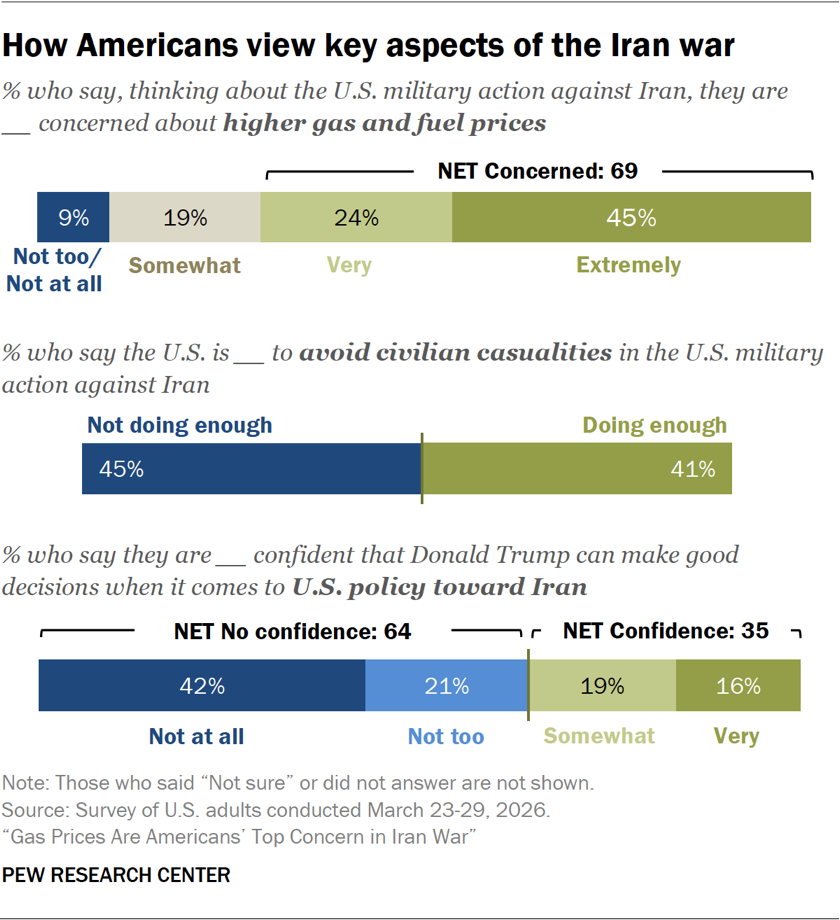
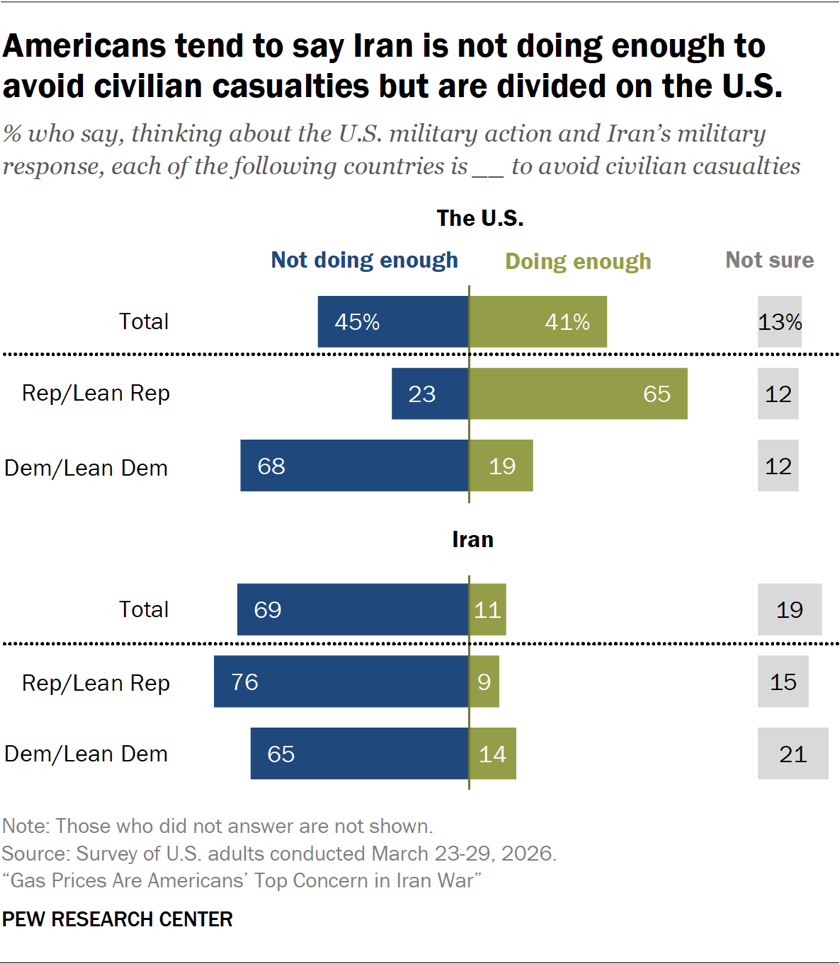
A key finding of the survey is the divided public opinion on the U.S. military’s efforts to prevent civilian casualties. While 41% of Americans believe the U.S. is taking adequate measures, a slightly larger percentage, 45%, feel otherwise, with 13% remaining undecided. This division largely mirrors partisan lines, with a significant majority of Republicans and Republican-leaning independents (65%) asserting that the U.S. is doing enough. Conversely, a similar proportion of Democrats and Democratic leaners (68%) express the view that the U.S. is not doing enough.
In stark contrast, there is widespread consensus across the political spectrum regarding Iran’s actions. An overwhelming 69% of all Americans believe that Iran itself is not doing enough to prevent civilian casualties. This suggests a shared perception that the Iranian forces are not adhering to international humanitarian norms.
Declining Confidence in Presidential Foreign Policy
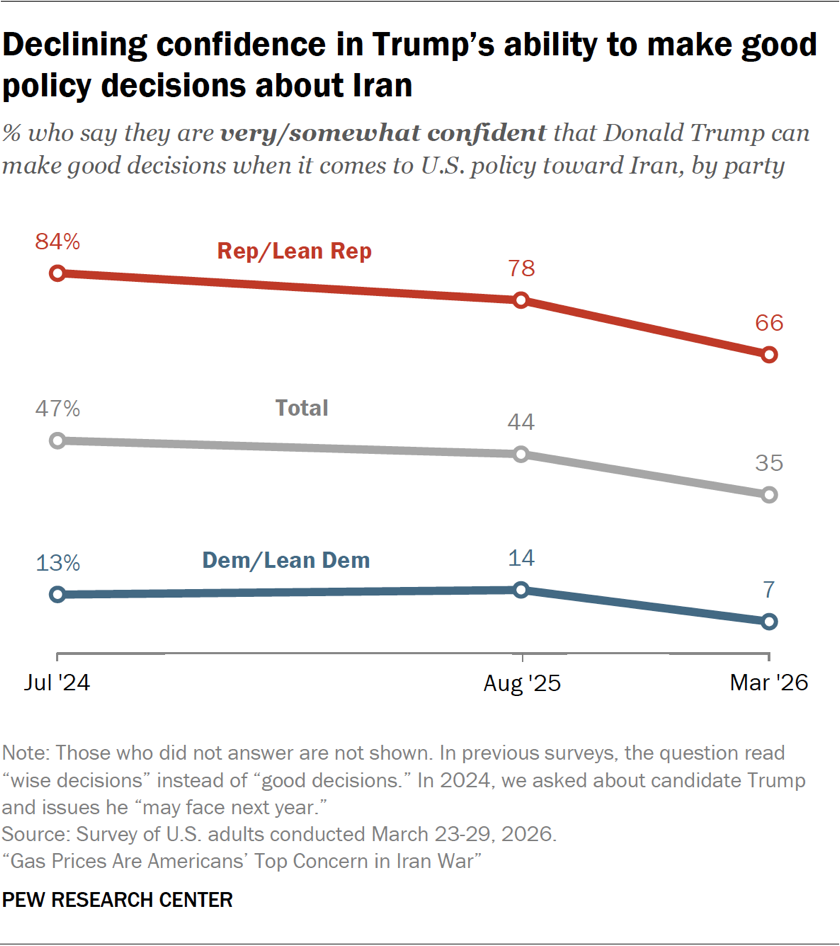
The survey also sheds light on a significant erosion of public confidence in President Donald Trump’s ability to navigate foreign policy decisions, particularly concerning Iran. Only 35% of Americans express confidence in his policymaking regarding Iran, while a substantial 64% state they are not confident. This lack of faith is particularly pronounced among Democrats, with a mere 7% expressing confidence, a notable drop from 14% in August 2025.
While Republicans have historically shown higher levels of confidence in President Trump, even within this demographic, confidence has waned. Currently, 66% of Republicans express confidence, a decline of 18 percentage points since 2024 and 9 points since August 2025. This decline is more pronounced among younger Republicans (ages 18-29), who are nearly evenly divided on their confidence (46% confident vs. 53% not confident), in contrast to older Republicans (ages 65 and older), where confidence remains high at 80%.
A particularly interesting correlation emerged among Republicans: those who express extreme or very high concern about rising gas prices due to the war are less likely to have confidence in President Trump’s Iran policy (56% confident) compared to Republicans who are not concerned about gas prices (86% confident). This suggests that economic fallout from the conflict is directly impacting trust in the administration’s foreign policy acumen among its core supporters.
Widespread Economic and Security Concerns
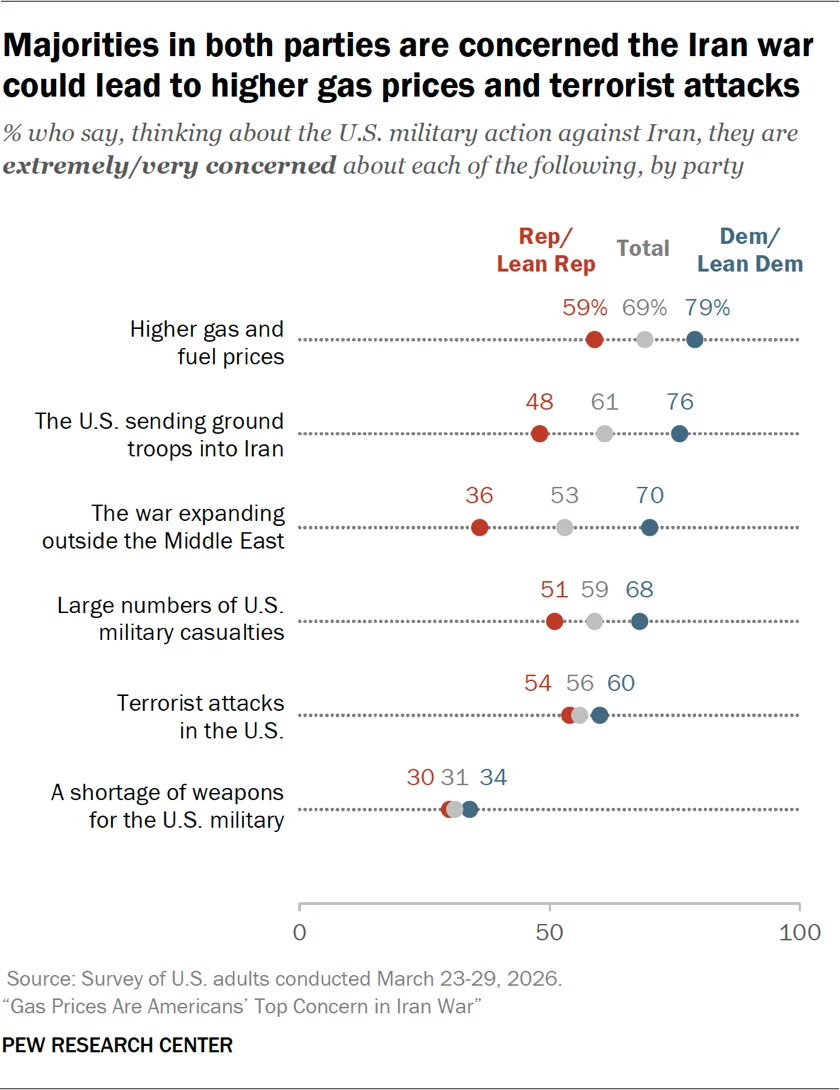
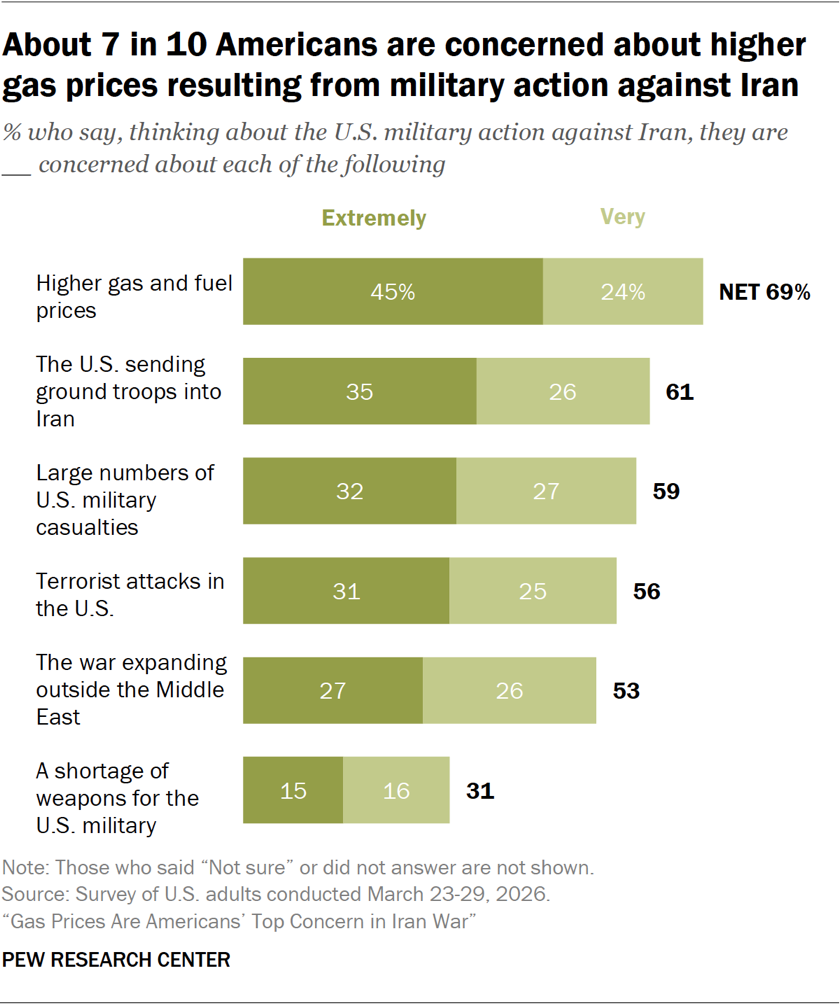
The specter of higher gas and fuel prices looms large in the minds of Americans. Approximately 69% of the public, including 45% who are "extremely concerned," view this as a direct consequence of the U.S. military engagement in Iran. This economic apprehension outranks other concerns, underscoring the immediate impact of geopolitical events on household budgets.
Beyond economic worries, significant portions of the population are concerned about broader security implications:
- Ground Troops: Majorities are apprehensive about the deployment of U.S. ground troops into Iran.
- Military Casualties: The prospect of large numbers of American military casualties is a significant concern.
- Terrorism: Concerns about terrorist attacks on U.S. soil remain high.
- Regional Escalation: A substantial segment of the population worries about the war expanding to encompass other Middle Eastern nations or beyond.
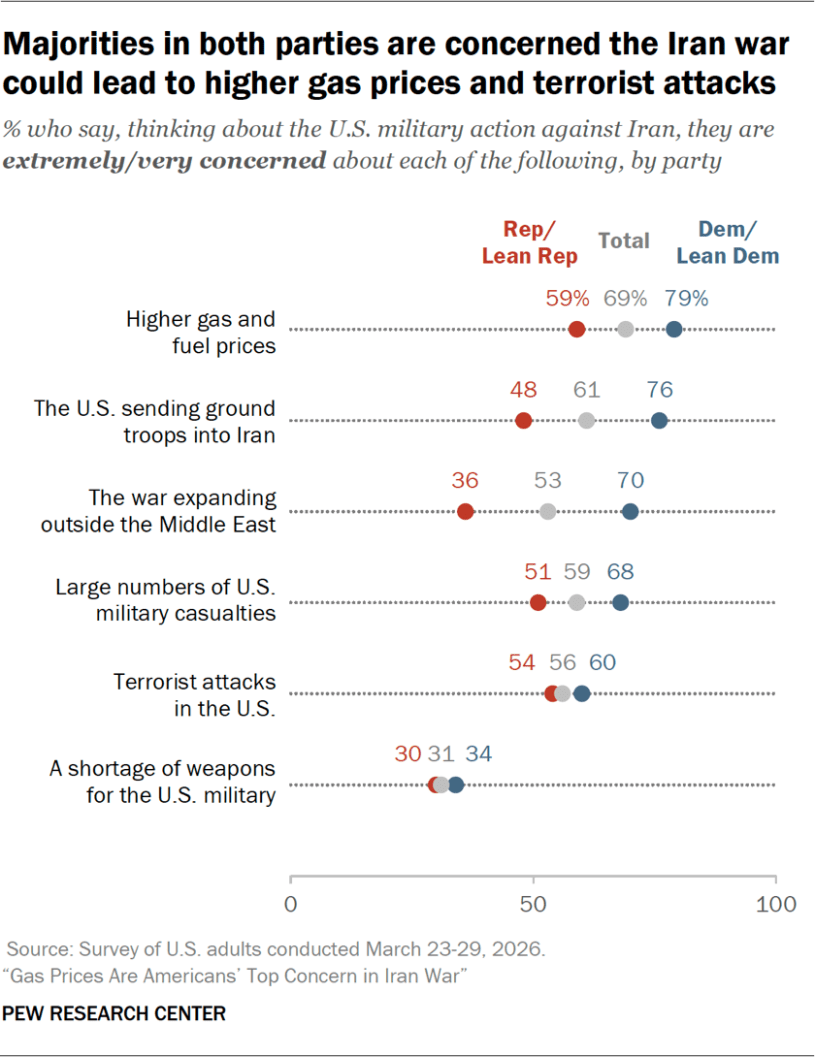
While both Democrats and Republicans share concerns about rising gas prices (79% of Democrats and 59% of Republicans), Democrats express a markedly higher level of concern regarding the potential for the conflict to spread beyond the Middle East, roughly double that of Republicans.
A smaller, but still significant, segment of the population (31%) expressed concern about a potential shortage of weapons for the U.S. military, indicating a focus on the immediate and tangible consequences of sustained military operations.
Projected Outcomes and the Nuclear Question
The survey also delved into Americans’ projections about the war’s long-term impact on Iran and its nuclear ambitions. There is a notable division of opinion regarding the likelihood of Iran developing a nuclear weapon as a result of the U.S. military action. Exactly 27% believe it will make Iran more likely to develop a nuclear weapon, while another 27% believe it will make it less likely. A further 29% anticipate no change in the likelihood, and 16% are unsure.
Partisan divides are evident on this issue. Republicans are significantly more likely than Democrats to believe the military action will make Iran less likely to develop a nuclear weapon (47% vs. 10%). Conversely, Democrats are more inclined to believe the action will increase the likelihood (38% vs. 17% of Republicans).
Younger Americans, particularly Democrats, tend to be more skeptical of the conflict’s positive outcomes. They are more likely to express concern that U.S. military action will increase the likelihood of Iran obtaining a nuclear weapon.
The Human Cost and the Future of Iran
When contemplating the ultimate fate of the Iranian people in the aftermath of the conflict, a plurality of Americans (36%) predict they will be worse off. Only a quarter (25%) believe the Iranian people will be better off, with 16% foreseeing no significant change.
This outlook is heavily influenced by party affiliation. A majority of Democrats (56%) anticipate that the Iranian people will be worse off, a sentiment echoed by 17% of Republicans. In stark contrast, nearly half of Republicans (47%) express optimism, believing the Iranian people will be better off as a result of U.S. military intervention. This optimistic view among Republicans is particularly strong among older demographics, with 63% of those aged 65 and older predicting a better future for the Iranian people, compared to 33% of Republicans aged 18-29.
Broader Context and Historical Perspective
The U.S. military campaign against Iran, initiated in February 2026, followed a period of escalating tensions in the region. While specific catalysts for the military action are not detailed in this report, historical precedents suggest that concerns over Iran’s nuclear program, regional destabilization efforts, and perceived threats to international shipping lanes, particularly in the Strait of Hormuz, likely played significant roles. The image accompanying this report, showing a crude oil tanker successfully docking in Mumbai on March 11, 2026, after navigating the Strait of Hormuz, underscores the critical importance of this waterway to global energy supplies and the potential vulnerabilities associated with its security.
A related Pew Research Center survey conducted in March 2026 found that a significant majority of Americans (68%) believed the war would continue for six months or longer, a perception held more strongly by Democrats (79%) than Republicans (58%). This indicates a prevailing sentiment that the conflict is likely to be protracted, further fueling public concerns about its economic and security implications.
Conclusion
The Pew Research Center’s latest findings underscore a nation grappling with the multifaceted consequences of a foreign military engagement. While the immediate economic impact, primarily through rising energy prices, is a dominant concern, deep-seated anxieties about American casualties, domestic security, and the potential for wider regional conflict are equally prevalent. The survey also highlights a significant erosion of public trust in presidential leadership on foreign policy matters, particularly concerning the handling of the Iran conflict. As the military campaign continues, these public sentiments will likely remain a critical factor in shaping domestic discourse and influencing policy decisions.