More than four years after Russia’s full-scale invasion of Ukraine, a comprehensive new report from the Pew Research Center reveals persistent and widening partisan divides in American public opinion regarding the ongoing conflict. The survey, conducted between March 23-29, 2026, with 3,507 adults, underscores a deepening divergence between Republican and Democratic perspectives on the level of U.S. support for Ukraine, confidence in leadership, and the overall perception of Russia’s role on the global stage.
The findings highlight a complex and evolving landscape of American engagement with the protracted war, with Republicans showing a greater inclination to believe the United States is providing too much aid to Ukraine. This sentiment contrasts sharply with Democratic leanings, which favor increased or sustained support. Furthermore, the data points to a significant, albeit waning, confidence in former President Donald Trump’s decision-making capabilities concerning the conflict, a view held predominantly among Republicans and largely absent among Democrats.
A Nation Divided: U.S. Support for Ukraine

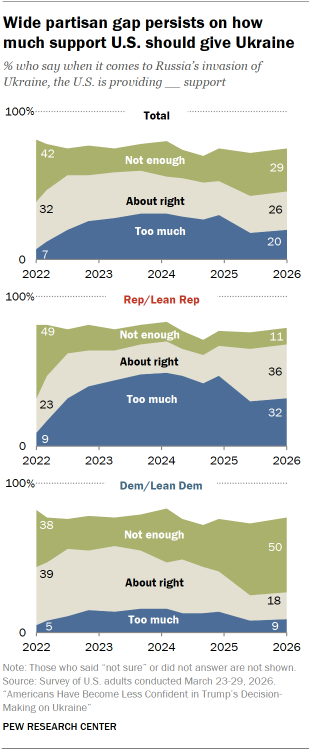
The Pew Research Center’s latest analysis reveals that Americans hold a deeply divided opinion on the appropriate level of U.S. support for Ukraine. Currently, 29% of Americans believe the United States is not providing enough support, while 26% feel the current level of assistance is about right. A significant 20% express the view that the U.S. is providing too much support. These figures indicate a slight stabilization in the "too much support" sentiment compared to February 2025, when it stood at 30%. However, the proportion of Americans advocating for increased support has remained relatively steady since August 2025.
The most striking aspect of this data is the stark partisan chasm. Democrats are more than four times as likely as Republicans to state that the U.S. is not providing enough support to Ukraine (50% versus 11%). This significant disparity has been a consistent feature of American opinion for years, but the gap widened considerably in 2025 and has maintained its considerable breadth into 2026, underscoring the differing priorities and foreign policy philosophies between the two major parties.
Confidence in Leadership: Trump and Zelenskyy Under Scrutiny
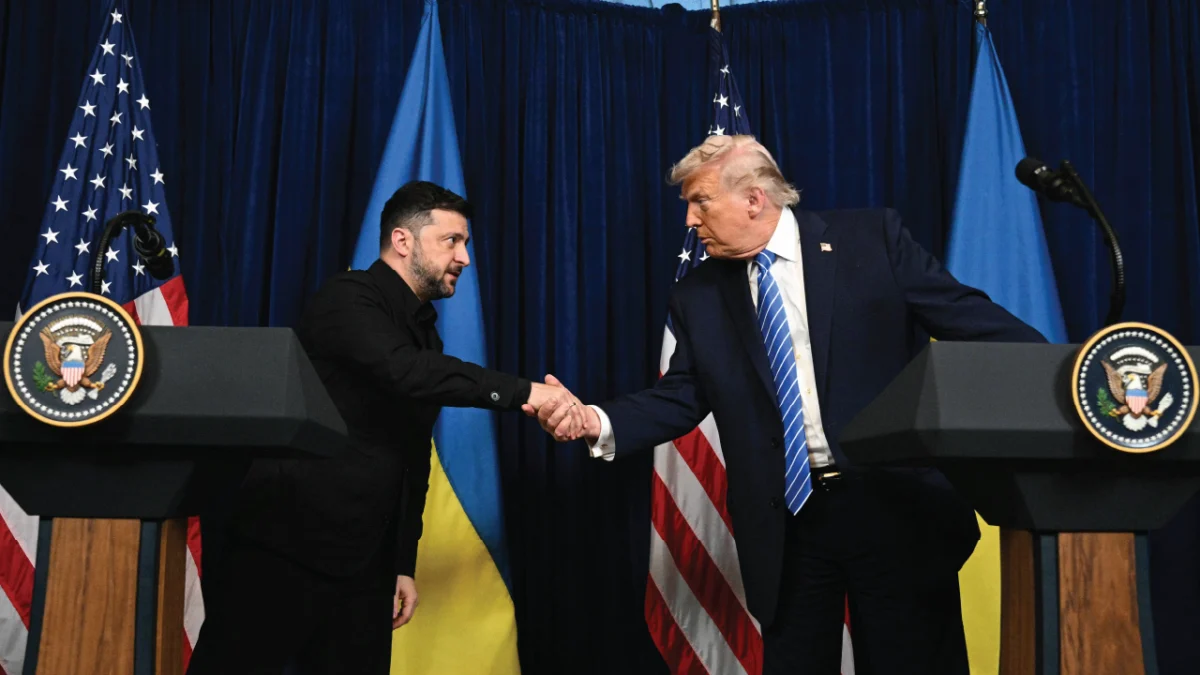
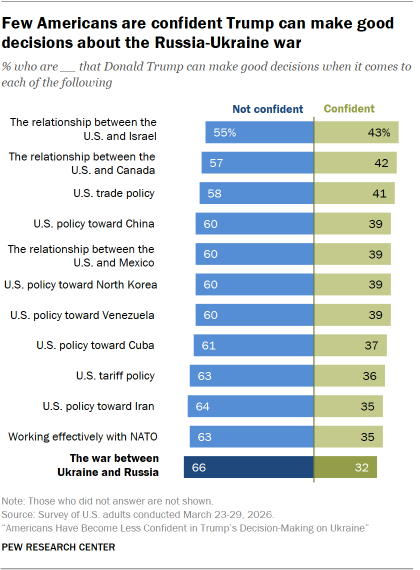
A key finding of the report is the differing levels of confidence Americans place in former President Donald Trump and Ukrainian President Volodymyr Zelenskyy regarding their handling of the Russia-Ukraine war and broader world affairs. Confidence in Trump’s ability to make sound decisions concerning the war has seen a notable decline. Currently, only 32% of Americans express being "very" or "som "confident" in his decision-making, a drop from 40% in August 2025. This decline has been observed across both Republican and Democratic demographics, with a 13-percentage-point decrease among Republicans and a 4-point decrease among Democrats during this period.
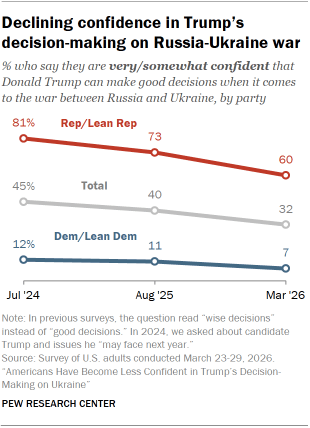
Overall, a substantial two-thirds of Americans (66%) report a lack of confidence in Trump’s ability to navigate the complexities of the Russia-Ukraine conflict. This places his decision-making on this issue among the lowest confidence levels recorded across twelve foreign policy areas examined by the Pew Research Center. The partisan divide on this issue is profound: 60% of Republicans express confidence in Trump, a stark contrast to the mere 7% of Democrats who share this view. Within the Republican party, conservative Republicans exhibit a higher degree of confidence (68%) compared to their moderate and liberal counterparts (46%).
In contrast, Ukrainian President Volodymyr Zelenskyy garners more confidence from the American public. Half of U.S. adults express confidence in his ability to "do the right thing regarding world affairs," while 40% lack confidence. A small segment, 9%, remain unfamiliar with the Ukrainian leader. While confidence in Zelenskyy has remained relatively stable in recent years, following a slight dip between 2023 and 2024 primarily among Republicans, his approval rating among Democrats remains high (69%). Notably, Republican confidence in Zelenskyy has shown a modest uptick since last year, increasing by 4 percentage points to 34%.
Perception of Russia: Enemy, Competitor, or Partner?
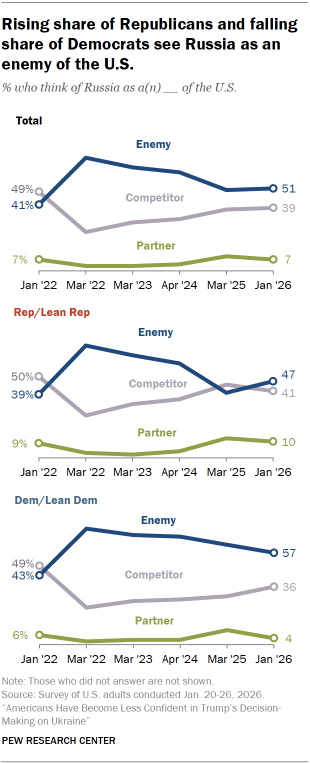
The Pew Research Center’s analysis also delves into how Americans perceive Russia’s role in the international arena. As of late January 2026, a slight majority of Americans (51%) categorize Russia as an "enemy" of the United States. A substantial 39% view Russia as a "competitor," while a mere 7% still consider it a "partner."
While these figures have remained relatively consistent over the past year, the partisan dynamics surrounding the perception of Russia have shifted. The gap between Republicans and Democrats in viewing Russia as an enemy has narrowed from 22 percentage points to 10 points. This is attributed to a rise in the percentage of Republicans who perceive Russia as an enemy (from 40% to 47% over the past year) and a slight decrease among Democrats (from 62% to 57%). For the first time since 2024, more Republicans now consider Russia an enemy than a competitor, signaling a hardening of attitudes within this demographic.
On a broader scale, American views of Russia remain overwhelmingly negative. A staggering 83% of U.S. adults express an unfavorable view of Russia, a sentiment shared by large majorities within both Republican and Democratic parties. This widespread disapproval extends to Russian President Vladimir Putin, with large majorities across the political spectrum expressing little to no confidence in his ability to act appropriately in world affairs. These negative perceptions of both Russia and Putin have remained largely unchanged over the past year and have been consistently dire since prior to the full-scale invasion of Ukraine.
Background and Context: The Evolving Conflict
The Russia-Ukraine war, which began with Russia’s full-scale invasion in February 2022, has entered its fifth year. The conflict has had profound geopolitical, economic, and humanitarian consequences, reshaping global alliances and intensifying international tensions. The United States, alongside its NATO allies and other international partners, has provided extensive military, financial, and humanitarian assistance to Ukraine. This support has been a central tenet of U.S. foreign policy under both the Biden and, to a lesser extent, the previous Trump administration, although the nature and extent of that support have been subjects of considerable domestic debate.
The initial phase of the war saw a surge of bipartisan solidarity in the U.S. in support of Ukraine. However, as the conflict has protracted and domestic political priorities have come to the fore, particularly with the approaching 2026 U.S. general election cycle, public opinion has become more fragmented. The Pew Research Center’s reports over the past few years have consistently tracked these evolving sentiments, highlighting the growing partisan divergence on key aspects of the war and U.S. involvement.
Timeline of Key Developments and Shifting Opinions:
- February 2022: Russia launches a full-scale invasion of Ukraine. U.S. and Western allies condemn the invasion and begin imposing sanctions on Russia. Bipartisan support for Ukraine is initially very high.
- 2022-2023: The U.S. provides substantial military and financial aid to Ukraine. Public opinion largely supports this assistance, though some initial concerns about the cost and duration of the conflict begin to emerge.
- August 2025: Pew Research Center data shows 40% of Americans express "very" or "somewhat" confidence in President Trump’s decision-making on the Russia-Ukraine war.
- February 2025: A Pew Research Center survey indicates that 30% of Americans believe the U.S. is providing too much support to Ukraine.
- March 2026: The latest Pew Research Center survey reveals a sustained partisan divide on U.S. support for Ukraine. Confidence in Trump’s decision-making on the war drops to 32% overall, with significant partisan differences. Views on Russia solidify, with a majority seeing it as an enemy.
Methodology and Data
The findings in this report are based on two distinct surveys conducted by the Pew Research Center. The primary survey, focusing on U.S. views of the Russia-Ukraine war, involved 3,507 adults who are members of the American Trends Panel, a nationally representative online survey panel. This survey was conducted from March 23 to March 29, 2026. The margin of error for this survey is plus or minus 2.1 percentage points at the 95% confidence level.
Data on Americans’ views of Russia as a partner, enemy, or competitor, as well as their overall favorability ratings of Russia and confidence in Vladimir Putin, comes from an earlier survey of 8,512 U.S. adults conducted from January 20 to January 26, 2026. The margin of error for this earlier survey is plus or minus 1.2 percentage points. The Pew Research Center provides comprehensive details on its survey questions, detailed responses, and methodology for those seeking further information.
Broader Impact and Implications
The persistent partisan divisions in American public opinion regarding the Russia-Ukraine war carry significant implications for U.S. foreign policy. A deeply divided electorate can make it challenging for any administration to maintain a consistent and robust policy of support for Ukraine, especially if the conflict continues to be costly in terms of resources and American lives.
The findings also highlight the continuing influence of partisan identity on foreign policy attitudes. Republicans and Democrats are increasingly inhabiting different informational ecosystems and holding distinct worldviews, which are reflected in their approaches to international conflicts. This polarization can complicate diplomatic efforts and the formation of a unified national stance on critical global issues.
Furthermore, the declining confidence in leadership, particularly concerning former President Trump, suggests a complex political calculus for any future administration seeking to engage with the ongoing conflict. The data indicates that while a significant portion of the Republican base remains loyal to Trump, broader confidence in his foreign policy decision-making is not universal and has shown a downward trend.
As the war in Ukraine continues to evolve, the Pew Research Center’s ongoing analysis will be crucial in understanding the shifting currents of American public opinion and their potential impact on U.S. engagement with one of the most significant geopolitical crises of the 21st century. The findings underscore the enduring challenge of maintaining national consensus on foreign policy in an increasingly polarized political environment.