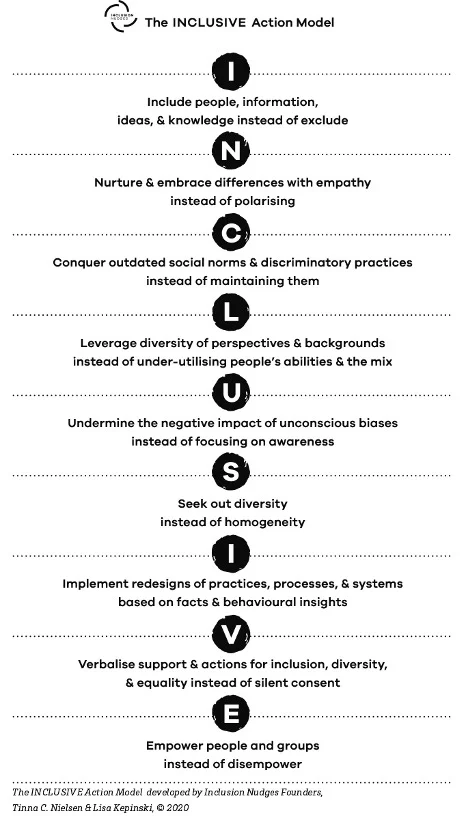
The global landscape of diversity, equity, and inclusion (DEI) initiatives has long been characterized by fervent intention yet often frustratingly slow progress. Despite significant investment in training, policy development, and awareness campaigns, many organizations and communities find themselves caught in a cycle of incremental gains followed by regressions, a phenomenon frequently described as "three steps forward, one step back." This persistent challenge highlights a fundamental gap between conscious intent and unconscious action, a chasm that traditional DEI methods have struggled to bridge effectively. A new paradigm, rooted in behavioral science and known as Inclusion Nudges, is emerging as a powerful antidote, offering a scientifically-backed pathway to embed inclusion as the default behavior across all facets of society.
For years, dedicated change-makers within corporations, non-profits, and governmental bodies have grappled with the frustration of seeing well-intentioned efforts falter. Programs designed to foster diversity and combat discrimination, gender inequality, and human rights issues often fail to yield the rapid, profound, or sustainable impact anticipated. This was a critical observation made by the founders of Inclusion Nudges during their extensive careers as internal change agents within multinational corporations. They, like many of their peers in wide global networks, recognized that while awareness and rational arguments are essential, they are often insufficient to overcome deeply ingrained human behaviors and systemic defaults. The prevailing sentiment was clear: a new, more effective solution was urgently needed to translate knowledge and good intentions into consistent, inclusive actions.
This critical need propelled the founders to explore interdisciplinary insights from the burgeoning fields of behavioral economics, nudging theory, psychology, anthropology, linguistics, neuroscience, and complex system and microeconomic theory. This scientific synthesis marked a pivotal shift, revealing a crucial difference in impact when these principles were applied to DEI challenges. The result was the development of Inclusion Nudges – a methodology designed to proactively re-engineer environments and processes to make inclusive choices the easiest, most natural, and default option for everyone.
To truly understand the imperative behind designing for inclusion, one must first confront the often-absurd realities shaped by our unconscious minds. Consider a scenario, seemingly outlandish in its premise: a group of senior leaders, tasked with selecting the best candidate for a high-level position, concludes that "the best qualified candidate is definitely the tallest of them." They confidently assert that "tall leaders are the best at executing strategy," possess "the most presence and are most resilient in tough times," and are, unequivocally, "the best leaders." Such a statement, when consciously considered, is patently irrational and would be dismissed by any rational mind aiming to hire based on merit.
Yet, a vast body of global research consistently demonstrates that similar unconscious biases profoundly influence real-world decisions. The "height-leadership effect" is a well-documented phenomenon: studies have shown that height disproportionately influences perceptions of leadership ability and competence. Data reveals that approximately 60% of top leaders in many industries stand at or above 185 cm (6 feet 1 inch) tall, a striking statistic when compared to the mere 14% of the general population who reach this height. This disparity is not due to superior leadership qualities inherently linked to height but rather to deeply embedded, unconscious associations. Tall individuals are often perceived as having greater presence, power, and capability, leading to more high-status opportunities, promotions, and even higher incomes. This seemingly absurd reality is a pervasive normative pattern, unmitigated by local cultural differences, and it underscores the profound influence of our automatic cognitive processes.
At the core of this challenge lies the intricate functioning of the human mind, which operates through two interdependent modes of thinking. The automatic system is characterized as unconscious, fast, instinctive, effortless, associative, and uncontrolled – akin to an autopilot. This system dominates the vast majority, estimated by researchers to be between 90-99%, of our daily thought processes, choices, and behaviors. It relies on mental shortcuts, such as associations (perceived connections between elements) and biases (errors in processing information), to make rapid judgments and decisions, conserving cognitive energy. While often efficient and vital for survival, these shortcuts can lead to flawed conclusions, such as equating "tall" with "strong leader."
In contrast, the reflective system is conscious, slow, effortful, rational, logical, self-aware, rule-following, and controlled. This is the system we typically associate with deliberate thought and decision-making. However, when faced with ambiguity, complexity, or time pressure, the brain’s default is to lean heavily on the automatic system. This inherent design means that even when our reflective mind possesses rational knowledge – for instance, understanding that height bears no correlation to leadership efficacy – our unconscious mind can still make judgments and choices as if it did. This gap between our rational knowledge and our unconscious doing is precisely why the intention-action gap persists in DEI efforts. We intend to be fair and inclusive, but our automatic system can steer us toward behaviors that contradict these values, often without our conscious awareness. Knowledge and willpower alone prove insufficient to consistently bridge this divide.
This fundamental insight into human cognition forms the bedrock of Inclusion Nudges. It recognizes that simply telling people to be inclusive or educating them about biases is often insufficient. Instead, a more potent approach involves redesigning the environment and processes within which choices are made, thereby "nudging" the unconscious mind toward inclusive behaviors. A nudge, in the context of behavioral economics, is an intervention that steers people toward better choices without removing their freedom of choice or resorting to mandates, threats, or punishments. It subtly "pushes" the automatic system in a predictable, desired direction.

An Inclusion Nudge specifically applies this principle to DEI, defined as "a design based on insights from behavioural and social sciences to steer the unconscious mind to change behaviour in direction of inclusiveness by targeting the behavioural drivers, judgment and choice processes, and perceptions." This approach allows for combating discrimination, mitigating bias, altering stereotypes, reducing exclusion, and fostering a sense of belonging by making inclusive actions the default and effortless norm. This is particularly crucial in an era of increasing cognitive overload, amplified by social media echo chambers and the relentless pace of modern life, which intensifies our reliance on mental shortcuts and can inadvertently exacerbate homogeneity and exclusion. Inclusion Nudges offer a systemic way to close the intention-action gap by addressing the implicit norms embedded in cultures and systems, making inclusion easy to do.
The Inclusion Nudges change approach is operationalized through three distinct, yet often interconnected, types of designed interventions:
1. Show the Hidden Issue and Make People Feel the Need
Human beings are primarily moved to action by what they see and feel, not merely by what they know or are told. Directly confronting individuals with accusations of bias often leads to defensiveness, shutting down the very openness required for change. Instead, this pillar focuses on designs that make invisible patterns visible, allowing individuals to intuitively grasp the implications of current behaviors and feel an intrinsic need for change. For example, visualizing performance recognition data across different demographics can powerfully illustrate disparities in visibility without explicitly stating "you are biased." By presenting data in a compelling, often unexpected way – such as highlighting the disproportionate representation of one group in formal and informal networks, contrasting it with the near absence of another – leaders can viscerally experience the inequality. This emotional realization, rather than a rational argument, motivates the unconscious mind to seek change. A design might involve showcasing a list of individuals frequently sponsored or mentored, then juxtaposing it with a starkly shorter list for an underrepresented group. The sheer visual imbalance, without a single word of accusation, prompts a recognition of the status quo’s inadequacy and a felt need to engage in initiatives like sponsorship programs for diverse talent. These are "Feel the Need Inclusion Nudges," designed to motivate widespread inclusive engagement.
2. Process Designs to Make Inclusion the Norm Without Talking About Inclusion and Diversity
Beyond motivating change, sustained inclusion requires embedding it directly into daily operations, processes, and environments. This pillar focuses on designing systems where inclusive behaviors become the automatic default, bypassing the need for constant conscious effort or discussion about "inclusion" itself. The goal is to make it simple and effortless to do inclusion. Examples include redesigning meeting facilitation to ensure all voices are heard, or structuring decision-making processes to mitigate bias. One powerful "Process Design" is the "Share with a peer" technique in group discussions. Instead of directly asking for individual input, participants are first asked to discuss their thoughts with a peer. This ensures that quieter individuals feel safe to articulate their perspectives, reduces the tendency for group conformity, and allows for the capture and correction of misunderstandings before ideas are presented to the larger group. This fosters psychological safety and ensures diverse perspectives are accessed by default. Other examples include blind resume reviews, structured interview questions, or even redesigning physical office layouts to encourage spontaneous, diverse interactions. By building inclusion into the very fabric of how work is done, organizations can foster inclusive cultures where bias is mitigated and diverse perspectives are naturally integrated.
3. Frame Perceptions of Issues in Ways That Alter Understanding and Support Action
Perception is reality, and the way issues, data, or even other people are framed profoundly influences understanding, judgment, and subsequent behavior. This pillar leverages the power of language, communication, and presentation to subtly shift perceptions and break down stereotypes or limiting narratives. By altering the frame through which information is viewed, or by priming specific associations, one can influence what people notice, how they interpret it, and ultimately, how they act. A powerful example is "Show the hidden people by reversing the numbers." If a report highlights that "only 10% of our senior leadership are women," the framing often focuses on the "missing" 90% and can evoke a sense of failure or burden. However, by reversing the numbers – for instance, stating, "90% of our senior leadership are men, obscuring the valuable contributions of many talented women" – the perception shifts. It highlights the overrepresentation of one group and the consequences of overlooking others, making the "hidden people" visible and reframing diversity as an untapped resource rather than a deficit. This kind of "Framing Perceptions Inclusion Nudge" can dismantle entrenched stereotypes and narratives, transforming perceptions of diversity from a compliance issue into a strategic imperative.
The efficacy of these behavioral designs has been demonstrated in numerous contexts worldwide, making it significantly easier for change agents to achieve tangible, lasting impact. The approach emphasizes co-creation, ensuring that solutions are developed with the people they are intended for, fostering greater buy-in and sustainability. Inclusion Nudges offer a practical framework for individuals and organizations to design inclusive systems, cultures, technologies, policies, and environments, thereby embedding inclusive behavior, interactions, and decision-making as the norm.
The mission of the Inclusion Nudges global initiative is to empower individuals to apply these powerful tools, recognizing that systemic change requires collective action. This global movement is built upon three core principles:
- Sharing: Unlike many professional fields where proprietary knowledge is closely guarded, Inclusion Nudges champions the open sharing of effective "how-to" designs. The founders, driven by a desire to accelerate global change, meticulously document and disseminate step-by-step examples of successful interventions, complete with the underlying behavioral insights. This commitment to open knowledge transfer, via guidebooks, action guides, and online resources, ensures that change-makers everywhere are equipped with proven strategies. Sharing one’s experiences and designs becomes an inclusive action in itself, contributing to a collective intelligence.
- Reciprocity: The movement thrives on mutual exchange. By receiving and contributing examples, offering support, and spreading awareness of these resources, individuals strengthen the collective capacity for social change. This collaborative spirit of reciprocity ensures that the movement remains dynamic and responsive, continuously evolving with new insights and applications from diverse contexts.
- Open Source: Fundamentally, the Inclusion Nudges global initiative believes that knowledge for social good should not be hoarded or sold to an elite few. The concepts and approach are shared under a Creative Commons License, ensuring open access for everyone, from curious learners to seasoned designers. This commitment to open-source principles democratizes access to effective change methodologies, accelerating the pace and scale of inclusive transformation globally.
In a world increasingly complex and interconnected, the need for genuine, widespread inclusion has never been more pressing. Inclusion Nudges offers a pragmatic, evidence-based pathway to move beyond mere intentions to impactful, everyday actions. By understanding and strategically influencing the unconscious mind, we can collectively redesign our world to make inclusion the unwavering norm, everywhere, for everyone. This is an invitation to join forces, to experiment, and to integrate these powerful behavioral designs into daily work and interactions, making inclusion a natural, effortless part of our collective future.
NOTE: All sources and references in this article are listed in The Inclusion Nudges Guidebook and Action Guides.