A significant shift in U.S. immigration policy, introduced by the Trump administration, is poised to alter the landscape for hundreds of thousands of immigrants seeking lawful permanent residency, commonly known as a green card. A new guidance memo issued by the administration could compel many individuals currently residing in the United States on legal temporary status to depart the country and apply for their green cards from their home nations, rather than completing the process domestically. This directive grants immigration officers broad discretion to adjudicate applications on a case-by-case basis, potentially leading to a substantial increase in applications processed at U.S. consulates abroad.
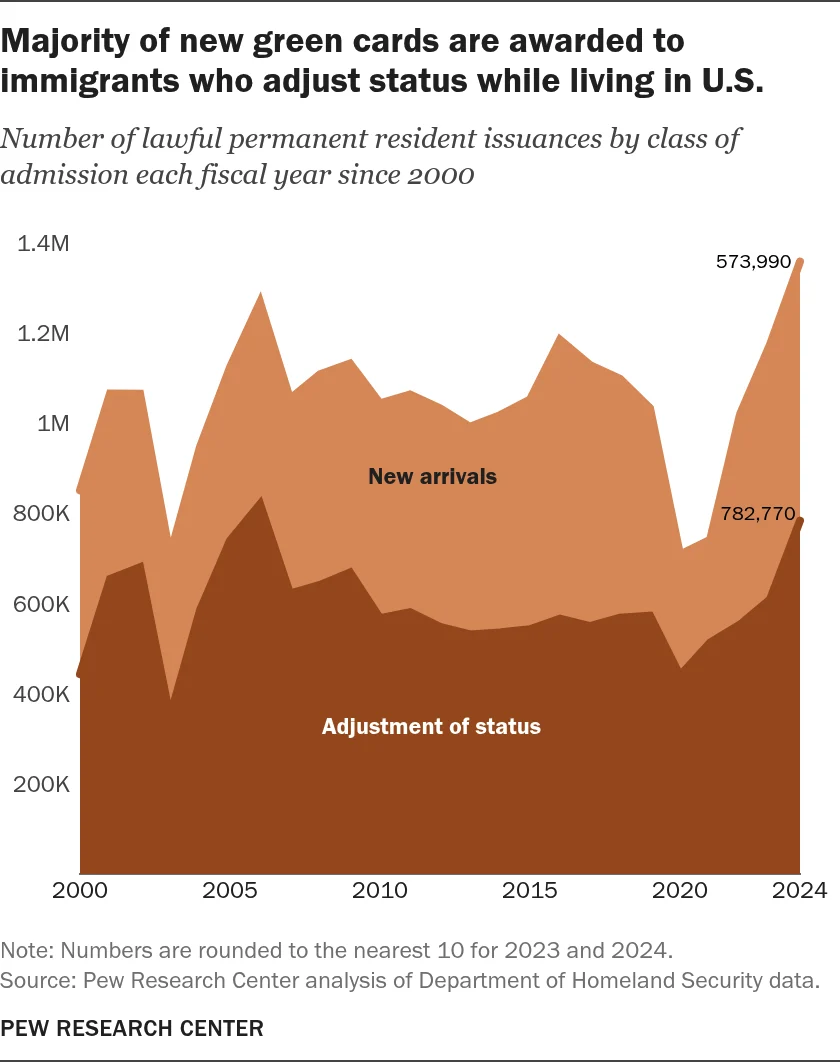
This policy change has emerged as a focal point of discussion regarding the nation’s immigration system, particularly given that a majority of green cards issued in recent years have been granted to individuals already present within the United States. A comprehensive analysis by the Pew Research Center reveals that since the turn of the century, approximately half or more of all green cards have been awarded to immigrants who adjust their status while living in the U.S., a pathway that the new guidance aims to restrict.
Understanding the Shift: The "Adjustment of Status" Process
The core of this policy change revolves around the "adjustment of status" (AOS) process. This established procedure allows eligible immigrants who are legally present in the United States, often on temporary visas such as student or work permits, to apply for and obtain lawful permanent residency without leaving the country. For decades, AOS has served as a critical pathway for individuals to transition from temporary legal status to permanent residency, offering a more streamlined and often less disruptive route compared to applying from overseas.

The Trump administration’s rationale for issuing the new guidance, as stated by officials, is to "return to the original intent of the law" and "close loopholes in the immigration process." Proponents argue that this move aims to ensure a more rigorous and controlled immigration system, aligning with the foundational principles of U.S. immigration law. They contend that the prior broad application of AOS may have inadvertently created avenues for circumventing established immigration procedures.
However, critics of the memo express significant concerns about its potential repercussions. They warn of substantial processing delays, the possibility of family separations, negative impacts on employment, and a general limitation of pathways to legal immigration. The shift could introduce considerable uncertainty and hardship for individuals and families who have planned their lives and careers based on the existing AOS procedures.
Pew Research Center Analysis: A Deep Dive into Green Card Issuances
A detailed analysis by the Pew Research Center, examining data from the Department of Homeland Security, sheds critical light on the prevalence of the adjustment of status process. For fiscal year 2024, the U.S. issued approximately 1.36 million green cards. The Pew analysis found that a significant majority, 58%, were granted to individuals already residing in the United States through adjustment of status. Conversely, 42% of these green cards went to new arrivals who applied through U.S. consulates in their home countries. This data underscores the substantial reliance on the domestic AOS pathway for achieving permanent residency.
The trend of a majority of green cards being issued to individuals already in the U.S. has been consistent for many years. For instance, in fiscal year 2023, 608,260 green cards were issued through adjustment of status, representing a notable portion of the total lawful permanent resident issuances. Even in earlier years, such as fiscal year 2006, adjustment of status applications accounted for a significant number of green card approvals, with 819,248 individuals adjusting their status, compared to 447,016 new arrivals. This historical data illustrates that the practice of adjusting status within the U.S. is not a recent phenomenon but rather a long-standing component of the immigration system.

Implications for Various Immigrant Groups
The new guidance is expected to disproportionately affect certain groups of immigrants who have historically relied more heavily on the adjustment of status pathway. The Pew Research Center’s analysis highlights these disparities by examining green card issuances by category in fiscal year 2024:
- Refugees and Asylees: These individuals overwhelmingly receive their green cards through adjustment of status. In 2024, 178,200 refugees and 41,650 asylees had their status adjusted within the U.S., representing virtually 100% of their respective green card issuances. This suggests that future refugees and asylees may face a more complicated process if the new guidance is strictly applied.
- Employment-Based Preferences: A substantial majority of immigrants in this category, 69% in 2024 (118,480 individuals), adjusted their status within the U.S. This indicates that highly skilled workers and professionals who have secured employment in the U.S. and are pursuing permanent residency through employer sponsorship will likely be significantly impacted.
- Immediate Relatives of U.S. Citizens: This category, a cornerstone of family-based immigration, also shows a strong reliance on AOS. In 2024, 60% of these immigrants (402,890 individuals) adjusted their status domestically. This could affect a large number of individuals seeking to reunite with family members already in the U.S.
Conversely, certain categories of immigrants are significantly less likely to adjust their status within the U.S., suggesting they may be less directly impacted by the new policy. For example, only 6% of family-sponsored preference immigrants (10,430 individuals) and 3% of diversity visa recipients (1,240 individuals) adjusted their status in 2024. These individuals primarily enter the U.S. as new immigrants.
Country-Specific Trends in Adjustment of Status
The Pew Research Center’s data also reveals distinct national patterns in the use of the adjustment of status process. For fiscal year 2024, several countries stand out:

- Cuba: Immigrants from Cuba demonstrate an exceptionally high rate of adjustment of status, with 87% (over 155,000 individuals) receiving their green cards this way. This trend is attributed to factors such as recent migration patterns and specific U.S. policies, including those affecting Cuban parolees and refugees who are often eligible for AOS.
- Mexico: Mexico consistently ranks among the top countries for AOS green card approvals. In 2024, 65% of Mexican immigrants adjusted their status within the U.S., totaling approximately 131,330 individuals. This high rate is partly due to the large number of Mexican nationals applying as immediate relatives of U.S. citizens, a category frequently processed domestically.
- China and India: These countries are also prominent contributors to AOS green card issuances, largely driven by employment-based immigration. In 2024, 66% of Chinese immigrants and 61% of Indian immigrants adjusted their status in the U.S.
These country-specific trends highlight how the new guidance could have varying degrees of impact across different immigrant populations, depending on their primary pathways to permanent residency and existing U.S. immigration policies.
Background and Timeline of Policy Changes
The issuance of the new guidance memo marks a significant development in the ongoing evolution of U.S. immigration policy. While the memo itself was released recently, the debate surrounding the application of the adjustment of status process has been a recurring theme in immigration discourse.
The current administration’s approach reflects a broader pattern of scrutinizing and, in some instances, tightening regulations related to immigration pathways. This latest directive builds upon earlier efforts to re-evaluate the application and enforcement of immigration laws. The memo, formally dated May 21, 2026, provides detailed instructions to U.S. Citizenship and Immigration Services (USCIS) officers on how to exercise discretion in adjudicating AOS applications.
The Pew Research Center’s analysis, published concurrently with the news of this guidance, serves to contextualize the potential impact by providing empirical data on the scale and nature of the adjustment of status process. The research methodology involved a thorough examination of the Department of Homeland Security’s Yearbook of Immigration Statistics, focusing on annual counts of both adjustment of status recipients and new arrivals processed abroad.

Broader Context: Temporary Visas and Public Opinion
It is important to note that the new guidance specifically targets individuals seeking lawful permanent residency. Millions of immigrants reside in the U.S. legally under various temporary (nonimmigrant) visa categories, such as international students, temporary workers, and seasonal laborers. These individuals, whose status is not tied to permanent residency, would not be directly affected by this particular memo.
The public’s perspective on immigration priorities, as revealed by a Pew Research Center survey conducted in August 2024, offers additional context. The survey indicated that nearly half of Americans believe legal immigration levels should remain steady. When asked about priorities for legal immigration, a substantial portion of respondents (42%) favored giving top priority to high-skilled workers, including scientists, doctors, and programmers. This was followed by those filling labor shortages (25%), individuals with close family ties in the U.S. (19%), and those from underrepresented countries (5%). This data suggests a public inclination towards prioritizing skilled labor, which aligns with a significant portion of immigrants who adjust their status through employment-based channels.
The implications of this new guidance are far-reaching, potentially reshaping the immigration experiences of hundreds of thousands of individuals annually. As immigration agencies implement this directive, careful monitoring and further analysis will be crucial to understanding its full impact on individuals, families, and the broader U.S. immigration system. The balance between enforcing existing laws and maintaining accessible pathways for legal immigration remains a central challenge for policymakers.