The landscape of religious expression in U.S. public schools is a subject of ongoing debate and evolving legislation, with several states recently advancing or enacting policies that either encourage prayer or mandate the display of the Ten Commandments in educational settings. This trend has coincided with new findings from a Pew Research Center survey, released on June 22, 2026, indicating a significant segment of the American populace is receptive to various forms of religious expression within public schools, though opinions diverge sharply on the nature and mandatory participation in such activities.
The survey, conducted from April 6-12, 2026, among 3,592 U.S. adults, reveals a nuanced public opinion on the intersection of religion and public education. While a substantial majority of Americans support students’ rights to engage in voluntary prayer, the enthusiasm wanes considerably when considering teacher-led prayer or the mandatory display of religious texts. This data provides crucial context to legislative efforts across the nation, such as those recently seen in Texas, where Attorney General Ken Paxton has been a prominent advocate for incorporating prayer and displaying the Ten Commandments in public schools. These legislative pushes often face legal challenges, as seen in ongoing court rulings regarding the constitutionality of such mandates.

Shifting Legal and Political Currents
The push for increased religious expression in public schools is not a new phenomenon, but it has gained momentum in recent years. Landmark Supreme Court cases, such as Engel v. Vitale (1962) which banned state-sponsored prayer in public schools, and Abington School District v. Schempp (1963) which prohibited mandatory Bible reading, have historically set a precedent for secular public education. However, subsequent legal interpretations and evolving societal views have created a complex legal environment. The rise of religious conservative advocacy groups and a shifting political climate have emboldened states to test the boundaries of these precedents, leading to a wave of legislation aimed at reintroducing or strengthening religious elements in schools.
The survey data from Pew Research Center offers a snapshot of public sentiment amidst these developments. It highlights a public that, while generally supportive of religious freedom and expression, appears to draw a line when it comes to the imposition of religious practices on students.
Public Opinion on Religious Expression in Schools
The Pew Research Center’s findings illuminate a spectrum of public support for different types of religious expression in public schools:
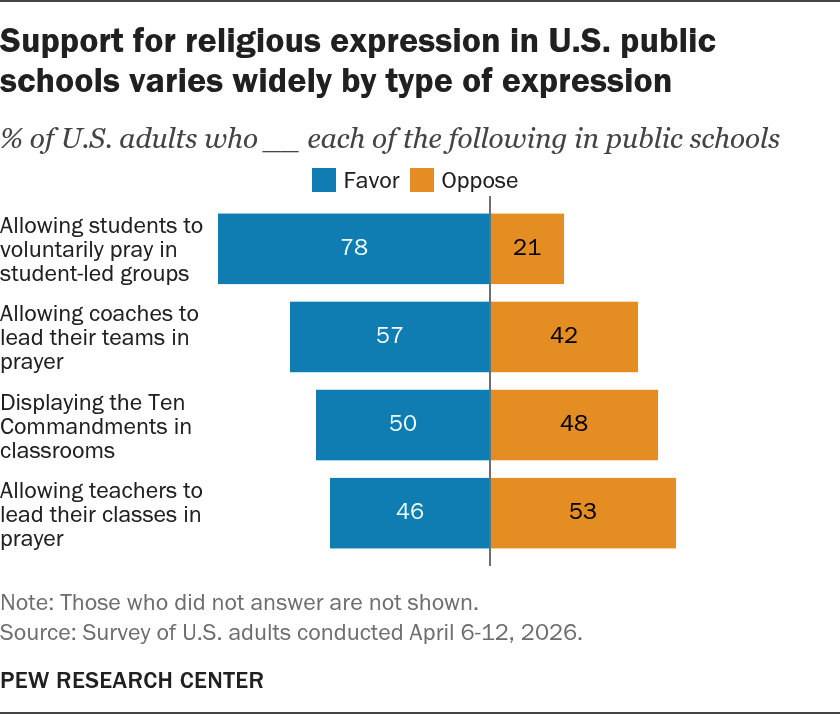
- Voluntary Student-Led Prayer: A robust 78% of U.S. adults favor allowing students to voluntarily pray in student-led groups. This level of support indicates a broad consensus on the right of students to express their faith freely, provided it is student-initiated and not disruptive.
- Coach-Led Prayer: Support dips for coaches leading their teams in prayer, with 57% in favor and 42% opposed. This suggests a growing awareness of the potential for coercion when authority figures are involved in religious activities.
- Displaying the Ten Commandments: Opinions are closely divided on displaying the Ten Commandments in classrooms, with 50% in favor and 48% opposed. This issue often sparks debate regarding the Establishment Clause of the First Amendment, which prohibits government establishment of religion.
- Teacher-Led Prayer: The most significant division emerges concerning teachers leading classes in prayer, with 46% in favor and 53% opposed. This indicates a strong reluctance among a majority of Americans to endorse religious instruction or practice led by educators.
The Crucial Distinction: Mandatory vs. Voluntary Participation
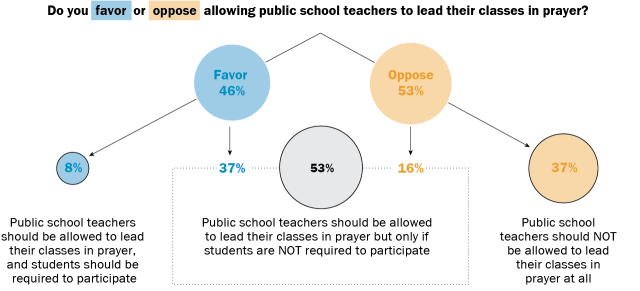
A key takeaway from the survey is the public’s clear preference for voluntary religious activities over mandatory ones, particularly concerning teacher-led prayer. While 46% of Americans favor allowing teachers to lead classes in prayer, a follow-up question reveals that only 8% believe students should be required to participate. In stark contrast, 53% of respondents support teacher-led prayer only if students are not required to participate. This suggests that the overwhelming majority of those who favor teacher-led prayer do so with the crucial caveat of student choice. Furthermore, 37% of Americans are entirely opposed to teacher-led prayer in classrooms.
This distinction is critical for understanding the broader implications of legislative efforts. While some lawmakers may champion the idea of teacher-led prayer, the public’s sentiment indicates that widespread acceptance hinges on ensuring that participation remains entirely optional, respecting the diverse beliefs and non-beliefs of students and their families.
Demographic and Political Divides
The survey also highlights significant differences in opinion across various demographic, religious, and political subgroups:
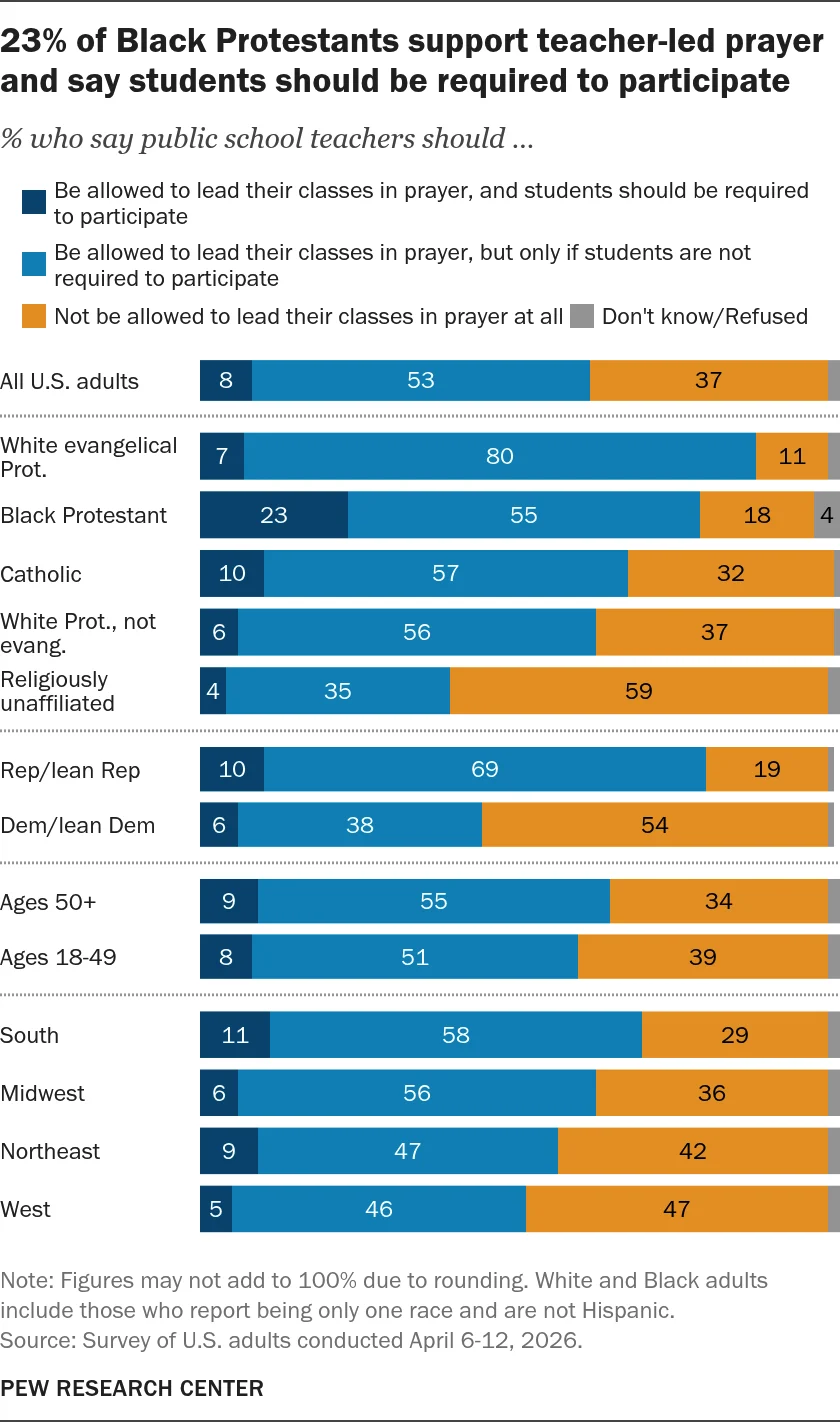
- Political Affiliation: Republicans and Republican-leaners are more likely to support various forms of religious expression, including teacher-led prayer and displaying the Ten Commandments. Conversely, Democrats and Democratic-leaners tend to oppose these measures, with a slight majority even opposing voluntary teacher-led prayer.
- Religious Affiliation: White evangelical Protestants show the highest levels of support for nearly all forms of religious expression in schools. Religiously unaffiliated Americans (atheists, agnostics, and those with no particular religion) largely oppose teacher-led prayer and displaying the Ten Commandments, with a majority (59%) stating teachers should not lead prayer at all. Black Protestants, while generally supportive, show a notable percentage (23%) favoring teacher-led prayer with mandatory student participation, a figure significantly higher than other groups.
- Age and Geography: Older Americans (50+) are more inclined to support teacher-led prayer and displaying the Ten Commandments compared to younger adults (18-49). Regional differences are also apparent, with residents of the South and Midwest showing greater support for these religious expressions than those in the Northeast and West.
Implications for Policy and Practice
The Pew Research Center’s findings have profound implications for the ongoing debates and legislative actions surrounding religion in public schools. The data suggests that while there is public appetite for religious expression in schools, the specifics of that expression and the degree of coercion involved are paramount concerns for Americans.
The strong support for voluntary student-led prayer indicates a societal acceptance of religious freedom as a fundamental right that extends to students within the school environment. However, the clear majority opposition to mandatory participation in teacher-led prayer underscores the importance of maintaining a separation between religious instruction and public education, as established by constitutional law.
The closely divided opinion on displaying the Ten Commandments suggests that this issue remains a contentious point, likely to continue fueling legal battles. The differing views across religious and political lines underscore the deep societal schisms on the role of religion in public life.

For policymakers, the survey serves as a reminder that public opinion is not monolithic. While some legislative efforts aim to increase religious expression in schools, the majority of Americans appear to favor a more cautious approach, prioritizing student choice and avoiding the perception of state-sponsored endorsement of religion. The findings also highlight the potential for such legislation to become a significant political wedge issue, further polarizing the electorate.
The survey’s methodology, which included a nationally representative sample of U.S. adults with a margin of error of plus or minus 1.9 percentage points, lends significant weight to its conclusions. The detailed breakdown by various subgroups provides a granular understanding of where differing viewpoints lie, offering valuable insights for educators, lawmakers, and legal experts navigating this complex terrain.
As legislative debates continue and court cases unfold, the Pew Research Center’s data provides a crucial benchmark for understanding the American public’s complex and often contradictory views on religion in public schools. The findings emphasize that while many Americans are open to religious expression, the principle of voluntary participation and the avoidance of perceived coercion remain central to public consensus.