Juneteenth National Independence Day, celebrated annually on June 19, marks a pivotal moment in American history: the end of slavery in the United States. While recognized as a federal holiday since 2021, the way states commemorate this significant day varies considerably, ranging from official legal holidays with paid days off for state workers to days of observance that do not include a day of paid leave. This evolving landscape of recognition reflects a growing national understanding of Juneteenth’s profound historical importance and its ongoing relevance.
The Current Landscape of State Recognition
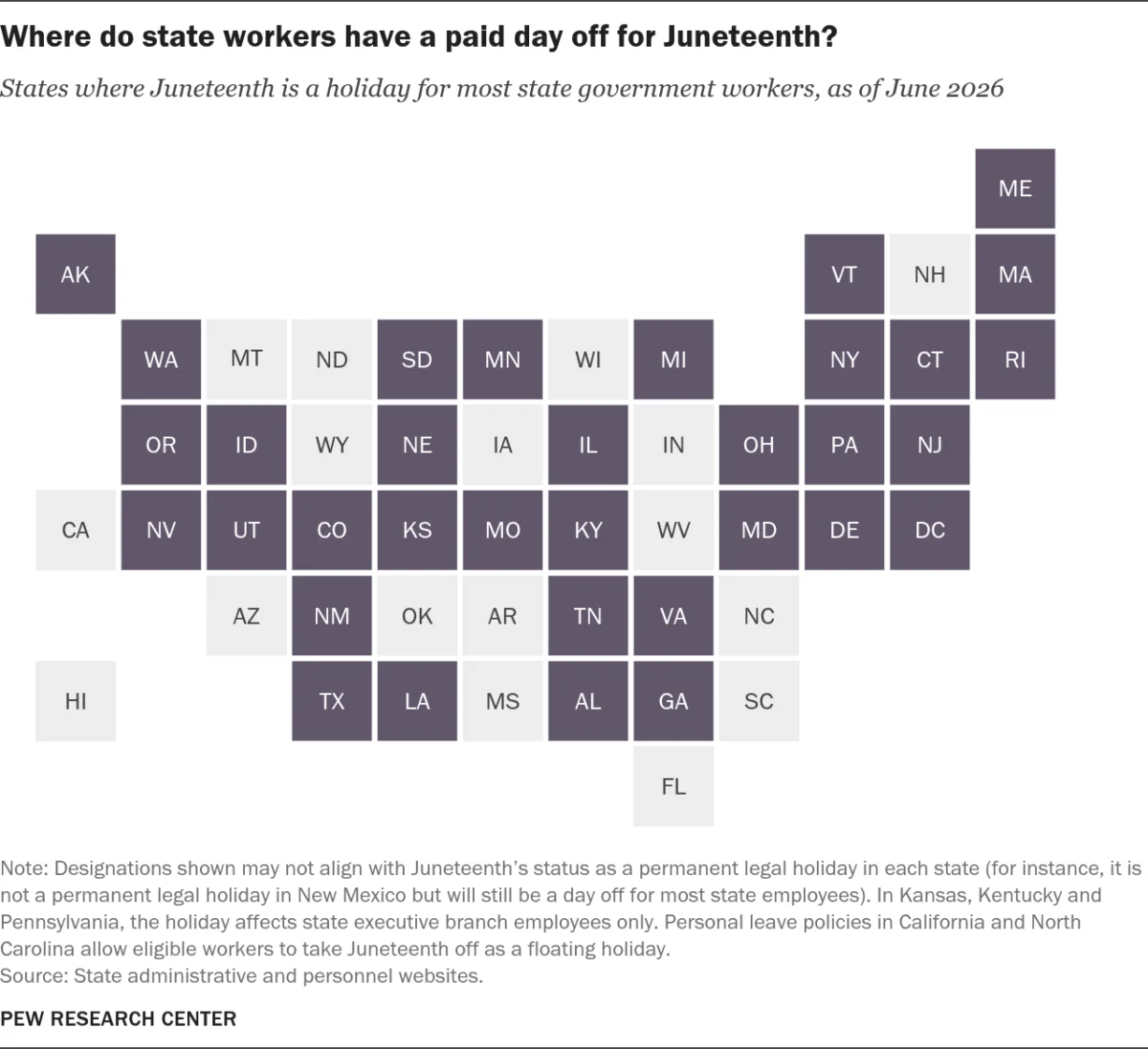
As of June 2026, a substantial majority of states are acknowledging Juneteenth in some official capacity. Administrative calendars indicate that at least 33 states, along with the District of Columbia, will grant most state government workers a paid day off to commemorate Juneteenth. This figure represents a significant expansion of official recognition since the holiday was established at the federal level.
Of these states, 30, plus the District of Columbia, have enshrined Juneteenth as a permanent legal holiday. This means that legislation has been enacted to formally recognize June 19th as a holiday each year, typically accompanied by a paid day off for state employees. These legislative actions underscore a commitment to ensuring that the historical significance of Juneteenth is formally acknowledged and observed.
However, the definition of a "holiday" can differ. In three additional states, Juneteenth is not yet a permanent legal holiday but is still observed with a paid day off for most state workers. These states may be on the cusp of enacting permanent legislation, with the potential for further legislative action to solidify its status.
Nuances in State-Specific Policies
The recognition of Juneteenth extends beyond a simple "yes" or "no" for a paid day off. Several states have implemented policies that offer Juneteenth as a floating holiday, allowing eligible workers to choose this day for personal leave. For instance, in California and North Carolina, state employees can utilize personal leave policies to observe Juneteenth. This approach provides flexibility while still acknowledging the day’s importance.
Furthermore, the specific designation can vary within a state’s government. In Kansas, Kentucky, and Pennsylvania, for example, the Juneteenth holiday primarily affects state executive branch employees. This highlights the intricate nature of how government holidays are implemented and the potential for differing policies across different branches or levels of state administration.
A notable instance of varied recognition is West Virginia. While former Governor Jim Justice had authorized Juneteenth as a state holiday via annual proclamation from 2021 to 2024, current Governor Patrick Morrisey opted not to continue this practice after taking office in 2025. Instead, state employees in West Virginia will have June 19th off in observance of West Virginia Day, demonstrating how political administrations can influence the recognition of commemorative days.
Historical Context and the Path to Federal Recognition
Juneteenth, a portmanteau of "June" and "nineteenth," commemorates the day in 1865 when enslaved African Americans in Galveston, Texas, were finally informed of their freedom. This occurred more than two months after the end of the Civil War and over two years after President Abraham Lincoln’s Emancipation Proclamation in 1863. The delayed announcement in Texas underscores the uneven and often protracted nature of the abolition of slavery across the nation.
The celebration of Juneteenth has deep roots in Texas, where it has been locally observed since the 1860s. The state officially recognized Juneteenth as a permanent holiday in 1980, making it the first state to do so. This early adoption by Texas laid the groundwork for broader recognition across the country.
The national consciousness surrounding Juneteenth surged in 2020, amplified by widespread protests against racial injustice and police brutality following the killings of George Floyd, Breonna Taylor, and others. This period of intense national dialogue on race and equality spurred greater momentum for federal recognition of the holiday. In June 2021, President Joe Biden signed bipartisan legislation establishing Juneteenth as a federal holiday, marking a significant milestone in its national acknowledgment.
The Journey to State-Level Holidays
The establishment of Juneteenth as a federal holiday provided a significant impetus for states to re-evaluate their own recognition policies. Prior to 2020, Juneteenth was primarily observed as an official observance in a limited number of states, often without a paid day off for state employees. The year 2020 and the subsequent years have seen a dramatic increase in states enacting permanent legal holidays for Juneteenth.

The Congressional Research Service has compiled data illustrating the timeline of Juneteenth’s adoption as an observance or a permanent legal holiday across states. This data reveals a clear trend: the vast majority of states that now recognize Juneteenth as a permanent legal holiday enacted this legislation in 2020 or later. This indicates a collective societal shift in understanding and prioritizing the historical significance of this day.
For example, states like Virginia and Pennsylvania adopted Juneteenth as a permanent legal holiday in 2020 and 2019, respectively. However, the surge in legislative action became most pronounced in 2021 and 2022, with numerous states formally recognizing the holiday during these years. This widespread adoption reflects the growing national consensus on the importance of commemorating the end of slavery.
Variations in State Observances
While many states have moved towards making Juneteenth a permanent legal holiday with a paid day off, the path to recognition has not been uniform. Some states have designated Juneteenth as an "observance" rather than a legal holiday. This distinction is crucial, as an observance typically signifies a day of public awareness and reflection but does not mandate a paid day off for government employees.
States such as Arkansas, Iowa, and Montana, for instance, recognize Juneteenth as an observance. In these cases, the holiday is often affixed to the third Saturday in June, aligning it with a weekend and making it more accessible for public participation without disrupting the regular work week for state employees.
The pace of legislative action also varies. Florida, Oklahoma, and Minnesota were among the first states outside of Texas to commemorate Juneteenth as an official observance in the 1990s. Minnesota has since elevated its recognition, making Juneteenth a permanent holiday in 2023. This demonstrates a progression in how states acknowledge the day, with some moving from observance to a more formal holiday status over time.
The last states to grant formal recognition of any kind to Juneteenth were Hawaii, North Dakota, and South Dakota. Hawaii and North Dakota designated it as an observance in 2021, while South Dakota adopted it as a permanent holiday in 2022. This late adoption by some states highlights the diverse timelines and political processes involved in establishing commemorative holidays.
Federal Holiday Impact and Broader Implications
As a federal holiday, Juneteenth impacts various sectors of American life. Federal government offices are typically closed on Juneteenth, and federal workers receive a paid day off. This aligns with the federal holiday schedule, which includes 11 annually recognized days of observance.
Beyond federal institutions, the financial markets also observe Juneteenth. Major stock exchanges and bond markets, such as those operated by the Securities Industry and Financial Markets Association (SIFMA), close on this day. This closure is a common practice for most federal holidays, reflecting the interconnectedness of financial systems and government operations.
Furthermore, some major national banks, including Bank of America, JPMorgan Chase, and Wells Fargo, have also made Juneteenth a paid holiday for their employees. This move by prominent financial institutions signifies a broader corporate acknowledgment of the holiday’s significance, extending its impact beyond government and financial sectors.
While many businesses, stores, and supermarkets remain open on Juneteenth, the growing recognition of the holiday by government entities and major corporations suggests a gradual shift in its societal integration. The closures and paid leave for a significant portion of the workforce mean that Juneteenth is increasingly becoming a day for collective reflection, commemoration, and engagement with its historical meaning.
The evolving landscape of Juneteenth recognition across the United States is a testament to the enduring legacy of the fight for freedom and equality. As more states and institutions formally acknowledge this historic day, it contributes to a more comprehensive understanding of American history and the ongoing pursuit of justice and equity for all. The continued dialogue and legislative actions surrounding Juneteenth reflect a nation grappling with its past and striving to build a more inclusive future.