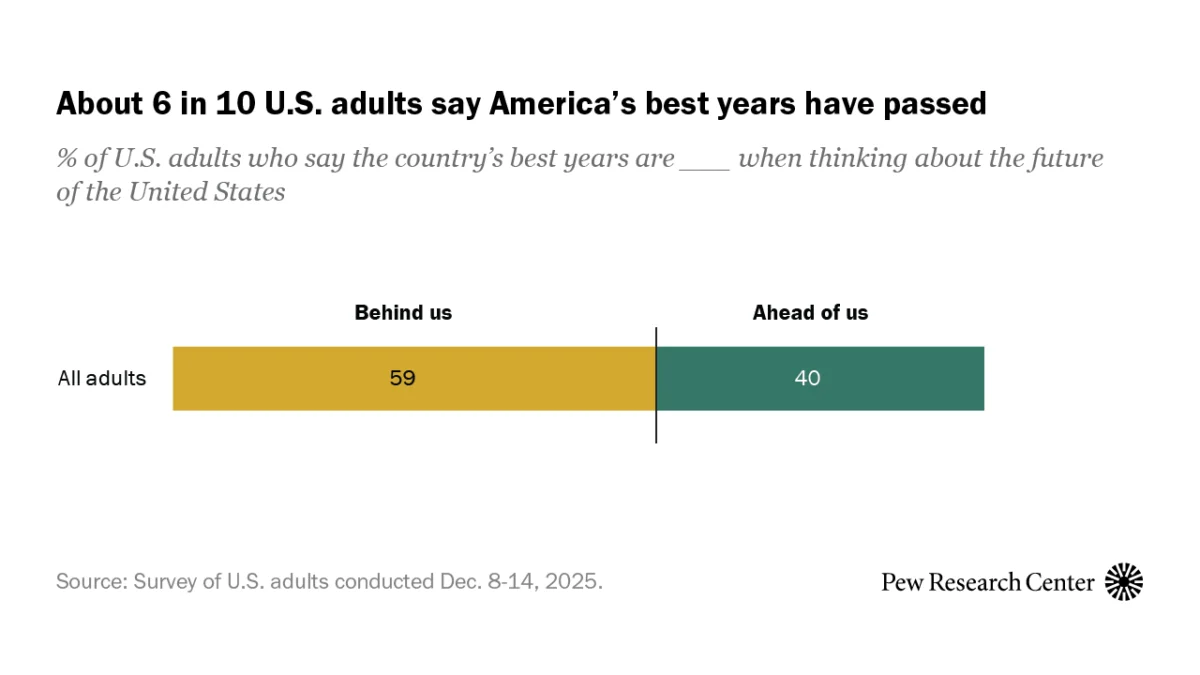
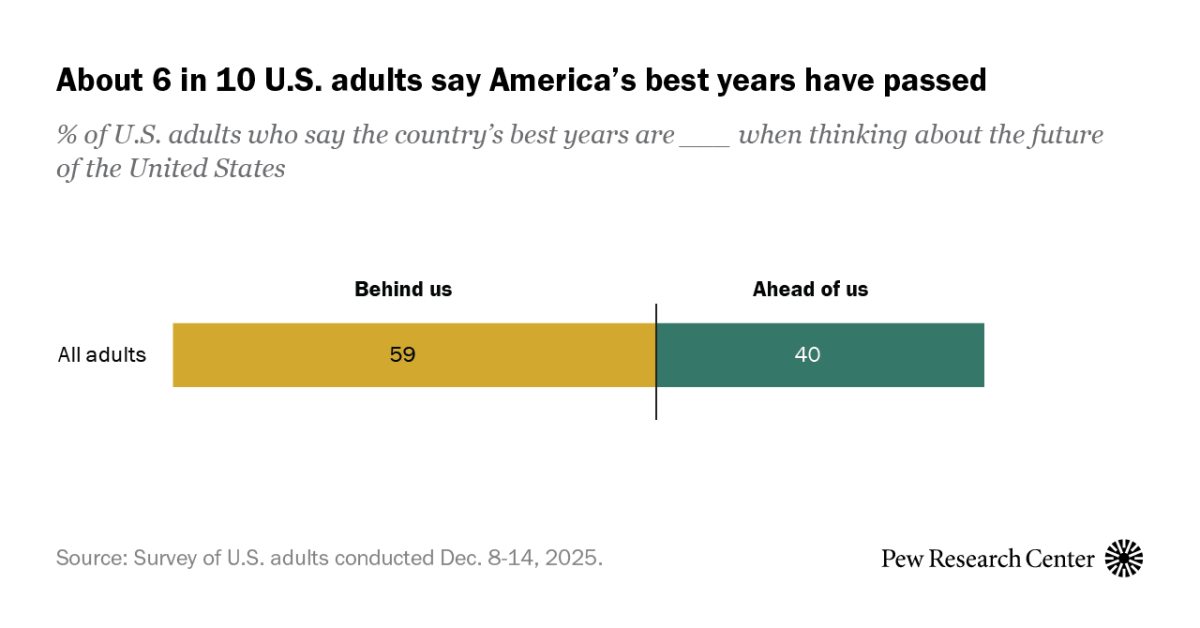
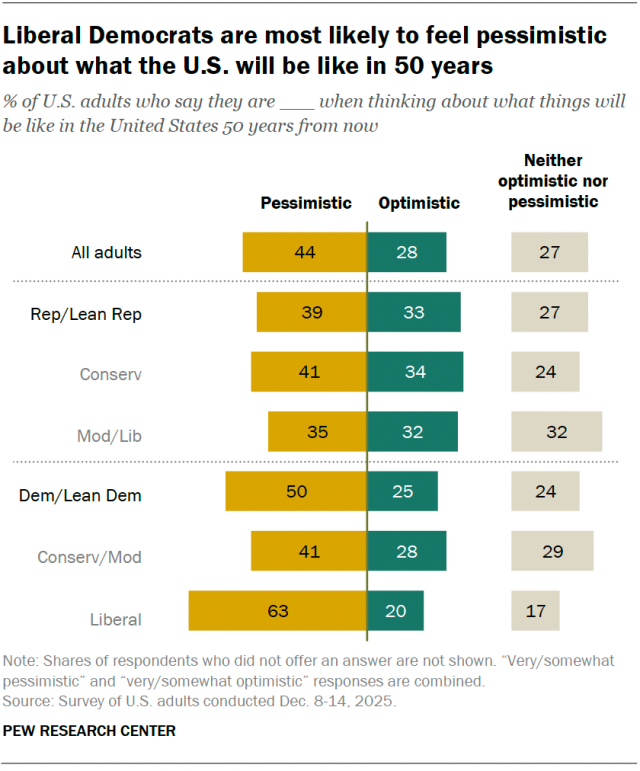
As the United States approaches its 250th anniversary, a significant portion of the American populace believes the nation’s most vibrant era has already passed. A recent survey conducted by the Pew Research Center reveals a stark division in national sentiment, with 59% of Americans asserting that the country’s best years are behind us. Conversely, 40% hold a more optimistic outlook, believing the nation’s greatest achievements and periods of prosperity still lie ahead. This sentiment extends to long-term projections, with a notable 44% of Americans expressing pessimism about the state of the U.S. 50 years from now, compared to 28% who feel optimistic. An additional 27% remain neutral, neither optimistic nor pessimistic about the nation’s distant future.
The findings, detailed in a comprehensive analysis released in May 2026, are based on a survey of 3,560 adults conducted by the Pew Research Center’s American Trends Panel from December 8-14, 2025. This research is part of a broader initiative by the center to understand public perceptions regarding the direction of the United States as it nears its semiquincentennial milestone. The study also aligns with ongoing analyses by Pew Research Center examining how the U.S. has transformed over the past half-century, since the nation’s bicentennial celebration in 1976.
A Historical Perspective on National Optimism
The current sentiment of looking back to a more glorious past contrasts sharply with historical trends in American optimism. For much of the 20th century, a prevailing narrative of American exceptionalism and continuous progress fueled a generally optimistic outlook. The post-World War II era, in particular, was characterized by significant economic growth, technological advancements, and a growing global influence, contributing to a widespread belief in an ever-brightening future. However, periods of significant social upheaval, economic recessions, and geopolitical challenges have historically tested this optimism.
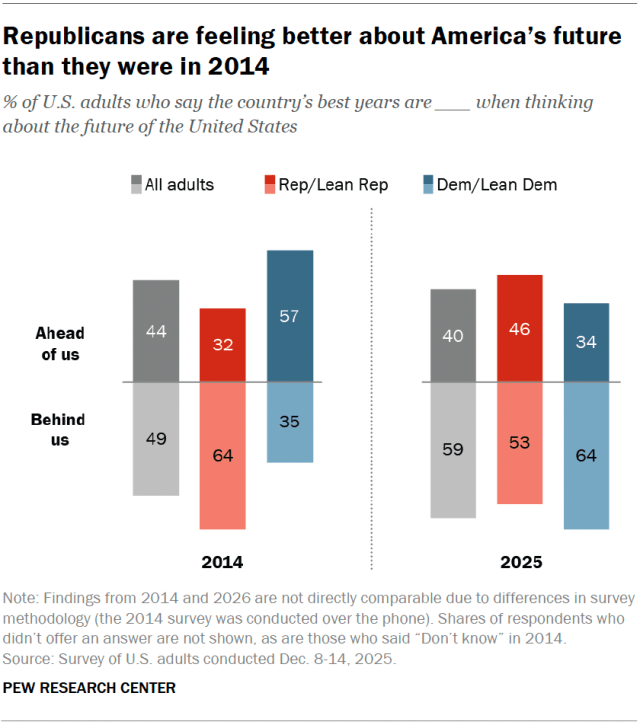
The Pew Research Center’s 2014 telephone survey, conducted during a period when the Democratic Party controlled both the White House and the U.S. Senate, showed a different partisan dynamic. At that time, 57% of Democrats expressed optimism about the country’s future, believing its best years were ahead, while only 32% of Republicans shared this view. The majority of Republicans (64%) in that survey felt the nation’s best years had already passed. It is important to note that due to methodological differences between the 2014 telephone survey and the 2025 panel survey, a direct, one-to-one comparison of these specific figures may be limited. Nevertheless, the shift in partisan outlook over the past decade offers a compelling insight into evolving national moods.
Demographic and Political Divides Shape Future Outlook
The divergence of opinion on whether America’s best years are in the past or ahead is not uniform across the American population. Significant variations emerge when examining different demographic and political groups.
Race and Ethnicity:
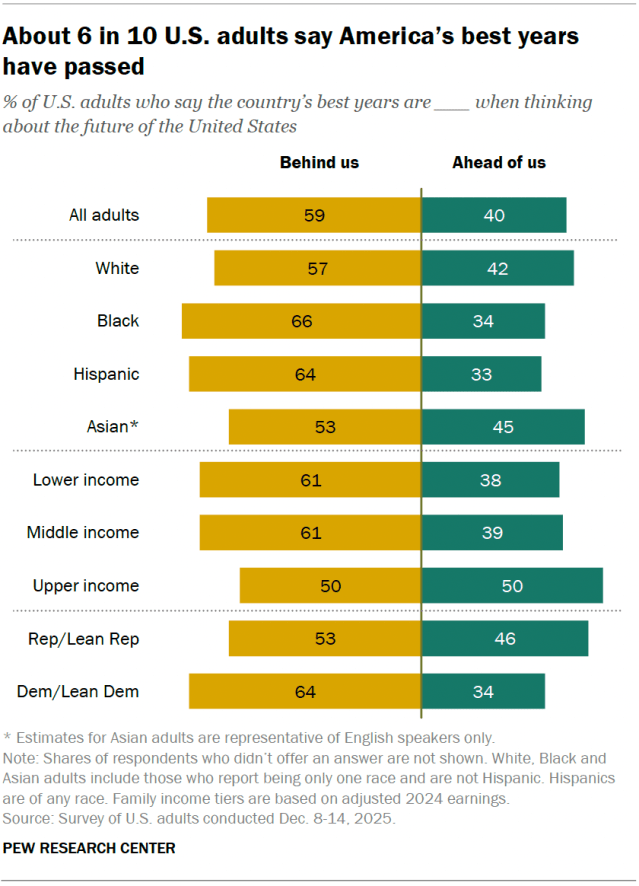
Majorities across racial and ethnic lines express a sentiment that the nation’s peak has passed. This view is held by 66% of Black adults, 64% of Hispanic adults, and 57% of White adults. Asian adults also lean towards this perspective, with 53% agreeing that the country’s best years are behind it.
Income Levels:
The perception of past glories is also more prevalent among lower and middle-income households. A substantial 61% of adults in both the lower and middle-income brackets believe the nation’s best years are in the past. In contrast, upper-income adults are evenly divided, with exactly half stating that the country’s most prosperous period has concluded and the other half believing it is yet to come. This suggests that economic standing may play a role in how individuals view national progress and future potential.
Political Affiliation:
Political party affiliation demonstrates a clear, albeit nuanced, divide. Democrats and those leaning Democratic are more likely to feel that the country’s best years are behind it (64%) compared to those who believe they are ahead (34%). Republicans and Republican leaners present a more balanced, though still leaning towards the past, perspective. Fifty-three percent of this group believe the nation’s best years have passed, while 46% maintain that they are still to come. This indicates that while both major parties exhibit a degree of nostalgia, the sentiment is more pronounced among Democrats in the current political climate.
Shifting Partisan Fortunes and National Mood
The evolution of partisan views on national prospects provides a compelling narrative of how political power and societal trends can influence collective sentiment. The stark contrast between the 2014 survey and the 2025 findings, particularly concerning the Republican party’s outlook, is notable. In 2014, Republicans were significantly more likely to believe the country’s best years were behind it. By 2025, while still a plurality, that gap has narrowed, with a larger percentage expressing a belief in future prosperity. This shift may be influenced by a variety of factors, including changes in political leadership, evolving economic conditions, and the broader socio-political landscape.
Conversely, Democrats, who in 2014 were more optimistic about the future, have seen a greater proportion of their party express a view that the best years are in the past. This suggests that the party in power, or the party out of power, may have a discernible impact on how its supporters perceive the nation’s trajectory. The Pew Research Center’s methodology for the 2025 survey, which utilized its American Trends Panel, offers a more robust and consistent measure of public opinion compared to traditional telephone surveys.
Pessimism Pervades Outlook on the Distant Future
Beyond the question of past glories versus future potential, Americans express a general sense of unease when contemplating the nation’s trajectory over the next half-century. The survey reveals a decidedly pessimistic outlook on what the U.S. will be like in 50 years.
- Overall Pessimism: 44% of Americans are pessimistic about the country’s future state.
- Optimism: A smaller segment, 28%, holds an optimistic view.
- Neutral Stance: A significant portion, 27%, remains neutral, reflecting a degree of uncertainty or a lack of strong conviction either way.
This pessimism is more pronounced among Democrats than Republicans. Half of Democrats express pessimism regarding the country’s future in 50 years, compared to 39% of Republicans. The ideological leanings within the Democratic Party further illuminate this trend. Liberal Democrats exhibit particularly gloomy views, with 63% reporting being very or somewhat pessimistic. In contrast, 41% of moderate and conservative Democrats share this sentiment. Among Republicans, ideological differences appear to have less impact on their outlook regarding the nation’s long-term future.
Implications for National Discourse and Policy
The findings from the Pew Research Center survey carry significant implications for the national discourse and the formulation of public policy. A prevalent sentiment that the nation’s best years have passed can foster a sense of disillusionment and potentially hinder forward-looking initiatives. If a majority of citizens believe that a golden age is in the rearview mirror, it could lead to increased skepticism towards government programs, a resistance to change, and a focus on preserving perceived past achievements rather than innovating for the future.
Conversely, the segment of the population that remains optimistic about the future represents a crucial reservoir of hope and a potential catalyst for progress. Understanding the demographic and political factors that contribute to this optimism could provide valuable insights for leaders seeking to foster a more positive national outlook.
The partisan divide in both past-present and future outlooks suggests that political polarization may be a significant factor shaping perceptions of national well-being. Addressing the underlying causes of this polarization, and finding common ground on issues critical to the nation’s future, will be paramount as the U.S. navigates the complex challenges of the 21st century.
The upcoming 250th anniversary provides a critical juncture for reflection and recalibration. The data from Pew Research Center underscore the need for a national conversation that acknowledges the nation’s historical achievements while also confronting present challenges and collectively charting a course for a promising future. The disparities in views across different segments of the population highlight the importance of inclusive dialogue and policy-making that addresses the concerns and aspirations of all Americans. As the nation stands on the precipice of a significant historical milestone, the prevailing sentiment of looking backward rather than forward warrants careful consideration by policymakers, community leaders, and citizens alike. The ability to foster a shared vision for the future, one that builds upon the nation’s legacy while embracing innovation and addressing contemporary issues, will be crucial in determining whether America’s best years are indeed yet to come.
About the Research
The Pew Research Center’s commitment to informing the public, journalists, and decision-makers is exemplified by this in-depth analysis of American perceptions of the nation’s future. This research is intrinsically linked to the broader effort to understand public sentiment as the United States approaches its 250th anniversary. It complements the center’s concurrent examination of how the U.S. has evolved since its bicentennial in 1976, offering a comprehensive historical and contemporary perspective.
The methodology employed for this study involved surveying 3,560 adults between December 8 and 14, 2025. All participants were members of the Pew Research Center’s American Trends Panel, a nationally representative online survey panel. This rigorous approach ensures that the findings accurately reflect the views of the broader U.S. adult population. The survey questions, detailed responses, and full methodology are publicly available through the Pew Research Center’s website, providing transparency and allowing for further scholarly examination.