On June 23, 1926, a pivotal moment in American higher education unfolded as approximately 8,000 high school students across the nation took the inaugural Scholastic Aptitude Test (SAT). This test, a precursor to the standardized assessment familiar to millions today, marked the beginning of a new era in college admissions. The SAT, now administered annually to around 2 million students, has undergone a dramatic metamorphosis since its inception, reflecting shifts in educational philosophy, technological advancements, and societal expectations. This comprehensive analysis delves into the historical trajectory of the SAT and its contemporary rival, the ACT, examining their structural, content, and scoring evolutions, alongside their evolving role in the competitive landscape of college admissions.
The Genesis of the SAT: An Intelligence Measure for Elite Institutions
The SAT’s origins are deeply intertwined with the desire to standardize college admissions, particularly for elite institutions. Modeled after the U.S. Army’s IQ tests, its initial purpose was to assess students’ innate intelligence rather than their acquired knowledge. This approach was championed by figures like Carl Brigham, a psychologist at Princeton University who developed the test, believing it could offer a more objective measure of a student’s potential for academic success, especially for those from diverse backgrounds or attending schools with varying academic rigor. The early SAT was a high-pressure, rapid-fire examination. In 1926, students faced 315 questions in a mere 97 minutes, a stark contrast to the current iteration, which presents 98 questions over 134 minutes. This initial design implied that completing every question was unlikely, a deliberate feature intended to gauge a student’s ability to perform under time constraints. Over the subsequent decades, test developers gradually adjusted the format, lengthening the time limits and reducing the question count to refine the assessment.
A Century of Change: Structural and Content Evolution
The content and structure of the SAT have been in constant flux, mirroring broader trends in education and assessment. The shift away from a pure intelligence measure began to take shape over time. A significant development occurred in 1994 when the College Board introduced math questions that required students to provide their own answers, moving beyond the traditional multiple-choice format. Simultaneously, the test developers retired antonym questions, signaling a move away from assessing rote memorization and towards evaluating higher-order thinking skills.
Technological advancements have also played a crucial role in the SAT’s evolution. The allowance of calculators in 1994 was a notable integration of technology. More recently, the transition to a fully digital format in 2024 marked a paradigm shift. This digital SAT employs an adaptive testing model, where the difficulty of subsequent questions adjusts based on a student’s performance on earlier ones, aiming for a more personalized and efficient assessment.
The College Board, the organization that oversees the SAT, has implemented several scoring recalibrations to maintain comparability over time. A significant "recentering" of scores occurred in 1994, an adjustment designed to reflect the evolving student population and changes in the test itself. However, substantial revisions in 2016, including the elimination of the penalty for incorrect answers, rendered scores from that year onward incomparable to those from prior periods.
Analyzing the Trends: SAT Score Performance Over Time
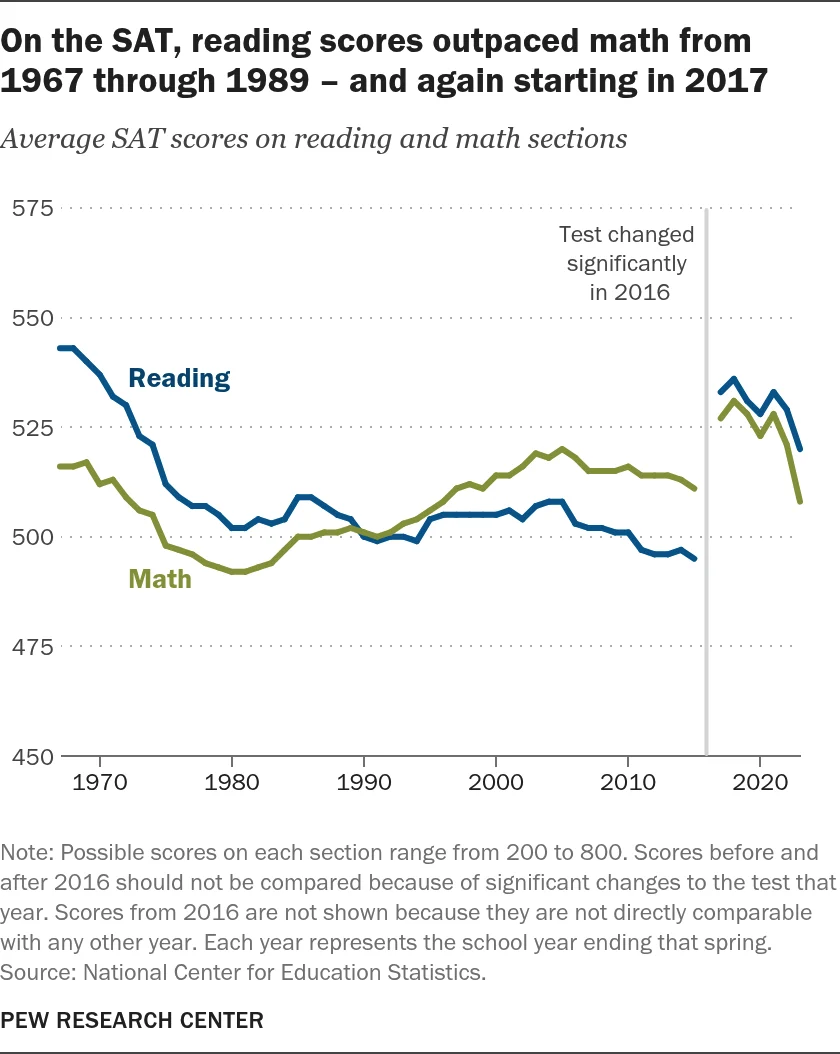
Data from the National Center for Education Statistics (NCES) provides a detailed look at SAT score trends. From the 1966-67 academic year through 2014-15, the average overall SAT score (out of a maximum of 1600) saw a decline, dropping from 1059 to 1006. This trend was not uniform across sections. The average reading score experienced a more pronounced decrease than the average math score.

In the 1966-67 school year, the average reading score stood at 543 out of 800, while the average math score was 516 out of 800. For over two decades, reading scores consistently outpaced math scores. This dynamic shifted in the 1989-90 academic year, when average math scores surpassed reading scores for the first time. This trend persisted through the 2014-15 school year, with average math scores generally exceeding reading scores. In that year, the average math score was 511, a modest decrease from its 1966-67 level, while the average reading score had fallen to 495, a nearly 50-point decline.
Following the significant changes implemented in 2016, the scoring patterns exhibited a resurgence of the trend seen in the late 1960s and early 1970s. Scores in the new reading and writing section tended to be slightly higher than those in the math section. However, both sets of scores generally showed a downward trend between the 2016-17 and 2022-23 academic years, the most recent period for which comprehensive data is available.
The Rise of the ACT: A Broader Assessment Approach
The American College Test (ACT), introduced in 1959, emerged as a direct competitor to the SAT. Its fundamental philosophy differed from the SAT’s initial focus on intelligence for elite admissions. The ACT was designed to evaluate students’ mastery of high school curriculum content, aiming to serve a broader range of colleges and students. This focus on academic content has made the ACT a comprehensive assessment of college readiness.
Currently, both the SAT and ACT are widely accepted for college admissions, holding similar reputations. In the graduating class of 2023, a significant portion of students participated in these standardized tests, with 51% taking the SAT and 37% opting for the ACT. Some students strategically took both tests, while others chose neither.
The ACT comprises four multiple-choice sections: English, Math, Reading, and Science. Notably, the Science section became optional in 2025, and an optional essay section has been available since 2005. The standard ACT, with its four multiple-choice sections, presents 171 questions to be answered within 165 minutes. The test can be administered in both computer-based and paper-based formats.
ACT Score Trends: A Picture of Decline
Similar to the SAT, ACT scores have also exhibited a general downward trend over time, according to NCES data. In the 1994-95 academic year, the average composite ACT score was 20.8 out of a possible 36. By the 2022-23 academic year, this average had decreased to 19.5. This decline was consistent across all four subject areas. In 1995, average scores in all ACT subjects exceeded 20.0. However, by 2022-23, only the average reading score maintained a value above 20.0.
A notable distinction between the ACT and SAT lies in their subject score comparisons. For all years for which NCES has collected data, the average ACT reading score has consistently been higher than the average ACT math score. This contrasts with the SAT, where math scores surpassed reading scores for a significant period before 2016.

The Shifting Landscape of College Admissions
The role of standardized tests in college admissions has become increasingly complex and debated. While many institutions have historically relied on SAT and ACT scores for evaluation, the landscape has evolved dramatically. By the year 2000, nearly 300 colleges had adopted test-optional policies, allowing students to choose whether to submit their scores. This movement gained significant momentum during the COVID-19 pandemic, when widespread test center closures made standardized testing inaccessible for many.
However, in recent years, a counter-trend has emerged, with some highly selective institutions reinstating mandatory standardized testing requirements. This decision often stems from a desire to reintroduce a common metric for evaluating applicants from diverse educational backgrounds and to better understand the academic preparedness of their applicant pools.
Public opinion on the use of standardized tests in college admissions remains divided yet generally supportive of their inclusion. A December 2022 Pew Research Center survey revealed that 71% of U.S. adults believe colleges should consider standardized test scores in their admissions decisions. Furthermore, a March 2022 survey indicated that 85% of Americans view standardized test scores as either a major or minor factor in college admissions. This suggests a persistent belief in the utility of these assessments, even amidst the ongoing discussions about their fairness and predictive validity.
Implications and Future Outlook
The nearly century-long evolution of the SAT and ACT reflects a continuous effort to refine college admissions testing. From an intelligence-based assessment to a curriculum-focused evaluation, and from paper-based exams to adaptive digital platforms, these tests have consistently adapted to changing educational paradigms and technological advancements. The observed trends of declining average scores in recent decades, coupled with the rise and fall of test-optional policies, highlight the dynamic nature of college admissions.
As institutions continue to grapple with how best to identify promising students, the debate over the role and impact of standardized tests will undoubtedly persist. The historical data and ongoing analyses of SAT and ACT performance offer valuable insights into the strengths and limitations of these assessments, informing future discussions about their place in the American educational system. The journey of these standardized tests is far from over, promising further adaptations as the educational landscape continues to transform.