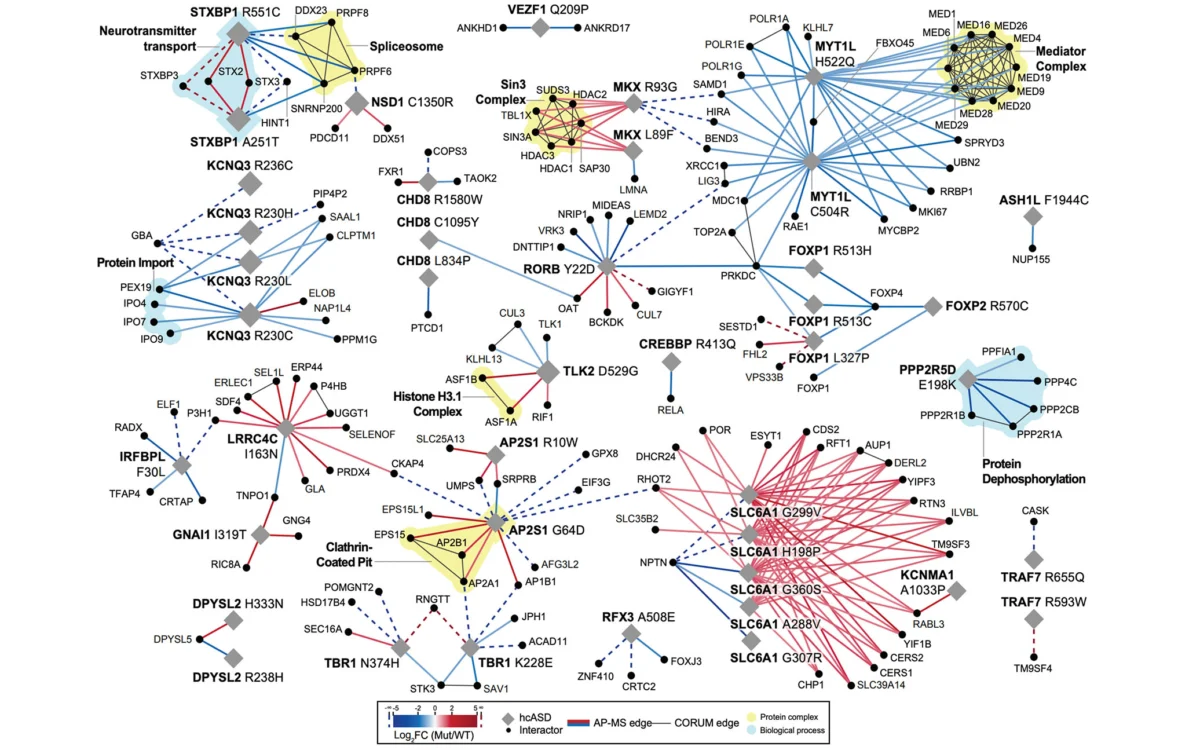
In a scientific milestone that researchers believe could fundamentally reshape the future of neurodevelopmental medicine, a comprehensive new study has successfully mapped the complex molecular pathways through which autism-linked genes alter brain development. Published in the journal Science, the research provides the most extensive view to date of how genetic mutations associated with autism spectrum disorder (ASD) disrupt the delicate machinery of human cells. By examining proteins encoded by 100 high-confidence autism risk genes, an interdisciplinary team of scientists has charted over 1,800 protein interactions—87% of which were previously undocumented—revealing that disparate genetic mutations frequently converge to disrupt the exact same protein complexes within the cell.
This convergence suggests a paradigm shift in how pharmacologists and neuroscientists might approach drug development. Rather than requiring hyper-personalized therapies tailored to each of the hundreds of distinct genetic variants known to cause autism, future treatments could theoretically target shared molecular hubs. By focusing pharmaceutical interventions on these centralized communication networks, researchers anticipate the potential creation of broader-spectrum therapeutics capable of ameliorating core neurological disruptions across diverse patient populations.
The study, spearheaded by researchers at the University of California, San Francisco (UCSF) in collaboration with a wide network of geneticists, molecular biologists, and computational scientists, represents the culmination of years of meticulous mapping. As the medical community digests the implications of the findings, experts emphasize that the research could prove particularly transformative for individuals diagnosed with profound autism. Comprising roughly 30 percent of the autism spectrum, this population often deals with severe intellectual disability, limited verbal communication, and rare, highly complex genetic variations that have historically resisted targeted pharmaceutical intervention.
Background Context and the Complexity of Autism Genetics
Understanding the monumental scale of this research requires examining the historical challenges of autism genetics. For decades, clinicians and researchers have known that autism is a profoundly heterogeneous condition with a strong hereditary component. Twin and family studies have long established that genetics play a primary role in the development of ASD, with heritability estimates frequently exceeding 80 percent. However, translating this genetic architecture into actionable clinical treatments has proven exceptionally difficult.
Over the past twenty years, advances in high-throughput DNA sequencing have allowed scientists to identify more than 100 high-confidence risk genes robustly linked to autism. These genes perform a staggering array of biological functions, ranging from synaptic transmission and neuronal migration to transcriptional regulation and chromatin remodeling. Yet, the sheer diversity of these risk genes created a massive translational bottleneck. Clinicians faced a perplexing biological puzzle: if hundreds of different genes, each affecting seemingly unrelated cellular pathways, can all result in an autism diagnosis, how can researchers ever hope to develop effective, universally applicable pharmacological treatments?
Historically, the prevailing assumption was that each genetic subtype of autism would require its own bespoke drug—a financial and logistical impossibility for pharmaceutical companies given the rarity of many individual mutations. This daunting prospect left many patients and families with symptomatic therapies, such as behavioral interventions and off-label medications for anxiety or irritability, rather than disease-modifying treatments that address the underlying neurological mechanisms of the condition.
The new study in Science directly challenges the necessity of individualized therapies by demonstrating that while the initial genetic triggers are diverse, their downstream physiological effects coalesce into a much smaller, more manageable set of molecular disruptions.
The Chronology and Methodology of the Mapping Project
The genesis of this landmark research lay in the collaborative effort to move beyond static lists of genes and instead examine the dynamic, physical interactions of the proteins those genes produce. Proteins rarely act in isolation; instead, they bind to one another to form intricate molecular machines and signaling networks that dictate cellular behavior. When a genetic mutation occurs, it can alter the three-dimensional structure of a protein, causing it to lose critical interactions with normal cellular partners or, conversely, to aberrantly bind to molecules it should ignore.
To capture this dynamic interplay, the research team at UCSF embarked on a systematic mapping initiative targeting 100 of the most rigorously validated autism risk genes. Utilizing advanced affinity purification-mass spectrometry and high-throughput proteomics, the scientists generated mutations associated with clinical autism diagnoses within these proteins and observed how their binding profiles shifted compared to their wild-type (normal) counterparts.
The researchers mapped these changes visually and functionally, utilizing blue indicator lines to denote protein-protein interactions that were weakened or entirely lost due to a mutation, and red lines to highlight newly gained or strengthened interactions. This exhaustive biochemical accounting ultimately yielded a massive dataset comprising over 1,800 distinct protein interactions.
The analytical phase of the project involved integrating these protein networks with clinical genetic databases to determine whether mutations occurring in entirely different genes—often discovered in unrelated patients—were nonetheless disrupting the same functional modules within the cell. The computational models revealed a striking pattern of convergence: despite the genetic heterogeneity of autism, the mutant proteins tended to bottleneck into shared macromolecular complexes, effectively sabotaging identical biological pathways.
Supporting Data and Visualizing the Molecular Machinery
The quantitative scope of the published data underscores the depth of the undertaking. Out of the 1,800-plus protein interactions cataloged in the study, nearly nine out of ten (87%) were entirely novel to science. This vast reservoir of biochemical data provides an unprecedented atlas of the molecular architecture underlying neurodevelopment.
Furthermore, the data illuminated the precise biochemical interfaces where mutant proteins fail to communicate properly with their cellular neighbors. By identifying these exact physical contact points down to the amino acid level, the researchers have provided the pharmaceutical industry with actionable blueprints for drug design. Rather than guessing how to repair a complex genetic disorder, medicinal chemists can now use structural biology to design small molecules or biologics that stabilize these impaired protein interfaces—either by preventing aberrant binding or by restoring lost interactions.
This quantitative leap forward transforms autism research from a descriptive genetic science into a precise molecular engineering discipline. The data clearly demonstrates that while the genetic landscape of autism is vast and varied, the functional convergence of these genes into centralized protein networks creates distinct, identifiable chokepoints that are theoretically amenable to pharmacological intervention.
Official Responses and Expert Perspectives
The academic and clinical communities have responded to the publication with considerable enthusiasm, viewing the study as a watershed moment for translational neuroscience.
Dr. Matthew W. State, chair of the Department of Psychiatry and Behavioral Sciences at UCSF and one of the senior authors of the study, emphasized the clinical optimism the research inspires. “This current work opens up a whole new world of possibilities for therapeutic targets and promises a generation of novel drugs that can transform what we are able to do in the clinic,” Dr. State stated, noting that the transition from genetic discovery to targeted drug development has long been the holy grail of developmental psychiatry.
Echoing these sentiments, Nevan J. Krogan, a professor at UCSF and a co-author of the study whose laboratory specializes in systems biology and quantitative proteomics, underscored the deterministic nature of the findings. “The science demonstrates that autism is written in our genes,” Dr. Krogan remarked. “This study maps the exact molecular machinery that is altered, including the specific protein interactions, down to the interfaces we can target with a drug.”
Independent researchers not directly involved in the study have likewise praised its methodological rigor and conceptual clarity. Developmental neurobiologists note that by shifting the focus from individual genes to interacting protein networks, the study bridges the historical gap between basic genetic discovery and clinical pharmacology. Clinicians who work daily with autistic individuals and their families have expressed cautious optimism, emphasizing that while moving from a protein map to an approved medication will take years of rigorous clinical trials, the foundational roadmap is finally in place.
Broader Impact, Therapeutic Implications, and Future Horizons
The implications of this research extend far beyond the immediate field of autism therapeutics. By establishing a robust methodological framework for mapping how high-risk mutations disrupt protein interaction networks, the UCSF research team has provided a blueprint that could fundamentally alter how scientists study other complex genetic conditions.
The researchers have noted that the same proteomic mapping approach could be applied to cancer biology, neurodegenerative disorders such as Alzheimer’s and Parkinson’s disease, and cardiovascular conditions. In oncology, for instance, tumors frequently harbor diverse and shifting mutations that resist targeted therapies; understanding how these mutations converge on shared protein complexes could lead to more durable, multi-target cancer treatments.
For the autism community specifically, the potential impact on individuals with profound autism is particularly profound. Profound autism—characterized by significant cognitive impairment, the inability to live independently, and severe language deficits—often stems from rare, highly penetrant de novo genetic mutations. Because these severe cases are frequently driven by distinct genetic variants, they have often been excluded from or underserved by broader developmental research initiatives. By identifying common molecular hubs where even rare mutations converge, this study offers a viable scientific pathway toward developing medications that could alleviate some of the most debilitating aspects of profound autism.
As the scientific community transitions from mapping these interactions to testing potential pharmacological compounds in preclinical models, the roadmap laid out in Science serves as a beacon of hope. What was once viewed as an insurmountable labyrinth of genetic diversity is now understood as a connected network of molecular interactions—one that modern medicine is finally equipped to navigate, target, and treat.