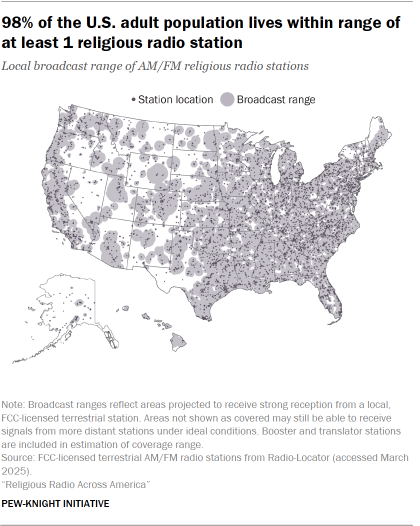
The United States is home to a substantial and pervasive network of religious radio stations, with over 4,000 terrestrial AM and FM stations broadcasting faith-based content. This vast landscape, representing roughly a quarter of all licensed radio stations, ensures that nearly every American adult, 98%, lives within reach of at least one such station. This comprehensive analysis, conducted by the Pew Research Center as part of the Pew-Knight Initiative, delves into the characteristics of these stations, the content they broadcast, and the motivations of their listeners.
Historical Roots and Pervasive Reach
The history of religious broadcasting in America dates back to the dawn of radio in the early 1920s, with initial broadcasts often featuring Sunday services. Over the subsequent century, this medium has evolved into a significant component of the nation’s media ecosystem. The Pew Research Center’s extensive analysis, drawing from data compiled by Radio-Locator and supplemented by content analysis of broadcast hours and public surveys, paints a detailed picture of this influential sector.

The study, conducted with funding from The Pew Charitable Trusts and the John S. and James L. Knight Foundation, aims to provide the public, media, and policymakers with a deeper understanding of the sources Americans rely on for information and connection, particularly through religious audio programming. Understanding the reach and content of religious radio is crucial for comprehending the diverse ways Americans engage with information and form their beliefs.
Defining the Religious Radio Landscape
To identify religious radio stations, the Pew Research Center utilized data from Radio-Locator, a comprehensive source for FCC-licensed terrestrial AM and FM radio station information. A station was classified as "religious" if its primary genre was listed as Religious, Christian Contemporary, Gospel Music, or Spanish Christian. While the vast majority of these stations are Christian in affiliation, the study acknowledges the existence of a very small number of stations tied to other religious traditions. Importantly, stations that primarily broadcast secular content but occasionally include religious programming, such as a local church service on a Sunday morning, were excluded from this definition. The accuracy of this classification was further verified by reviewing station websites and analyzing broadcast content.
Station Identity and Mission: A Predominantly Christian Focus
An examination of the websites of U.S. religious radio stations reveals a strong Christian identity. A significant majority, 63% of all religious stations, identify simply as "Christian" without specifying a particular denomination. Another 10% align with specific Protestant traditions, and 8% identify as Catholic. A very small fraction could be categorized as belonging to other Christian traditions or non-Christian faiths, while approximately 19% of stations either lacked a website or provided insufficient information to ascertain their religious affiliation.
A core component of the mission statement for many religious radio stations is evangelism. Three-quarters (77%) of stations with an "About Us" or mission statement page explicitly mention evangelism or spreading the gospel as a key objective. This mission often translates into the types of content broadcast, which can include inspirational music, sermons, Bible teachings, and faith-based discussions, aligning with the reasons listeners cite for tuning in.
Ownership Structures: Syndication and Independence
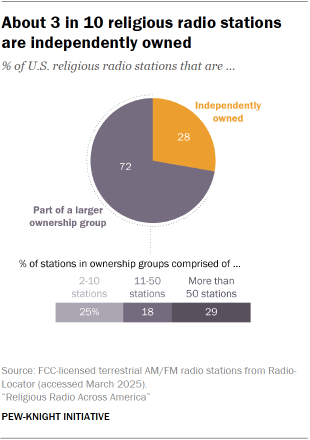
The ownership structure of religious radio stations reveals a landscape dominated by larger entities. While 28% of religious radio stations operate independently, the remaining 72% are part of multistation ownership groups. These groups often share online feeds and broadcast identical content across multiple stations, indicating a degree of syndication and centralized programming.

Content Analysis: Music and Talk in Balance
On average, religious radio stations dedicate roughly half of their broadcast time to music and the other half to spoken content. A notable finding is that 81% of the spoken content is delivered by male speakers. The spoken content broadly falls into two categories: traditional "talk radio" formats, including host-led discussions, interviews, and call-in segments, and religious services or sermons. Other spoken content, such as advertisements, audio dramas, and news, traffic, or weather updates, constitutes a smaller portion.
A Religious Lens on Diverse Topics
While music forms a significant part of religious radio programming, the spoken content consistently integrates religious references. An impressive 86% of spoken content includes mentions of religion or religious teachings, even if it’s not the primary focus. This translates to an average of over 10 hours of religion-related discussion per station daily.
Religious stations also delve into a range of everyday topics through a religious lens. Three topics stand out as being discussed for approximately two hours per station per day:
- Lifestyle and Advice: This broad category encompasses guidance on daily living, personal growth, and practical matters, all framed within a faith-based perspective.
- News and Politics: Discussions on current events and political matters are often interwoven with moral or theological viewpoints.
- Family, Parenting, and Education: Content in this area provides guidance and support for family life, child-rearing, and educational choices, informed by religious values.
Other subjects, including health and wellness, entertainment, pop culture and sports, business and finance, and science and technology, are also addressed, though typically for shorter durations.
Dominance of Popular Artists and Programs
The music played on religious radio stations, while diverse, leans heavily towards contemporary Christian music (CCM) and worship music. A significant concentration of airtime is dedicated to a relatively small pool of popular, established artists. Analysis revealed that 16% of all songs examined over a month were by just 10 individuals or bands, highlighting a core playlist that resonates widely with listeners.

Similarly, a select group of talk programs enjoys broad national reach. Programs like "Unshackled," "Turning Point," and "Focus on the Family" are featured on as many as half of all religious stations nationwide. A testament to the digital age, 99 out of the top 100 most frequently aired talk shows are also available on demand online or as podcasts, underscoring the multifaceted ways listeners can access this content.
Varied Content Mix: Music vs. Talk
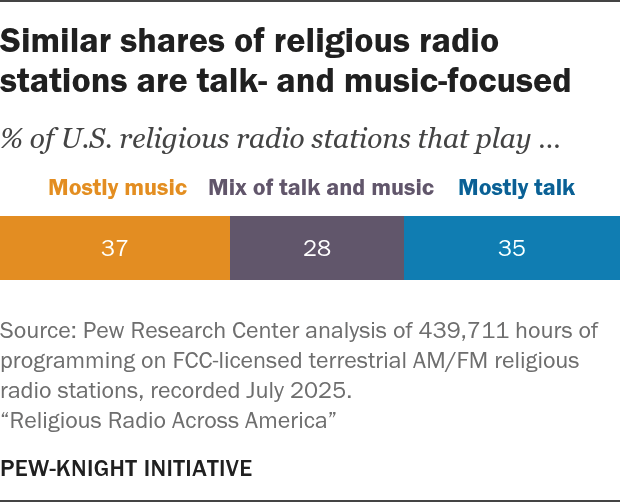
While the national average suggests an even split between music and talk programming, individual stations exhibit significant variation. Approximately 37% of religious radio stations primarily broadcast music, while 35% focus predominantly on talk programming. The remaining 28% maintain a more balanced mix of both music and talk.
The Role of News and Politics
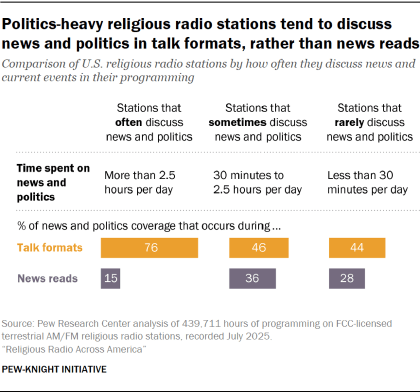
Despite the primary focus on faith, news and politics are not entirely absent from religious radio programming. On average, stations dedicate around two hours per day to discussing politics, current events, and social issues. However, this average masks considerable disparity among stations. While 30% of stations dedicate less than 30 minutes daily to these topics, a nearly identical share (29%) spends over two and a half hours on politics and current events, with some devoting as much as 10 hours per day.
Interestingly, most listeners of religious audio programming do not cite news and politics as a primary reason for tuning in. Only 14% of listeners identify keeping up with current events as a major motivator, though 40% acknowledge it as a minor reason.
Political Commentary and Topics of Discussion
The way political and social issues are discussed on religious radio varies significantly. Stations with a heavy focus on politics tend to present their coverage through long-form talk formats, such as interviews and host commentaries, rather than brief news reads.
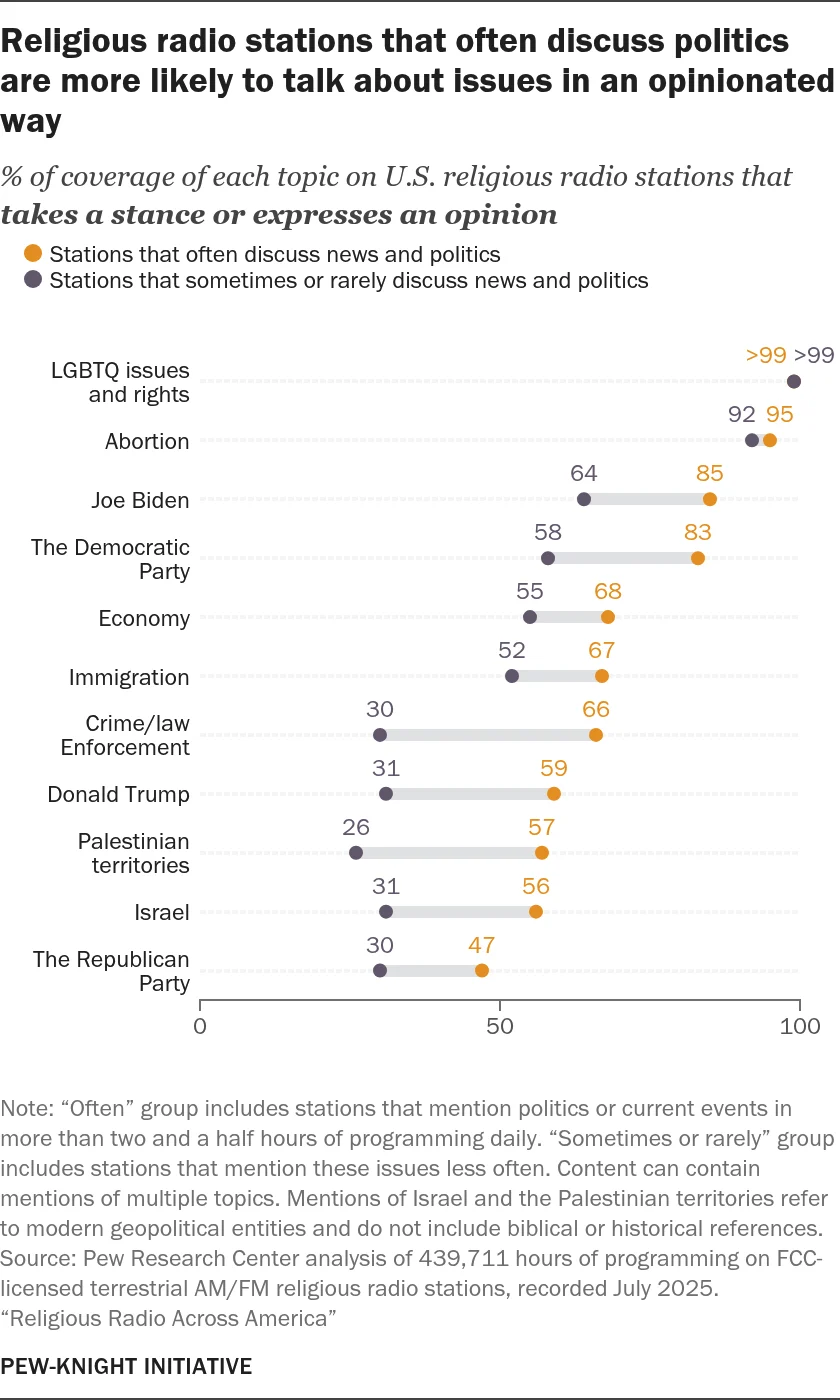
An analysis of station mentions of 11 specific issues, entities, or people – including the economy, crime, Donald Trump, Joe Biden, the Republican and Democratic parties, Israel, Palestinian territories, LGBTQ issues, abortion, and immigration – revealed differing levels of engagement. Stations that rarely discuss news and politics tend to focus on more general issues like the economy or crime, with limited daily coverage.
In stark contrast, stations that frequently discuss politics dedicate substantial airtime to specific figures and issues. Donald Trump, for instance, was mentioned in nearly two hours of content per day on these politically focused stations, exceeding coverage of the economy. These stations also frequently discuss abortion (40 minutes daily) and LGBTQ issues (similar duration), often framing these topics with a strong stance. Coverage of the Republican and Democratic parties also appears more frequently on these stations.
Opinionated Discourse on Key Issues
The analysis further distinguished between neutral and opinionated discussions of political and social issues. Stations that frequently engage with politics generally present nearly all the studied topics in an opinionated manner. This tendency is particularly pronounced for issues like abortion and LGBTQ rights, where coverage, when it occurs, is almost universally expressed with a clear stance. Mentions of abortion are overwhelmingly against it, while discussions of LGBTQ issues tend to be against expanded rights or acceptance.

Other observations regarding the discussion of these topics include:
- Abortion: Stations that frequently discuss politics are highly likely (95%) to express an opinion on abortion, compared to 92% on stations that discuss politics less often.
- LGBTQ Issues: Discussions surrounding LGBTQ issues are almost universally opinionated (over 99%) across all types of religious radio stations, regardless of their overall political focus.
- Donald Trump: Mentions of Donald Trump are opinionated in 59% of coverage on politically focused stations, compared to 31% on less politically focused stations.
- Joe Biden: Opinionated coverage of Joe Biden is prevalent at 85% on stations that often discuss politics, versus 64% on others.
- Immigration: Discussions on immigration are opinionated in 67% of coverage on politically focused stations, rising to 52% on stations that discuss politics less frequently.
This deep dive into religious radio in America highlights a dynamic and influential media sector that plays a significant role in the lives of millions, shaping perspectives and fostering community through a blend of faith, music, and discourse on a wide array of topics.