The discourse surrounding diversity, equity, belonging, and inclusion (DEBI) initiatives has become a cornerstone of modern organizational development, yet its effectiveness often hinges on a subtle but profound element: the language used to define and articulate these concepts. How these terms are framed, understood, and communicated directly impacts engagement, reveals hidden barriers, and ultimately dictates the success or failure of efforts to embed inclusion as a cultural norm. A recent analysis, alongside decades of field experience and supporting studies, highlights that the precise definitions applied to DEBI work can either galvanize collective action or inadvertently erect significant psychological and operational obstacles, often leading to confusion, apathy, or even resistance among employees. This complex interplay between semantics and psychology demands a more deliberate and inclusive approach to DEBI communication.
The Unseen Barriers: Psychological Reactions to DEBI Terminology
Despite the universally recognized importance of fostering inclusive environments, the mere mention of "diversity," "equity," or "inclusion" can trigger a spectrum of subconscious reactions, ranging from disengagement to defensiveness. Experts in organizational psychology and change management have observed consistent patterns in how individuals interpret and respond to these terms. For instance, some individuals from majority groups may perceive DEBI as an issue exclusively for minority populations, leading to the dismissive sentiment, "Diversity isn’t my issue! It only applies to people from minority groups, not me!" This perspective inadvertently absolves them of responsibility and engagement, as internal surveys often show a significant portion of employees (up to 30% in some contexts) feeling that DEBI initiatives are not personally relevant to them.
Conversely, members of minority groups might express frustration, feeling burdened by the expectation to educate or fix systemic issues: "I am the one being discriminated against. Don’t ask me how to fix it – it’s your problem," or, "You’re diverse, so you need to fix it – it’s your problem." These reactions underscore a critical disconnect, where the onus of change is misplaced or unfairly distributed, contributing to burnout among DEBI advocates from underrepresented groups. Furthermore, a widespread perception exists that DEBI work is a secondary concern, detached from core business functions, manifesting in phrases like, "Diversity and inclusion are not my day job, so I don’t really have time for that. Someone else has got to fix it." This detachment often stems from a lack of clear articulation regarding DEBI’s intrinsic link to organizational performance and innovation, with a 2022 study indicating that only 45% of employees fully understand how DEBI connects to their company’s overall business strategy.
More concerning are the interpretations that foster a sense of zero-sum competition. Statements such as, "Let’s make sure we attract some diversity talent," often implicitly referring to women or racial minorities, can be misconstrued. The most damaging perception, however, is the notion that promoting diversity inherently means excluding others: "If we are going to promote women and minorities, then we have to exclude others," a sentiment frequently expressed by white men who fear a loss of privilege or opportunity. A 2021 survey found that 35% of male employees in certain industries expressed concerns that DEBI initiatives might disadvantage them. These varied, often negative, interpretations are not merely anecdotal but represent deeply ingrained mental models shaped by historical contexts and imprecise communication strategies.
Setting Unintentional Trip Wires: Misguided Approaches to Inclusion
These perceptions are not random; they are often the direct consequence of how diversity, equity, and inclusion initiatives have been historically structured and communicated. For decades, many organizations have implemented strategies focused on setting diversity targets primarily for minorities and women, inadvertently framing DEBI as an issue of "fixing the difference" or "helping the minority." Programs aimed at gender equality, for instance, frequently target only women, creating an impression that women are the problem to be fixed, rather than focusing on systemic barriers or engaging all genders in solutions. A common criticism, highlighted by a 2020 Harvard Business Review article, is that many DEBI programs are designed to "fix" individuals rather than the systemic issues within the organization.
This approach frequently misses two crucial elements: engaging all people—both majority and minority groups—and systematically redesigning implicit norms and organizational systems that perpetuate discriminatory practices. The outcome is often a push towards assimilation, where individuals from underrepresented groups are expected to conform to existing norms, rather than an authentic embrace of diverse attributes. This narrow framing creates divisions, reinforces an "us versus them" bias, and ultimately undermines the very intentions of fostering an inclusive environment. By framing DEBI in ways that inadvertently exclude or alienate segments of the workforce, organizations paradoxically work against their stated goals of leveraging diversity for competitive advantage and creating equitable workplaces. The lack of universal engagement is a significant factor in the stagnation of DEBI progress, with reports indicating that employee engagement in DEBI training can be as low as 50% when not perceived as universally relevant.
The Potent Psychology of Words: Shaping Perceptions and Behaviors
The power of language to shape human perception, behavior, and culture is well-documented in scientific literature. Neuro-linguistic programming and cognitive psychology offer robust evidence that words, far from being neutral vessels of meaning, are potent triggers for thoughts, emotions, and unconscious actions. The priming effect, for instance, demonstrates how exposure to certain words or images can unconsciously influence subsequent thoughts and behaviors. A classic study by John Bargh and colleagues illustrated this by showing participants words associated with the elderly (e.g., "wrinkle," "forgetful"); these participants subsequently walked slower than a control group exposed to neutral words. This phenomenon extends to DEBI discourse, where repeated exposure to certain phrases can inadvertently reinforce stereotypes or negative associations. For example, well-intentioned statements like "girls are as good as boys at math" have been shown to backfire, subtly reinforcing the underlying (false) stereotype that boys are inherently better at math, as highlighted by a study in the Journal of Experimental Social Psychology.
Beyond unconscious priming, words directly engage our emotional centers, which are powerful drivers of decision-making and behavior. One significant emotional trigger in DEBI discussions is the "fear of loss," rooted in loss-aversion bias, a concept famously explored by Daniel Kahneman and Amos Tversky. When diversity is perceived as a zero-sum game—where one group’s gain necessitates another’s loss—efforts towards equality can be interpreted as a demand to relinquish power or privilege. This perception triggers a strong aversion to change, prompting individuals to resist new initiatives and fight to maintain the status quo. Research consistently shows that humans are more motivated by the prospect of avoiding loss than by the potential for equivalent gain, making the "fear of loss" a formidable barrier to DEBI progress in corporate environments.
Another psychological hurdle is the innate human tendency towards "tribalism" and the fear of the "unknown." Our instinctive group mentality, rooted in evolutionary psychology, is activated when we perceive interactions with "out-groups" (those outside our familiar social circles). This can create an unconscious, irrational fear or anxiety, influencing behaviors where knowledge and information shared by out-group members are unintentionally excluded, while greater trust and acceptance are extended to "in-group" members. This "in-group/out-group" bias, explored in social identity theory, significantly impacts how individuals process information and construct their mental models of reality, often leading to unconscious biases in hiring, promotion, and collaboration.
Perhaps one of the most insidious emotional impacts in DEBI work is the feeling of shame. Language used in DEBI discussions, even when well-intentioned, can inadvertently evoke feelings of blame or guilt. Individuals may feel ashamed for past discriminatory actions they committed unknowingly or without malicious intent, or for their unearned privilege in the face of systemic inequality. This shame can manifest as defensiveness, withdrawal, or even unconscious micro-aggressions against those perceived as the source of these uncomfortable feelings, thereby creating a significant impediment to constructive dialogue and genuine change. These examples underscore that the words chosen in DEBI discourse are not merely semantic choices but powerful psychological levers that can either open pathways to inclusion or fortify existing barriers.
The Historical Trajectory of DEBI: From Compliance to Culture
The evolution of diversity, equity, and inclusion initiatives provides crucial context for understanding the current challenges in language. Early efforts, largely emerging from civil rights movements and legislative mandates in the mid-20th century, often focused on legal compliance and numerical representation. Terms like "affirmative action" and "equal opportunity employment" became prevalent, emphasizing quotas and legal protections. While vital for addressing historical injustices, this compliance-driven approach sometimes inadvertently fostered the perception of DEBI as a legal burden rather than a strategic imperative. For instance, the 1964 Civil Rights Act in the United States marked a pivotal moment, yet its implementation often led to a focus on legalistic interpretations of equality.
In the late 20th and early 21st centuries, the focus broadened to "diversity management," recognizing the business case for diversity in terms of market access and varied perspectives. However, this era often treated diversity as an add-on, a separate department or program, rather than an integrated aspect of organizational strategy. "Inclusion" emerged as a critical complement, acknowledging that simply having diverse representation was insufficient without creating environments where all individuals felt valued and empowered to contribute. More recently, "equity" has gained prominence, shifting the conversation from mere equality (treating everyone the same) to fairness (providing different support to achieve equal outcomes), recognizing systemic disparities. The addition of "belonging" further refines this, emphasizing the individual’s emotional experience of being accepted and integrated, a concept gaining traction since the mid-22nd century.
This historical progression highlights a continuous struggle to move DEBI from a reactive, compliance-focused endeavor to a proactive, culturally embedded philosophy. The language used at each stage reflected the prevailing understanding and goals, and as these goals became more nuanced, the inadequacy of simplistic or poorly defined terms became more apparent. The current challenge, therefore, is to craft language that accurately reflects the comprehensive, systemic, and human-centered nature of contemporary DEBI aspirations, moving beyond buzzwords to foster genuine cultural transformation.
Towards Clarity: Redefining Diversity, Equity, Belonging, and Inclusion
Given the profound impact of language, establishing clear, commonly understood definitions for DEBI terms is paramount. Without a shared framework, individuals within an organization are left to their own interpretations, leading to disparate mindsets, misaligned actions, and stalled progress. What one person understands as "diversity" (e.g., only women) another may perceive differently (e.g., racial minorities), and yet another might interpret it as "diversity of thought." Similarly, "inclusion" might be reduced to networking events for some, while for others it means actively leveraging varied perspectives in decision-making. "Equity" might be simplistically equated with "diversity hiring targets," overlooking deeper systemic issues. This divergence in understanding creates an "absurd reality" where alignment and collective action are almost impossible to achieve, often leading to a reported 40% failure rate for DEBI initiatives that lack clear, shared definitions.
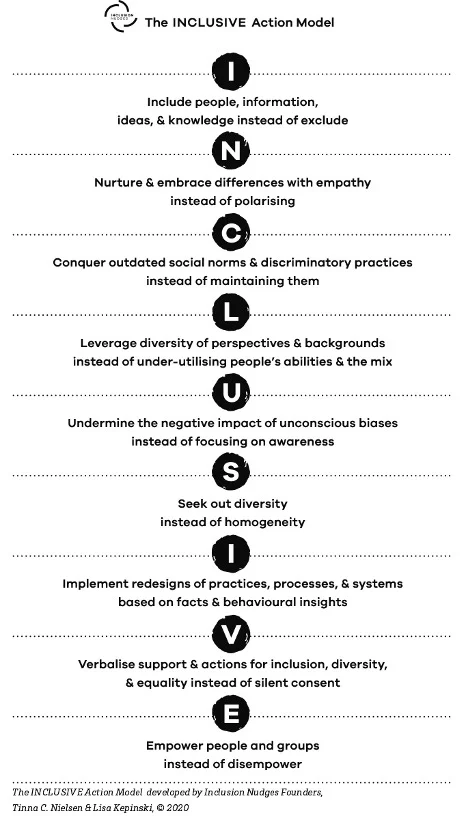
To counter this, a structured approach to defining these terms is crucial. One such approach, exemplified by the Inclusion Nudges global initiative, offers comprehensive definitions designed to guide design work in actions, behaviors, systems, and cultures:
- Diversity: The Mix of All of Us. This definition emphasizes that diversity encompasses all people and their multifaceted differences, including demographic traits, backgrounds, multiple identities, unique experiences, perspectives, knowledge, and abilities. It explicitly moves away from the narrow view of diversity as referring only to "the minority," instead positioning it as a characteristic of humanity itself. This broad definition seeks to foster a universal sense of relevance.
- Equity: The Fairness Frame for the Mix. Equity is defined as ensuring all individuals have equal access to opportunities and fair treatment, actively working to eliminate discriminatory practices, systems, laws, policies, social norms, and cultural traditions. It involves balancing power imbalances and correcting historical and ongoing inequalities, focusing on fairness for all. This is not merely about treating everyone the same, but about providing what each individual needs to thrive, acknowledging systemic disadvantages.
- Belonging: I Feel Valued as a Part of the Mix. This concept centers on the individual’s lived experience within an environment. Belonging is achieved when people feel welcomed, safe, seen, heard, and valued, and can be their full, authentic selves without needing to "cover" or downplay personal traits. It is presented as the natural outcome when diversity, equity, and inclusion are successfully implemented, with studies showing a direct correlation between strong belonging and increased employee retention.
- Inclusion: Welcoming and Applying the Mix. Inclusion focuses on fostering the structures, systems, processes, culture, behaviors, and mindsets that embrace and respect all people and their diversity. It’s about actively seeking out diversity, challenging exclusionary norms, being open to others, and speaking up. Crucially, it emphasizes ensuring that diverse knowledge, perspectives, information, and ideas are not just present, but actively welcomed and utilized, enabling all individuals to participate and contribute to their fullest potential.
These definitions aim to serve as guiding stars, providing a common language and framework that aligns understanding and sets clear expectations for what an inclusive environment truly entails.
Beyond Definitions: Fostering Action-Oriented Engagement
While clear definitions are foundational, simply articulating them intellectually is insufficient to drive behavioral change. Rational understanding, residing in the conscious mind (System 2 thinking), often does not directly translate into unconscious behaviors (System 1). To bridge this gap, definitions must resonate with individuals on a personal level and be linked to actionable steps. A 2019 report by Deloitte highlighted that employees are more likely to engage with DEBI initiatives when they can see tangible, everyday applications.
Organizations can adapt these core definitions by contextualizing them with their specific strategic objectives, using vocabulary that aligns with their existing organizational values such as "performance," "innovation," "agility," or "global mindset." However, a more potent strategy involves engaging employees directly in defining what DEBI means to them in terms of concrete actions. This shifts the focus from abstract words to tangible behaviors. By involving "the people it’s about" in identifying actions and behaviors that they perceive as inclusive, inviting, respectful, empathetic, and that make them feel included, valued, and empowered, organizations achieve multiple objectives:
- Contextualized Definitions: The resulting definitions are directly relevant and meaningful to the specific group or organization.
- Increased Ownership: Employees involved in the co-creation process develop a stronger sense of ownership and commitment to the change initiative.
- Built-in Onboarding: The development process itself becomes an inclusive onboarding mechanism, preparing individuals for the desired changes.
- Leveraging Diversity: The process inherently leverages the diversity of perspectives within the group to create richer, more universally applicable understandings.
Once these inclusive behaviors are identified, the next critical step is to make them visible and celebrated. Rather than burying them in complex documents or spreadsheets, organizations should share these diverse, real-life practical examples and personal stories prominently. Displaying them on factory floors, office walls, meeting rooms, or internal communication channels illustrates how inclusion manifests in everyday actions. Effective communication involves sharing one example at a time, highlighting that these actions are being performed by peers and colleagues, thereby leveraging social proof. When data is available—for instance, "8 out of 10 of your colleagues are doing X"—it should be communicated specifically to reinforce the norm, aligning with principles of behavioral economics that show people are more likely to conform to perceived social norms.
Achieving Inclusion Without Overusing the Word
Ultimately, the goal is to embed inclusive practices so deeply that they become "how work gets done here" or "how people experience being in the group," rather than a standalone initiative. This means strategically reducing the over-reliance on buzzwords like "inclusion," "diversity," and "equity" once a common understanding and behavioral shift are underway. By focusing on desired outcomes, organizations can frame discussions around the benefits of inclusion without constantly invoking the terms themselves. For example, instead of saying, "We need more inclusion," one might say, "We need the thinking from everyone for new solutions" or "We need our systems designed to enable our most objective decision-making." This shifts perceptions towards a resource-oriented and positively associated view of DEBI, fostering inclusive behaviors and cultures as the norm.
The journey from abstract definitions to lived reality across thousands of individuals with diverse understandings is indeed a significant challenge for any change-maker. However, by intentionally framing DEBI through clear, universally understood, and action-oriented language, organizations can navigate this complexity more effectively. The strategic use of language, coupled with inclusive engagement and consistent reinforcement of desired behaviors, forms the bedrock of a truly inclusive culture, moving beyond mere rhetoric to create environments where everyone can thrive.
Implications for Organizational Performance and Societal Cohesion
The stakes extend far beyond internal dynamics. For organizations, a failure to articulate DEBI effectively translates into tangible losses: diminished innovation, higher employee turnover, reduced market competitiveness, and potential legal liabilities. Research consistently links diverse and inclusive workplaces to higher financial returns, enhanced problem-solving capabilities, and improved employee engagement. A McKinsey & Company report, for instance, found that companies in the top quartile for ethnic and cultural diversity on executive teams were 33% more likely to have industry-leading profitability. When language creates barriers, these benefits remain elusive.
On a broader societal level, the misframing of DEBI contributes to polarization and misunderstanding. In a world increasingly grappling with issues of social justice and inequality, the ability to communicate these concepts clearly and inclusively is critical for fostering empathy, bridging divides, and building cohesive communities. The challenge, therefore, is not merely semantic; it is a fundamental test of leadership, communication, and commitment to creating a future where inclusion is genuinely the norm—everywhere, for everyone. The strategic application of thoughtfully chosen words and a focus on collective action serve as the guiding principles for this transformative endeavor.