
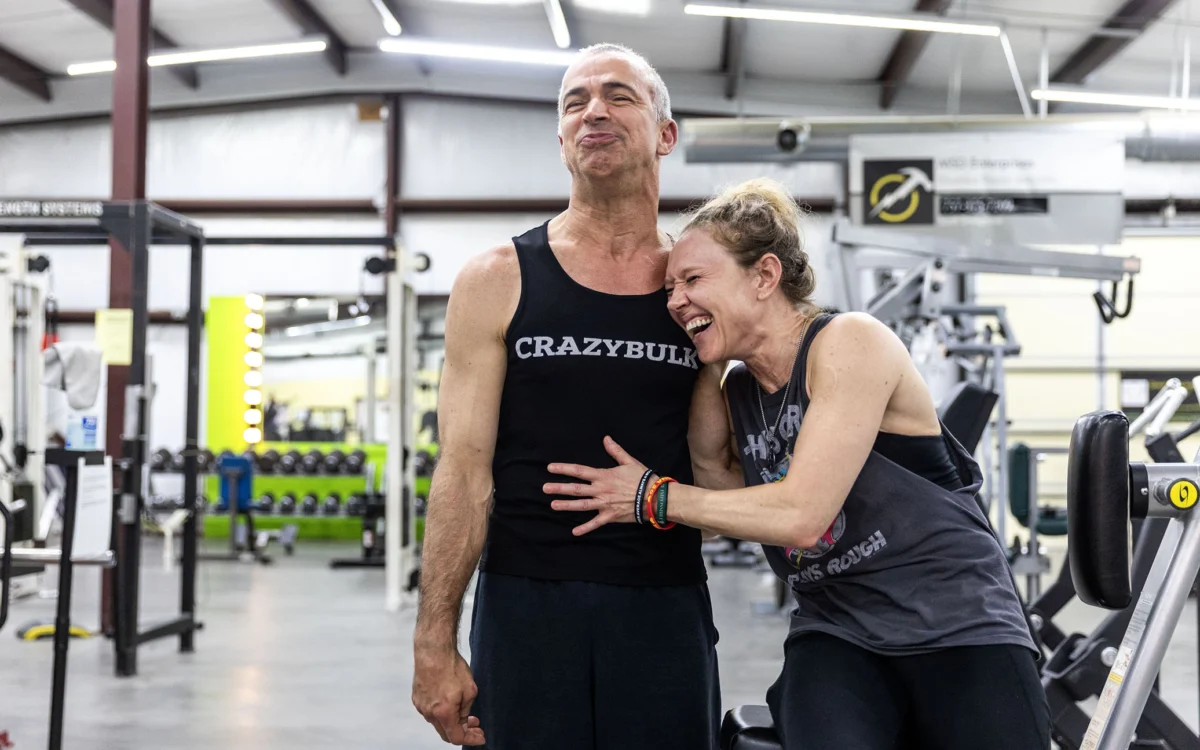
The sound of clanging iron echoes through Retro Flex Gym in Courtland, Virginia, a familiar symphony for regular patrons. Yet, the athletes commanding the weight racks here challenge conventional perceptions of strength sports. Steve Alexy, 53, and his partner, Arlyn Smith, 45, move across the gymnasium floor with distinct physical gaits dictated by their respective neurological conditions. Alexy, diagnosed with cerebral palsy as an infant, steps deliberately with one arm held close and the other swinging out of sync. Smith, managing cerebellar ataxia stemming from a medical emergency in her twenties, navigates the space with short, precise steps to secure her balance.
Despite the physical hurdles presented by muscle incoordination and slurred speech, the couple has spent the last five years dominating mainstream powerlifting competitions—not specialized events for adaptive athletes, but open-class, highly competitive regional and national tournaments. Their ascent from personal rehabilitation to international record holders underscores a broader shift in how sports organizations and society view athletic capability among individuals with physical disabilities.
The Journey to the Platform: A Chronology of Perseverance
The path each athlete traveled to reach the competitive powerlifting stage was marked by distinct personal trials, decades of physical adaptation, and an eventual partnership forged through mutual resilience.
Alexy’s engagement with physical fitness began in his youth growing up in Franklin, Virginia. Diagnosed with cerebral palsy—a congenital brain disorder that affects body movement, muscle control, and coordination—he sought out physical outlets early in life. By age 21, he had established a daily routine at the local YMCA weight room.
For five years, between 2014 and 2019, Alexy competed not in powerlifting, but in bodybuilding. While powerlifting measures raw functional strength across specific compound movements, bodybuilding judges muscular aesthetics, symmetry, and conditioning under stage lighting. Alexy approached this era with characteristic humor, referring to it as “trying to look pretty.” Over the course of his bodybuilding career, he entered 13 competitions and secured victories in nearly all of them, establishing a foundation of discipline and stage composure.
Smith’s trajectory was altogether different. Childhood aspirations of athletics were fostered by her father, who would watch her run laps around a local track. However, the tragic suicide of her father when she was 21 introduced profound emotional trauma. At age 23, a severe drug overdose induced a stroke, resulting in permanent cerebellar ataxia—damage to the cerebellum, the region of the brain responsible for motor control, balance, and posture.
The medical episode fundamentally altered Smith’s life. For 15 years, she was unable to move unassisted, relying entirely on a wheelchair or a walker. Compounding her physical challenges, she battled severe anorexia and substance abuse issues. By the time she entered recovery around age 39, she had spent a decade and a half detached from physical exertion, harboring a quiet regret that she would never discover her true physical potential.
The two crossed paths through a mutual acquaintance met backstage at one of Alexy’s final bodybuilding shows. When the acquaintance suggested Smith connect with Alexy—who shared an understanding of navigating the world with a physical disability—a text message sparked a relationship. Within three months of a Williamsburg courtship, Alexy relocated to the Peninsula, and six months later, the couple moved permanently to his hometown of Franklin.
Bonding over shared humor, professional wrestling, and the care of a three-legged cat, Alexy and Smith found an invaluable sanctuary in one another. Crucially, Alexy recognized Smith’s innate desire to feel strong again and encouraged her to return to physical training.
Breaking Barriers and Setting Records
At Retro Flex Gym, under the ownership of Hunter Darden, the couple’s daily training regimen became a masterclass in determination. Darden notes that their consistent presence and dedication have made them fixtures of the facility. “They’re here almost every day,” Darden said. “They’re good people, really good people. They are inspiring people.”
Under Alexy’s guidance, Smith began making incremental physical milestones. What started as pushing herself to walk to the end of a driveway without a walker evolved into comprehensive resistance training.
Powerlifting is traditionally evaluated through three primary disciplines: the squat, the bench press, and the deadlift, the scores of which are combined for a cumulative total. Due to physiological limitations—Alexy’s knees buckle under heavy vertical loads, and shoulder arthritis prevents him from safely performing a bench press—he specializes exclusively in the deadlift. Smith, however, competes across all three disciplines.
The dedication bore unprecedented competitive fruit:
- In 2024, Steve Alexy captured a United States Powerlifting Coalition (USPC) deadlift record in the men’s masters 50 to 54 division, successfully pulling 227 pounds in the 67.5-kilogram weight class.
- Last year, the International Powerlifting Coalition (IPC) recognized Arlyn Smith as a world record holder in the women’s masters 45 to 49 division for the 56-kilogram weight class, executing a deadlift of 264.5 pounds—more than twice her 123-pound body weight.
- In subsequent competitions, Smith continued to add to her accolades, receiving official certification from the USPC verifying that she had established national standards for maximum weight lifted in her designated categories.
Confronting Societal Misconceptions
Despite their athletic achievements, Alexy and Smith navigate a daily landscape defined by public misunderstanding. Their neurological conditions—which affect speech cadence, articulation, and motor coordination—frequently lead casual observers to conflate physical impairments with cognitive deficits.
“What was assumed was that something else was wrong with me because I couldn’t verbalize,” Smith explained regarding her early recovery and public interactions. “But the reason was, I physically could not, which was frustrating, because I had fully formed thoughts. I just couldn’t get them out.”
This dichotomy—possessing active, analytical minds housed within bodies that fail to execute commands predictably—forms the cornerstone of their shared empathy. “We are the same,” Alexy noted.
Psychologists and rehabilitation specialists note that adaptive athletics serve a dual purpose for individuals with congenital or acquired neurological conditions: they build physiological resilience while functioning as a powerful public counterweight to ableist assumptions. By stepping onto open competition platforms, athletes like Alexy and Smith force sporting organizations, judges, and audiences to reevaluate the parameters of human capability.
Broader Implications for Adaptive Sports
The success of Alexy and Smith highlights an ongoing evolution within strength sports organizations regarding inclusivity. While specialized organizations like the Paralympics provide vital global platforms for athletes with disabilities, the integration of adaptive competitors into open, mainstream powerlifting federations—such as the USPC and IPC—demonstrates a growing technical flexibility in judging and classification.
Mainstream sports federations increasingly recognize that equipment modifications and specialized starting protocols can accommodate physical divergences without compromising the integrity of the sport. For Alexy and Smith, competing alongside able-bodied peers validates their training methodology on an absolute scale, rather than a relative one.
As they continue to train daily at Retro Flex Gym, their goals extend beyond personal silverware. The couple hopes that their journey from isolation, institutional support systems, and medical trauma to international podiums will resonate with others facing comparable challenges.
For Smith, who spent decades detached from physical agency, the gymnasium represents the reclamation of her narrative. Reflecting on a life that could have passed without ever testing her physical boundaries, she embraces the reality of what discipline and partnership have unlocked: a world where limits are continually redefined, one pound at a time.




