A comprehensive new report by the Pew Research Center reveals a nuanced and often divided American perspective on the current global power structure, with a significant portion of the population acknowledging the rise of China and Russia as major international players, even as the United States remains the most frequently cited superpower. The study, conducted in March 2026, surveyed 3,507 adults and delved into Americans’ perceptions of global dominance, offering a snapshot of evolving geopolitical sentiment.
The research, building on decades of Pew’s analysis of U.S. global engagement, sought to understand how Americans view the nation’s influence and the roles of other countries in the international arena. This exploration is particularly timely given the complex geopolitical landscape of the mid-2020s, marked by ongoing international competition, shifting alliances, and the persistent reverberations of past global conflicts. The survey aimed to provide data-driven insights for public discourse and policy considerations regarding America’s place in a dynamic world.
Defining Superpower Status: A Multifaceted American View
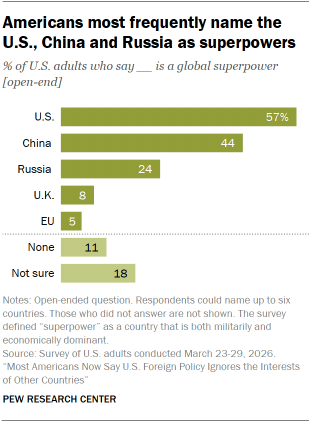
At the heart of the Pew Research Center’s inquiry was a direct question posed to 1,765 U.S. adults: "What country or countries are global superpowers, where ‘superpower’ means a country that is both militarily and economically dominant?" Respondents were permitted to name up to six countries, allowing for a comprehensive assessment of perceived global power centers.

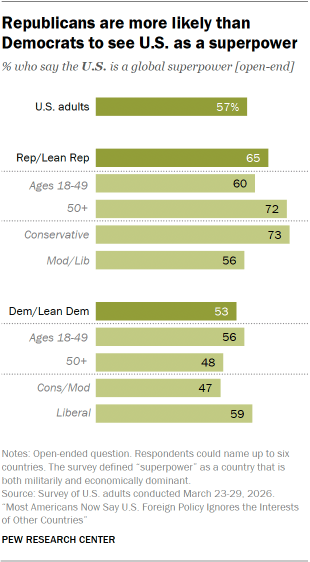
The findings indicate that a clear majority of Americans, 57%, still identify the United States as a global superpower, either on its own or in conjunction with other nations. This suggests a persistent belief in American exceptionalism and its enduring global standing. However, this figure also implies that nearly half of Americans do not solely view the U.S. in this singular dominant role.
China and Russia Emerge as Significant Contenders
Complementing the strong perception of U.S. superpower status, China was named by 44% of respondents, signaling its significant economic and military influence in the eyes of many Americans. Russia, often viewed through the lens of its assertive foreign policy and substantial military capabilities, was identified as a superpower by 24% of those surveyed. These figures highlight a growing acknowledgment of a multipolar world order, where power is distributed among multiple key actors.
Beyond these three nations, the survey also revealed that 11% of Americans believe there are no global superpowers, and a notable 18% expressed uncertainty. This division in identifying the existence and number of superpowers underscores the complexities and differing interpretations of the current international system.
Generational Divides in Perceptions of Global Power
The Pew report also illuminated significant generational differences in how Americans perceive global power. While majorities across all age groups recognize the United States as a superpower, younger Americans (ages 18-49) are demonstrably more inclined than their older counterparts (ages 50 and older) to view both China and Russia as dominant international powers. This generational divergence may reflect varying levels of exposure to global events, differing media consumption habits, and potentially distinct ideological frameworks shaped by their formative years. Younger generations have come of age in an era of rapid globalization and the ascendant economic power of China, which may influence their assessments of the global balance of power.
Partisan Rifts in Superpower Recognition
Political affiliation also plays a discernible role in shaping views on global power. Republicans exhibited a stronger consensus on U.S. superpower status, with 65% identifying the U.S. as such, compared to 53% of Democrats. Conversely, Democrats were somewhat more likely than Republicans to identify China as a superpower (49% versus 42%). Both parties showed a similar level of recognition for Russia as a superpower, with a quarter of adults in each party holding this view. These partisan leanings suggest that perceptions of superpower status can be influenced by broader political narratives and foreign policy priorities.
Further dissecting these partisan divides by age revealed additional nuances. Older Republicans (50+) were more likely to assert U.S. superpower status than younger Republicans, although younger Republicans expressed more uncertainty. Among Democrats, a slight majority of those under 50 (56%) considered the U.S. a superpower, compared to 48% of older Democrats. Crucially, younger Democrats were more likely than their older peers to acknowledge China and Russia as superpowers, echoing the broader generational trend.
The Spectrum of Superpower Count: Unipolar, Bipolar, or Multipolar?
The Pew study also explored Americans’ perceptions of the number of global superpowers, a concept often discussed in international relations as "polarity." When asked to quantify the number of dominant military and economic powers, Americans expressed a divided opinion.
- No Superpowers: 11% of respondents believe there are no global superpowers.
- Unipolar World (One Superpower): 27% of Americans perceive a unipolar world.
- Bipolar World (Two Superpowers): 16% identify two dominant powers.
- Multipolar World (Three or More Superpowers): A significant 27% believe there are three or more superpowers.
- Unsure: 18% remain undecided on the number of superpowers.
This distribution indicates a clear lack of consensus on the current structure of global power, with the concept of a multipolar world gaining substantial traction.
Generational and Partisan Influences on Polarity Views
Similar to superpower identification, age and party affiliation influenced perceptions of global polarity. A larger proportion of older adults (50+) believed in a unipolar world (33%) compared to younger adults (21%). Conversely, younger Americans were more likely to envision a multipolar world, with 31% believing there are three or more superpowers, versus 23% of older adults.
Partisan alignments also emerged. Republicans were more likely to perceive a unipolar world (34%) than a multipolar one (27%). Democrats, while also favoring a unipolar view over a multipolar one, showed a slightly higher propensity for multipolarity (29%) than Republicans.
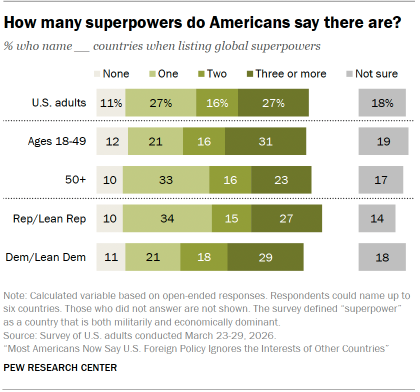
Within the parties, older Republicans were more inclined to see a unipolar world (43%) than younger Republicans (27%). For Democrats, those 50 and older were more likely to believe in a unipolar world (27%) compared to younger Democrats (17%). Younger Democrats, in turn, were more inclined to identify two or more superpowers.
The Dominant Power in a Unipolar Scenario
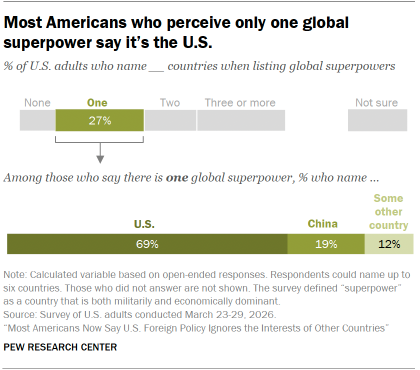
For the 27% of Americans who believe in a single global superpower, the United States remains the overwhelmingly favored candidate. An impressive 69% of this group identified the U.S. as the sole superpower. This highlights that even among those who perceive a singular dominant force, the belief in American preeminence is strong.
However, a notable minority within this group sees a different power at the helm. Nineteen percent of those who believe in a single superpower named China as the dominant nation, while 12% pointed to other countries. These figures, while smaller, underscore the evolving global landscape and the perceived challenges to traditional U.S. leadership.
Partisan Nuances in Unipolar Perceptions
When examining the partisan breakdown of those who believe in a single superpower, stark differences emerge. An overwhelming 81% of Republicans in this group identified the U.S. as the sole superpower. Among Democrats who hold this view, the landscape is more divided. Fifty-one percent of these Democrats identified the U.S. as the singular superpower, while a significant 34% named China. This suggests a greater willingness among Democrats to acknowledge China’s potential to be the sole dominant power, a viewpoint that may stem from concerns about U.S. economic competitiveness or a different assessment of global challenges.
The Bipolar and Multipolar Landscape: U.S. and China at the Forefront
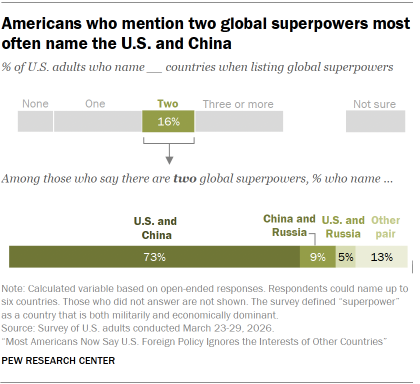
For the 16% of Americans who envision a bipolar world, the combination of the United States and China as the two superpowers is the most commonly cited scenario, named by 73% of this group. This pairing reflects the contemporary geopolitical reality of the two largest economies and militaries in the world. Other pairings in a bipolar view included China and Russia (9%) and the U.S. and Russia (5%).
The 27% of Americans who believe in a multipolar world—three or more superpowers—most frequently include the U.S., China, and Russia in their assessments. This perception of a complex, multi-actor global system is increasingly prevalent. The data further indicates that nearly all Americans who perceive a multipolar world (93%) include both the U.S. and China in their lists of superpowers. Beyond these two giants, the United Kingdom is also frequently mentioned by those who believe in a multipolar order, suggesting a lingering perception of its influence, albeit on a smaller scale than the U.S. and China.
Methodology and Implications
The findings of this Pew Research Center report are based on a robust survey conducted between March 23 and 29, 2026, involving 3,507 adults from the American Trends Panel. The methodology ensures the findings are representative of the U.S. adult population, providing a statistically significant insight into public opinion.
The implications of these findings are far-reaching. They suggest a growing American awareness of a shifting global order, one that is less dominated by a single hegemon and more characterized by the rise of multiple influential powers. This perception has direct relevance for U.S. foreign policy, trade negotiations, and defense strategies. A public increasingly divided on the nature of global power may lead to debates about the extent of U.S. global commitments, the nature of international alliances, and the prioritization of national interests in a complex world.
The generational divide in recognizing China and Russia’s power, coupled with partisan differences, points to potential future policy challenges. Bridging these divides will be crucial for developing a cohesive and effective American approach to international affairs. As the geopolitical landscape continues to evolve, understanding these American perspectives will be key for policymakers and citizens alike as they navigate the complexities of the 21st-century world order. The Pew Research Center’s ongoing commitment to tracking these trends will undoubtedly provide valuable insights for years to come.