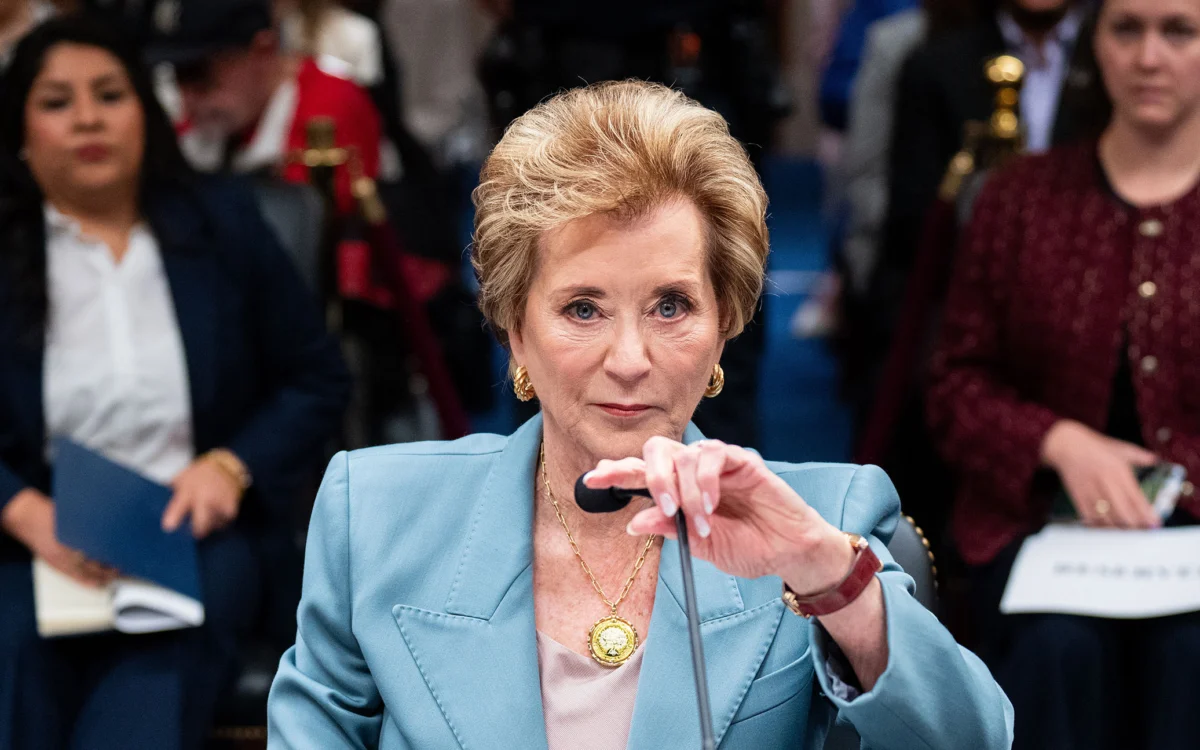
U.S. Secretary of Education Linda McMahon confirmed on Tuesday that the Trump administration is actively exploring the division of federal programs supporting students with disabilities among various government agencies, a move that follows President Donald Trump’s stated intention to dismantle the Department of Education. While no definitive decisions have been finalized, McMahon indicated to lawmakers that the department is still considering offloading responsibilities currently governed by the Individuals with Disabilities Education Act (IDEA) and the Rehabilitation Act.
During a Senate subcommittee hearing, Secretary McMahon outlined the administration’s ongoing evaluation process. "Currently, we are still evaluating where those programs would best be located," McMahon stated. "We have not made that determination yet. We are looking at the Department of Labor for some of its programs and we are also looking at (the Department of Health and Human Services) for a potential home for some of those programs." This suggests a significant potential restructuring of federal oversight for special education and disability support services, shifting them from the purview of the Department of Education to other departments with potentially different mandates and expertise.
This potential fragmentation of services stems from a broader initiative articulated by President Trump over a year ago, when he first announced his desire to move "special needs" programs to HHS as part of a larger plan to eliminate the Department of Education entirely. Since that initial declaration, the Department of Education has gradually transferred various responsibilities to other federal bodies through a mechanism known as interagency agreements. However, the core functions related to special education have, until now, remained under the department’s direct supervision.
The Secretary’s remarks were made in response to pointed questions from Senator Patty Murray, a Democrat from Washington, who chairs the Senate subcommittee on Labor, Health and Human Services, Education, and Related Agencies. Senator Murray revealed that she had received a petition signed by thousands of parents, educators, and disability advocates who expressed grave concerns about the proposed changes. These stakeholders fear that relocating special education programs away from the Department of Education could "undermine 50 years of progress in making sure the rights of children and students with disabilities are met."
Secretary McMahon acknowledged that she had not personally seen the petition but emphasized that she has been engaging with parents of children with disabilities across the nation. "I have said to each of them, who is better positioned to know what your children need than you working with them and then working with your local school board," she asserted to the Senate panel. "These parents need to understand that regardless of which department these programs are located, they will still get the same treatment, the same funding." This assurance, however, did little to assuade the anxieties of disability advocacy groups.
Widespread Opposition from Advocacy Groups
Disability advocacy organizations have voiced strong and consistent opposition to the proposed dispersal of special education programs. They argue that consolidating these services under a single federal department dedicated to education has been crucial for ensuring equitable access and comprehensive support for students with disabilities.
Stephanie Smith Lee, who previously served as the director of the Education Department’s Office of Special Education Programs under President George W. Bush and is now the co-director of policy and advocacy at the National Down Syndrome Congress, articulated a common sentiment among these groups. "Dismantling the department and scattering education programs among agencies will result in confusion and chaos for schools, districts and states and reduce support for students and families," Lee stated. "It is time to refocus on how to improve outcomes for students."
Lee has been a vocal proponent of maintaining the integrity of the Department of Education’s role in special education. Last year, she spearheaded a letter to Congress that garnered signatures from over a dozen former Education Department officials. These individuals, who held leadership positions responsible for overseeing IDEA implementation under both Republican and Democratic administrations, stretching back to President Richard Nixon, argued in unison that the continued existence and focus of the Department of Education are "essential to students with disabilities." Their collective experience underscores the deep-rooted understanding of the importance of a centralized federal agency for safeguarding and advancing the educational rights of this vulnerable population.
Concerns Over Civil Rights Enforcement
Beyond the potential fragmentation of special education programs, the hearing also touched upon significant concerns regarding the administration’s actions impacting the Department of Education’s Office for Civil Rights (OCR). This office plays a critical role in investigating complaints of disability discrimination within educational institutions nationwide.
Last year, the Department of Education controversially shuttered seven out of its twelve regional civil rights offices and initiated a process to terminate more than half of the OCR’s staff. While Secretary McMahon stated that many of these staffers have since been rehired, Senator Chris Murphy, a Democrat from Connecticut, pointed out a crucial detail: their reinstatement was reportedly a consequence of court orders, suggesting that the initial dismissals were potentially unlawful or ill-advised.
Further fueling these concerns is a recent report released by the office of Senator Bernie Sanders, an Independent from Vermont. The report, titled "Justice Denied: How Trump’s Office for Civil Rights Reached a 12-Year Low in Protecting Students from Discrimination," presents stark data illustrating a significant decline in the OCR’s effectiveness. According to the report, resolution agreements for disability discrimination cases plummeted by an alarming 78.7% in 2025 when compared to the preceding year. The data revealed an especially troubling lack of action in critical areas: zero cases involving restraint and seclusion were resolved, only one disability harassment case was addressed, and a mere 40 cases concerning the fundamental right to a free appropriate public education were resolved out of a substantial backlog of 1,887 pending cases in 2025.
In response to these critical findings, Secretary McMahon acknowledged past inefficiencies. "There was a time when we were not processing cases as quickly as we should, but we are now focused on doing that," she told lawmakers. She also highlighted the department’s budget request for the upcoming fiscal year, which she claimed includes "more money to hire more lawyers." However, Senator Murphy countered this assertion by referencing the department’s official written proposal, which he stated actually calls for a significant 35% cut to the civil rights office’s budget, reducing it from $140 million to $91 million. This discrepancy raises questions about the administration’s true commitment to bolstering the OCR’s capacity to protect students’ civil rights.
Historical Context and Potential Ramifications
The ongoing discussions surrounding the potential restructuring of special education programs are situated within a broader political and ideological debate about the role and scope of federal government agencies. President Trump’s initial call to eliminate the Department of Education reflects a long-standing conservative push for decentralization and a reduction in federal oversight, arguing that such functions are better managed at the state and local levels.
However, advocates for students with disabilities contend that a federal presence is indispensable. The Individuals with Disabilities Education Act (IDEA), first enacted in 1975, was a landmark piece of legislation that guaranteed free appropriate public education (FAPE) to all children with disabilities and ensured special education and related services were provided in the least restrictive environment. The Rehabilitation Act of 1973, particularly Section 504, prohibits discrimination on the basis of disability in programs receiving federal financial assistance. These laws established a federal baseline of rights and protections that many fear would be diluted or inconsistently applied if oversight is scattered across multiple agencies with differing priorities.
The potential shift to departments like Labor and Health and Human Services, while seemingly logical in terms of the services they provide, raises questions about integration and continuity. The Department of Labor focuses on workforce development and employment, while HHS oversees a vast array of health and human services, including programs for children and families. While there are overlaps, their primary missions differ from the educational mandate of the Department of Education. For instance, ensuring that educational interventions are effectively integrated with vocational training or healthcare services would require robust interagency coordination, which could be challenging to achieve if the programs are housed in separate entities.
The timeline of these proposed changes has been gradual. While President Trump voiced his intent over a year ago, the implementation has been piecemeal, relying on interagency agreements. This approach has allowed the administration to test the waters and make incremental shifts without immediately dismantling the entire department. However, the recent confirmation from Secretary McMahon that the evaluation of housing for IDEA and Rehabilitation Act programs is actively underway signals a potential acceleration of these plans.
The implications of such a dispersal could be far-reaching. For parents and guardians, navigating a fragmented system could become more complex, requiring them to engage with multiple federal agencies to secure the necessary supports for their children. For school districts, the lack of a single point of federal guidance and funding could lead to confusion regarding compliance and program implementation. This fragmentation could also lead to a reduction in dedicated resources and expertise within each agency, potentially diminishing the overall quality of support available to students with disabilities. The historical progress made under a unified federal framework, championed by laws like IDEA, could be jeopardized, leading to a rollback of protections and a widening of the educational disparities that these laws were designed to address. The coming months will be critical in determining the final shape of federal support for students with disabilities, with significant implications for millions of American families.