By a three-to-one margin, Americans are more likely to say that China, not the United States, is more advanced when it comes to developing artificial intelligence. However, many U.S. adults say they’re not sure who is more advanced, according to a new Pew Research Center survey conducted in June 2026. The findings underscore a significant public perception gap regarding the ongoing technological competition between the two global powers.
As the United States and China vie for dominance in the rapidly evolving field of artificial intelligence, a substantial portion of the American public acknowledges China’s perceived lead. The survey of 3,488 adults reveals that 36% of Americans believe China is more advanced in AI development, compared to only 12% who believe the U.S. holds the advantage. Another 18% of respondents indicated that both nations are equally advanced, while a significant 33% expressed uncertainty, highlighting a widespread lack of definitive consensus.
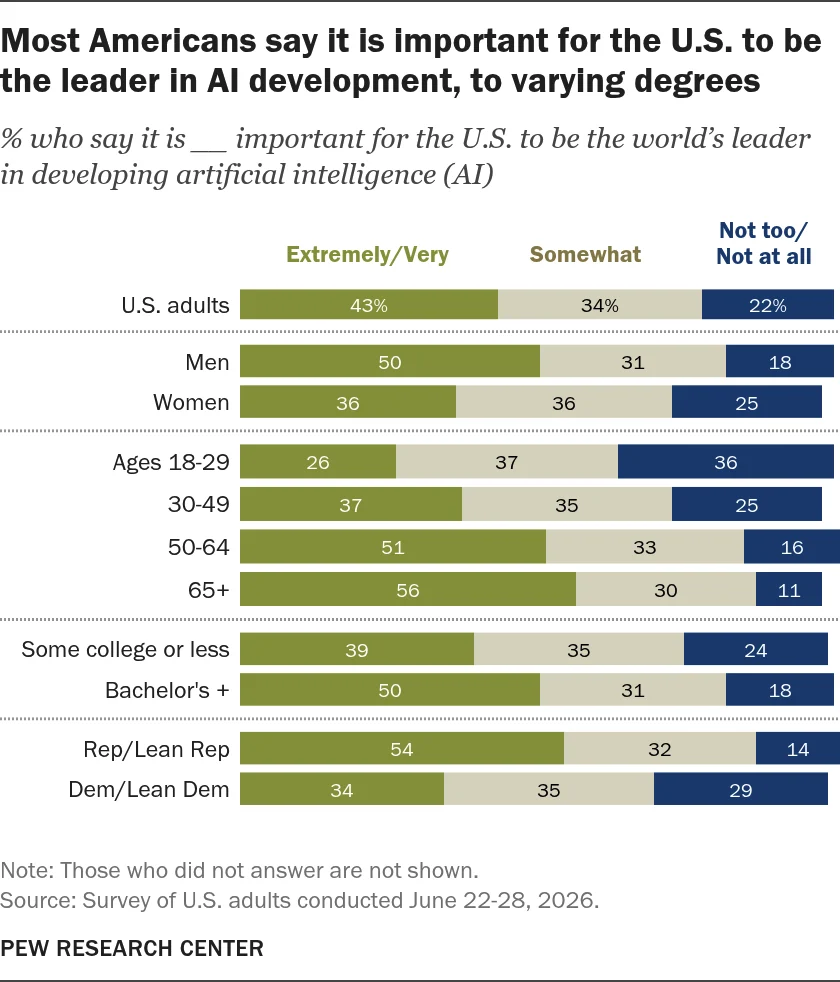
The importance of the U.S. maintaining a leading role in AI development is a key concern for many Americans. Forty-three percent of respondents stated that it is extremely or very important for the U.S. to be the world’s leader in developing AI. Conversely, 22% of Americans indicated that this leadership position is not too or not at all important to them. This division suggests varying levels of strategic awareness and national priority assigned to AI among the U.S. populace.
Furthermore, the survey delves into the potential socioeconomic consequences of a global AI race. Concerns about the widening disparity between nations are palpable, with 51% of Americans predicting that AI will exacerbate the gap between rich and poor countries. Only 7% believe AI will decrease this disparity, while 16% foresee no significant change. This outlook suggests a prevailing sentiment that the benefits of advanced AI may not be evenly distributed on a global scale, potentially leading to increased economic stratification between developed and developing nations.
The Global AI Landscape: A Shifting Balance of Power
The competition between the United States and China in artificial intelligence is not merely a technological arms race; it is a multifaceted geopolitical and economic struggle with profound implications for global order. Both nations have identified AI as a critical component of their future economic prosperity, national security, and international influence. This rivalry has intensified in recent years, marked by substantial investments in research and development, talent acquisition, and the strategic deployment of AI technologies across various sectors.
China’s rapid ascent in AI has been fueled by a combination of significant government funding, a vast pool of data, and a strategic national AI plan aimed at becoming a global leader by 2030. Initiatives like the “Next Generation Artificial Intelligence Development Plan” have propelled Chinese companies to the forefront in areas such as facial recognition, natural language processing, and autonomous systems. The World Artificial Intelligence Conference in Shanghai, as depicted in accompanying visuals, serves as a testament to China’s ambition and its growing prominence in the global AI discourse.

The United States, while historically a leader in AI innovation, faces challenges in maintaining its edge. Concerns about the pace of innovation, regulatory frameworks, and the impact of AI on the workforce are subjects of ongoing debate within the U.S. The U.S. government has responded with executive orders and legislative proposals aimed at fostering AI development while addressing ethical considerations and national security risks. The interplay between private sector innovation and governmental policy is crucial in shaping the trajectory of U.S. AI capabilities.
American Perceptions: China’s Perceived AI Ascendancy
The Pew Research Center’s survey offers a revealing snapshot of American public opinion on this critical issue. The finding that a majority of Americans perceive China as more advanced in AI development than the United States is a significant indicator of the prevailing narrative surrounding the global AI race. This perception is likely influenced by a confluence of factors, including widespread media coverage of China’s technological advancements, the sheer scale of its AI investments, and the visible integration of AI technologies into Chinese society.
The breakdown of responses on the U.S. vs. China AI advancement question reveals nuanced perspectives:
- China Leading: 36% of U.S. adults believe China is more advanced.
- U.S. Leading: 12% of U.S. adults believe the U.S. is more advanced.
- Equally Advanced: 18% of U.S. adults believe both nations are at a similar stage.
- Not Sure: A substantial 33% of U.S. adults are undecided.
This distribution underscores a lack of overwhelming confidence in the United States’ current AI leadership among its own citizens. The significant percentage of those who are “not sure” suggests that the complexities of the AI landscape and the ongoing competition are not fully grasped or are perceived as too fluid to make a definitive judgment.
Demographic Divides in AI Perceptions
The survey also highlighted notable demographic variations in how Americans view the U.S. and China’s AI capabilities:

- Gender: Men (18%) were more likely than women (7%) to believe the U.S. is more advanced than China. Conversely, women (41%) were more likely than men (31%) to perceive China as leading.
- Political Affiliation: Republicans and those leaning Republican (17%) were more likely than Democrats and those leaning Democratic (9%) to believe the U.S. is more advanced. Democrats were more inclined to see China as leading (43%) compared to Republicans (30%).
- AI Chatbot Usage: Americans who actively use AI chatbots showed a slightly higher inclination to believe the U.S. is leading (16%) compared to non-users (9%). However, a significant portion of both groups (36% each) still saw China as more advanced. This suggests that while familiarity with AI tools might slightly bolster confidence in domestic capabilities, the perception of China’s lead remains pervasive.
These demographic divergences point to how factors such as political ideology, gender, and direct engagement with AI technologies can shape an individual’s outlook on the global AI competition.
The Strategic Imperative: U.S. Leadership in AI
The question of whether the U.S. should lead in AI development elicits a more unified, albeit not unanimous, response. The survey indicates that a majority of Americans recognize the importance of this objective:
- Extremely or Very Important: 43% of U.S. adults consider it crucial for the U.S. to be the world leader in AI.
- Somewhat Important: An additional 34% view it as somewhat important.
- Not Too or Not at All Important: 22% believe it holds little to no importance.
This collective sentiment underscores a recognition of AI’s strategic significance. The implications of AI leadership extend beyond economic competitiveness, encompassing national security, technological innovation, and the ability to set global standards and ethical guidelines for AI deployment.
Further analysis of demographic trends reveals differing levels of perceived importance:
- Age: Older Americans expressed a stronger conviction regarding U.S. leadership. Those aged 65 and older were more than twice as likely as 18- to 29-year-olds to deem U.S. AI leadership “extremely or very important” (56% vs. 26%). This disparity might reflect generational perspectives on technological advancement, national pride, and the perceived threats and opportunities associated with AI. Younger demographics, while potentially more technologically adept, may also be more attuned to the potential downsides or the idea that global collaboration, rather than singular leadership, is more desirable.
- Education: Americans with a bachelor’s degree or higher (50%) were more likely than those with some college education or less (39%) to consider U.S. AI leadership extremely or very important. This suggests a correlation between higher education attainment and a perceived understanding of AI’s strategic value.
- Gender: Men (50%) were more likely than women (36%) to view U.S. AI leadership as extremely or very important. This aligns with broader trends where men sometimes express stronger opinions on issues related to technological competition and national power.
- Political Affiliation: Republicans (54%) were significantly more likely than Democrats (34%) to emphasize the critical importance of U.S. leadership in AI. This finding resonates with the stated policy priorities of recent Republican administrations, which have often framed AI as a domain of national competition. The Biden administration, while also prioritizing AI development, has placed a greater emphasis on international cooperation and ethical governance, potentially influencing Democratic responses.
The explicit mentions of former Presidents Donald Trump’s and Joe Biden’s stances on AI in the original article provide valuable context. Trump’s declaration of a "race to achieve global dominance" in AI reflects a more assertive, competitive approach, while Biden’s focus on preventing adversaries from using AI for malicious purposes highlights a security-centric perspective. These differing political philosophies likely contribute to the partisan divide observed in the survey.
AI’s Impact on Global Inequality: A Looming Concern

Perhaps one of the most striking findings of the survey is the widespread apprehension that AI will widen the economic chasm between wealthy and impoverished nations. Over half of Americans (51%) believe that AI will increase this gap. This sentiment suggests a concern that the benefits of AI, such as increased productivity, automation, and access to advanced services, may primarily accrue to countries already possessing the resources and infrastructure to develop and implement these technologies.
The implications of this perception are significant. If AI is seen as a force that exacerbates global inequality, it could lead to increased international tensions, calls for redistribution of AI-generated wealth, and potential resistance to the widespread adoption of AI technologies in developing economies. The UN report mentioned in the original text, discussing AI and inequality, underscores the global nature of this concern, indicating that the anxieties of American adults are mirrored in international discussions.
Detailed responses regarding AI’s impact on global economic disparities include:
- Increase the Gap: 51% of U.S. adults believe AI will widen the divide between rich and poor countries.
- Decrease the Gap: A mere 7% anticipate AI will narrow this divide.
- No Significant Difference: 16% believe AI will have a negligible impact on this disparity.
- Not Sure: A considerable 25% remain uncertain about AI’s long-term economic effects on a global scale.
These figures reveal a predominantly pessimistic outlook on AI’s potential to foster global economic equity.
Demographic Differences in Inequality Perceptions
The survey also identified demographic trends in how Americans perceive AI’s role in global inequality:
- Political Affiliation: Democrats (60%) were more likely than Republicans (45%) to believe AI will increase the gap between rich and poor countries. This might reflect a greater emphasis on social justice and equitable distribution of resources within the Democratic party.
- Education: Americans with a bachelor’s degree or higher (62%) were more likely than those with some college or less (46%) to foresee AI widening global economic disparities. This could stem from a deeper understanding of the economic mechanisms at play or a greater awareness of global economic trends.
- AI Chatbot Usage: Individuals who use AI chatbots (55%) were more inclined to believe AI would increase global inequality compared to non-users (47%). This suggests that direct engagement with AI might, for some, highlight its potential to create further advantages for early adopters and technologically advanced nations.
Broader Implications and Future Outlook

The Pew Research Center’s findings offer a critical lens through which to view the evolving narrative of the global AI race. The perception that China is leading in AI development, coupled with the concern that AI will exacerbate global inequalities, presents a complex challenge for U.S. policymakers and technologists.
Firstly, the public perception of China’s AI prowess could influence domestic policy decisions, potentially leading to increased calls for government investment and a more aggressive approach to technological competition. It may also impact international relations, as other nations assess the shifting balance of power and align themselves accordingly.
Secondly, the widespread belief that AI will widen the gap between rich and poor countries raises important ethical and economic questions. Addressing these concerns will require proactive strategies to ensure that the benefits of AI are accessible globally, potentially through international collaborations, technology transfer initiatives, and the development of AI applications tailored to the needs of developing economies. Failure to do so could lead to a more fragmented and inequitable global landscape.
The survey’s methodology, conducted among 3,488 adults from June 22 to 28, 2026, using the Pew Research Center’s American Trends Panel, ensures that the findings are representative of the U.S. adult population. The detailed methodology, questionnaire, and topline responses are publicly available, allowing for further scrutiny and analysis.
In conclusion, the American public holds a nuanced and somewhat anxious view of the global AI race. While there is a strong desire for the U.S. to maintain a leadership position, there is also a prevalent perception that China is currently ahead and a significant concern that AI will deepen existing global economic disparities. These insights are crucial for understanding public sentiment and informing future policy debates on artificial intelligence at both national and international levels. The ongoing evolution of AI technology and its strategic implications will undoubtedly continue to shape these perceptions and priorities in the years to come.