The twenty-fifth anniversary of the September 11, 2001, terrorist attacks serves as a significant inflection point for American society, marking a quarter-century since the day that fundamentally altered the nation’s geopolitical trajectory and domestic security landscape. For the vast majority of Americans who were alive and at least 10 years old at the time of the attacks, the memory of that day remains etched with remarkable clarity. According to a September 2026 survey conducted by the Pew Research Center, 93% of this demographic can recall exactly where they were or what they were doing when they first received news of the hijacked planes striking the World Trade Center, the Pentagon, and the field in Shanksville, Pennsylvania.
This collective memory underscores the enduring cultural and psychological impact of the event. In the years following the attacks, 9/11 has consistently been identified by U.S. adults as the most significant historical event of their lifetimes, surpassing the fall of the Berlin Wall, the dawn of the internet age, and various economic crises. As the nation observes this milestone, researchers are examining not only the legacy of the trauma itself but also how the subsequent erosion of trust in institutional information has transformed the way Americans perceive history and current events.
A Chronology of the 2001 Attacks and Their Aftermath
The morning of September 11, 2001, began as a typical Tuesday before descending into an unprecedented national crisis. At 8:46 a.m. EDT, American Airlines Flight 11 crashed into the North Tower of the World Trade Center. At 9:03 a.m., United Airlines Flight 175 struck the South Tower, confirming to the public that the United States was under coordinated attack. By 9:37 a.m., American Airlines Flight 77 hit the Pentagon, and at 10:03 a.m., United Airlines Flight 93 crashed in Pennsylvania after passengers revolted against the hijackers.
The immediate aftermath saw the collapse of both Twin Towers, the loss of 2,977 lives, and the rapid mobilization of the U.S. government. The subsequent legislative and military response—including the creation of the Department of Homeland Security, the passage of the USA PATRIOT Act, and the initiation of the War on Terror in Afghanistan—redefined the relationship between the American state and its citizens. These events also heralded a new era of surveillance, border security, and international military engagement that would dominate the American political discourse for the next two decades.
The Information Crisis: A Widening Knowledge Gap
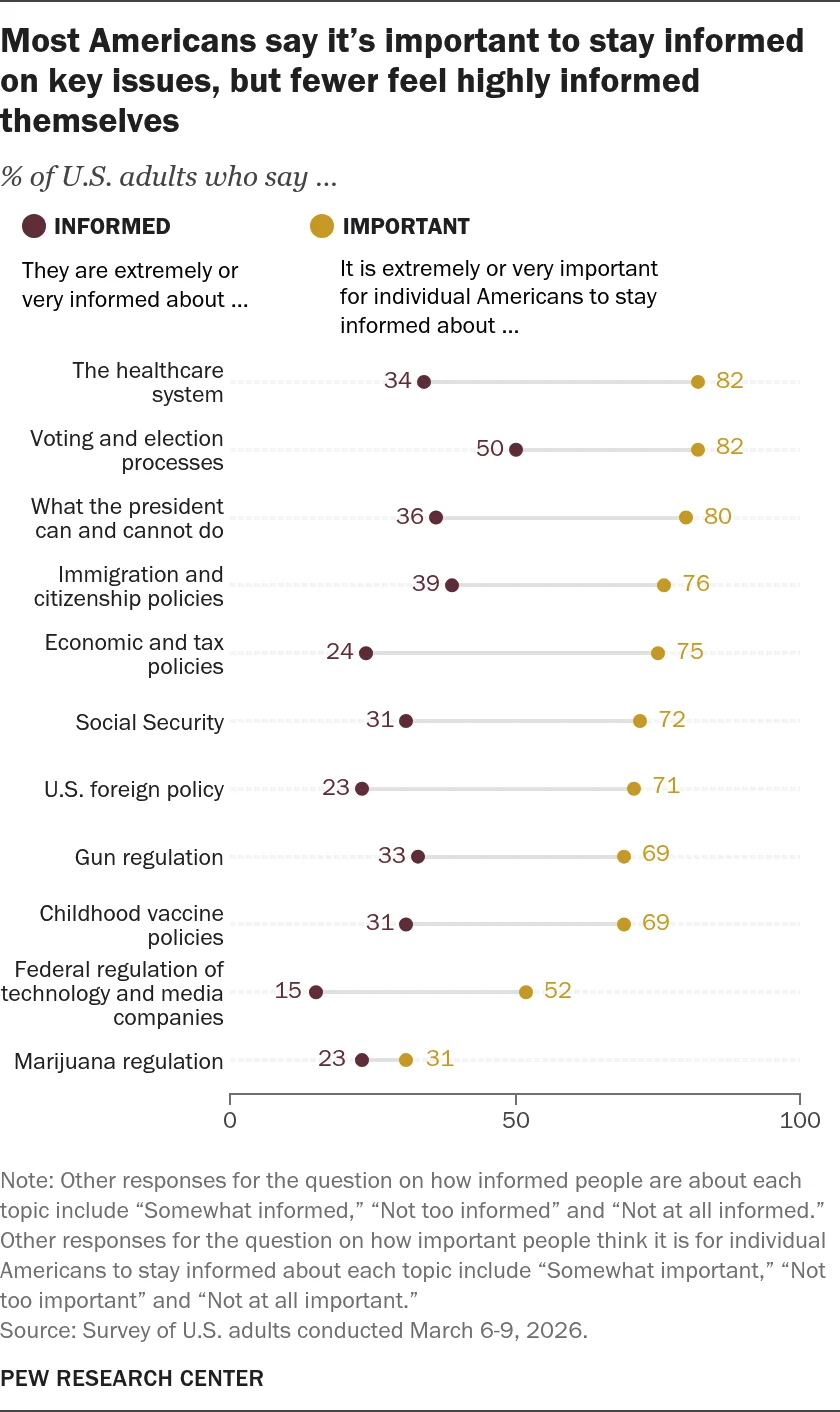
While the memory of 9/11 remains vivid, the mechanisms by which Americans consume and verify information today stand in stark contrast to the media landscape of 2001. A March 2026 survey by the Pew Research Center highlights a concerning trend: while Americans view it as vital to stay informed on critical national issues, there is a persistent gap between the perceived importance of these topics and the public’s self-reported level of understanding.
The data reveals a stark disparity across several key sectors. For instance, 82% of U.S. adults believe it is extremely or very important for citizens to remain informed about the healthcare system, yet only 34% feel "extremely" or "very" informed about the subject. Similarly, while 75% of respondents prioritize knowledge of economic and tax policies, only 24% claim to have a high level of understanding regarding those complex financial mechanisms. Even in the realm of voting and election processes, where 82% of Americans recognize the importance of staying informed, only 50% express high confidence in their knowledge.
This "informedness gap" has profound implications for democratic stability. As the nation grapples with complex policy debates, the inability of a large segment of the population to grasp the nuances of federal regulation, foreign policy, and economic strategy leaves the public vulnerable to misinformation.
The Rise of AI and the Battle for Narrative Accuracy
In response to the degradation of the media ecosystem, new technological solutions are being deployed to combat the proliferation of false narratives. The emergence of "Arbiter," an AI-driven analytical tool, represents a significant development in the effort to preserve the integrity of public information. Developed by independent nonprofits, Arbiter is designed to monitor social media trends and flag misleading or inaccurate narratives, providing journalists with a critical layer of defense against disinformation.
The necessity for such tools is rooted in the declining trust that Americans have in traditional and social media alike. In 2025, only 37% of U.S. adults reported having at least some trust in the information disseminated through social media platforms. Data from 2024 further emphasizes this skepticism, as the majority of users on platforms like X, Facebook, Instagram, and TikTok reported frequently encountering news that appeared inaccurate. When asked to identify their primary dissatisfaction with social media as a news source, the lack of accuracy was the most cited concern by a significant margin.
Industry analysts suggest that the deployment of AI tools like Arbiter could represent a pivot toward a more fact-based digital environment, provided that these tools remain independent and transparent. However, the reliance on automation to verify truth also raises questions about who defines "accuracy" in an increasingly polarized political climate.
Socio-Political Implications of the 25th Anniversary
The 25th anniversary of 9/11 serves as more than just a historical marker; it is a moment of reckoning for the American public. The trauma of the attacks initially fostered a sense of national unity and a shared reliance on traditional media gatekeepers. Over the intervening years, the fragmentation of the information landscape—fueled by the rise of social media and the decline of traditional news outlets—has contributed to a society that is both more connected and more divided.
Political scientists note that the loss of a "shared reality" has made the legislative process more difficult, as voters and policymakers often operate from entirely different sets of facts. When citizens acknowledge that they do not feel informed about critical issues like Social Security (where 72% see importance but only 31% feel informed) or U.S. foreign policy (71% vs. 23%), the capacity for constructive political debate is diminished.
The challenge moving forward, according to observers, is two-fold: first, to rebuild the structural integrity of the news cycle by leveraging AI to mitigate the spread of falsehoods; and second, to encourage a culture of civic education that empowers individuals to bridge the gap between their desire to be informed and their actual level of knowledge.
Conclusion: Looking Toward the Future
As the United States moves beyond the quarter-century mark of the September 11 attacks, the focus is shifting from reflection to sustainability. The legacy of the 9/11 era—an era defined by rapid technological change, global conflict, and a complex digital transformation—demands that future generations remain vigilant about the quality of the information they consume.
The commitment of organizations like the Pew Research Center to continue tracking these trends provides a valuable longitudinal look at the state of American democracy. As the data shows, while the emotional memory of the nation’s most difficult days remains strong, the intellectual rigor required to maintain a functioning democracy is a continuous, evolving task. The integration of advanced analytical tools, combined with a renewed emphasis on civic literacy, will likely define the next chapter of the American experience, as the nation attempts to reconcile its past with a digital future that remains fraught with both opportunity and peril.
Whether the "Arbiter" project and similar initiatives can successfully curb the tide of misinformation remains to be seen. However, the current consensus among researchers is clear: the health of the American republic in the 21st century depends on the ability of its citizens to discern truth in an era where the barrier to information has disappeared, but the barrier to understanding has never been higher.