
The Evolution of Survey Sampling: From Random Digit Dialing to Address-Based Systems
The history of survey research has been defined by a constant battle against declining response rates and the fragmentation of communication channels. Prior to 2018, the Pew Research Center relied heavily on landline and cellular random-digit-dial (RDD) surveys. While this method was once the gold standard, the proliferation of caller ID, the decline of landline ownership, and the general public’s fatigue toward unsolicited calls necessitated a shift in strategy.
The current ATP protocol utilizes address-based sampling (ABS), a method that leverages the U.S. Postal Service’s Computerized Delivery Sequence File. This database is estimated to cover between 90% and 98% of the total U.S. housing stock, providing a stable foundation for recruitment. By mailing physical invitations and pre-incentives to randomly selected households, the center ensures that participation is not limited to those reachable via telephone. Within these selected households, a randomized process selects the adult with the upcoming birthday as the target respondent, a technique designed to minimize selection bias and ensure a representative demographic distribution.

Chronology of Wave 200 Execution
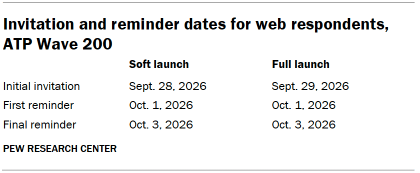
The operational timeline for Wave 200 was characterized by a meticulous, phased rollout designed to maximize participation while maintaining data integrity. The process began well before the survey launch, with pre-notification postcards sent to phone-based participants on September 25, 2026.
On September 28, the survey entered a "soft launch" phase, a vital quality-control measure in professional polling. During this period, 60 online panelists and a small cohort of telephone interviewees were invited to participate. This allowed researchers to observe the survey’s functionality in real-time, checking for technical glitches, confusing question wording, or unexpected logical flow issues. Following a successful review of this pilot data—analyzed through software such as SPSS to ensure randomizations were performing as intended—the full launch commenced on September 29.
The field period closed on October 4, culminating in a robust dataset of 5,062 completed responses. This achievement was supported by a multi-channel communication strategy, involving email invitations, SMS alerts for opted-in panelists, and, for the telephone cohort, a protocol that allowed for up to six callback attempts by trained SSRS interviewers to ensure that hard-to-reach populations were adequately represented.
Data Quality, Weighting, and the Role of AI
A significant challenge in modern survey research is "satisficing," a behavior where respondents provide superficial answers to finish the survey quickly. To combat this, Pew Research Center implemented stringent data-quality checks. Respondents who exhibited patterns such as rapid-fire answering, consistently selecting the first or last options, or leaving excessive numbers of questions blank were flagged. In the case of Wave 200, eight individuals were excluded from the final dataset, demonstrating the center’s commitment to analytic purity over sample size.
The integration of artificial intelligence also marked a transition in how qualitative data is processed. For open-ended questions, AI-assisted text classification was utilized to categorize responses. However, this process was not automated in a vacuum. Human researchers conducted a systematic audit of the AI-generated codes, providing corrections and validation to ensure that the nuanced intent behind participant responses was captured accurately.
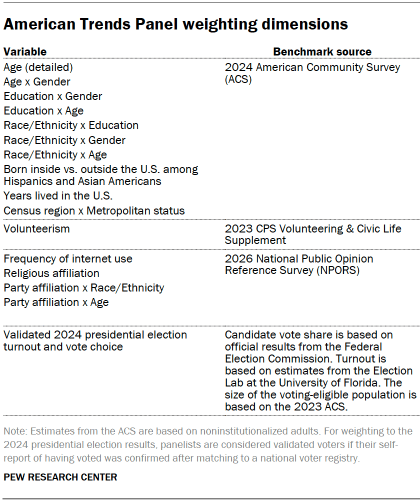
Weighting, the final step in the research process, is perhaps the most critical for ensuring accuracy. Because certain demographic groups—specifically Hispanic adults, non-Hispanic Asian adults, and younger Americans aged 18 to 29—are traditionally underrepresented in voluntary surveys, the ATP employs an oversampling strategy. These groups are intentionally invited at higher rates. To ensure these figures do not skew the results, they are later weighted back to align with U.S. Census Bureau population benchmarks. This mathematical adjustment corrects for the unequal probability of selection, ensuring that the final, reported findings accurately mirror the American population.
Statistical Significance and the Margin of Error
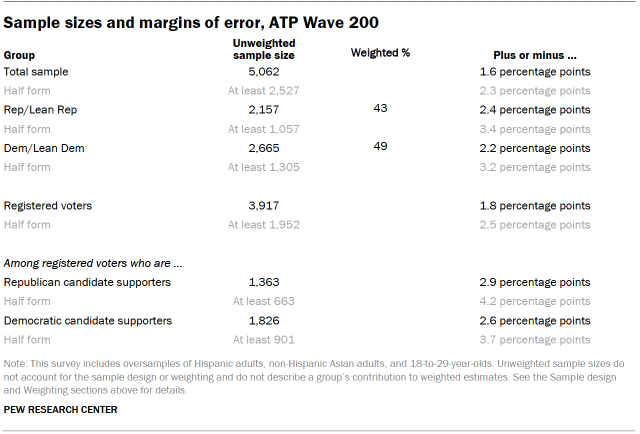
The reliability of a survey is fundamentally tied to its margin of sampling error (MOE). For the full sample of 5,062 respondents, the MOE is plus or minus 1.6 percentage points. This indicates that if the same survey were conducted 100 times, the results would fall within this range of the true population value in 95 of those instances.
The report highlights the importance of the cumulative response rate, which, at 3%, serves as a reminder of the inherent difficulties in modern polling. While the survey-level response rate—the proportion of sampled panelists who actually completed the survey—was an impressive 87%, the cumulative rate accounts for the long-term attrition of panelists over years of participation. This distinction is crucial for transparency, as it acknowledges that the "active" pool of survey takers is a subset of the broader population, and maintaining that pool requires consistent, long-term investment.
Incentives and the Psychology of Participation
To maintain engagement, the survey offered post-paid incentives ranging from $5 to $20. The variation in these amounts is a strategic choice; lower-income households or specific demographics that historically have lower response propensities are offered higher incentives to compensate for their time and effort. This practice acknowledges that time is a valuable commodity and that survey participation requires a degree of civic labor that is increasingly difficult to secure in a competitive information economy.
Implications for Public Opinion Research
The implications of the methodology used in Wave 200 extend beyond the data collected during that week. By maintaining a longitudinal panel, the Pew Research Center can track how individual opinions shift over time, rather than relying on a series of disconnected snapshots. This longitudinal capacity allows for the study of causality and change, providing researchers with the ability to see not just what Americans think, but how their thinking evolves in response to policy shifts, economic conditions, and cultural events.
The use of hybrid data collection—combining online platforms with traditional, live-interviewer telephone calls—also addresses the "digital divide." Relying solely on online surveys would exclude individuals with limited internet access, who often belong to specific socioeconomic or age cohorts. By ensuring that the survey is accessible via phone, the researchers maintain a broader reach, which is essential for accurate representation in a democracy.
Conclusion
The methodological rigor applied to the American Trends Panel serves as a benchmark for the industry. In an era characterized by concerns regarding the reliability of polling and the impact of misinformation, the transparency displayed in the documentation of Wave 200 provides a necessary layer of accountability. By documenting everything from the specific date of postcard mailings to the exact weighting dimensions used to normalize demographic imbalances, the Pew Research Center reinforces the value of empirical, evidence-based social science. As the electorate continues to face complex political and social challenges, the ability to gauge public sentiment with precision remains a vital tool for policymakers, journalists, and citizens alike. The success of this survey underscores that while the methods of data collection may evolve, the core principles of transparency, representative sampling, and rigorous quality control remain the bedrock of credible public opinion research.




