A comprehensive new survey by the Pew Research Center, conducted from March 24-30, 2025, reveals a complex and often divided American public when it comes to moral judgments on a range of contemporary issues. The findings underscore significant variations in moral viewpoints based on religious affiliation, political party, age, and gender, offering a granular look at the nation’s evolving ethical compass. The study, titled "What Do Americans Consider Immoral?", surveyed over 2,000 U.S. adults to gauge their opinions on activities ranging from marital infidelity and abortion to gambling and the death penalty.
Widespread Condemnation of Marital Infidelity
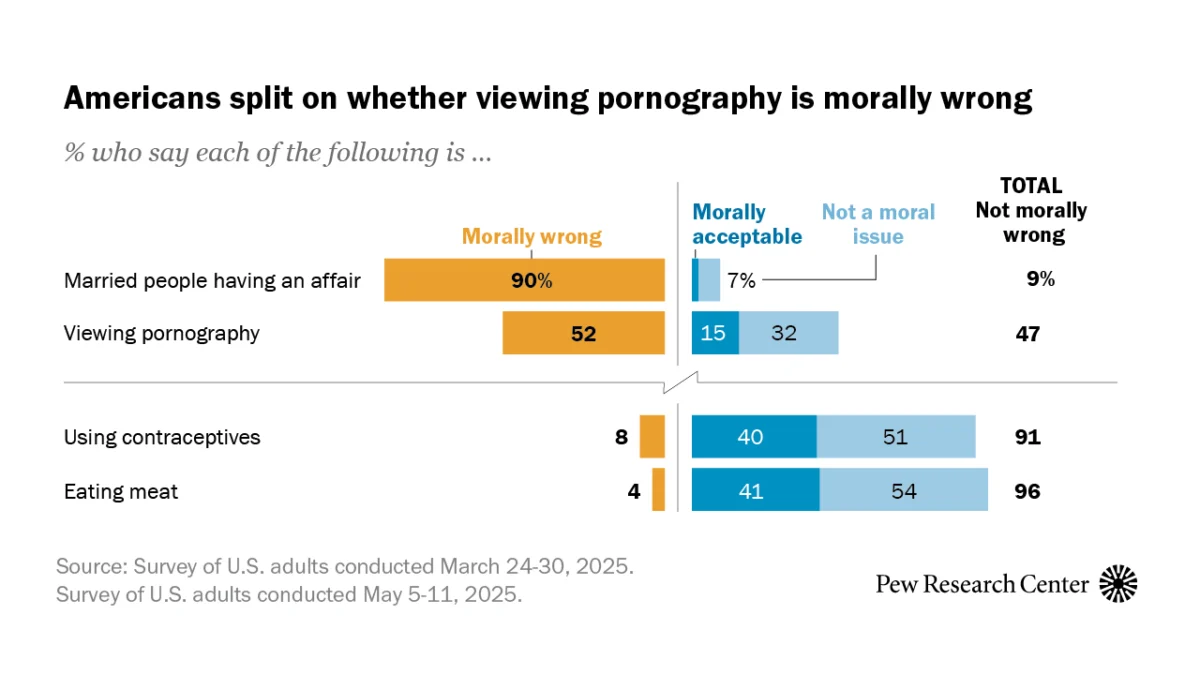
One of the most striking findings is the near-universal condemnation of married people having an affair. Across all U.S. adults surveyed, a staggering 90% deemed such behavior morally wrong. This sentiment remained remarkably consistent across various demographic groups. Christians, in particular, showed a high degree of agreement, with 92% finding affairs morally wrong. Even among the religiously unaffiliated, 87% held the same view, with atheists at 84%. This suggests a deeply ingrained societal norm against infidelity, transcending religious observance. Only a scant 2% of all U.S. adults found married people having an affair to be morally acceptable, with a slightly larger 7% viewing it as "not a moral issue." The data indicates a strong moral consensus on this issue, with minimal dissent across the surveyed population.
Abortion: A Deeply Divisive Issue
In stark contrast to the consensus on infidelity, the morality of abortion remains a deeply polarizing topic in the United States. The survey found that 47% of all U.S. adults consider having an abortion morally wrong, while 21% find it morally acceptable, and a substantial 31% view it as not a moral issue. This division is particularly pronounced along religious and political lines. White evangelical Protestants overwhelmingly view abortion as morally wrong (78%), a sentiment echoed by a majority of Republicans (71%). Conversely, religiously unaffiliated individuals are far more likely to see abortion as morally acceptable or not a moral issue (76% combined), with atheists at 89% and Democrats at 75% holding this view. The findings highlight the ongoing societal debate and the profound moral and ethical considerations surrounding reproductive rights.
Gambling and Marijuana: Shifting Perceptions
The survey also sheds light on evolving public attitudes towards activities that have historically carried moral stigma. Gambling, for instance, is viewed as morally wrong by 29% of U.S. adults, but a combined 70% consider it either morally acceptable or not a moral issue. This suggests a growing secularization of views on gambling, with younger adults and the religiously unaffiliated being more likely to see it as a non-moral concern.
Similarly, the morality of using marijuana is seen as morally wrong by only 23% of Americans, with a significant 76% considering it morally acceptable or not a moral issue. This aligns with the broader trend of marijuana legalization across many states and a shifting public perception of its ethical standing. The religiously unaffiliated and atheists, in particular, exhibit strong leanings towards viewing marijuana use as not a moral issue (59% and 62%, respectively).
Contraceptives and Alcohol: Broad Acceptance
The use of contraceptives and the consumption of alcohol emerge as widely accepted practices with minimal moral objection. Only 8% of U.S. adults find the use of contraceptives morally wrong, with a commanding 91% deeming it morally acceptable or not a moral issue. This reflects decades of widespread access and societal integration of family planning methods.
Drinking alcohol also garners broad moral acceptance, with only 16% of Americans viewing it as morally wrong. A substantial 84% consider it morally acceptable or not a moral issue. While some religious groups, like Black Protestants (20% morally wrong) and Hispanic Catholics (26% morally wrong), show slightly higher disapproval, the overall sentiment is one of widespread acceptance.
Divorce and Homosexuality: Generational and Religious Divides
The morality of getting a divorce reveals a generational and religious divide. While 23% of all U.S. adults consider divorce morally wrong, this figure is significantly higher among white evangelical Protestants (44%) compared to the religiously unaffiliated (11%). Younger adults (18-29) are less likely to view divorce as morally wrong (28%) than older adults (65+), who show a 18% disapproval rate.
Views on the morality of homosexuality also display stark differences. Overall, 39% of Americans consider homosexuality morally wrong, while 23% find it morally acceptable, and 37% see it as not a moral issue. This division is heavily influenced by religious affiliation. White evangelical Protestants overwhelmingly view homosexuality as morally wrong (72%), a sentiment shared by a majority of Republicans (59%). In contrast, the religiously unaffiliated (13% morally wrong) and Democrats (20% morally wrong) are significantly more accepting, with atheists and agnostics showing the lowest levels of moral disapproval. The data indicates a continuing shift in societal attitudes, particularly among younger generations and those with less religious adherence.
Complex Views on Sensitive Issues: Death Penalty, Euthanasia, and Wealth
More complex and nuanced moral landscapes emerge when examining issues such as the death penalty, physician-assisted suicide, and extreme wealth.
The Death Penalty: While 34% of Americans consider the death penalty morally wrong, a slightly larger 38% find it morally acceptable, and 26% view it as not a moral issue. Political affiliation plays a significant role, with Republicans largely supporting the death penalty (53% morally acceptable) while Democrats are more inclined to see it as morally wrong (48%). Religious groups also show divergence, with white evangelical Protestants largely accepting it (56% morally acceptable), while Black Protestants are more divided.
Physician-Assisted Suicide: The morality of patients choosing to end their lives with medical assistance presents a more divided picture. 35% of U.S. adults consider it morally wrong, 34% find it morally acceptable, and 29% view it as not a moral issue. The religiously unaffiliated are notably more accepting (51% morally acceptable), as are atheists (66% morally acceptable). Conversely, white evangelical Protestants express strong moral opposition (60% morally wrong). This issue reflects ongoing ethical and philosophical debates about autonomy, suffering, and the role of medicine.
Extreme Wealth: The concept of being extremely rich, defined as having billions of dollars, is viewed as "not a moral issue" by a substantial majority of 63% of Americans. However, 18% deem it morally wrong, and another 18% find it morally acceptable. This perception is significantly influenced by political affiliation, with Democrats more likely to see extreme wealth as morally wrong (29%) than Republicans (7%). The religiously unaffiliated also show a higher proportion viewing extreme wealth as morally wrong (30%) compared to Christians (13%). This suggests a societal undercurrent of concern regarding vast wealth inequality, even if it is not universally framed as a moral failing.
IVF and Spanking: Emerging Moral Considerations
The use of In Vitro Fertilization (IVF) for pregnancy is generally viewed positively, with 42% finding it morally acceptable and 47% considering it not a moral issue. Only 9% find it morally wrong. However, Catholic respondents show a higher degree of moral concern (15% morally wrong) compared to other Christian denominations and the religiously unaffiliated.
Spanking children elicits a more mixed response. While 36% find it morally acceptable and 39% consider it not a moral issue, a significant 23% view it as morally wrong. This practice is more strongly opposed by the religiously unaffiliated (37% morally wrong) and Democrats (35% morally wrong), while white evangelical Protestants largely find it morally acceptable (54%).
Eating Meat: A Relatively Uncontroversial Practice
In contrast to many other examined behaviors, eating meat is viewed as morally wrong by a mere 4% of U.S. adults. A significant 96% consider it either morally acceptable or not a moral issue, indicating a broad societal acceptance of meat consumption as a non-moral concern for the vast majority of Americans.
Conclusion: A Nation of Shifting Moral Tides
The Pew Research Center’s 2025 survey "What Do Americans Consider Immoral?" paints a nuanced picture of the American moral landscape. While a strong consensus exists on some issues, such as marital infidelity, many others reveal deep societal divisions, particularly along religious and political lines. The findings underscore the dynamic nature of moral views in response to changing social norms, scientific advancements, and ongoing cultural dialogues. As the nation navigates these complex ethical questions, the survey provides valuable data for understanding the diverse moral frameworks that shape American society. The data suggests a trend towards secularization in moral judgments for many behaviors, while deeply held religious beliefs continue to influence perspectives on issues like abortion, homosexuality, and physician-assisted suicide.