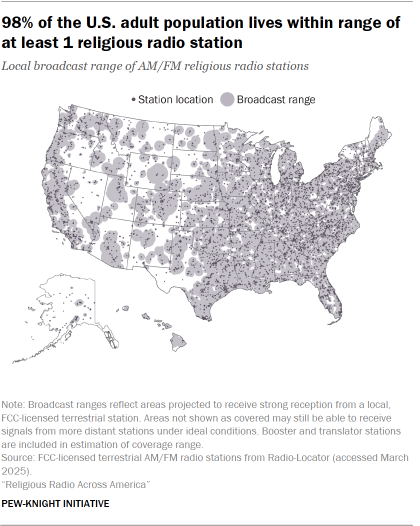
Faith-based radio has been a consistent presence in the American media landscape for over a century, with its origins tracing back to the earliest broadcasts of Sunday services in the 1920s. Today, this sector represents a significant portion of the nation’s audio media, with over 4,000 terrestrial religious radio stations operating across the United States. This substantial number means that an overwhelming 98% of U.S. adults live within the broadcast range of at least one religious radio station, underscoring its widespread accessibility. This comprehensive analysis, conducted by the Pew Research Center as part of the Pew-Knight Initiative, delves into the characteristics of these stations, the nature of their programming, and the motivations of their listeners.
The Pew-Knight Initiative, a joint endeavor by The Pew Charitable Trusts and the John S. and James L. Knight Foundation, is dedicated to fostering research that illuminates how Americans engage with civic information, shape their beliefs and identities, and participate in their communities. Pew Research Center operates as a nonpartisan, non-advocacy fact tank, providing the public, media, and policymakers with crucial insights into contemporary issues. Knight Foundation, in turn, is a social investor committed to nurturing informed and engaged communities.
This particular research effort addresses the significant presence of AM and FM radio stations that primarily broadcast religious or faith-based content. The study examines the defining features of these stations, the content they air, and the reasons individuals choose to tune in. Understanding the role of religious radio stations is a key component of the Pew Research Center’s ongoing research into news habits and media consumption, recognizing their substantial contribution to the nation’s media ecosystem.

The Landscape of Religious Radio
A recent analysis by the Pew Research Center reveals that religious stations constitute approximately a quarter of the roughly 17,000 FCC-licensed AM and FM stations in the U.S. This widespread reach ensures that religious programming is a readily available option for a vast majority of the American population.
The research methodology employed by the Pew Research Center for this study was multifaceted, drawing on three primary data sources to provide a holistic view of religious radio in the United States. This approach aimed to capture the geographical distribution of these stations, the thematic and stylistic elements of their programming, and the listener demographics and motivations.
Methodology: Identifying and Analyzing Religious Radio
To accurately identify religious radio stations, the research utilized data from Radio-Locator, a comprehensive vendor of FCC-licensed terrestrial AM and FM radio station information. A snapshot of this database from March 2025 provided the foundational data. Radio-Locator assigns a primary genre to each station, and for this study, stations categorized as Religious, Christian Contemporary, Gospel Music, or Spanish Christian were classified as "religious." It’s important to note that the vast majority of these stations are Christian, with a very small percentage affiliated with other religious traditions. Stations that broadcast secular content but occasionally include religious segments were excluded from this definition.
To ensure accuracy, the research team cross-referenced the identified stations by reviewing their websites for explicit religious affiliation or mission statements. Further validation was conducted through content analysis of broadcast material from July 2025, confirming the presence of religious spoken content or music by religious artists.
The study also included secondary stations, such as "booster" or "translator" stations that rebroadcast primary signals. While these were considered for geographic coverage analysis, they were excluded from content analysis to avoid duplication. Stations categorized as Spanish Christian were included in analyses of station characteristics and coverage but were excluded from the content analysis due to limitations in analyzing non-English programming.
The research involved a detailed content analysis of approximately 440,000 hours of streamed broadcasts from religious stations during July 2025. Complementing this, a survey of 5,023 U.S. adults was conducted between June 9 and June 15, 2025, to gather insights into their experiences with religious audio programming. The survey questions, detailed responses, and the full methodology are available through links provided by the Pew Research Center.
How Religious Radio Stations Describe Themselves
An examination of the websites of U.S. religious radio stations reveals how they perceive their mission and role in the media landscape. The findings indicate a strong Christian identity across the sector.
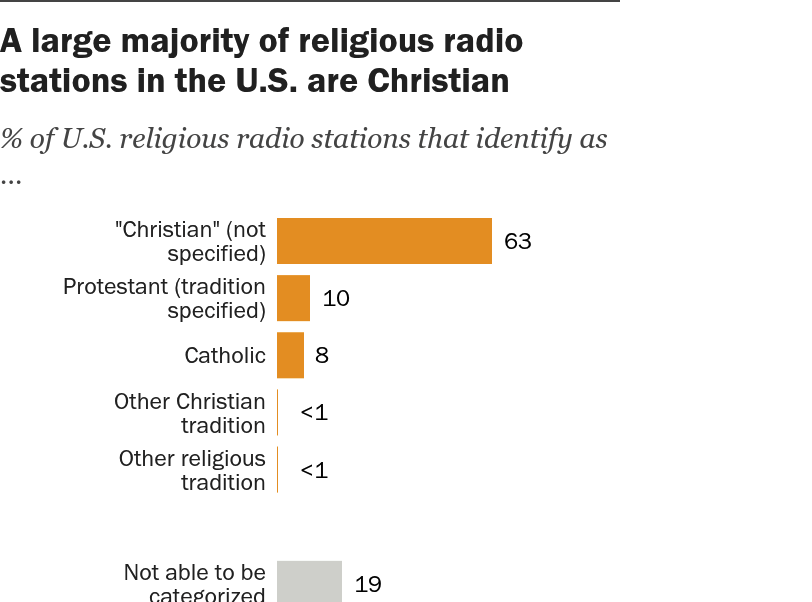
- Dominance of Christian Affiliation: A significant majority of religious radio stations identify as Christian. The largest segment, comprising 63% of all religious stations, simply identifies as "Christian" without specifying a particular denomination or tradition. Another 10% align with specific Protestant denominations, and 8% identify as Catholic.
- Limited Non-Christian Presence: Only a small fraction of stations could be reliably identified as belonging to non-Christian faiths or other Christian traditions outside of Catholic and Protestant denominations.
- Categorization Challenges: Approximately 19% of stations could not be categorized due to a lack of website information or insufficient detail on their websites.
- Evangelism as a Core Mission: A substantial 77% of stations with an "About Us" page or mission statement explicitly mention evangelism or spreading the gospel as a key aspect of their purpose. This aligns with common descriptions of their programming, which often focus on spiritual growth, biblical teachings, and community engagement.
These self-descriptions resonate with the reasons listeners provide for tuning into religious audio programming, highlighting a shared understanding of the medium’s purpose.
Ownership and Syndication
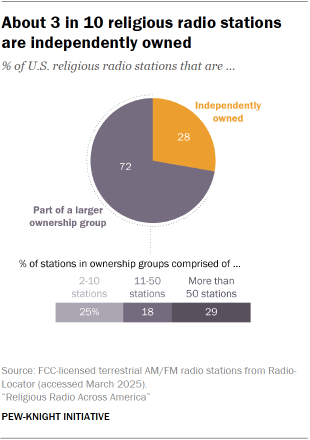
The ownership structure of religious radio stations reveals a trend towards consolidation within larger media groups.
- Independent vs. Syndicated: Only about 28% of religious radio stations in the U.S. are independently owned. The remaining 72% are part of multistation ownership groups, often broadcasting the same content across multiple frequencies and online feeds. This syndication model allows for broader reach and resource sharing among affiliated stations.
Programming Content: A Mix of Music and Spoken Word
Religious radio stations typically allocate roughly equal portions of their broadcast time to music and spoken content. Analysis of spoken content indicates a notable gender disparity:
- Gender Imbalance in Spoken Content: On average, 81% of spoken content on religious radio is delivered by male speakers. This suggests a potential area for further investigation into diversity and representation within religious broadcasting.
The spoken content generally falls into two main categories:
- Talk Radio Formats: This includes host-led discussions, commentaries, interviews with guests, and audience call-in segments.
- Religious Services and Sermons: Direct broadcasts or recordings of church services and sermons form another significant component.
Other types of spoken content, such as advertisements, scripted audio dramas, and brief news or weather updates, constitute a smaller portion of the programming.
Key Topics and Their Religious Framing
A comprehensive analysis of broadcast content reveals that religion serves as a pervasive theme, often interwoven with discussions on various societal topics.
- Religion as a Central Theme: An impressive 86% of all spoken content on religious radio stations includes references to religion or religious teachings, even if it’s not the sole focus. This translates to an average of over 10 hours of religion-related discussion per station daily.
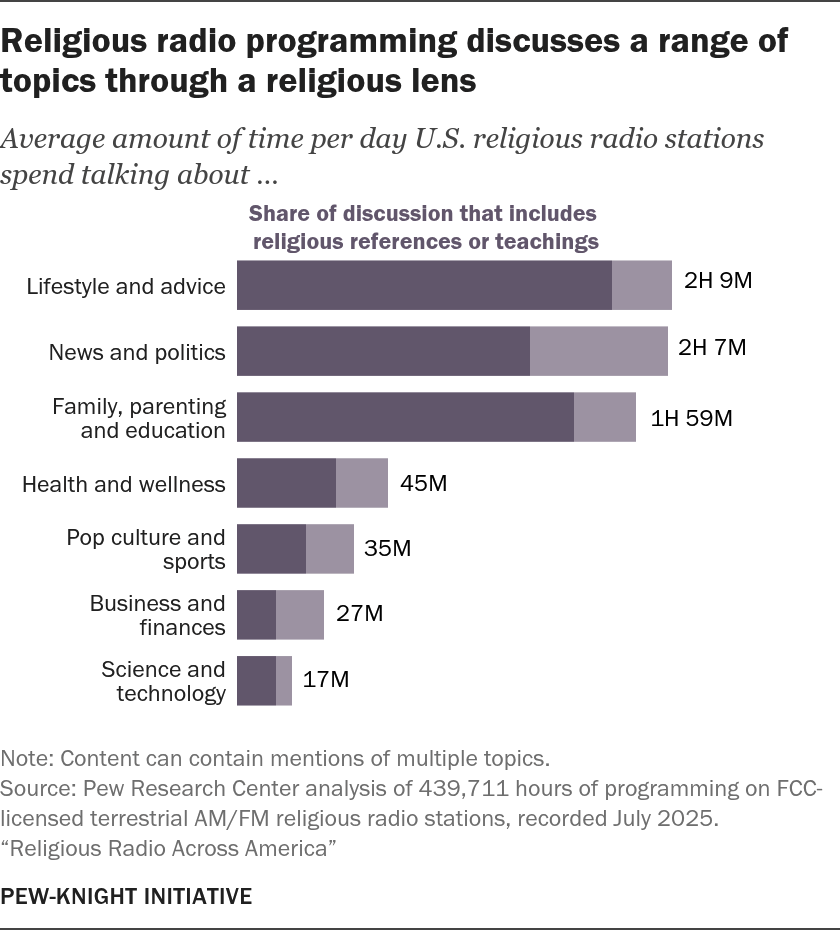
- Interweaving Religion with Other Subjects: Religious stations frequently address broader issues within a religious framework. Three topics emerge as particularly prominent, each occupying approximately two hours of broadcast time per station daily on average:
- Lifestyle and Advice: This encompasses guidance on personal conduct, relationships, and daily living, framed through a religious lens.
- News and Politics: While listeners may not always cite news and politics as a primary reason for tuning in, these stations dedicate significant airtime to discussing current events and political matters, consistently filtering them through religious perspectives.
- Family, Parenting, and Education: Discussions revolve around the religious upbringing of children, family dynamics, and educational philosophies, all informed by faith-based principles.
Other subjects, including health and wellness, pop culture and sports, business and finance, and science and technology, are also discussed, though less frequently.
Dominance of Popular Artists and Talk Shows
The music played on religious radio stations primarily features contemporary Christian music (CCM) and worship music. However, a notable concentration exists among popular artists.
- Concentrated Music Playlists: A relatively small selection of established artists dominates the music playlists. Analysis revealed that 16% of all songs examined over a month were by just 10 individuals or bands, indicating a high degree of rotation for certain musical acts.
Similarly, certain talk programs have achieved widespread national recognition and are frequently aired across numerous stations.
- Syndicated Talk Programs: Shows like "Unshackled," "Turning Point," and "Focus on the Family" are broadcast on as many as half of all religious stations nationwide. A significant aspect of their reach is their availability beyond radio waves, with 99 of the top 100 most frequently aired shows also accessible on demand online or as podcasts.
Variability in Content Mix
While national averages suggest an even split between music and talk programming, the actual content mix varies considerably among individual stations.
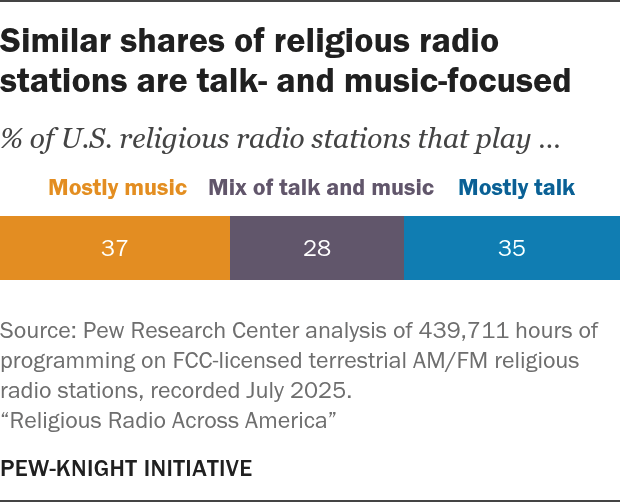
- Station Formats: Approximately 37% of religious radio stations primarily broadcast music, while 35% focus predominantly on talk programming. The remaining 28% offer a more balanced mix of both music and talk. This diversity in format caters to different listener preferences within the broader religious audience.
News and Politics on the Religious Airwaves
The presence and depth of news and politics coverage on religious radio stations present a nuanced picture. While most listeners do not identify current events as their primary reason for tuning in, a significant portion acknowledges it as a minor reason.
- Listener Perception vs. Broadcast Content: Only 14% of listeners cite keeping up with current events as a major reason for listening, though 40% consider it a minor factor. This contrasts with the broadcast reality, where religious radio stations dedicate an average of two hours per day to discussions of politics, current events, and social issues.
- Spectrum of Political Engagement: This average masks considerable variation. About 30% of religious radio stations spend less than 30 minutes daily on news and politics, with some dedicating only a few minutes. Conversely, a nearly identical share (29%) devotes over two and a half hours daily to these topics, with some stations focusing on them for 10 hours or more per day.
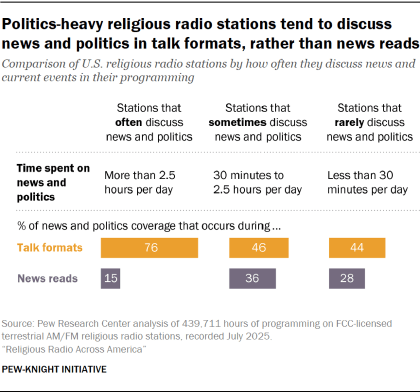
- Format of Political Discussion: On stations with a heavy focus on politics, coverage is predominantly delivered through long-form talk radio formats, such as interviews and host commentaries. On stations with less political emphasis, these topics are more likely to be addressed in brief news reads.
Specific Topics and Political Figures
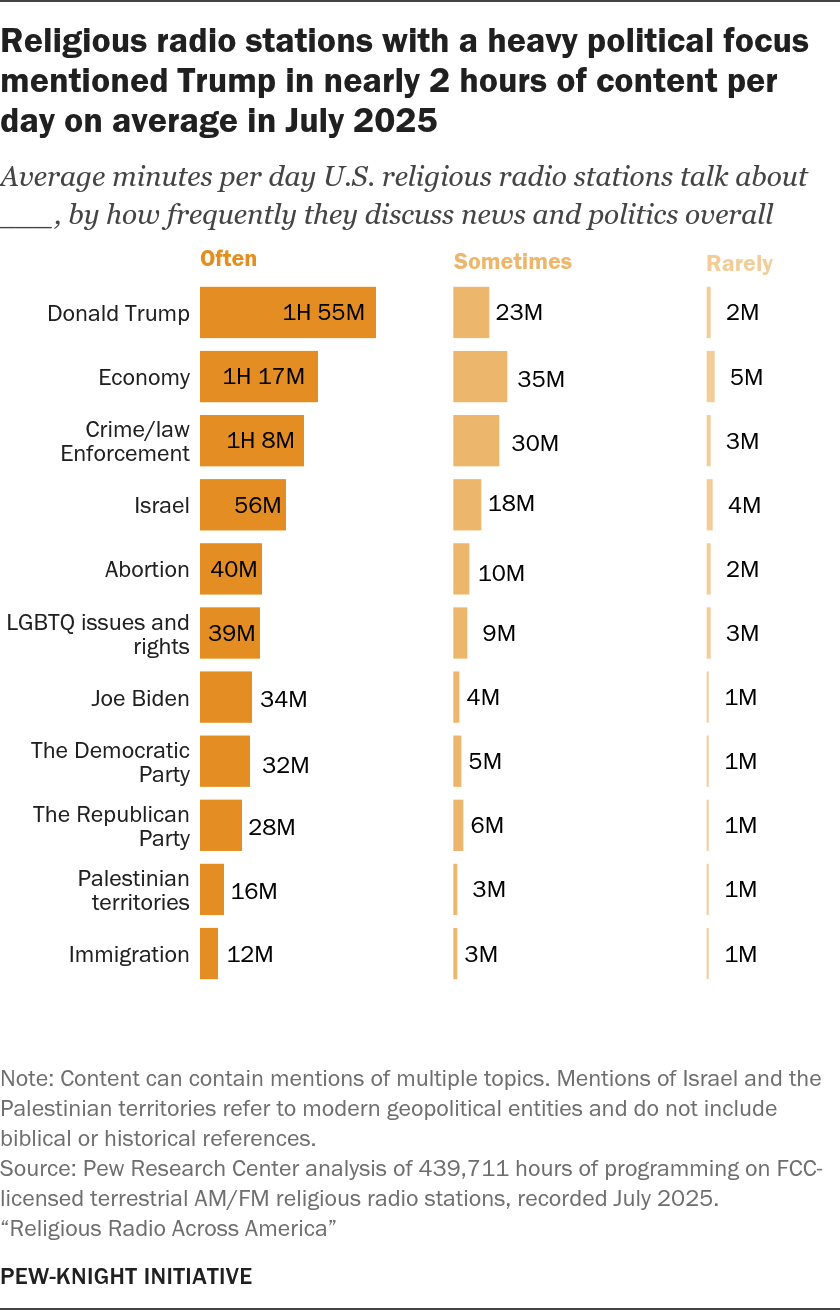
To gauge the depth of engagement with contemporary issues, the research analyzed mentions of 11 specific topics, entities, or political figures.
- General Issues on Less Political Stations: Stations that rarely discuss news and politics tend to focus on more general issues like the economy or crime. Even so, the economy, the most frequently mentioned topic, receives only about five minutes of daily coverage on these stations, with many other topics discussed for two minutes or less.
- Prominence of Donald Trump: A striking finding is the significant attention given to Donald Trump on stations that frequently discuss news and politics. These stations mention Trump in nearly two hours of coverage per day on average, surpassing even the economy, which is discussed for 77 minutes. This indicates a strong focus on prominent political figures within politically engaged religious radio programming.
- Deeper Dive into Specific Issues: Politically focused stations also dedicate substantial time to other topics that are less frequently discussed elsewhere. Daily coverage includes approximately 40 minutes on abortion and a similar amount on LGBTQ issues. Discussions of the Democratic and Republican parties are also more prevalent on these stations.
Opinionated vs. Neutral Discourse
The analysis extended to examining the manner in which political and social issues are discussed on religious radio, differentiating between opinionated and neutral presentations.
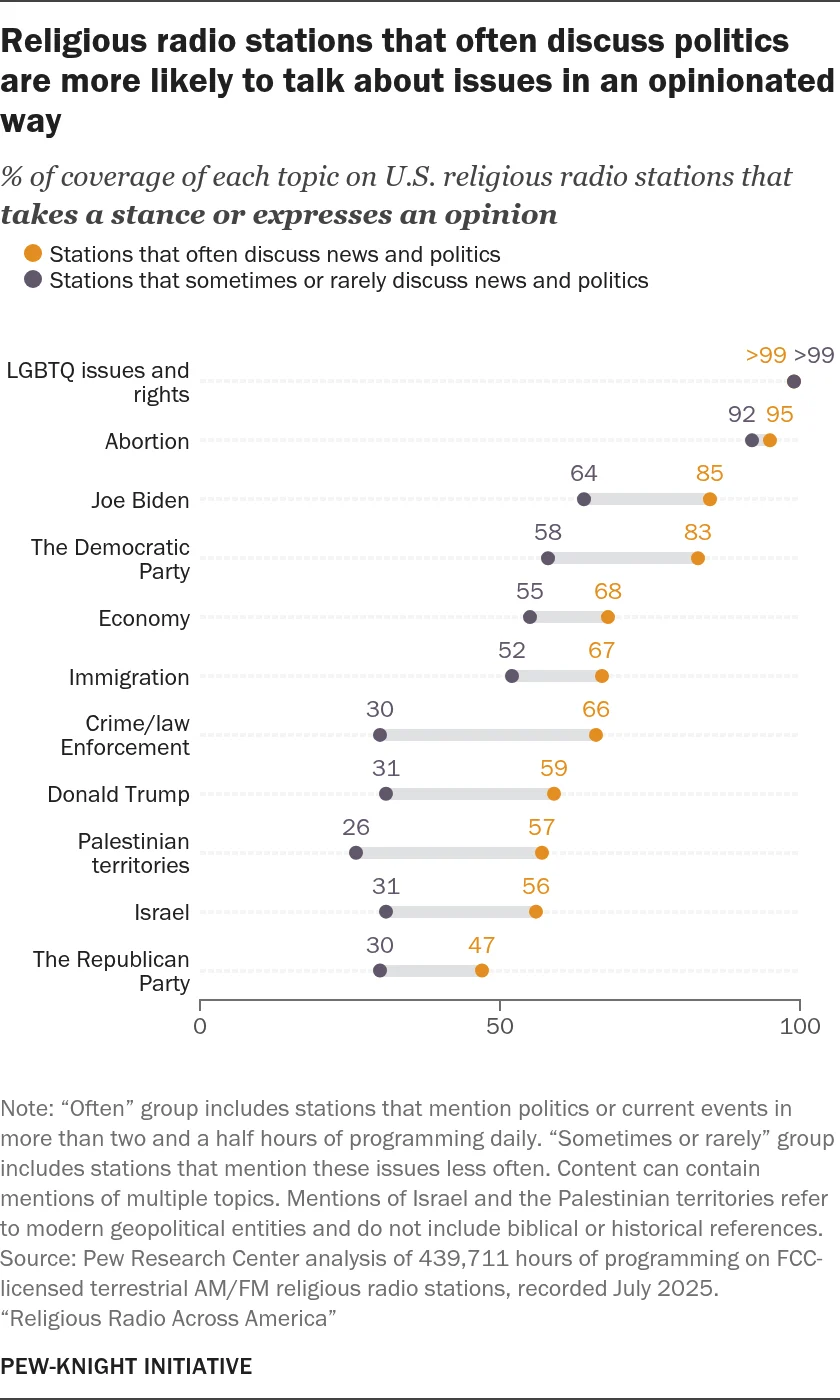
- Prevalence of Opinionated Coverage: Stations that frequently discuss politics tend to present nearly all studied issues in an opinionated manner. On nine of the 11 topics analyzed, these stations were significantly more likely than others to express a clear stance.
- Abortion and LGBTQ Issues: The discussion of abortion and LGBTQ rights stands out. While not all stations cover these topics, those that do overwhelmingly express a strong opinion. Coverage of abortion is almost universally against it, and discussions of LGBTQ issues typically oppose expanded rights or acceptance.
- Nuances in Political Discussion: The Republican Party is discussed in an opinionated way 47% of the time on politically focused stations, compared to 30% on less politically focused stations. Similarly, Joe Biden is discussed in an opinionated way 85% of the time on politically focused stations, compared to 64% on others. This highlights a consistent tendency towards advocacy and commentary on these platforms.
This detailed examination of religious radio in America provides valuable insights into the diverse landscape of faith-based broadcasting, its content, and its role in the lives of millions of listeners. The research underscores the significant reach and influence of these stations, as well as the varied ways in which they engage with both spiritual and secular matters.