A comprehensive analysis of religious radio stations across the United States reveals that while these stations form a significant portion of the nation’s media ecosystem, Catholic stations exhibit distinct characteristics in their programming, geographic distribution, and content focus compared to their Christian counterparts. This research, a product of the Pew-Knight Initiative, offers a nuanced understanding of how faith-based broadcasting serves diverse American communities. The Pew-Knight Initiative, a collaborative effort between The Pew Charitable Trusts and the John S. and James L. Knight Foundation, is dedicated to supporting novel research into how Americans engage with civic information, shape their beliefs and identities, and participate in their communities. Pew Research Center, a nonpartisan fact tank, aims to illuminate the issues, attitudes, and trends molding our world, while the Knight Foundation champions informed and engaged communities.
Unpacking the Reach and Nature of Religious Broadcasting
The study’s findings indicate that approximately a quarter of all FCC-licensed AM and FM radio stations in the United States are dedicated to religious content. A substantial majority of these stations identify as Christian, with 63% broadcasting under the general "Christian" banner without further specific affiliation. Another 10% align with specific Protestant denominations. Notably, 8% of these religious stations identify as Catholic radio. This segment of religious broadcasting, though smaller, presents a unique profile within the broader landscape.
The research methodology involved a multifaceted approach to capture a comprehensive picture of religious radio. Three primary data sources were utilized: an analysis of FCC-licensed AM and FM radio stations that primarily broadcast religious or faith-based content; an examination of the programming characteristics and content of these stations; and insights into listener demographics and motivations for tuning in. The detailed survey questions, topline responses, and the full methodology are available for public review, underscoring the commitment to transparency and rigorous research practices. This extensive data collection, encompassing 439,711 hours of programming recorded in July 2025, provides a robust foundation for the study’s conclusions.
Geographic Distribution: A Tale of Two Regions
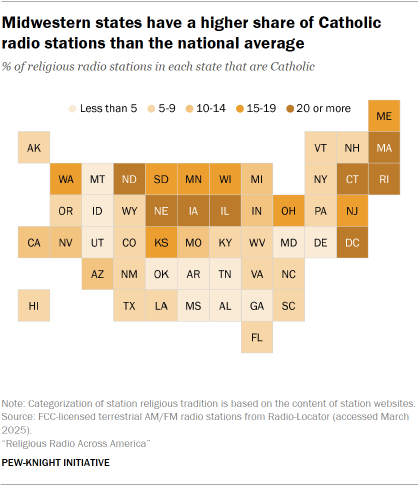
While religious radio stations are accessible nationwide, Catholic stations demonstrate a noticeable geographical concentration. They are more prevalent in the Midwest and Northeast regions of the United States, while being less common in the South. This pattern contrasts with stations identifying with Protestant traditions or as generally "Christian," which are more evenly distributed. This regional prevalence suggests potential historical, demographic, or cultural factors influencing the establishment and listener base of Catholic radio in specific areas. The visual representation of this data, often depicted on maps, clearly illustrates this regional disparity, highlighting states in the Midwest and Northeast with a higher share of Catholic radio stations compared to the national average.
Programming Divergence: Talk Over Tunes
A striking difference emerges when examining the typical programming on Catholic radio stations compared to other Christian formats. While popular syndicated talk shows like "Unshackled," "Turning Point," and "Focus on the Family" are frequently featured on non-Catholic religious stations, they are almost entirely absent from Catholic station schedules. This indicates a deliberate curation of content that sets Catholic broadcasts apart.

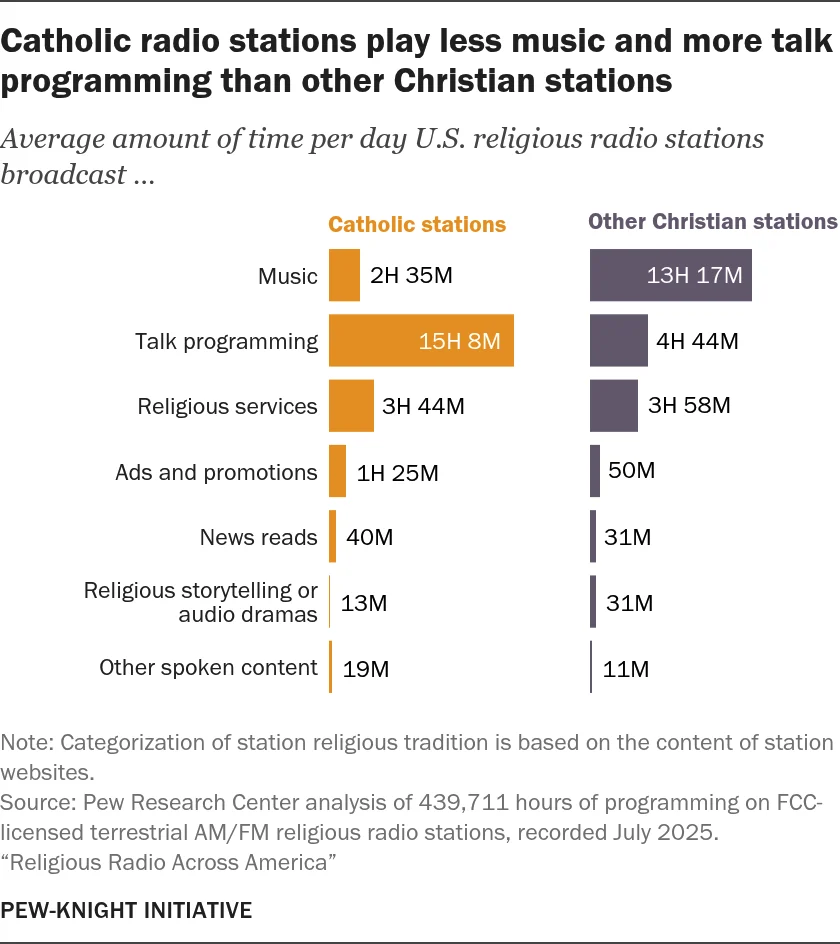
The data reveals a significant divergence in format. On average, Catholic radio stations dedicate a substantial 15.14 hours per day to talk programming. This includes host-led discussions, interviews, monologues, and audience participation segments. In stark contrast, other Christian stations average less than five hours of talk programming daily. This emphasis on talk radio positions Catholic stations as platforms for dialogue, commentary, and in-depth discussion of faith-related topics.
Conversely, music plays a far less dominant role on Catholic radio. While approximately half of the overall religious radio airtime is dedicated to music, this figure plummets to just 11% on Catholic stations. The music that does air on these stations is also noteworthy. An automated music recognition system finds that a considerable portion of this music is difficult to categorize, suggesting it may not originate from widely distributed studio recordings. This could imply a preference for more traditional hymns, liturgical music, or locally produced musical content that adheres to specific Catholic liturgical practices. The distinction in music content further reinforces the unique programming strategy of Catholic radio.
Content Focus: Beyond Music and Sermons
Beyond the stark differences in music and talk programming, the content of religious services also exhibits subtle variations. Both Catholic and non-Catholic stations allocate similar amounts of airtime to religious services and sermons. However, the nature of these broadcasts differs, reflecting the distinct theological and liturgical practices of Catholicism versus other Christian denominations. The Catholic Mass, for instance, possesses a unique structure and set of prayers that would be reflected in its broadcast programming.
Biblical references also provide insight into content focus. While common ground exists in the most frequently mentioned books of the Bible—the Gospels of Matthew, Luke, and John, alongside Old Testament texts like Psalms, Genesis, Exodus, and Isaiah—a notable difference arises concerning the Book of Revelation. At the time of the study, listeners were significantly more likely to encounter references to the Book of Revelation on non-Catholic radio stations than on Catholic ones. This suggests a potential difference in theological emphasis or interpretive approaches to eschatological themes between the two broadcasting formats.
The Pew-Knight Initiative: Fostering Informed Engagement
The Pew-Knight Initiative plays a crucial role in illuminating these trends. Its overarching mission is to support new research that delves into how Americans consume civic information, construct their beliefs and identities, and participate in their communities. By funding nonpartisan research, the initiative empowers the public, media organizations, and policymakers with data-driven insights. Pew Research Center’s commitment to high-quality, independent research ensures that findings are robust and reliable, contributing to a more informed public discourse.
The decision to investigate religious radio stems from Pew Research Center’s long-standing agenda on news habits and media consumption. Recognizing that religious radio stations are widely accessible and constitute a significant element of the media landscape, understanding their role is vital for a complete picture of how Americans engage with information and community. This study, therefore, not only sheds light on religious broadcasting but also contributes to a broader understanding of media diversity and its impact on societal engagement.
Broader Implications and Future Research
The findings from this Pew-Knight Initiative study have several implications. Firstly, they highlight the diverse ways in which religious organizations utilize media to connect with their adherents and the broader public. The distinct programming strategies of Catholic radio suggest a tailored approach to outreach and spiritual formation, catering to specific theological perspectives and listener preferences.
Secondly, the study underscores the importance of granular analysis within broad categories of media. Simply classifying all faith-based broadcasts as "religious radio" overlooks the significant internal variations in content, style, and focus. This nuanced understanding is crucial for researchers, media analysts, and community leaders seeking to comprehend the full spectrum of media influence.
The study also raises questions for future research. What are the specific motivations of listeners who tune into Catholic radio versus other Christian stations? How do the unique programming choices on Catholic radio influence listener engagement and religious practice? Further investigation into the economic models, staffing, and production methods of these stations could also provide valuable context. Moreover, exploring the digital presence and online content strategies of religious radio stations, particularly in light of evolving media consumption habits, would offer a more complete contemporary picture.
In conclusion, the Pew-Knight Initiative’s examination of religious radio in the United States reveals a dynamic and diverse media sector. The specific case of Catholic radio demonstrates a clear divergence in programming, with a strong emphasis on talk content and a reduced focus on music, setting it apart from other Christian broadcasting formats. This research not only enriches our understanding of religious media but also contributes to a broader appreciation of how various forms of media shape beliefs, identities, and community engagement across the American landscape.