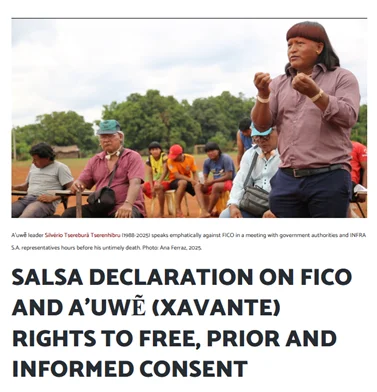
International scholars have issued a stark warning regarding the FICO railway project in Brazil, alleging that the government’s handling of Free, Prior, and Informed Consent (FPIC) has critically undermined the rights of Indigenous communities. The Society for the Anthropology of Lowland South America (SALSA), a prominent international scholarly organization representing academics, students, and practitioners in the field, has released a formal declaration detailing serious violations of FPIC in the consultation processes surrounding this massive infrastructure undertaking. The organization argues that the fragmented approach by the National Indian Foundation (FUNAI), Brazil’s primary Indigenous affairs agency, has systematically compromised the rights of multiple Indigenous Peoples whose ancestral lands and traditional ways of life are directly impacted by the FICO railway.
Background of the FICO Railway Project and Indigenous Rights
The FICO railway, a crucial component of Brazil’s ambitious logistical infrastructure expansion, aims to connect the mining region of Serra dos Carajás in Pará state to the port of Ilha de São Luís in Maranhão. The project, spearheaded by the mining giant Vale S.A. and the state-owned Valec Engenharia, Construções e Ferrovias S.A., is envisioned as a vital artery for transporting iron ore and other commodities, bolstering Brazil’s export capacity and economic growth. However, its expansive route cuts through territories historically occupied and vital to numerous Indigenous communities, including the Awá-Guajá, Guajajara, Tembé, and others within the states of Pará and Maranhão.
The concept of Free, Prior, and Informed Consent (FPIC) is a cornerstone of international human rights law, specifically enshrined in the United Nations Declaration on the Rights of Indigenous Peoples (UNDRIP). FPIC mandates that Indigenous peoples have the right to give or withhold their consent to projects affecting their lands, territories, and resources. This consent must be given freely, without coercion or manipulation, prior to the commencement of any activities, and based on complete and accurate information about the potential impacts and benefits of the proposed project.
SALSA’s Declaration: A Call to Action
SALSA’s declaration, published on their official website and made available in English, Portuguese, and Spanish, meticulously outlines the concerns raised by its members. The core of their argument centers on the procedural irregularities and substantive shortcomings observed in FUNAI’s engagement with affected Indigenous communities. According to the scholars, FUNAI’s approach has been characterized by a piecemeal consultation process, failing to adequately involve all potentially impacted communities from the outset or to provide them with comprehensive and understandable information about the FICO railway’s full scope and consequences.
The anthropologists highlight that the consultations have often been conducted in a manner that does not respect Indigenous customs and decision-making processes. This includes insufficient time for communities to deliberate, lack of access to independent technical expertise to assess environmental and social impacts, and the presentation of information in ways that are not culturally appropriate or linguistically accessible. These deficiencies, SALSA argues, directly contravene the spirit and letter of FPIC, rendering any consent obtained potentially invalid.
Key Allegations and Observed Violations
The scholars’ statement points to several critical issues:
- Fragmented Consultation Process: Instead of a holistic approach that considers the cumulative impacts on all affected communities, SALSA observes that consultations have been conducted in a fragmented manner, often addressing specific segments of the railway or individual communities in isolation. This prevents a comprehensive understanding of the project’s overall impact and hinders collective decision-making.
- Inadequate Information Dissemination: The provision of information about the FICO railway has been criticized as insufficient and often technical, failing to adequately convey the potential long-term socio-environmental and cultural consequences to Indigenous peoples. This includes impacts on biodiversity, water resources, sacred sites, and traditional livelihoods.
- Coercion and Undue Influence: There are concerns that the consultation process may have been influenced by external pressures, potentially leading to decisions that do not reflect the genuine will of the communities. This can include economic inducements or the manipulation of information to favor project approval.
- Lack of Free and Prior Engagement: The timeline for consultations has often been compressed, leaving insufficient time for Indigenous communities to engage in internal discussions, consult with their own experts, and arrive at a consensus, thus compromising the "prior" and "free" aspects of FPIC.
- Disregard for Traditional Governance Structures: SALSA notes that FUNAI’s engagement has not always respected the established governance structures and traditional decision-making protocols of Indigenous communities, leading to the alienation of legitimate representatives.
Supporting Data and Contextual Evidence
The FICO railway project is one of several large-scale infrastructure initiatives in Brazil that have raised significant concerns regarding their impact on Indigenous territories and human rights. Brazil’s National Center for Geographic Information and Indigenous Studies (CIAL) has documented numerous instances where infrastructure projects, including roads, railways, and hydroelectric dams, have led to deforestation, land invasion, increased violence, and the erosion of Indigenous cultures.
For instance, studies by the Indigenous Missionary Council (CIMI) have consistently shown a correlation between the expansion of large-scale development projects and an increase in conflicts and human rights violations in Indigenous territories. The Amazon region, in particular, faces immense pressure from mining, agribusiness, and logging, all of which are often facilitated by new infrastructure. The FICO railway, by facilitating greater access to these resource-rich areas, is seen by many as an enabler of further encroachment and exploitation.
The economic projections for the FICO railway highlight its potential to significantly boost Brazil’s commodity exports. Estimates suggest that the railway could increase the volume of iron ore transported from the Carajás region by tens of millions of tons annually. While this promises economic benefits for the nation, the localized and often irreversible impacts on Indigenous communities are frequently downplayed in these broader economic analyses.
Timeline of Concerns and Actions
While the exact timeline of consultations for the FICO railway can be complex and span several years, the concerns raised by SALSA are not isolated incidents. Indigenous organizations and human rights advocates have been voicing similar concerns about the FICO project and other development initiatives for an extended period.
- Early Stages: Initial project planning and feasibility studies for the FICO railway likely began several years ago, with preliminary engagements with government agencies and possibly initial, less formalized consultations with some Indigenous communities.
- Intensification of Consultations (Ongoing): As the project moved towards construction phases, the formal consultation processes, mandated by Brazilian law and international standards, would have intensified. It is during this phase that SALSA’s observed irregularities are alleged to have occurred.
- SALSA’s Declaration (Recent): The statement by the Society for the Anthropology of Lowland South America represents a recent crystallization of scholarly concerns, likely informed by ongoing monitoring and reports from affected communities and researchers on the ground. The timing of the declaration suggests a response to a critical juncture in the project, possibly related to ongoing construction or impending approvals.
- Call to Action (Present): The declaration includes a direct call to action, urging individuals and organizations to write to Brazilian authorities, including President Lula da Silva, the Minister of Indigenous Peoples, and the President of FUNAI, advocating for the respect of FPIC and the rights of affected Indigenous communities. This indicates an ongoing advocacy effort.
Potential Statements and Reactions from Related Parties (Inferred)
While direct quotes from all parties are not available in the initial release, it is possible to infer potential reactions based on general stances and previous engagements:
- Indigenous Communities: Representatives of the affected Indigenous communities, such as the Awá-Guajá and Guajajara, have historically expressed deep reservations about large-scale projects. They often highlight the disruption to their traditional way of life, the destruction of sacred sites, and the increased risk of invasion and violence. Their likely reaction to SALSA’s declaration would be one of validation and renewed calls for their rights to be respected and for the project to be halted or significantly altered.
- FUNAI (National Indian Foundation): FUNAI, as the government agency responsible for Indigenous affairs, would likely defend its consultation processes, stating that they adhere to legal requirements and are conducted in good faith. They might argue that they are working to balance development needs with the protection of Indigenous rights and that SALSA’s claims are an oversimplification or misrepresentation of complex realities. However, given the severity of the allegations, FUNAI might also initiate internal reviews or issue statements promising to investigate the specific concerns raised.
- Vale S.A. and Valec: The project proponents, Vale and Valec, would likely emphasize their commitment to responsible development and adherence to environmental and social safeguards. They would probably highlight the economic benefits of the FICO railway for regional and national development and assert that they have engaged in consultations as required by law, potentially framing any delays or challenges as impediments to progress. They might also point to mitigation measures already in place or planned.
- Brazilian Government: The broader Brazilian government, particularly under President Lula’s administration, has expressed a commitment to protecting Indigenous rights and the environment. However, they also face pressure to promote economic development and infrastructure projects. The government’s response would likely involve a balancing act, acknowledging the concerns while seeking to reaffirm their commitment to both development and Indigenous rights, potentially calling for dialogue and improved consultation mechanisms.
Broader Impact and Implications
The implications of the alleged FPIC violations in the FICO railway project extend far beyond the immediate affected communities.
- Erosion of Indigenous Rights: If these allegations are substantiated, it signals a significant setback for the recognition and implementation of Indigenous rights in Brazil, undermining decades of advocacy and international legal advancements.
- Environmental Concerns: The FICO railway’s route traverses ecologically sensitive areas, and inadequate consultation could lead to insufficient environmental impact assessments and mitigation plans, exacerbating deforestation, biodiversity loss, and pollution.
- International Reputation: Brazil’s adherence to international human rights standards, particularly concerning Indigenous peoples, is closely watched globally. Such violations can tarnish the country’s international image and affect its relationships with trading partners and international organizations.
- Precedent for Future Projects: The way this case is handled will set a precedent for future infrastructure projects in Brazil, influencing how Indigenous rights are prioritized and protected in the face of competing development interests.
- Social Unrest and Conflict: Continued disregard for Indigenous rights can fuel social unrest, deepen distrust between Indigenous communities and the state, and potentially lead to increased conflict and human rights abuses.
The scholars’ declaration serves as a critical reminder that large-scale development projects must not proceed at the expense of fundamental human rights. The FICO railway case underscores the urgent need for transparency, genuine participation, and the robust application of Free, Prior, and Informed Consent principles to ensure that development benefits all of Brazil’s citizens, including its Indigenous peoples, without compromising their inherent rights and cultural integrity. The call to action by SALSA urges greater public engagement and accountability for governmental and corporate actions that impact vulnerable populations.