Americans hold increasingly unfavorable views of Israel and its prime minister, Benjamin Netanyahu, according to a comprehensive new survey by the Pew Research Center. The findings, released in April 2026, reveal a significant downward trend in public opinion, particularly among younger demographics and Democrats, coinciding with escalating regional tensions and ongoing U.S. military involvement in the Middle East. The survey, conducted from March 23-29, 2026, polled 3,507 U.S. adults and utilized an oversample of Muslim, Jewish, and non-Hispanic Asian adults to ensure precise estimates for these subgroups.
The report comes at a critical juncture, approximately one month into the U.S.- and Israeli-led war against Iran, a conflict that has reshaped regional alliances and significantly impacted global energy markets. This new data offers a stark snapshot of how these geopolitical shifts are influencing American public perception of a long-standing ally and its leadership.
Declining Favorability Towards Israel
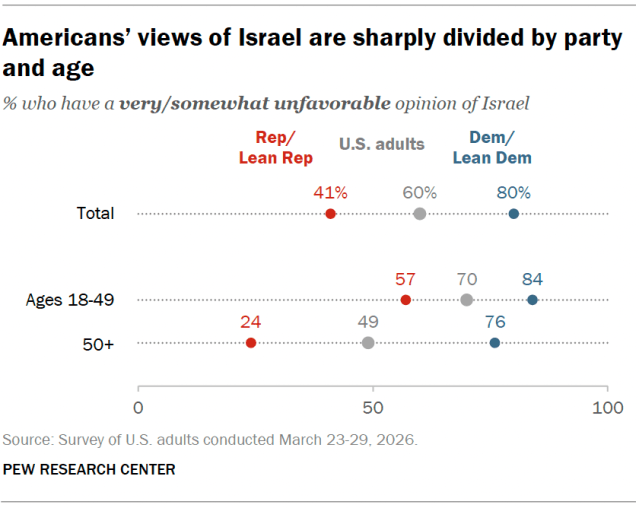
The survey data indicates a stark decline in positive sentiment towards Israel. Currently, six-in-ten Americans express an unfavorable view of the nation, marking a 7 percentage point increase from the previous year and a nearly 20-point surge since the spring of 2022. More alarmingly, the proportion of U.S. adults holding a very unfavorable view of Israel has risen to 28%, a 9-point jump from last year and nearly triple the figure of 10% recorded in 2022.
This negative sentiment is particularly pronounced among Democrats and Democratic-leaning independents. A staggering eight-in-ten Democrats now hold an unfavorable view of Israel, a substantial increase from 69% last year and 53% in 2022. Younger Democrats, those under 50, are even more likely to express a very unfavorable opinion (47%) compared to their older counterparts (39%).

While Republicans and Republican-leaning independents still show a majority favorable view of Israel (58% vs. 41%), this margin has narrowed, with an uptick in negative opinions. This shift is most notable among younger Republicans (ages 18-49), where 57% now hold an unfavorable view, up from 50% last year. Older Republicans, however, continue to express predominantly positive views.
Religious affiliations also play a significant role in perceptions of Israel. Jewish Americans and White evangelical Protestants remain largely supportive, with favorable views at 64% and 65%, respectively. However, other religious groups show considerably lower levels of favorability: White nonevangelical Protestants (39%), Catholics (35%), Black Protestants (33%), and the religiously unaffiliated (22%). Among Muslim Americans, positive views of Israel are exceptionally low, with only 4% expressing favorability.
Erosion of Confidence in Prime Minister Netanyahu
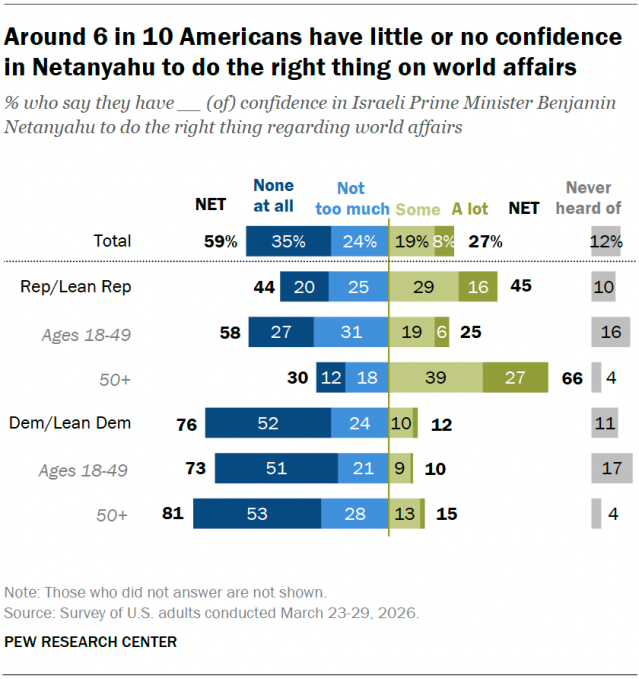
Parallel to the declining views of Israel, confidence in Prime Minister Benjamin Netanyahu’s ability to handle world affairs has significantly diminished. A substantial 59% of Americans now report having little or no confidence in Netanyahu, a 7-point increase from the previous year and a nearly 20-point jump since 2023.
Democrats overwhelmingly express a lack of confidence, with 76% reporting little or no confidence, a 6-point increase from last year. Notably, the number of Democrats stating they have no confidence at all in Netanyahu has risen sharply to 52%, up from 37% in 2025. This sentiment is consistent across all age groups within the Democratic party.
Republicans present a more divided picture regarding Netanyahu. For the first time in recent Pew Research Center surveys, confidence levels are nearly split, with 45% expressing confidence and 44% expressing little or no confidence. This marks a departure from previous years where a majority of Republicans held favorable views of Netanyahu. Younger Republicans (under 50) are significantly less confident in Netanyahu compared to their older counterparts (30% vs. 58%).
Religious demographics also reveal differing perspectives on Netanyahu. White evangelical Protestants continue to show strong confidence (52%). However, other religious groups express more reserved or negative views. A majority of Jewish Americans (56%) report little or no confidence in Netanyahu on world affairs. Among Muslim Americans, this figure rises to an overwhelming 91%, with 74% expressing no confidence at all.
Shifting Views on U.S.-Israel Relations Under Trump
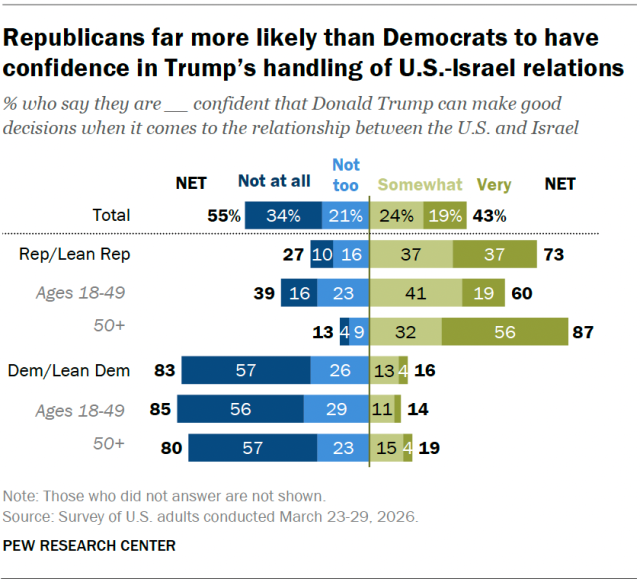
The survey also delved into American perceptions of former President Donald Trump’s handling of U.S.-Israel relations. More than half of Americans (55%) lack confidence in Trump’s ability to make sound decisions regarding the relationship between the United States and Israel. These figures remain relatively stable compared to August 2025, when the question was last posed.
Interestingly, Americans appear to have slightly more confidence in Trump’s approach to U.S.-Israel relations than they do in his capacity to manage other foreign policy issues, such as U.S. policy toward Iran, where confidence has declined significantly among both Republicans and Democrats.
Party affiliation is a strong predictor of confidence in Trump’s handling of U.S.-Israel relations. Approximately 73% of Republicans express confidence, while only 16% of Democrats share this view. A notable generational divide exists within the Republican party: younger Republicans (under 30) are considerably less likely to express confidence in Trump’s management of this relationship compared to older Republicans (52% vs. 93%). Democrats, however, demonstrate a more unified stance on this issue.
Perceived Importance of the Israel-Hamas Conflict
Despite the broader shifts in views on Israel and Netanyahu, the personal importance Americans attach to the Israel-Hamas conflict remains relatively stable. Over half of Americans (53%) consider the conflict to be either very or somewhat important to them personally. This is largely consistent with the previous year, even before the recent ceasefire.
However, Americans are significantly more likely to describe the U.S. military action against Iran as personally important (77%) compared to the Israel-Hamas conflict. Only 22% of Americans consider the Israel-Hamas conflict to be very important, in contrast to 48% who feel the same about the U.S. campaign in Iran.
Partisan alignment on the personal importance of the Israel-Hamas conflict shows little variation. However, older Republicans (69%) are more likely than their younger counterparts (43%) to deem it important. Democrats’ views on this matter do not differ significantly by age.
Religious groups exhibit distinct levels of engagement. A vast majority of Jewish Americans (91%) find the Israel-Hamas conflict personally important, alongside significant shares of Muslim Americans (70%) and White evangelical Protestants (65%). These figures are largely consistent with the previous year.
While Jewish and Muslim Americans view the Israel-Hamas conflict and the U.S. military action in Iran with similar levels of personal importance, White evangelical Protestants are more likely to find the Iran conflict personally important (86%) than the Israel-Hamas conflict (65%).
Context and Implications
The survey results are situated against a backdrop of escalating regional instability. The U.S.- and Israeli-led war in Iran, launched approximately a month before the survey, has undoubtedly influenced public discourse and perception. This conflict, coupled with the ongoing complexities of the Israel-Hamas war, has created a volatile geopolitical environment.
The increasing negative sentiment towards Israel and Prime Minister Netanyahu suggests a potential realignment of American public opinion, particularly among younger generations who are less likely to have experienced the historical context of the U.S.-Israel alliance. This shift could have long-term implications for U.S. foreign policy and diplomatic relations in the Middle East.
The divergence in views within the Republican party, particularly on Netanyahu’s leadership and Trump’s handling of U.S.-Israel relations, hints at internal party dynamics and the evolving priorities of different demographic segments. The data also underscores the persistent influence of religious identity on foreign policy views, with Jewish Americans and White evangelicals remaining staunch supporters of Israel, while other religious groups, notably Muslim Americans, express significant opposition.
As the U.S. navigates a complex and rapidly changing international landscape, these survey findings provide crucial insights into the evolving attitudes of the American public, highlighting the challenges and opportunities for policymakers in shaping future engagement with the Middle East.
This analysis is based on a Pew Research Center survey conducted March 23-29, 2026, among 3,507 U.S. adults. The survey included an oversample of Muslim, Jewish, and non-Hispanic Asian adults. The full survey questionnaire, detailed responses, and methodology are available on the Pew Research Center website.