A significant divergence in American perspectives on the United States’ global standing and responsibilities has emerged, according to a recent Pew Research Center survey. The findings reveal stark partisan divides, particularly concerning whether the U.S. considers the interests of other nations, its perceived respect on the world stage, and the trajectory of its global influence. This evolving landscape of public opinion carries profound implications for U.S. foreign policy and its engagement with an increasingly complex international order.
The comprehensive report, based on a survey of 3,507 adults conducted between March 23 and March 29, 2026, underscores a growing sentiment among a majority of Americans that the U.S. does not sufficiently account for other countries’ interests in its foreign policy decisions. This perception has intensified dramatically since previous surveys, signaling a potential recalibration of how Americans view their nation’s international conduct.
Shifting Perceptions of U.S. Foreign Policy
For over two decades, Pew Research Center has tracked American views on whether the United States factors in the interests of other countries when formulating its foreign policy. Historically, a consistent majority has believed the U.S. does consider these interests to a fair or great extent. However, the latest data marks a significant departure from this trend.

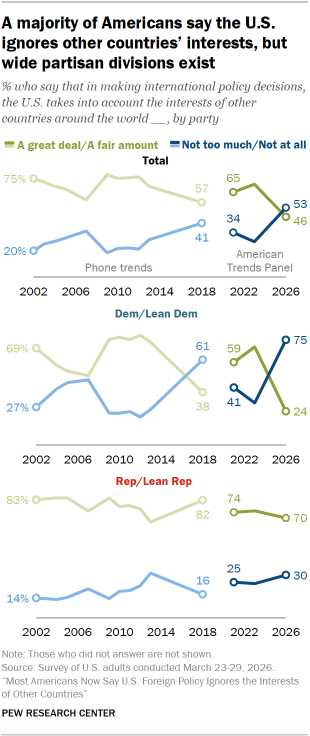
For the first time, a majority of Americans—53%—now contend that the U.S. gives little to no consideration to the interests of other nations. This represents a sharp increase from just 27% in 2023, a period coinciding with the Biden administration. The most substantial shift in this sentiment has occurred among Democrats and those who lean Democratic.
Currently, a staggering three-quarters of Democrats express the belief that the U.S. largely ignores the interests of other countries. This figure is the highest recorded in the two decades of polling on this issue. Even during the Trump administration’s first term, 61% of Democrats held this view, and approximately half of Democrats expressed similar sentiments towards the end of George W. Bush’s presidency.
In contrast, the views of Republicans and Republican-leaning individuals have remained remarkably stable over the years. Consistently, at least two-thirds of this demographic have maintained that the U.S. does consider other countries’ interests to a great deal or a fair amount when making foreign policy choices. This enduring perspective suggests a fundamental difference in how the two major parties interpret American global engagement.
Partisan Divides on Global Standing and Influence
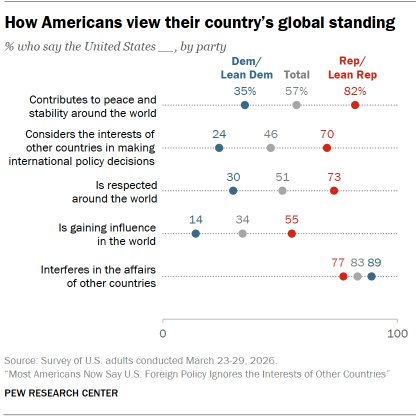
The disparity in views extends beyond the consideration of other nations’ interests, permeating attitudes toward the U.S.’s overall global standing and influence. Republicans tend to perceive a world where the United States actively contributes to peace and stability, earns respect, and wields growing influence in international affairs.
Conversely, Democrats often portray a different global tableau. Their perspective frequently highlights a U.S. that fails to foster peace and stability, disregards other nations’ interests, and struggles to command respect. A significant portion of Democrats also believe the nation’s global influence is in decline.
These divergent outlooks also shape perceptions of the U.S. as a global superpower. When asked to identify countries with dominant military and economic power, Republicans are significantly more likely to name the U.S. (around two-thirds) compared to China (fewer than four-in-ten). Democrats, however, exhibit a more balanced view, with roughly equal proportions identifying the U.S. (53%) and China (49%) as global superpowers.
Age and Ideology Within Party Lines
The Pew Research Center’s analysis also highlights notable internal divisions within the major parties, particularly among Republicans concerning age. Younger Republicans are generally less optimistic about the U.S.’s global standing and influence compared to their older counterparts. They are less likely to believe the U.S. is respected, that its influence is growing, or that it adequately considers the interests of other nations in its foreign policy. Consequently, younger Republicans are also less inclined to identify the U.S. as a preeminent global superpower.
These age-related differences among Republicans echo findings from previous Pew Research Center analyses on other foreign policy issues. For instance, younger Republicans have shown less confidence in Donald Trump’s ability to manage complex international relationships with countries like Iran and Israel, as well as alliances such as NATO.
Trends in Perceptions of U.S. Respect and Influence
The survey also delved into specific aspects of the U.S.’s global role. A near-universal consensus exists on the importance of international respect: 91% of Americans, regardless of party affiliation, deem it crucial for the U.S. to be generally respected by other countries. A substantial majority within both parties—around six-in-ten—consider this exceptionally important.
However, this shared value diverges sharply when assessing the current reality. A significant majority of Republicans (73%) assert that the U.S. is indeed respected, a sentiment that has remained consistent over the past year. Within this group, 21% believe the U.S. is "very respected," while 52% consider it "somewhat respected." Notably, older Republicans (65 and older) are considerably more likely to hold this view than younger Republicans (18-29), with an 84% to 63% split.
In stark contrast, only 30% of Democrats believe the U.S. is currently respected by other nations, a decrease from 39% a year prior. This decline is accompanied by a significant proportion of Democrats (23%) who feel the U.S. is "not at all respected."
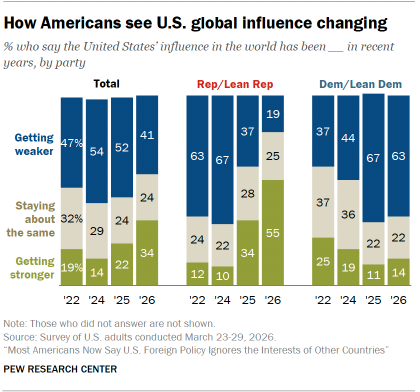
Regarding the trajectory of U.S. global influence, a plurality of Americans (41%) perceive it as weakening. However, this percentage represents the lowest figure recorded since 2022, suggesting a potential shift in sentiment. The primary driver of this perception is an increasing number of Americans—34%—who believe U.S. influence is strengthening. This uptick is almost exclusively attributed to Republicans. Currently, 55% of Republicans report that U.S. global influence is growing, a substantial increase from 2025 and even more pronounced from 2024, the final year of the Biden administration.
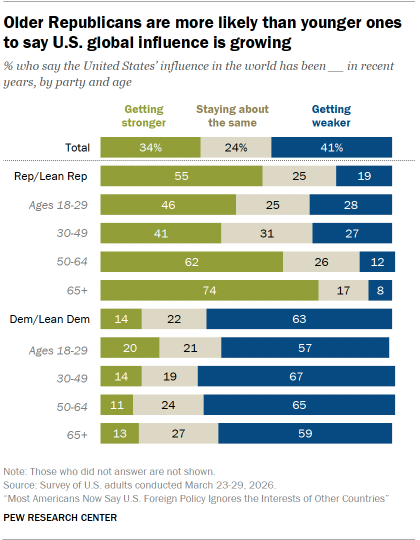
This perception of strengthening influence among Republicans also shows an age divide, with a 25-percentage-point gap observed between older and younger Republicans. Approximately two-thirds of Republicans aged 50 and above (68%) believe U.S. influence is on the rise, compared to 43% of those under 50.
Democrats, on the other hand, largely maintain the view that U.S. influence is waning, with 63% holding this opinion. While these numbers are largely consistent with the previous year, they are higher than during the Biden administration. There is no significant age-related divergence in this view among Democrats.
Interference and Contribution to Global Stability
The survey also found a strong consensus across party lines regarding U.S. interference in the affairs of other nations. A substantial majority of Americans (83%) believe the U.S. interferes, with 39% stating it does so "a great deal." Democrats are slightly more inclined than Republicans to agree with this assessment (89% versus 77%). Age variations exist within parties, with younger Democrats showing a slightly lower propensity to believe in U.S. interference compared to older Democrats, while younger Republicans are marginally more likely to hold this view than their older counterparts.
Conversely, when asked about the U.S. contribution to global peace and stability, a majority of Americans (57%) believe the nation contributes "a great deal" or "a fair amount." Republicans overwhelmingly hold this positive view (82%), a sentiment particularly strong among those aged 50 and older (91%). In contrast, only 35% of Democrats share this positive outlook. This represents a significant shift from 2023, when 72% of Democrats believed the U.S. contributed to global peace. Republicans, conversely, have become more likely to hold this view over the same period.
The Role of Compromise in Foreign Policy
A notable finding relates to the principle of compromise in foreign policy. A significant majority of Americans (65%) believe that when addressing major international issues, the U.S. should consider the interests of other countries, even if it requires making compromises. However, this principle finds more robust support among Democrats than Republicans. While a slim majority of Republicans (53%) favor prioritizing U.S. interests even when other nations strongly disagree, this stance has remained consistent since the question was last posed a year ago.
Broader Implications and Future Outlook
The data presented by Pew Research Center paints a picture of an American public increasingly divided on the nation’s role and responsibilities in the world. The sharp rise in the perception that the U.S. neglects other countries’ interests, particularly among Democrats, signals a potential challenge for future administrations seeking broad domestic consensus on foreign policy. The contrasting views on U.S. global influence, respect, and contributions to stability suggest differing interpretations of the current geopolitical landscape and the effectiveness of American leadership.
These divergent perspectives could influence policy debates on trade, alliances, international agreements, and military interventions. As the U.S. navigates a multipolar world with emerging powers and evolving global challenges, understanding these internal divisions will be crucial for shaping a cohesive and effective foreign policy that resonates with a broad segment of the American populace. The continued trend of age-related differences within the Republican party also suggests potential future shifts in foreign policy priorities as younger generations assume greater influence. The findings underscore the dynamic and often contentious nature of public opinion regarding America’s place on the global stage.