The landscape of British social policy underwent a significant shift on January 13, 2026, as Priya Sahni-Nicholas, Co-Executive Director of The Equality Trust, delivered a keynote analysis at the Public Policy Exchange event titled "Tackling Child Poverty: Improving Welfare, Security and Future Prospects." The event, which convened policy experts, civil servants, and advocacy groups, served as a critical forum for evaluating the government’s newly unveiled Child Poverty Strategy. While the strategy has been lauded for its moral clarity and immediate redistributive measures, the Equality Trust’s analysis highlights a profound disconnect between poverty reduction and the broader structural reality of wealth inequality.
The discussion centered on the government’s December 2025 release of the first UK-wide Child Poverty Strategy in over fifteen years. This document explicitly frames child poverty not as a series of unfortunate individual circumstances, but as a systemic failure inherited from over a decade of policy choices. However, Sahni-Nicholas argued that while the government’s shift in rhetoric is welcome, its failure to address the concentration of wealth and assets leaves the primary engines of inequality largely untouched.
The State of Child Poverty in 2026: A Statistical Overview
The urgency of the strategy is underscored by a decade of deteriorating social indicators. By the start of 2025, the United Kingdom emerged as an outlier among advanced economies. While many European nations successfully reduced child poverty rates through robust social safety nets and progressive taxation, the UK saw a steady incline. Current data indicates that 4.5 million children—approximately one in three—are living in poverty. Perhaps more jarring is the statistic that nearly 20% of UK children reside in households experiencing consistent food insecurity, unable to meet basic nutritional needs.
The economic cost of this crisis is staggering. Analysts suggest that child poverty costs the UK economy billions annually in lost productivity, increased healthcare demands, and higher expenditures within the criminal justice and social care systems. The 2025 strategy attempts to address this by setting a long-term goal to "end child poverty," with specific targets to reduce deprivation levels within the current parliamentary term.
Chronology of Policy Shifts: From Austerity to Intervention
To understand the significance of the 2026 strategy, one must look at the trajectory of UK welfare policy since the turn of the millennium. Between 1997 and 2010, the then-Labour government implemented a series of tax credits and benefit increases that lifted approximately 600,000 children out of poverty. This era was defined by a belief in state-led income redistribution.
Following 2010, the introduction of "austerity" measures led to a radical contraction of the welfare state. Policies such as the benefit cap and the controversial two-child limit were introduced, which critics argue were designed to "incentivize work" but in practice served to entrench hardship for larger families. The 2025 strategy represents a formal rejection of this era, characterizing post-2010 policies as a "moral and economic failure."
The current strategy’s timeline involves several key phases:

- December 2025: Official publication of the Child Poverty Strategy.
- January 2026: Launch of cross-government implementation task forces.
- April 2026: Scheduled abolition of the two-child limit and uprating of Universal Credit.
- 2027-2030: Expansion of universal breakfast clubs and childcare subsidies.
Strategic Victories: Addressing the "Sharp End" of Deprivation
The Equality Trust identifies several areas where the new strategy succeeds in providing immediate relief. The most significant policy lever is the abolition of the two-child limit. This single move is projected to lift 450,000 children out of relative poverty almost overnight. By removing a policy that disproportionately penalized larger families and specific ethnic minority groups, the government has addressed one of the most visible drivers of inequality within the benefits system.
Furthermore, the strategy’s emphasis on "in-work poverty" acknowledges a modern economic reality: having a job is no longer a guaranteed escape from poverty. With measures to increase the National Living Wage and cap the costs of school uniforms and essentials, the government is attempting to lower the "poverty premium"—the phenomenon where low-income families pay more for basic goods and services.
Another notable shift is the inclusion of "lived experience." The government’s collaboration with initiatives like Changing Realities signifies a move away from tokenism. By listening to parents who navigate the welfare system, the strategy incorporates issues of dignity, mental load, and the stigma of poverty into its diagnosis of the problem.
The Wealth Gap: The "Missing Pillar" of Social Policy
Despite these advancements, the Equality Trust’s analysis reveals a glaring omission: the total absence of the word "wealth" from the strategy. Sahni-Nicholas noted that while the government is focused on income—the flow of money into a household—it is ignoring assets, which represent the reservoir of security and opportunity.
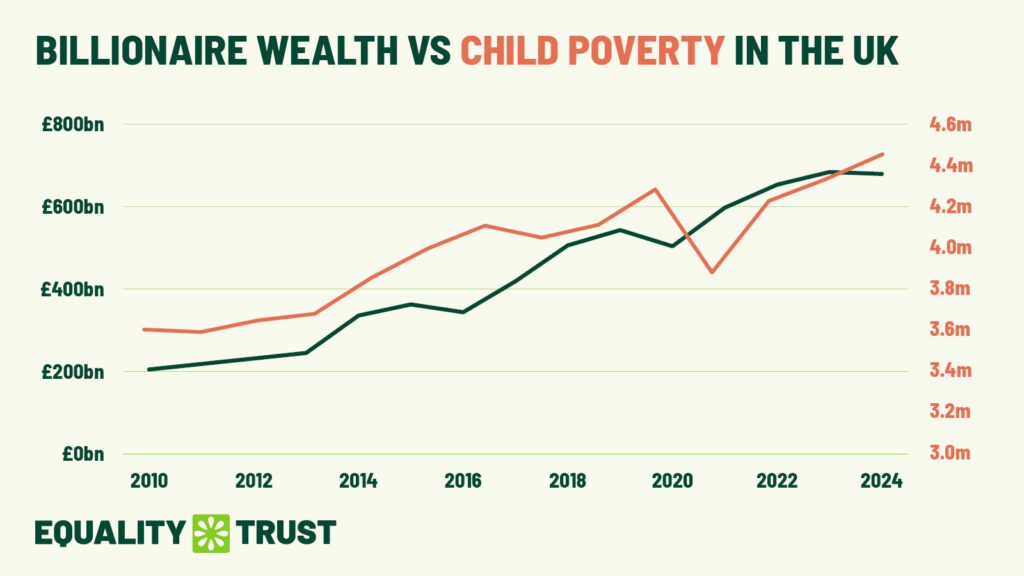
In the UK, wealth inequality is significantly more acute than income inequality. The top 10% of households hold nearly half of the nation’s total wealth, while the bottom 50% hold less than 5%. This disparity has profound implications for child poverty. A family with a low income but modest savings or home equity is in a vastly different position than a family with the same income but high debt and no assets.
The Equality Trust points to the economic theories of Thomas Piketty, specifically the "r > g" formula, which posits that when the rate of return on capital (r) grows faster than the economy (g), wealth naturally concentrates at the top. A strategy that focuses only on wages and benefits—taxed primarily through income tax—while leaving asset-based wealth undertaxed, is inherently limited. As Sahni-Nicholas described it, the government is attempting to "empty a bath while leaving the taps running."
Power Dynamics and Structural Influence
Beyond wealth, the critique extends to the dimension of power. The strategy discusses "opportunity" as a passive benefit but fails to address how corporate power, housing market volatility, and political lobbying at the top tiers of society shape the environment for those at the bottom.
History shows that the most successful periods of inequality reduction in the UK—specifically the post-WWII era—were not the result of targeted "poverty programs" alone. Instead, they were driven by structural shifts:

- The expansion of trade union power to ensure fair wage distribution.
- The mass construction of social housing to decouple the cost of living from private market speculation.
- High marginal tax rates on top earners and corporate profits to fund universal public services.
The 2026 strategy, by contrast, operates within the existing market-driven framework, attempting to mitigate the worst effects of the system without challenging the mechanisms that produce those effects.
Broader Implications and Future Outlook
The implications of this "income-only" focus are significant for the long-term sustainability of the government’s goals. If the strategy does not integrate fiscal reform—specifically the taxation of wealth and capital gains at rates comparable to work—the funding for these anti-poverty measures will remain precarious. Currently, government revenue is heavily dependent on income tax, meaning that public investment is tethered to wage growth, which has remained sluggish for nearly two decades.
For the Child Poverty Strategy to evolve from a "floor" to a "ceiling," the Equality Trust suggests several necessary evolutions:
- Binding Accountability: Moving beyond "intentions" to statutory targets that hold successive governments legally accountable for narrowing the gap between the richest and poorest.
- Housing Reform: Addressing the rent crisis, which currently consumes a disproportionate share of income for the poorest families, effectively negating any gains made through benefit increases.
- Fiscal Alignment: Reforming the tax system to ensure that those who benefit from asset appreciation contribute fairly to the social infrastructure that supports the next generation.
Conclusion: A Necessary Corrective, Not a Transformation
The 2026 Child Poverty Strategy marks a pivotal moment in British politics, signaling an end to the era of managed decline in the welfare state. Its focus on the two-child limit, school costs, and the dignity of claimants will undoubtedly improve millions of lives. However, the analysis from the Equality Trust serves as a sobering reminder that poverty is the symptomatic expression of a deeply unequal economic structure.

Until the government is willing to confront the concentration of wealth and the imbalance of power that defines the modern UK economy, child poverty will remain a persistent threat. The strategy as it stands is an essential first step, but without a broader "inequality lens," it risks being a temporary reprieve rather than a permanent solution. The challenge for the coming years will be whether the government can move from reducing hardship at the margins to reshaping the economic model for the benefit of all children, regardless of their family’s asset base.