When a breaking news event unfolds, Americans demonstrate a fragmented approach to seeking further information, mirroring the broader landscape of how they consume news and information in the contemporary digital age. A comprehensive survey conducted by Pew Research Center reveals a complex ecosystem of information sources, with established news organizations, search engines, and social media platforms vying for the attention of individuals looking to understand unfolding events. This trend underscores the persistent influence of traditional media while highlighting the significant role of digital platforms in the modern news cycle.
The Pew-Knight Initiative, a collaborative effort between Pew Research Center and the John S. and James L. Knight Foundation, supports crucial research into how Americans engage with civic information, shape their beliefs and identities, and participate in their communities. This initiative aims to provide a deeper understanding of the dynamics that influence public discourse and civic engagement in an increasingly interconnected world. Pew Research Center, a nonpartisan fact tank, and Knight Foundation, a social investor focused on fostering informed and engaged communities, collaborate to illuminate these vital aspects of American society.
The Shifting Landscape of Breaking News Consumption
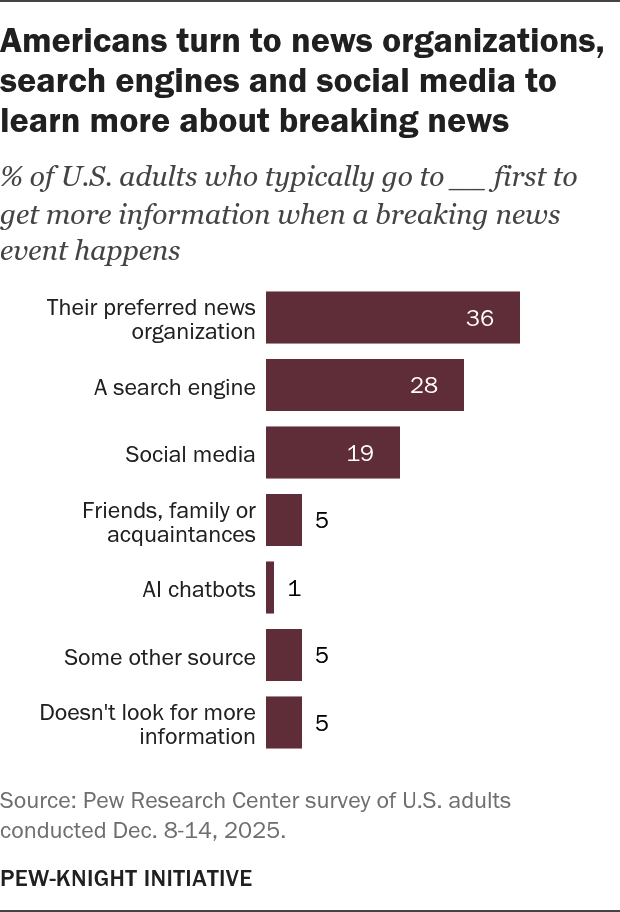
A 2025 survey by the Pew Research Center, part of the Pew-Knight Initiative, found that 36% of U.S. adults typically turn to their preferred news organization first when seeking more information about a breaking news event. This indicates that despite the proliferation of digital channels, a substantial portion of the population still places trust in established journalistic outlets. However, this figure represents a notable shift from 2018, when a slim majority (54%) of Americans reported turning to their preferred news organization for breaking news.
The digital realm has demonstrably expanded its reach. In 2025, 28% of U.S. adults identified search engines, such as Google or Bing, as their primary source for additional breaking news details. This represents a significant increase from 2018, when only 15% of Americans cited search engines as their initial point of inquiry. Social media platforms have also cemented their position in the breaking news information flow. In 2025, 19% of adults reported turning to social media first, a considerable rise from 9% in 2018. These figures highlight a discernible trend: a growing reliance on algorithmic-driven platforms and user-generated content for immediate updates.
A smaller but consistent segment of the population (5%) continues to rely on their social networks, turning to friends, family, or acquaintances for information about breaking news. This reliance on personal connections underscores the enduring human element in information dissemination, even in an era dominated by digital media.
Emerging Technologies and Information Sources
The 2025 survey also introduced new categories to gauge evolving information consumption habits. Notably, 1% of U.S. adults indicated that they first turn to AI chatbots, such as ChatGPT or Gemini, for information on breaking news events. While this percentage is currently small, it signals the nascent impact of artificial intelligence on news consumption. The report notes that this figure aligns with broader trends showing that relatively few Americans are currently using AI chatbots for news in general. Nevertheless, the presence of AI-generated summaries in search results means that individuals who rely on search engines may still encounter AI-driven content.

Furthermore, 5% of respondents indicated they consult "some other source" for breaking news information, and an equal percentage stated they "don’t look for more information" when a breaking news event occurs. These responses suggest a segment of the population that is either disengaged from the news cycle or finds information through channels not captured by the survey’s primary categories.
Comparative Analysis: A Decade of Change
Comparing the 2018 and 2025 survey data reveals a significant evolution in how Americans approach breaking news. The decline in reliance on preferred news organizations, coupled with the substantial rise in the use of search engines and social media, paints a clear picture of a fragmented and digitally influenced information landscape.
It is important to note methodological differences between the two surveys that warrant caution when making direct comparisons. The 2018 survey included an option for "News aggregating website or apps (such as Google News, Apple News or Flipboard)," which was not present in the 2025 survey. Conversely, the 2025 survey added options for "AI chatbots," "Some other source," and "I don’t look for more information," along with providing examples for search engines. Despite these variations, the overarching trends in the usage of preferred news organizations, search engines, and social media are robust and indicative of broader shifts in media consumption.
Age and Demographics: A Divided Information Ecosystem
The Pew Research Center’s findings reveal a pronounced divergence in breaking news information-seeking behavior across different age groups. This generational divide underscores the differing media habits and technological adoptions characteristic of various demographics.
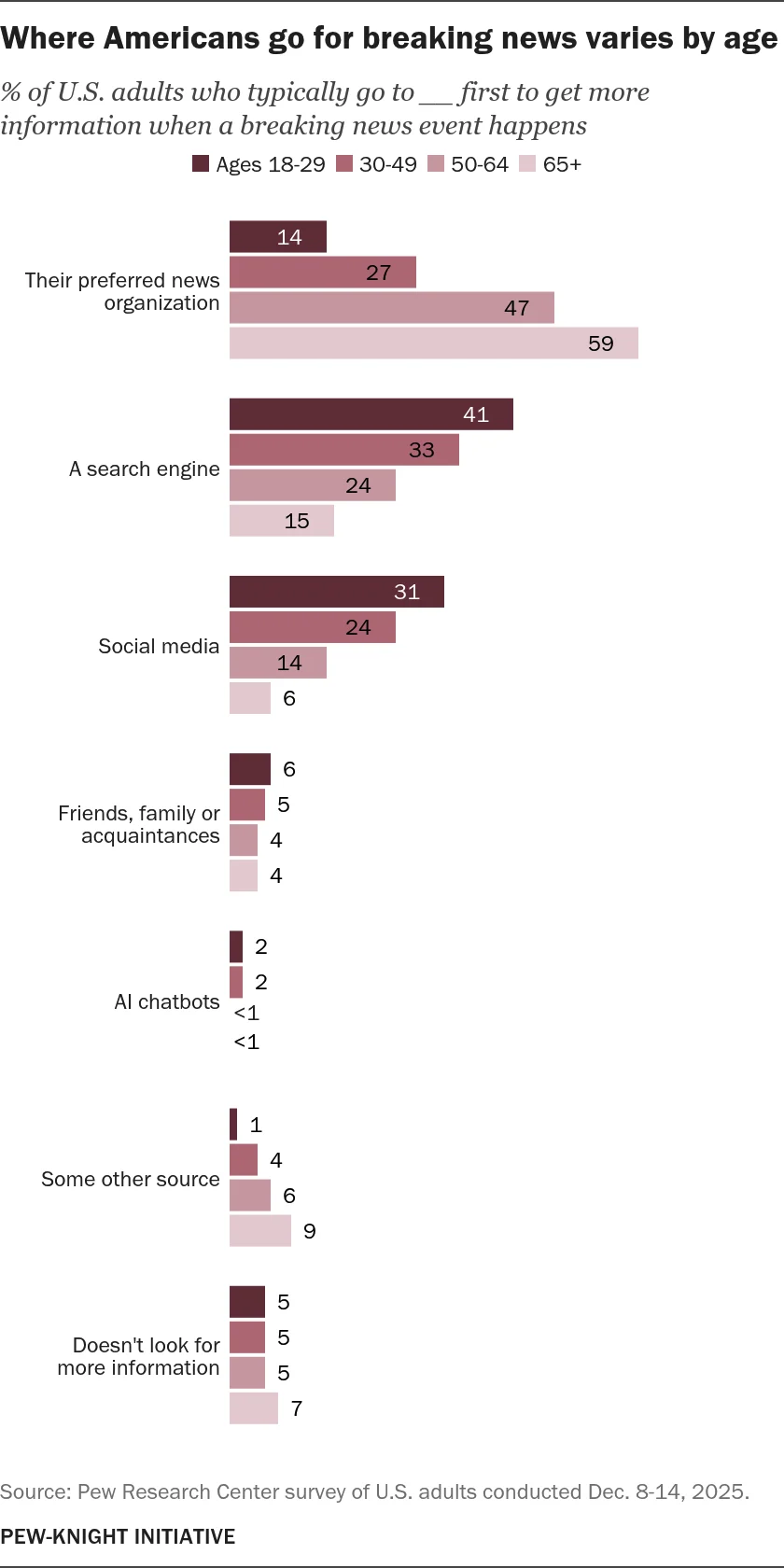
For Americans aged 65 and older, their preferred news organization remains the dominant first point of contact for breaking news information, with 59% reporting this preference in 2025. This stands in stark contrast to younger adults. Among those aged 18 to 29, only 14% turn to their preferred news organization first. Instead, younger demographics exhibit a greater propensity to utilize digital platforms.
Search engines are a significant source for younger adults, with 41% of those aged 18 to 29 reporting using them first for breaking news information. This contrasts with 15% of those 65 and older who do the same. Social media also plays a crucial role for younger audiences, with 31% of adults under 30 turning to these platforms for initial information. This figure drops significantly to just 6% among individuals aged 65 and older.
These generational patterns are consistent with broader trends in news consumption. A previous Pew Research Center study indicated that a substantial majority of young adults (76% of those aged 18-29) get their news from social media at least sometimes, compared to a much smaller proportion of older adults (28% of those 65+). Furthermore, younger Americans are more inclined to trust information from social media compared to their older counterparts. Notably, adults aged 18 to 29 are now about equally likely to trust information from social media as they are from national news organizations, a trend that signals a potential recalibration of trust in the digital age.
Broader Implications and Future Trends
The findings from the Pew-Knight Initiative offer critical insights into the evolving nature of news consumption and its implications for civic discourse and public understanding. The increasing reliance on search engines and social media for breaking news suggests a need for greater media literacy among the public, particularly concerning the verification of information and the identification of credible sources.
The fragmentation of news sources also poses challenges for traditional news organizations. To remain relevant, they must adapt to the digital environment, ensuring their content is accessible and engaging across multiple platforms while upholding journalistic standards of accuracy and impartiality. The sustained trust placed in preferred news organizations by a significant portion of the population, especially older demographics, highlights their continued importance as arbiters of credible information.
The emergence of AI chatbots as a nascent source for breaking news warrants ongoing observation. As AI technology advances and becomes more integrated into daily life, its role in information dissemination is likely to grow. This presents both opportunities and challenges, potentially offering new ways to access and synthesize information but also raising concerns about bias, accuracy, and the potential for misinformation.
The Pew-Knight Initiative’s research serves as a vital tool for understanding these complex dynamics. By providing data-driven insights into how Americans seek and consume information, these studies enable policymakers, journalists, educators, and the public to better navigate the challenges and opportunities of the modern information ecosystem. As the media landscape continues to transform, ongoing research into these trends will be essential for fostering an informed and engaged citizenry.
About the Pew-Knight Initiative
The Pew-Knight Initiative is dedicated to advancing research on how Americans engage with civic information, form their beliefs and identities, and participate in their communities. This initiative is a joint endeavor by Pew Research Center and the John S. and James L. Knight Foundation, aiming to shed light on the critical issues shaping public discourse and civic life in the United States. Pew Research Center is a nonpartisan, non-advocacy fact tank committed to informing the public about the issues, attitudes, and trends that shape the world. The John S. and James L. Knight Foundation is a social investor focused on supporting informed and engaged communities.
Methodology
The insights presented in this analysis are derived from a Pew Research Center survey of 3,560 U.S. adults conducted between December 8 and 14, 2025. All participants in this survey were members of the Center’s American Trends Panel, a nationally representative online research panel. The survey data is weighted to represent the full U.S. adult population.
This analysis also incorporates findings from a nationally representative survey conducted by GfK Group from February 22 to March 4, 2018, using its KnowledgePanel. This earlier survey also collected data on how Americans sought information about breaking news.
It is important to acknowledge that the survey questions regarding breaking news sources had different response options in 2018 and 2025. Specifically, the 2018 survey included "News aggregating website or apps (such as Google News, Apple News or Flipboard)" as an option, which was omitted in 2025. Conversely, the 2025 survey introduced "AI chatbots (such as ChatGPT or Gemini)," "Some other source," and "I don’t look for more information." Additionally, the 2025 survey provided examples for search engines like Google and Bing. These differences necessitate a cautious approach when making direct comparisons between the two survey years.
Detailed survey questions, topline results, and methodological information for both the 2025 and 2018 surveys are available through links provided by Pew Research Center, allowing for further in-depth examination of the data and research design. This comprehensive approach ensures transparency and supports rigorous analysis of the findings.