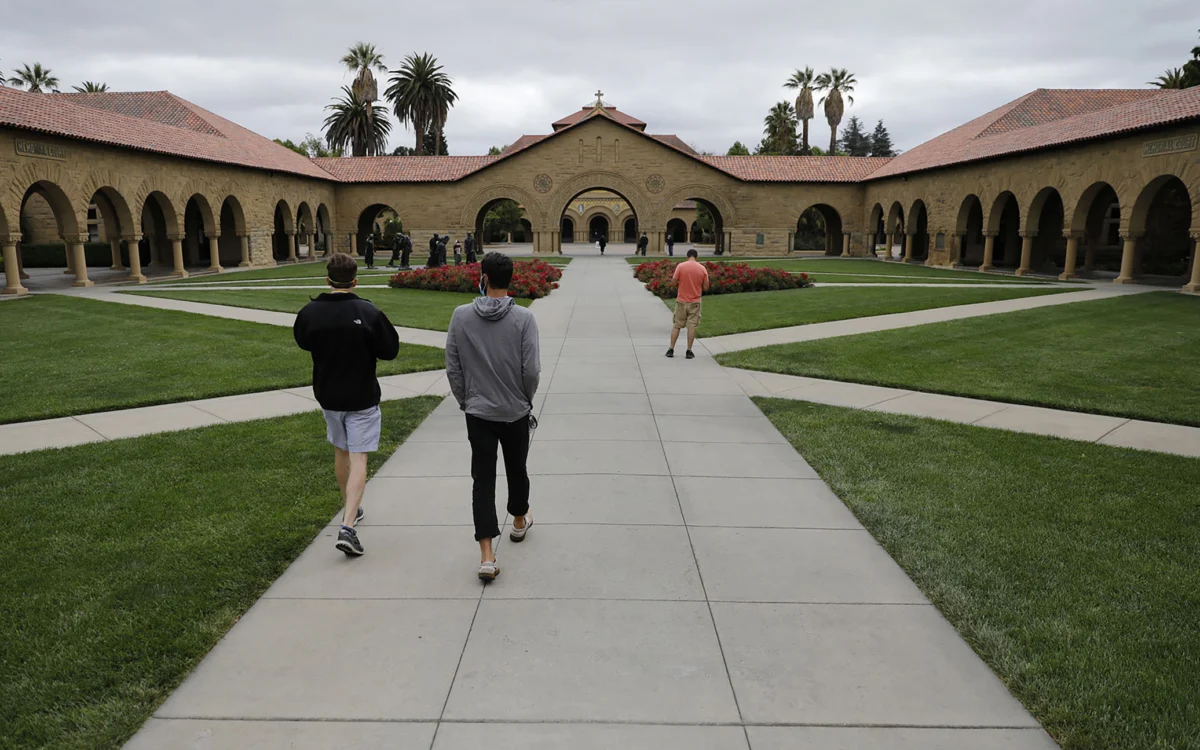
The landscape of higher education is witnessing a significant, and increasingly debated, shift: a marked increase in the number of college students registering with disabilities. This trend, observed nationwide, appears to be closely mirroring the documented rise in anxiety, depression, and ADHD diagnoses among young people, a phenomenon that has intensified since the onset of the COVID-19 pandemic. At the forefront of this discussion, and arguably the most pronounced in its manifestation and controversy, is Stanford University.
Stanford’s Outlier Status and National Trends
A comprehensive analysis of government data by The Chronicle reveals a striking reality at Stanford: outside of institutions exclusively dedicated to students with disabilities, the university reports the highest percentage of undergraduates registered with its Office of Accessible Education (OAE). In the fall of 2023, approximately 38% of Stanford’s 7,800 undergraduates were registered, a figure that dwarfs the national median of 5.3% and the California median of 4%. This statistical anomaly has ignited a vigorous debate on campus and beyond, pitting interpretations of institutional commitment against concerns of potential system gaming.
The Integrated Postsecondary Education Data System (IPEDS) survey, a mandatory reporting tool for colleges and universities seeking federal aid, serves as the primary source for this data. These surveys meticulously gather information on a wide array of student demographics and needs, including physical, mental, and learning disabilities. The most recent available data, from the 2024-2025 survey cycle, provides preliminary figures for the fall 2023 semester.
The core of the IPEDS question, "percentage of undergraduates who were formally registered as students with disabilities with the institution’s office of disability services," while seemingly straightforward, harbors significant variability in its interpretation and application across different institutions. This ambiguity is central to understanding the disparities observed in reporting.
A Spectrum of Accommodations and Growing Demand
At Stanford, the spectrum of disability accommodations is broad, encompassing essential support services such as note-taking assistance, extended time for examinations, reduced course loads, and a prioritized housing application process. Over the past decade, the number of students eligible for these resources has nearly tripled, placing considerable strain on the university’s housing and academic infrastructure.
This escalating demand is palpable even within the classroom. Paul Fisher, a professor of Human Biology at Stanford, estimates that roughly a quarter of students in his 150-seat lectures receive some form of test-taking accommodation, typically manifesting as additional time or a separate, distraction-free testing environment. Fisher projects that if this trend continues unabated, Stanford will face the daunting task of fundamentally re-evaluating core aspects of campus life. "Where do we put all these people? We want everyone to show their talent, but this is a reality," Fisher mused. "How are we going to pull it off?"
Explaining Stanford’s High Proportion: Commitment or Convenience?
The reasons behind Stanford’s outlier status are subject to varied interpretations. While some view the high proportion of students with disabilities as a testament to the university’s dedication to inclusivity and meeting the diverse needs of its student body, critics voice concerns that a culture of high achievement may be incentivizing students to leverage the institution’s robust offerings for competitive advantage. These advantages can range from securing preferential housing to gaining additional time on academic assessments.
Stanford’s administration acknowledges the high figure and suggests that it also reflects the inherent variability in how different institutions report disability data. A Stanford spokesperson indicated that the university is actively reviewing its reporting practices and plans to implement changes moving forward to ensure greater accuracy and clarity.
The Role of IPEDS and Reporting Ambiguities
The IPEDS survey’s question about disability registration is a critical element in this discussion. As noted, the definition of "formally registered" can fluctuate significantly from one university to another, influenced by their specific intake processes, the types of accommodations offered, and the documentation required. This lack of a universally standardized definition creates a fertile ground for discrepancies in reported numbers.
Historical Context and Evolving Perceptions
Stanford’s position as a leading research university, coupled with its stated commitment to serving a broad spectrum of students, including those with mental or physical health challenges, may contribute to its higher registration numbers. Professor Fisher himself suggests that Stanford has "historically taken an interest in serving a really broad range of students." This historical context, he believes, fosters an environment where students feel supported in seeking necessary accommodations.
However, Fisher also expresses a nuanced concern: "I understand equity – that’s an important thing. But I worry that everyone’s starting to look over their shoulders: ‘Well, if they have… an exception, I should have one too.’ I don’t think that’s a conscious gaming of the system." This sentiment hints at a potential ripple effect, where increased awareness and accessibility might inadvertently encourage a broader interpretation of need among the student population.
Student Perspectives: Access and Perceived Exploitation
The accessibility of Stanford’s accommodations has also led some to argue that the system may be susceptible to exploitation. Elsa Johnson, a junior who gained attention for an essay published in The Times of London, shared her experience of leveraging her endometriosis diagnosis to secure a single room, additional absences, and a blanket tardiness allowance. Johnson contends that, around her, other students are similarly utilizing accommodations to gain an edge in the highly competitive academic and social environment.
"If you’re one of these striver-optimizer types, it would be so easy to just put on a sad face and make some claim that you’re really suffering," Johnson told The Chronicle. "All of us had to do everything we could in high school to try to get here. Why would that stop, especially when it comes to something like housing?"
The Housing Crunch and Accommodation Premiums
The intense competition for on-campus housing at Stanford, where approximately 97% of undergraduates reside, is a significant factor. The emergence of an informal marketplace known as "Swapford" for room trading, reportedly involving transactions of thousands of dollars, underscores the premium placed on desirable living spaces. This scarcity elevates the value of housing accommodations, which grant students with certain disabilities priority in the housing selection process.
In response to concerns about the equitable distribution of these housing benefits, Stanford made a procedural adjustment in early March. The university modified its housing process to prevent students with disability accommodations from extending their priority status to roommates who do not possess such accommodations.
Emily Ocasio, a Stanford junior managing severe food allergies and chronic conditions affecting her heart rate, mobility, and sleep, expressed a reluctance to judge the legitimacy of other students’ accommodation needs. She acknowledges the societal assumption that students in the disability housing pool might not genuinely require their accommodations, despite the fact that Stanford’s robust accessibility offerings were a key factor in her decision to enroll.
Ocasio confessed to having downplayed her own need for accommodations, even joking about "scamming" the OAE. "When people said, ‘How did you get your great room?’ I would say, ‘Oh, like, the OAE helped me out.’ That’s not a lie. But I did not want to have to go on trial, every time I was asked how I got a good room, telling about the ins and outs of my most personal medical details." This candid reflection highlights the emotional toll and personal vulnerability associated with navigating disability accommodations in a competitive environment.
Stanford’s Proposed Reporting Overhaul
Stanford’s spokesperson, Angie Thomas, echoed the sentiment that the IPEDS survey question is "vague," allowing institutions significant latitude in defining what constitutes registration with a disability office. "Several recent inquiries we have received on this issue have prompted us to take a deeper look at how Stanford has been reporting data on student accommodations," Thomas stated. "We have determined that our previous practice did not accurately reflect the number of students who are actually receiving accommodations, and we plan to correct this in our IPEDS reporting moving forward."
Historically, Stanford’s reporting practice included all students who completed an intake form with the on-campus disability office, irrespective of whether they were ultimately granted accommodations or if their condition was temporary. This meant that a student who sustained a broken ankle during their first winter at Stanford could, hypothetically, be counted as having a disability by their senior year, even if no ongoing accommodations were required or provided.
The university plans to implement a significant change starting this spring: reporting will be limited to the number of undergraduates who have been granted accommodations. This process involves a more rigorous verification, including meetings with disability advisors, communication with professors, and a thorough review of medical documentation. According to Thomas, this revised reporting methodology is projected to reduce the reported percentage of Stanford undergraduates with disabilities in fall 2025 from an estimated 33.5% to a much lower 12.5%.
A Ripple Effect Across Institutions
Stanford’s impending shift in reporting aligns its practices with those of other California institutions, such as UC Berkeley, where approximately 13% of students were registered as having a disability in the latest IPEDS survey. However, even at seemingly less outlier institutions, the impact of increasing accommodations on the academic environment is a subject of ongoing discussion.
Frank Worrell, an education professor, observes that an increasing number of his students "meet the criteria for, but not the spirit of the diagnosis." He notes that while many students succeeded in high school without accommodations, the heightened academic rigor at universities like Berkeley makes the need for extra time on assignments and exams more acutely felt.
Worrell’s observations have led to some "awkward dynamics" with students, as the number receiving accommodations has surged by 44% between 2020 and 2025. He recounts an instance where a student requested to "pull out their diagnosis" for a seemingly straightforward assignment due on a Sunday evening. Despite the student’s appeal to college administrators, Worrell maintained his grading policy, resulting in a failing grade for the late submission.
This experience leads Worrell to predict that universities will eventually need to overhaul their accommodation policies. He envisions a future where assessments are designed with greater inherent difficulty, but all students receive the maximum allowable time, thereby "building in" the accommodation and creating a more equitable playing field.
The Human Cost of the Debate
The escalating debate over disability accommodations has, unfortunately, placed students who genuinely rely on these services in a difficult position. Antonio Milane, a Stanford senior with cerebral palsy, faced initial resistance from the university regarding the provision of a notetaking scribe. A subsequent petition, garnering over 74,000 signatures, appears to have influenced Stanford’s responsiveness to his needs, ensuring him a single room and extra time on tests and homework.
Despite this positive outcome, Milane reports facing resistance not from the university, but from his peers. He frequently overhears complaints about students with accommodations "taking all the rooms" during housing assignments. Similarly, when he shares his academic successes, some classmates attribute them solely to the advantage of having extra time.
"It makes me mad," Milane stated, voicing a sentiment shared by many students with disabilities. "There’s a lot of people who have disabilities and they’re afraid to accept accommodations – to present as a weakness, or like they’re taking advantage of the system." This fear can lead to students foregoing necessary support, thereby hindering their academic and personal well-being.
Not All "Gaming" Yields Desired Results
Furthermore, the assumption that students are universally successful in exploiting the system for significant personal gain may be overstated. Elsa Johnson, who authored the essay on perceived exploitation, had hoped to secure a room in one of Stanford’s highly sought-after co-op houses, known for their spaciousness and amenities. However, she was ultimately placed in a shared two-room suite in a transfer dorm. "It’s nice that I sort of have my own room," she conceded, "But it wasn’t worth it." This outcome suggests that even for students seeking to leverage accommodations, the perceived benefits may not always materialize as anticipated, underscoring the complex interplay of individual circumstances, university policies, and the persistent challenges of navigating a highly competitive academic environment.
© 2026 San Francisco Chronicle. Distributed by Tribune Content Agency, LLC.